
1. Background
A global demand for midwives exists, and the training of midwives who deliver midwife-led continuity of care is essential for ensuring global health security. This approach can enhance the quality of care while reducing the incidence of maternal and neonatal morbidity and mortality (1). The quality of education that midwifery students receive in the classroom is equally significant as their experiences in clinical practice (2). Blended learning (BL), which integrates digital tools with both traditional teacher-centered and innovative learner-centered approaches, has been shown to improve educational outcomes (3). Numerous studies have indicated that BL may lead to greater educational outcomes compared to conventional methods by facilitating learning, increasing effectiveness, promoting self-directed study, and fostering lifelong learning (4, 5). A Canadian study found that BL has the potential to lead to significantly higher academic performance compared to traditional face-to-face instruction (4). In midwifery education, BL represents an evolving approach that necessitates a shift in both cultural attitudes and pedagogical strategies among educators and students (6).
Labor dystocia, defined by abnormal cervical dilation or inadequate fetal descent during active labor, is a significant obstetric complication that endangers both maternal and neonatal health. It is a leading contributor to maternal and infant morbidity and mortality and is frequently associated with unnecessary cesarean deliveries (7). The World Health Organization’s global safe motherhood initiative highlights the crucial importance of skilled healthcare providers, particularly midwives, who are adept at managing labor dystocia (8). Despite the essential role of midwives in managing labor complications, midwifery education is confronted with several challenges. These include limited clinical training opportunities, overcrowded student cohorts, and inadequate emphasis on effective teaching and learning methodologies. Consequently, newly graduated midwives often lack sufficient clinical experience and self-confidence (4). The rapid advancements in information technology (IT) have introduced new opportunities for overcoming these educational barriers. Online learning platforms, leveraging IT, present a viable solution for enhancing midwifery education by expanding access to quality instruction and skill development globally (9).
Nevertheless, there is limited research on the application of modern educational methodologies within midwifery, particularly regarding the management of labor complications, including but not limited to labor dystocia. This gap is evident both in Iran and globally. It is important to highlight that certain studies have indicated adverse effects on student engagement associated with the implementation of a webinar-based BL approach (10). Because the primary objectives of midwifery education are to equip students with essential knowledge and practical skills, it is crucial to implement innovative teaching strategies to enhance their competency in managing labor complications. This study aims to evaluate the effectiveness of a webinar-based BL approach in improving midwifery students’ knowledge and skills related to labor dystocia management. Additionally, it seeks to assess students’ attitudes toward their learning experiences and their satisfaction with the BL method.
2. Objectives
The present study aimed to evaluate the effect of webinar-based BL on midwifery students’ knowledge and skills in managing labor dystocia.
3. Methods
This pre-experimental study with a single-group pre-test/post-test design aimed to evaluate the effectiveness of a webinar-based BL approach in enhancing midwifery students’ knowledge and skills in diagnosing and managing labor dystocia. The study was conducted in the Labor and Delivery Department of Rouhani Hospital affiliated with Babol University of Medical Sciences University of Medical Sciences, Iran, in 2019. The participants comprised the entire cohort of seventh-semester midwifery students (N = 26) from the same academic year of admission, who had previously undergone traditional lecture-based instruction on labor dystocia and consented to participate. Due to the small population size, a census-based sampling method was employed. Exclusion criteria included students who were guest enrollees, those with prior clinical experience, individuals with notable attendance issues, students with a confirmed history of mental health issues by a physician, or those who had experienced significant stressful events in the six months preceding the study. In accordance with ethical guidelines, written informed consent was obtained from all participants after they were fully briefed on the study’s objectives, the changes in the training method, and the voluntary nature of their participation in the research. The participants were assured that their involvement would not affect their academic performance or clinical training. The study adhered to ethical standards and was approved by the Ethics Committee of Babol University of Medical Sciences (IR.MUBABOL.HRI.REC.1397.123).
3.1. Data Collection
Data collection involved multiple stages. Initially, a pre-test was administered, consisting of a questionnaire to assess knowledge of labor dystocia and a checklist for evaluating labor dystocia management skills. Additionally, individual information was gathered with baseline data in the labor and delivery department of the hospital. After the intervention, along with the knowledge and skills questionnaire, two questionnaires on attitudes toward learning success and satisfaction with webinar-based BL were also completed. All intervention phases, as well as the completion of questionnaires and checklists, were carried out exclusively by a single faculty lecturer from the midwifery department, who is also one of the authors of this paper.
3.2. Intervention Procedure
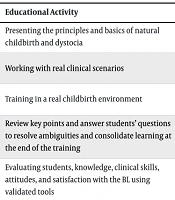
The educational intervention using the webinar-based BL method was implemented in five phases (Table 1) and was designed according to valid learning principles and theories, especially experiential learning theory, active learning, and problem-based learning theories.
Table 1.
Phases of Webinar-Based Blended Learning for Enhancing Midwifery Students’ Skills in Managing Labor Dystocia
| Phases | Educational Activity | Assessment Tool | Educational Goal |
|---|---|---|---|
| Phase one: Webinar-based BL | Presenting the principles and basics of natural childbirth and dystocia | Knowledge questionnaire | Improving theoretical knowledge |
| Phase two: In-person training | Working with real clinical scenarios | Real-life scenarios from hospitalized mothers with labor dystocia, before clinical practice | Critical analysis and decision-making in clinical scenarios |
| Phase three: Clinical training | Training in a real childbirth environment | Skills checklist | Improving practical skills |
| Phase four: Summarizing and reinforcement learning | Review key points and answer students’ questions to resolve ambiguities and consolidate learning at the end of the training | - | Review, address issues, and reinforce students’ key theoretical and practical concepts |
| Phase five: Final evaluation | Evaluating students, knowledge, clinical skills, attitudes, and satisfaction with the BL using validated tools | Knowledge questionnaire, skills checklist, attitudes toward success in learning, and satisfaction with the BL | - |
Abbreviation: BL, blended learning.
3.2.1. Phase 1: Web-Based Virtual Sessions
The initial phase of the study consisted of four 90-minute online webinar sessions, conducted over four consecutive days. The content focused on providing an overview of normal labor, as well as exploring the causes, signs, diagnosis, and management of labor dystocia. To ensure smooth participation, coordination with the university’s IT Center was made to train both the lecturer and students on how to install and use the necessary software, such as Mozilla, Flash Player, Adobe Connect 9 add-in, and Ammy. In addition, to guarantee reliable internet access, each student was provided with a one-day, two-gigabyte data package, totaling four gigabytes over the course of the sessions. There were no location restrictions for students, allowing them to join the webinar from anywhere. Student attendance was closely monitored via the webinar platform, and throughout the sessions, the students could ask questions and interact with the lecturer using chat, audio, or video communication.
3.2.2. Phase 2: Face-to-Face Sessions
The second phase included two 3-hour in-person sessions. These sessions featured real-life scenarios derived from actual cases of labor dystocia reported from hospitalized mothers, which were used to prepare students before their clinical practice. The students were divided into four groups (6 - 7 individuals per group) and assigned two scenarios each. The groups discussed labor progression and potential interventions and presented their conclusions to the class. After the presentations, the lecturer summarized key points, evaluated student performance, and provided immediate feedback to correct misconceptions and reinforce learning.
3.2.3. Phase 3: Clinical Training
In the third phase, clinical training for labor dystocia management was conducted individually for each group over a four-week period in the labor and delivery setting. This training was provided by the same lecturer. The clinical training adhered to guidelines established by the American College of Obstetricians and Gynecologists (ACOG) and the Consortium on Safe Labor (CSL). This approach consisted of three key points: (A) Active labor determination, (B) protraction detection, and (C) arrest diagnosis definition (11).
3.2.4. Phase 4: Summarizing and Reinforcement Learning
Upon completion of the educational intervention, the lecturer summarized the key concepts and provided an opportunity for students to ask questions and clarify the material covered.
3.2.5. Phase 5: Post-Intervention Evaluation
A post-test was administered to evaluate the students’ knowledge of labor dystocia and their skill in managing labor dystocia in a clinical setting. Additionally, questionnaires on attitudes toward success in learning and satisfaction with the webinar-based BL were completed.
3.3. Survey Instruments
3.3.1. Individual Questionnaire
This instrument collected demographic data, including age, marital status, residence, daily computer use, grade point average (GPA), and GPA trend.
3.3.2. Knowledge Questionnaire
To assess the knowledge of the midwifery students regarding labor dystocia, a 20-item, four-option multiple-choice questionnaire was developed. The content of the questionnaire was designed based on the three-point approach (A, B, C) utilized in the clinical training phase. Each question carries a value of 1 point, resulting in a total score range of 0 to 20.
3.3.3. Skill Assessment Checklist
To evaluate midwifery students’ skills in managing labor dystocia, a 12-item checklist was developed based on the three-point approach (A, B, C) used in clinical training. The checklist included five items on identifying active labor, four on detecting labor protraction, and three on arrest of dilation and descent. Each item was scored on a three-level scale: Zero (failure to understand/perform), 0.25 (needs improvement), and 0.5 (good understanding/skill). The total score ranged from 0 to 6, with higher scores indicating better comprehension and skills.
3.3.4. Attitude and Satisfaction Questionnaires
Two 12-item questionnaires measured students’ attitudes toward learning success and satisfaction with the webinar-based BL method using a 3-point scale, with scores ranging from 0 to 36. Using the relative scale method, the scores were categorized as follows: Weak (0 to 12 points, 0% to 33% of the total score), average (13 to 24 points, 34% to 66% of the total score), and good (25 to 36 points, 67% to 100% of the total score).
The questionnaires were carefully designed by reviewing relevant sources and articles. To ensure validity, both face and content validity were assessed. The questionnaires were reviewed by experts in health education, midwifery, and nursing, as well as students, and refined based on their feedback to improve clarity and relevance. Quantitatively, the content validity ratio (CVR) was calculated using expert opinions, with values above 0.59 considered acceptable. The Content Validity Index (CVI) was also measured, and items scoring higher than 0.79 were retained. For reliability, Cronbach’s alpha coefficient was employed to assess internal consistency, with results ranging from 0.73 to 0.86, confirming the reliability of the instruments. Similarly, the test-retest reliability showed that the correlation between scores at two different times was above 0.80 for all questionnaires.
3.4. Data Analysis
Data analysis was conducted using SPSS version 23 software (SPSS Inc., Chicago, IL). A significance level of P < 0.05 was adopted to determine the statistical significance of the findings. The Shapiro-Wilk test was conducted to assess the normality of the data distribution, and the results indicated that the data were not normally distributed. Descriptive statistics, including mean ± standard deviation, frequency, and percentage, were used to summarize the individual characteristics of the participants, as well as their attitudes toward learning success and satisfaction with the webinar-based BL approach. To evaluate the effectiveness of the webinar-based BL intervention, the Wilcoxon signed rank test was applied. By comparing the scores pre- and post-intervention, as well as the mean changes, the Wilcoxon signed rank test allowed for the evaluation of changes in knowledge and skills related to the management of labor dystocia.
4. Results
All participants (n = 26) successfully completed the study, providing a comprehensive dataset for analysis. Detailed participant characteristics are summarized in (Table 2).
Table 2.
Characteristics of the Midwifery Students (Number = 26) a
| Variables | Descriptive Statistics |
|---|---|
| Age (y) | 21.1 ± 1.24 |
| CGPA(score) | 15.26 ± 2.16 |
| The amount of computer work per day (h) | |
| 1 - 2 | 17 (65.38) |
| ≥ 2 | 9 (34.61) |
| Marital status | |
| Single | 24 (92.31) |
| Married | 2 (7.69) |
| Living place | |
| Rural | 7 (26.93) |
| Urban | 19 (73.07) |
| Residence | |
| Student dormitory | 10 (38.46) |
| With family | 16 (61.53) |
| CGPA trend | |
| Ascending | 16 (61.54) |
| Steady | 4 (15.38) |
| Unstable | 6 (23.07) |
Abbreviation: CGPA, cumulative grade point average.
a Values are expressed as mean ± SD or No (%).
4.1. Knowledge and Clinical Skills Improvement
The intervention had a significant impact on knowledge and clinical skills related to labor dystocia management, with statistically significant improvements observed in both areas. Prior to the intervention, participants demonstrated a baseline level of knowledge, which notably increased following the intervention (P < 0.001). Clinical skills similarly showed marked improvement, achieving statistical significance (P < 0.001). The overall mean changes also indicated a statistically significant difference (P < 0.05) (Table 3).
Table 3.
The Mean Scores of Midwifery Students’ Knowledge and Skills About Labor Dystocia Before and After the Intervention a
| Assessment | Before | Min - Max Score | After | Min - Max Score | P-Value | Mean Change | P-Value |
|---|---|---|---|---|---|---|---|
| Knowledge | 9.56 ± 1.45 | 8 - 11 | 16.15 ± 2.35 | 13 - 18 | 0.001 | 6.59 ± 2.76 | 0.001 |
| Skill | 2.35 ± 0.64 | 1 - 3 | 5.02 ± 0.70 | 3 - 6 | 0.001 | 2.67 ± 0.95 | 0.001 |
a Values are expressed as mean ± SD.
4.2. Attitudes Toward Webinar-Based Blended Learning
Students’ attitudes toward the webinar-based BL method were overwhelmingly positive. The mean score reflecting students’ attitudes toward learning success with BL was 28.56 ± 3.48. Over 60% of participants reported that webinar-based BL enhanced their learning effectiveness, simplified access to information, improved comprehension and retention, and was generally more engaging compared to traditional methods (Table 4).
Table 4.
Frequency Distribution of Midwifery Students’ Attitudes Toward Success in Learning in Webinar-Based Blended Learning Method a
| Items | Completely Agree/Agree | No Comment | Completely Disagree/Disagree |
|---|---|---|---|
| 1. Provides useful lesson content. | 12 (46.15) | 10 (36.46) | 4 (15.38) |
| 2. Provides sufficient and comprehensive lesson content. | 14 (53.84) | 10 (36.46) | 2 (7.69) |
| 3. The content of the lesson is up to date and new. | 13 (50.00) | 8 (30.76) | 5 (19.23) |
| 4. The method is easy and accessible. | 17 (65.38) | 6 (23.07) | 3 (11.53) |
| 5. It fits my needs and desires. | 13 (50.00) | 10 (36.46) | 2 (7.69) |
| 6. It facilitates understanding and memorization of content. | 17 (65.38) | 9 (34.61) | - |
| 7. It enables me to control my learning progress. | 10 (36.46) | 11 (42.30) | 5 (19.23) |
| 8. It facilitates discussion with the teacher. | 12 (46.15) | 10 (36.46) | 4 (15.38) |
| 9. The teaching method is attractive. | 16 (61.53) | 10 (36.46) | - |
| 10. Multimedia education makes learning more effective. | 18 (69.23) | 6 (23.07) | 2 (7.69) |
| 11. Teaching labor dystocia with a BL is preferable to the traditional method. | 15 (57.69) | 10 (36.46) | 1 (3.84) |
| 12. Makes it easy to find the educational content and information I need. | 11 (42.30) | 10 (36.46) | 5 (19.23) |
a Values are expressed as No (%).
4.3. Satisfaction with Blended Learning
Students’ satisfaction with the webinar-based BL approach was notably high, with an average score of 30.05 ± 4.06. The factors contributing to this high level of satisfaction were multifaceted. All students reported an increased depth of learning as a major benefit of the webinar-based BL method. Additionally, 92.3% of students found that the approach significantly improved their ability to apply knowledge in clinical settings. Active participation in group discussions was highly valued by 88.5% of the students, who also expressed increased overall satisfaction with their learning experience, which was reported by 88.5% of the participants. Furthermore, 80.8% of students felt a boost in their self-confidence regarding their learning, and the same proportion appreciated the constructive competition fostered within their groups (Table 5). These aspects collectively underscore the effectiveness of the webinar-based BL method in enhancing the educational experience.
Table 5.
Frequency Distribution of Midwifery Students’ Satisfaction with the Webinar-Based Blended Learning Method a
| Items | Completely Agree/Agree | No Comment | Completely Disagree/Disagree |
|---|---|---|---|
| 1. It enables me to use science better in the clinical settings. | 24 (92.30) | 2 (7.69) | - |
| 2. It makes me confident in learning. | 21 (80.76) | 4 (15.38) | 1 (3.84) |
| 3. I feel more satisfied with learning. | 23 (88.46) | 3 (11.53) | - |
| 4. Increases the motivation for individual learning and study. | 18 (69.23) | 8 (30.76) | - |
| 5. Increases the depth of learning. | 26 (100) | - | - |
| 6. Increases intimacy among peers. | 17 (65.38) | 5 (19.23) | 4 (15.38) |
| 7. It increases my enthusiasm for attending classes. | 19 (73.07) | 5 (19.23) | 2 (7.69) |
| 8. Improves student self-confidence in learning. | 16 (61.53) | 10 (36.46) | - |
| 9. It allows me to be active in discussions about subjects. | 23 (88.46) | 3 (11.53) | - |
| 10. This method will help me get more marks in the exam. | 14 (53.84) | 8 (30.76) | 4 (15.38) |
| 11. It creates a constructive competition between peer groups in the learning. | 21 (80.76) | 3 (11.53) | 2 (7.69) |
| 12. Provides a greater sense of responsibility for student learning. | 15 (57.69) | 6 (23.07) | 5 (19.23) |
a Values are expressed as No (%).
5. Discussion
The study demonstrated that the BL method significantly improved midwifery students’ knowledge and skills in managing labor dystocia. While numerous studies favor new teaching methods over traditional ones (8, 12-17), fewer establish the equal effectiveness of both approaches (18-20).
Studies around the world have shown the effectiveness of diverse BL approaches in enhancing midwifery and nursing education. In India, a 72-hour virtual training package was used, which proved effective in improving essential midwifery skills, especially for learners in remote locations (4). Similarly, in Australia, a study on a virtual maternity clinic revealed significant benefits in promoting professional development and practice repetition (21). In Tanzania, a focus on postpartum hemorrhage management among healthcare workers through simulated scenarios highlighted the need for ongoing training in this area (12). Online role-playing in Australia was found to effectively enhance communication skills among midwifery students (16). An extensive review on BL in sexual health education programs emphasized the personalized and confidential learning experiences, making BL appealing for sexual health education (13). In Thailand, web-based learning combined with traditional teaching significantly improved students’ understanding of childbirth processes compared to traditional lectures alone (17). Similarly, in China, a blended approach combining online content with traditional teaching significantly improved nursing students’ performance in medical physiology (15). Moreover, a study demonstrated that the BL model provided greater educational value to nursing students in clinical supervision skills compared to online learning alone (14). A study in Iran demonstrated the usefulness of virtual clinical education for midwifery internships in obstetrics and gynecology during the COVID-19 pandemic (22). These diverse studies underscore the effectiveness and advantages of BL in various aspects of midwifery and nursing education globally.
Today, there’s a growing integration of web-based technologies in long-term learning, echoing a broader trend in education (11). Blended learning, combining traditional and online learning, offers advantages like student-centeredness, flexibility for both learners and educators, better access to learning materials, efficient information exchange, and improved time management (4). However, this method has limitations in teaching clinical skills. A qualitative study in Iran showed that virtual gynecology training clinics can only help with some educational goals, but are not effective enough in increasing skills (23).
Over recent decades, several studies have compared electronic learning methods to traditional face-to-face instruction, often showing comparable learning outcomes. In Indiana, a study comparing traditional and BL in a pathophysiology course for nursing students found no significant difference in learning outcomes, although students in the traditional group reported higher satisfaction levels (19). Similarly, a study assessing nursing students’ obstetrical palpation skills compared video-assisted teaching with traditional hands-on demonstration, concluding both methods were equally effective, with traditional demonstration proving slightly more effective (18). One study examined the effectiveness of virtual laboratory simulations (vLAB) compared to face-to-face instruction for microbiology skills. Researchers found that both groups showed similar improvements in microbiology knowledge and motivation to study (20). Moreover, in Saudi Arabia, electronic education methods were as effective as traditional approaches in enhancing nursing students’ knowledge and skills, particularly in newborn resuscitation (22). These studies consistently indicate comparable effectiveness between electronic and traditional teaching methods in various nursing education contexts.
The functionality of online learning platforms can be hindered by issues such as system instability, slow computer performance, processing disruptions, rigid interfaces, and a lack of user-friendliness. Additionally, learners from diverse backgrounds may offer different feedback on BL due to geographic, family, and school-related factors, impacting their responses to online technologies. Therefore, it is vital to consider these aspects when designing BL programs (23).
Research on BL in midwifery education is limited. A study comparing lecture and simulation methods for managing shoulder dystocia found simulations to be significantly more effective (24). Another study on web-based training and simulations for postpartum hemorrhage showed increased self-confidence in midwifery students (25). A study introduced a one-semester BL program for nursing and midwifery students that led to improved learning outcomes and engagement (6). A meta-analysis (2010 - 2017) highlighted positive impact of BL on academic achievement (26). These findings align with Cao’s global meta-analysis, emphasizing beneficial effects of BL on performance, attitudes, and learning progress across countries (23).
In today’s educational landscape, traditional education often fails to meet diverse needs, while virtual education cannot fully replace traditional methods. The BL, as the third generation of distance education, combines the strengths of both. Given the importance of clinical supervision training in healthcare professional education emphasized by the World Health Organization (27), adopting BL becomes crucial for enhancing higher education effectiveness.
One limitation of the study is the convenience sampling and the absence of a control group, which limits the ability to compare the intervention group to a non-intervention group. This limitation was due to the practical constraints of working with a single cohort of students in the same academic term. Despite this, the pre-test/post-test design provided valuable insights into the effectiveness of the intervention. Additionally, the study’s small sample size and limited access to computers and high-speed internet further constrain the generalizability of the findings. These factors underscore the exploratory nature of this pilot study, which serves as an initial investigation into the effectiveness of BL in enhancing knowledge and skills in labor dystocia management.
Despite these limitations, the study offers valuable insights into a relatively under-researched area. The investigation into labor dystocia management within the context of BL is notable, given the scarcity of studies focusing on both knowledge and clinical skills in this field. Most existing research has predominantly addressed theoretical knowledge rather than practical skills. This study’s contribution lies in its attempt to bridge this gap by evaluating both aspects, thereby enriching the learning experience and providing a foundation for future research. The demonstrated improvement in students’ knowledge and skills highlights the potential of BL methods to enhance midwifery education, particularly in specialized areas like labor dystocia management.
5.1. Conclusions
In essence, our study supports the effectiveness of BL in midwifery education, demonstrating a significant increase in both the knowledge and skills of midwifery students in managing labor dystocia. This dual improvement marks an important advancement, as most prior research has predominantly focused on either knowledge acquisition or clinical competencies alone. Our pilot study highlights that integrating web-based technologies with hands-on training not only enhances theoretical understanding but, more crucially, improves practical skills, which are vital for managing complex obstetric situations like labor dystocia. However, as this was a pilot study with a limited sample size, further research is essential to confirm these results on a larger scale.