The dose-dependent relationship between the concentration of inhaled toluene and that found in the blood is well documented in humans (
13,
14). The major metabolic pathway of toluene in the blood is the formation of benzyl alcohol and further oxidation to benzaldehyde and benzoic acid. Thereafter, benzoic acid is conjugated with glycine to form hippuric acid, and most of the toluene absorbed are excreted in the urine in the form of hippuric acid (
15). Exhalation is also known as another excretion route of toluene in the blood (
16). As it is a volatile and hydrophilic compound, toluene in the blood moves directly to the lung and is excreted with exhaled air. Meanwhile, our findings suggest that dermal emission is also a possible route of excretion of toluene from the blood.
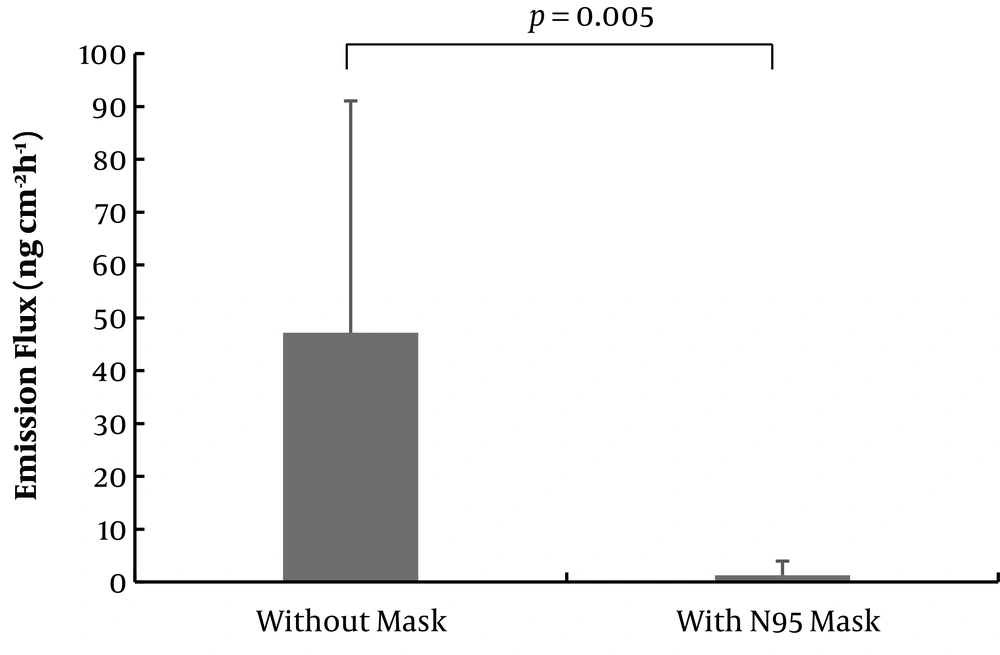
Figure 2 shows the dermal emission flux of toluene of healthy volunteers with and without N95 mask. The dermal emission flux without wearing N95 mask ranged from < LOD to 1.1 × 10
2 ng cm
-2 h
-1 with an average of 47 ± 43 ng cm
-2 h
-1 (n = 9, one outlier was excluded). Meanwhile, those with N95 mask decreased to < LOD to 7.2 ng cm
-2 h
-1 with an average of 1.3 ±2.6 ng cm
-2 h
-1 (n = 9). This indicates that the dermal emission flux of toluene depends on the amount of toluene inhaled.
Comparison of the emission flux of toluene emanating from healthy volunteers at rest with and without wearing the N95 mask during exposure in the chemical laboratory for 1 hour. Bars show standard deviation of dermal emission fluxes (sampling site: forearm, indoor toluene concentration: 1.5 mg.m-3, n = 9, one outlier was excluded, Wilcoxon signed-rank test: P = 0.005).
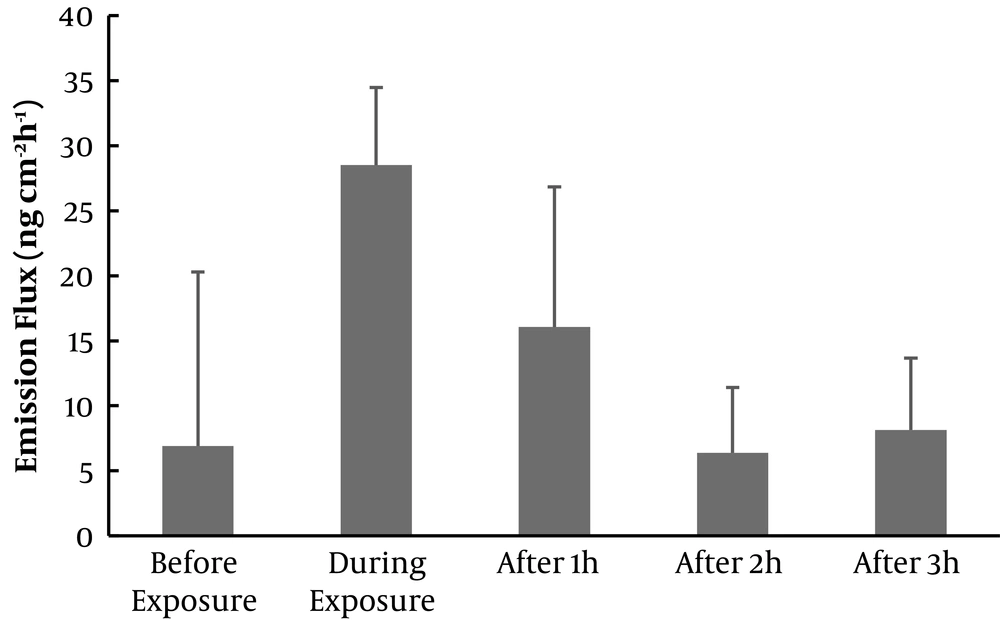
Figure 3 shows the time-course of the dermal emission flux of toluene before and after inhalation. The dermal emission flux of toluene increased during exposure in the chemical laboratory and then decreased to the initial levels after moving to the school class room. The elimination kinetic of VOCs in a body is often described using the sum of two or three exponential expressions (
17-
19). According to Lof et al. (
14), the elimination of toluene from the blood in humans is considered triphasic; the half-lives (t
1/2) were 3 min for the initial very rapid elimination phase, 40 min for the rapid phase, and 738 min for the slow phase. Though the time-resolution was only for 1 h due to a limitation of analytical sensitivity in this study, the t
1/2 obtained from the decrease in the dermal emission flux of four volunteers resulted in 46 minutes, which is in accordance with that of the rapid elimination phase in the blood reported by Lof et al. (
13). This suggests the time-course of the dermal emission of toluene corresponds to that of the blood concentration.
Time-course of the dermal emission flux of toluene before and after the inhalation of 1.5 mg.m-3 of toluene. Bars show standard deviation of dermal emission fluxes (n = 4, sampling site: forearm).
Monitoring of the personal exposure concentration of VOCs using a passive air sampler has been accepted as an alternative to that of the indoor concentration of VOCs in bulk air for occupational safety. Therefore, personal exposure was measured for 12 volunteers in the chemical laboratory and compared with the dermal emission flux of toluene. The personal exposure concentration ranged from 0.28 to 0.37 mg.m-3 (n = 12), whilst the dermal emission flux showed a greater variation from below LOQ to 82 ng cm-2 h-1 (n = 12) during the stay in the chemical laboratory for 8 h. There was no significant correlation (r = 0.14) between exposure concentration and the dermal emission flux of toluene due to greater variation in the individual dermal emission.
To investigate a mass balance between uptake and dermal elimination, the uptake rate by inhalation exposure and whole-body emission rate of toluene were roughly estimated. The uptake rate of toluene by inhalation exposure, U (mg.h-1), was calculated using Euation 2 as follows:
Where C is the individual personal exposure concentration of toluene (mg.m
-3) and Q is the daily inhalation rate (17.3 m
3.d
-1) for Japanese people (
20). Carlsson (
16) reported that approximately 55% of inspired air was absorbed in the body of men exposed to 300 mg m
-3 for 2 h at rest; this value dropped to 50% during the next 2 h of exposure at rest. Lof et al. (
21) reported a similar absorption percentage (approximately 50% absorbed) in groups of 10 men exposed to approximately 300 mg m
-3 at rest for 4 h. Then, the coefficient of 0.5 was used in this estimation.
In contrast, the whole-body dermal emission rate of toluene, D (mg.h-1), was calculated using Equation 3 as follows:
Where E is the individual dermal emission flux of toluene (ng cm
-2 h
-1) and S is the surface area of the forearm region of young Japanese (men: 895 cm
2, women: 768 cm
2). As the partial emission rate from the forearm region contributed to 20% of the whole-body emission rate of toluene (
22), the ES was divided by 0.2 to obtain the whole-body dermal emission rate.
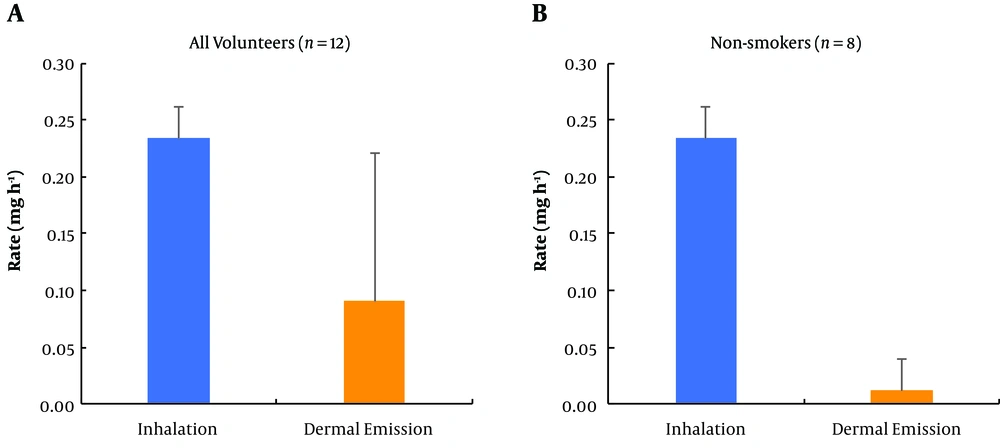
Figure 4 shows the comparison of inhalation rate and whole-body dermal emission rate of toluene for all volunteers (a) and selected non-smokers (b). The average whole-body dermal emission rate resulted in approximately 77% of the inhalation rate (D/U = 0.77) for all volunteers. According to previous studies, around 80% of the absorbed toluene is excreted in the urine (
14) and between 7% and 14% is eliminated by exhalation (
15). Considering these percentages, the 77% elimination via the skin surface is not in accordance with findings of those studies. Profiles of the participating volunteers revealed that four volunteers had a smoking habit. As cigarettes contain many VOCs, including toluene, cigarette smoking can be a source of dermal emission of toluene (
3). Although smoking was prohibited during the experiment, the daily smoking habit probably increased the baseline toluene concentration in the blood and ultimately increased the dermal emission. After excluding the four smokers, the whole-body dermal emission reduced to 9.9% of the inhalation rate (D/U = 0.099). This emission would be in accordance with the previous studies, making the total excretion amount of the absorbed toluene roughly 80% in the urine, 7% - 14% in exhaled air, and 10% from the skin surface. However, there were some limitations in the estimation, especially due to uncertainty in the use of the respiration rate, skin surface area, and small number of participants.
Comparison between the estimated uptake and whole-body dermal emission rates of toluene in (A) all healthy volunteers and (B) non-smokers. Bars show standard deviation of rates.
The uptake of chemicals in environment occurs via three main routes, ingestion, inhalation, and dermal absorption, that lead to an internal concentration or body burden of the chemicals (
23). Therefore, risk assessment of hazardous chemicals on human health is usually conducted based on the integrated uptake amount by the three routes. However, this study showed that toluene, whose uptake route is dominantly by inhalation, is released from the skin surface. This may also be the case when the dominant uptake route is by ingestion. The body internal concentration of the chemical is determined by the way of exposure, and physiological characteristics of individual. Therefore, the dermal emission of toluene may indicate the individual biological susceptibility to inhalation exposure to toluene.
In this study, the dermal emission flux of toluene was determined for healthy volunteers using the PFS coupled with GC/MS in relation to inhalation exposure in the chemical laboratory. The results showed that the dermal emission of toluene occurs when toluene is absorbed by inhalation. Therefore, dermal emission can be the “third” elimination route of absorbed toluene in addition to urinary excretion and exhalation. There was a great variation in the dermal emission flux of toluene among individuals, even when the study volunteers stayed in the same exposure environment. This suggests the dermal emission of toluene reflects physiological characteristics of individuals.