
The Formation of Addiction Psychotherapy Core Can be a Suit Supplement to the Methadone/Buprenorphine Maintenance Therapy Centers: A Fresh Bid to Successfully Treat Drug Abuse

Authors

Saeid KomasiSaeid Komasi ORCID1, Mozhgan Saeidi2, Ali Soroush3,*
1Clinical Research Development Center, Imam Reza Hospital, Kermanshah University of Medical Sciences, Kermanshah, IR Iran
2Cardiac Rehabilitation Center, Imam Ali Hospital, Kermanshah University of Medical Sciences, Kermanshah, IR Iran
3Lifestyle Modification Research Center, Imam Reza Hospital, Kermanshah University of Medical Sciences, Kermanshah, IR Iran
*Corresponding Author: Corresponding author: Ali Soroush, Lifestyle Modification Research Center, Imam Reza Hospital, Kermanshah University of Medical Sciences, Zakaria Razi Boulevard, Kermanshah, IR Iran. Tel: +98-8334276299, Fax: +98-8334276299, E-mail: Email: [email protected]

Middle East Journal of Rehabilitation and Health Studies:Vol. 4, issue 3; e57488
Published online:Jul 11, 2017
Article type:Letter
Received:Feb 28, 2017
Accepted:Apr 16, 2017
How to Cite:Komasi S, Saeidi M, Soroush A. The Formation of Addiction Psychotherapy Core Can be a Suit Supplement to the Methadone/Buprenorphine Maintenance Therapy Centers: A Fresh Bid to Successfully Treat Drug Abuse. Middle East J Rehabil Health Stud. 2017;4(3):e57488. doi: https://doi.org/10.5812/mejrh.57488

Dear Editor,
During recent years, methadone/buprenorphine maintenance therapy (MMT/BMT) has been one of the effective methods in controlling substance abuse and risky behaviors in Iran (1, 2). However, one of the major challenges of this therapeutic approach is treatment retention rate (3). Obviously, there are weaknesses in the routine work of these centers that increase the likelihood of treatment failure (4). For example, at least 50 patients are undergoing methadone therapy in Grade 4 clinics and some patients are under treatment with buprenorphine and opium tincture. However, in each of MMT/BMT clinics, only one psychologist is active who usually does not have enough experience. Additionally, according to the working hours of the clinics, the psychologist does not have enough time to provide exclusive psychotherapy. On the other hand, today in developed countries, the emphasis is placed on specialization in implement interventions. Specialization or specialized interventions mean that each part of the treatment is processed to be performed by a qualified and experienced professional. As a result, the multi-component psychiatric profile of patients treated in centers has required implementing the specialized interventions by an experienced psychotherapy team (5). Thus, it seems that specialized interventions must be performed by a number of clinical psychologists and psychiatrists because the patients can benefit from the specialized and extensive services of the psychotherapy team.
Given these considerations, the formation of a number of addiction psychotherapy cores in every city with the participation of various experts can be fruitful. So that in each metropolitan area that covers a number of MMT/BMT clinics, an addiction psychotherapy core can be formed. Then, expert psychologists in the field of individual psychotherapy, couples and family therapy, and treatment of personality and clinical disorders can be placed in each of these cores (5). Also, a psychiatrist can join this group for the diagnosis of psychosis and drug therapy which would be beneficial (5). It seems that through this method, MMT/BMT centers’ psychologists can focused solely on the initial interview, motivational interview, and supportive psychotherapy which may create better efficiency (4). Moreover, referral of the patients to the addiction psychotherapy core, giving diagnostic interviews, and receiving appropriate and timely treatment can prevent the wandering of the patients and their family members (6). This procedure reduces the likelihood of dropping out of treatment and re drug abuse (3). Therefore, we recommend the formation of addiction psychotherapy cores that simultaneously cover a number of MMT/BMT clinics. Our suggestive model is shown in Figure 1.
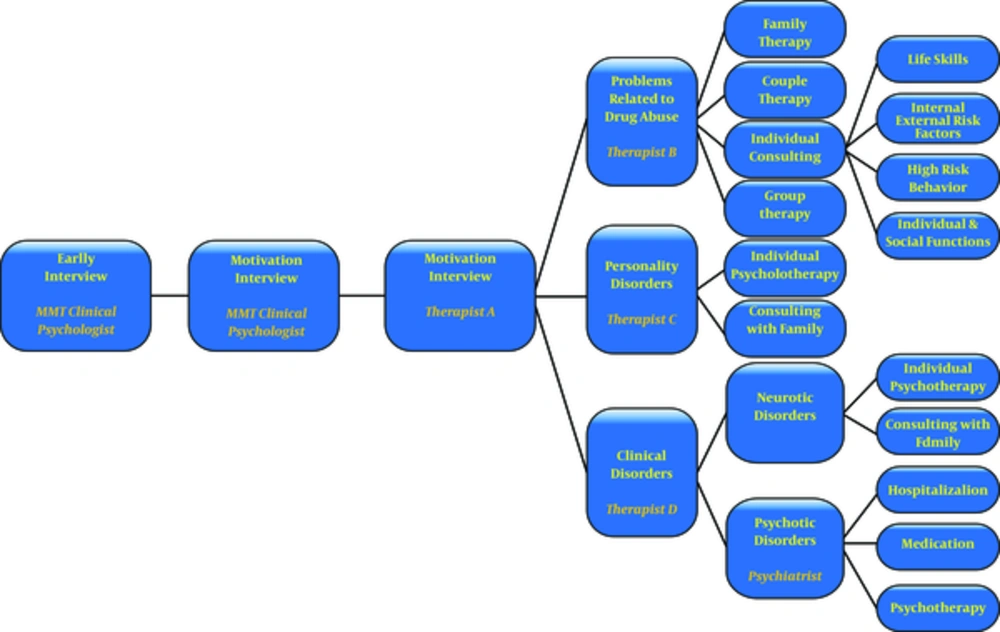
The Suggestive Model. MMT:methadone maintenance therapy.

Figure 1.
The Suggestive Model. MMT:methadone maintenance therapy.

Footnotes

  • Authors’ Contribution:All authors participated in the design of the study and drafted the manuscript and read and approved the final manuscript.

  • Conflict of Interest:None of the authors have conflicts of interest to report.

  • Funding/Support:None.

  • Competing Interests:None declared.

References

  • 1.
    Montazerifar F, Karajibani M, Lashkaripour K. Effect of methadone maintenance therapy on anthropometric indices in opioid dependent patients. Int J High Risk Behav Addict. 2012;1(3):100-3. [PubMed ID: 24971244]. https://doi.org/10.5812/ijhrba.4968.
  • 2.
    Kheradmand A, Banazadeh N, Abedi H. Physical effects of methadone maintenance treatment from the standpoint of clients. Addict Health. 2010;2(3-4):66-73. [PubMed ID: 24494103].
  • 3.
    Meier PS, Donmall MC, McElduff P, Barrowclough C, Heller RF. The role of the early therapeutic alliance in predicting drug treatment dropout. Drug Alcohol Depend. 2006;83(1):57-64. [PubMed ID: 16298088]. https://doi.org/10.1016/j.drugalcdep.2005.10.010.
  • 4.
    Alam-Mehrjerdi Z, Abdollahi M. The Persian methamphetamine use in methadone treatment in Iran: implication for prevention and treatment in an upper-middle income country. Daru. 2015;23:51. [PubMed ID: 26578071]. https://doi.org/10.1186/s40199-015-0134-5.
  • 5.
    Dugosh K, Abraham A, Seymour B, McLoyd K, Chalk M, Festinger D. A Systematic Review on the Use of Psychosocial Interventions in Conjunction With Medications for the Treatment of Opioid Addiction. J Addict Med. 2016;10(2):93-103. [PubMed ID: 26808307]. https://doi.org/10.1097/ADM.0000000000000193.
  • 6.
    Friedmann PD, Lemon SC, Stein MD, D'Aunno TA. Accessibility of addiction treatment: results from a national survey of outpatient substance abuse treatment organizations. Health Serv Res. 2003;38(3):887-903. [PubMed ID: 12822917].

Copyright

Copyright © 2017, Middle East Journal of Rehabilitation and Health Studies. This is an open-access article distributed under the terms of the Creative Commons Attribution-NonCommercial 4.0 International License (http://creativecommons.org/licenses/by-nc/4.0/) which permits copy and redistribute the material just in noncommercial usages, provided the original work is properly cited.

Similar Articles

8
Nov
2023

Narcotics Anonymous: An Obstacle to Methadone Maintenance Treatment

Kamaledin Alaedini,
Maryam Sefidgarnia

Alaedini K, Sefidgarnia M. Narcotics Anonymous: An Obstacle to Methadone Maintenance Treatment. Iran J Psychiatry Behav Sci. 2023;17(4):e139534. doi: https://doi.org/10.5812/ijpbs-139534

25
Jul
2012

New Clinical Implications of Opiate Maintenance Treatments

Gonzalo Haro

Haro G. New Clinical Implications of Opiate Maintenance Treatments. Int J High Risk Behav Addict. 2012;1(2):88-89. doi: https://doi.org/10.5812/ijhrba.6532

7
Dec
2019

An Epidemic Problem: A Commentary on Stimulant Use in Opioid Maintenance Treatment

Saeed Nateghi,
Hosein Effatpanah

Nateghi S, Effatpanah H. An Epidemic Problem: A Commentary on Stimulant Use in Opioid Maintenance Treatment. Iran J Psychiatry Behav Sci. 2019;13(4):e97805. doi: https://doi.org/10.5812/ijpbs.97805

13
Jan
2018
Mobile Intervention: A New Proposal for Increased Success of Methadone/Buprenorphine Maintenance Treatment in Iranian Population

Mobile Intervention: A New Proposal for Increased Success of Methadone/Buprenorphine Maintenance Treatment in Iranian Population

Saeid Komasi,
Mozhgan Saeidi,
Ali Soroush

Komasi S, Saeidi M, Soroush A. Mobile Intervention: A New Proposal for Increased Success of Methadone/Buprenorphine Maintenance Treatment in Iranian Population. Int J High Risk Behav Addict. 2018;7(2):e13941. doi: https://doi.org/10.5812/ijhrba.13941

22
Aug
2020

A Commentary on the Drug Addiction Treatment Market in Iran

Saeed Nateghi,
Hosein Effatpanah

Nateghi S, Effatpanah H. A Commentary on the Drug Addiction Treatment Market in Iran. Iran J Psychiatry Behav Sci. 2020;14(3):e105347. doi: https://doi.org/10.5812/ijpbs.105347

More by these authors

Saeid KomasiPubMedScholar
Mozhgan SaeidiPubMedScholar
Ali SoroushPubMedScholar
Share
Cited by
Metrics