
1. Background
According to the World Health Organization (WHO), quality of life is "the conditions of life of every person in accordance with the objectives, expectations, and standards based on the cultural background". In evaluating the quality of life as a measure of health, in addition to the lifespan, having an optimal life is also considered (1). Based on this definition, quality of life can be affected by various factors including physical health, psychological status, social relationships, personal beliefs, individual relationship with the environment, and disease or the treatment people receive (2). One aspect of life satisfaction is health or illness impact assessment on the quality of life, which is called health-related quality of life (HRQoL). The most common tool for assessing health-related quality of life is the SF-36 questionnaire, which can comprise both physical and mental health (3). The SF-36 questionnaire is a generic type that can be used as a measure of health (4).
Some studies have shown that working in professions related to health has a negative effect on quality of life (5, 6). The level of quality of life in health practitioners can be influenced and decreased by stress and burnout, caused by repeated examinations and treatments and inadequate resting time (7). Dentists are at risk of occupational hazards. These factors can have adverse effects on physical health, mental health, and social functioning of dentists.
Tountas et al. in Greece examined health status and health-related quality of life of hospital staff using the SF-36 (8). This study showed that the quality of life in Greek hospital staff was undesirable. Nunes et al. conducted a cross-sectional study in Brazil to investigate the quality of life and related factors among dental hygienists (9). The study showed that dental hygienists had a low level of quality of life. Puriene et al. studied the dentists’ health status (10). The study showed that fatigue, having a headache, hand problems, chest pain, and musculoskeletal disorders had significant adverse effects on the general health status of the dentists. Ayers et al. in a study in New Zealand evaluated occupational dentists’ health (11). According to this study, the general health of most dentists was at a good level but physical health was not desirable. Doshi et al. in the state of Karnataka, India, examined the quality of life of dentists using the World Health Organization questionnaire (12). According to their results, the highest average score was in the domain of social communications (38.2 ± 15.16) and the lowest score was in the domain of the environment (12.2 ± 72.14).
Direct contact with patients and contamination by saliva and blood increase the risk of communicable diseases among dentists. Moreover, physical pressures exerted on the body during dental procedures may lead to the impaired joint-osseous system and musculoskeletal and peripheral nervous system disorders. In addition, the respiratory, cardiovascular, and digestive disorders might be stricken (13). There are a variety of risk factors in a dental environment, including winning devices and sharp trauma to the skin, aerosols containing infectious agents, radiation, the toxicity of some dental materials, and noise pollution (14). In addition to physical problems, dentists are at risk of occupational psychological problems, as well. Stress, psychological pressure, depression, emotional discharge, and personality problems might affect dentists’ psychological condition (10). Few studies have evaluated the quality of life of dentists (11, 12, 15). No studies have shown the quality of life of dentists working in Semnan. Therefore, the aim of this study was to evaluate health-related quality of life among dentists in Semnan, Iran. The results of this study would help to understand the health condition and health-related quality of life among dentists who are responsible for an important part of the healthcare community. Health-related quality of life can have a significant impact on the performance of dentists for providing health services to patients.
2. Methods
In this descriptive analytical study, all general dentists and dental specialists working in the city of Semnan, Iran, in 2015 - 2016 were enrolled. After preparing a list of names and addresses of the general dental offices in the city of Semnan from the Medical Council, the executive producer (a student) came in person to the offices. The questionnaires were given to the dentists in person. In order to comply with ethical standards, all questionnaires were completed by anonymous dentists.
In this study, as a measuring tool, a checklist consisting of two sections was used. The first part was designed to collect demographic information including age, gender, level of education (as general dentists or dental specialists), a history of systemic diseases, and job satisfaction. In the second part, for the assessment of health-related quality of life, the SF-36 questionnaire was used. Previous studies have confirmed the validity and reliability of the Persian version of SF-36 (16).
The SF-36 includes 36 questions to evaluate the two aspects of health (physical and psychological). Each aspect is composed of four parts:
Physical health includes:
1. Physical functioning (questions 3, 4, 5, 6, 7, 8, 9, 10, 11, and 12)
2. The role of physical health problems (questions 13, 14, 15, and 16)
3. Bodily pain (questions 21 and 22)
4. The general health (questions 1, 33, 34, 35, and 36)
Mental health includes:
1. The role of emotional health disorder (questions 17, 18, and 19)
2. Energy/vitality (questions 23, 27, 29, and 31)
3. Mental or emotional health (questions 24, 25, 26, 28, and 30)
4. Social function (questions 20 and 32)
Question 2 is not used in the measurement.
Data were analyzed using SPSS 17 statistical software. Results were presented using descriptive statistics as frequency and percentage. To assess the impact of gender, age, and history of systemic disease on health-related quality of life, the test of T (t-test) was used. A significance level of P < 0.05 was considered.
3. Results
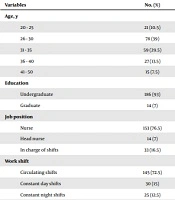
In this study, 76 dentists in the age range of 26 to 69 and with the average age of 36.1 ± 9.2 years, comprising 40 men (52.6%) and 36 women (47.4%), participated.
In terms of age, 44 dentists (57.9%) were in the age group of below 35 years and 32 (42.1%) in the age group of above 35 years.
Sixty-one dentists (80.3%) were general dentists and 15 (19.7%) were dental specialists.
Sixty-six dentists (86.8%) had not any systemic disease and 10 (13.2%) had at least one systemic disease.
Among the dentists, 22 (28.9%) had a lack of job satisfaction/indifference and 54 (71.1%) had job satisfaction.
The scores of quality of life are shown in Table 1.
Table 1.
Mean Scores of Quality of Life Among Dentists in the City of Semnan in 2015 - 2016
| Quality of Life | Mean ± SD |
|---|---|
| Total quality of life | 73.2 ± 10.8 |
| Aspect | |
| Physical | 76.6 ± 12.8 |
| Mental | 64.8 ± 16.0 |
| Physical function | 88.7 ± 10.8 |
| Physical health disorder | 77.3 ± 32.2 |
| Bodily pain | 74.6 ± 17.9 |
| General health | 65.7 ± 17.5 |
| Emotional disorder | 66.2 ± 38.7 |
| Energy/fatigue (freshness, vitality) | 62.6 ± 15.8 |
| Mental health (emotional) | 64.3 ± 14.9 |
| Social work | 66.3 ± 17.8 |
The quality of life of dentists according to age and gender is shown in Table 2.
Table 2.
Comparison of the Quality of Life of Dentists According to Gender and Age
| Quality of Life | Quality of Life Score (Mean ± SD) | P Value* | |
|---|---|---|---|
| Male | Female | ||
| Total quality of life | 73.1 ± 11.5 | 73.2 ± 10.2 | 0.991 |
| Aspect | |||
| Physical | 76.5 ± 13.5 | 76.6 ± 12.1 | 0.969 |
| Mental | 64.8 ± 18.2 | 64.9 ± 13.5 | 0.980 |
| < 35 | ≤ 35 | ||
| Total quality of life | 73.3 ± 10.4 | 72.9 ± 11.6 | 0.892 |
| Aspect | |||
| Physical | 77.1 ± 12.9 | 75.9 ± 12.7 | 0.681 |
| Mental | 63.9 ± 15.2 | 66.2 ± 17.2 | 0.546 |
Based on the results presented in Table 3, general dentists and the specialists did not show a significant difference with each other in the overall quality of life scores (P = 0590), physical (P = 0.231), and mental (P = 0.573) aspects.
Table 3.
Comparison of the Quality of Life of Dentists in Terms of Qualification
| Quality of Life | Quality of Life Score (Mean ± SD) | P Valuea | |
|---|---|---|---|
| General Dentists | Specialists | ||
| Total quality of life | 72.8 ± 10.7 | 74.5 ± 11.7 | 0.590 |
| Aspect | |||
| Physical | 75.7 ± 12.4 | 80.1 ± 14.0 | 0.231 |
| Mental | 64.3 ± 16.5 | 66.9 ± 14.1 | 0.573 |
at-test.
Table 4 shows that the differences between the dentists without a history of the systemic disease and the dentists with systemic disease in the overall quality of life scores (P = 0.140), physical (P = 0.508), and mental (P = 0.148) aspects were not statistically significant.
Table 4.
Comparison of the Quality of Life of Dentists Regarding Systemic Diseases
| Quality of Life | Quality of Life Score (Mean ± SD) | P Valuea | |
|---|---|---|---|
| No Systemic Disease | With Systemic Disease | ||
| Total quality of life | 73.9 ± 10.5 | 68.4 ± 12.3 | 0.140 |
| Aspect | |||
| Physical | 76.9 ± 12.6 | 74.1 ± 14.4 | 0.508 |
| Mental | 65.9 ± 15.6 | 57.9 ± 17.6 | 0.148 |
at-test.
According to Table 5, the difference between the dentists with job satisfaction and the dentists without job satisfaction/indifferent was significant in terms of the overall quality of life scores (P = 0.01) and the mental aspect (P = 0.02).
Table 5.
Comparison of the Quality of Life of Dentists in Terms of Job Satisfaction
| Quality of Life | Quality of Life Score (Mean ± SD) | P Valuea | |
|---|---|---|---|
| Satisfaction | No Satisfaction/Indifference | ||
| Total quality of life | 70.6 ± 4.13 | 64.2 ± 9.5 | 0.01a |
| Aspect | |||
| Physical | 77.9 ± 11.4 | 69.3 ± 15.4 | 0.154 |
| Mental | 66.1 ± 14.5 | 58.9 ± 19.2 | 0.02a |
at-test.
4. Discussion
In Klersy and colleagues study, doctors and nurses in hemodialysis centers were assessed by the SF-36. The scores on the physical and mental aspects for the doctors were 53.3 ± 5.8 and 49 ± 8.6, respectively, and for the nurses were 50 ± 7.2 and 49.1 ± 9.7, respectively (17). The scores in their study are lower than the results of the present study. It seems that health-related quality of life in healthcare staff can significantly be affected by the harsh working conditions, especially in terms of working with critically ill patients. This study showed that scores ranged between a maximum of 88.7 ± 10.8 for the aspect of physical functioning and a minimum of 62.6 ± 15.8 for the aspect of the emotional health disorder.
Our findings are very similar to the results of Aghamolaei and colleagues study conducted in one of the cities of Iran. Using the SF-36 to assess health-related quality of life, they reported scores ranged between 67.4 ± 20 and 92.2 ± 7.9 in the general population in the physical and mental aspects, respectively (18). According to the study, the overall quality scores and the scores of physical and mental aspects of male and female dentists statistically were not significant. Despite these results, in the study of Aghamolaei and colleagues, a higher quality of life in men compared to women was observed (18).
Hopman and colleagues also conducted a study in Canada and found that the quality of life was significantly higher in men than in women (19). In a study conducted by Tountas and colleagues in Greece, the overall quality of life and its various dimensions in admitted patients were determined and it was found that the scores were higher in men than in women (8). The discrepancies between the results of this study and those of other studies can be attributed to differences in the study samples. In the present study, a group of dentists was examined while in Aghamolaei and colleagues (18) and Hopman and colleagues (19) studies, general populations were studied, and Tountas and colleagues evaluated the admitted patients (8). It seems that employment, especially in the dental profession, can significantly improve the quality of life of women. According to Saravi and colleagues, the job is of great importance in the women's quality of life (20).
Svensson et al. evaluated the HRQoL in individuals with severe dental pain and demonstrated that having dental pain was associated with poor HRQoL. As mentioned previously, their studied sample was completely different from our study’s sample, which can explain the difference between the results (21).
According to our study, health-related quality of life between general dentists and dental specialists showed no significant difference. It could be explained by the attribution of the health-related quality of life to the similar working conditions in both groups. Similarly, Gonzales-Sullcahuaman et al. reported no significant difference in the HRQoL of various levels of academic education among dental students (22), while Abraham et al. showed that among dentists who work in the UAE, QoL could be affected by several factors, one of which is whether dentists are general practitioners (GPs) or specialists. They reported a significantly better QoL among specialists compared to GPs (23).
The present study showed that among dentists aged less than 35 years and aged 35 years or above, there was no significant difference in terms of health-related quality of life. Based on the findings of this study and other studies, it seems that the relationship between age and health-related quality of life is very different depending on the population studied. Conversely, Lira E Silva et al. examined the QoL of patients undergoing hemodialysis and reported that being older may adversely affect the QoL (24). Another study by Kruger et al. revealed that age differences are predominantly observed in the physical QoL dimensions rather than in the mental aspects (25). It could be explained that in our study, the maximum age of the subjects was 69 years that is in the range of middle adulthood and the individual at this age is not considered an old person, while the sample in the Kruger et al. study consisted of elderly patients wearing dentures.
In the present study, the results showed that health-related quality of life among the dentists with job satisfaction was significantly higher in terms of overall and mental health than among dentists with low levels of job satisfaction. Similarly, Ioannou et al. showed that Greek nurses with high levels of job satisfaction had better HR-QoL (26).
4.1. Conclusion
The study showed that the quality of life of general dentists and dental specialists in Semnan, Iran, is similar to each other and is at an acceptable level. The factors such as gender, age, education level, and systemic diseases had no significant impact on their quality of life. Job satisfaction is associated with quality of life so that an improvement in the work environment would contribute to a healthier and more satisfied dental workforce. In addition, providing the training programs is essential in order to improve the health and prevent the occupational hazards.