




1. Background
Drug addiction, as a chronic, progressive disease, is one of the health challenges hindering the development of countries around the world and Iran (1). During the past decade, this health problem has inflicted about 1.5 million Iranians (1) and much more are in danger (2). In the past, the roles of various factors such as age and gender (3), culture (4), irrational beliefs (1, 5), and personality traits (6) have been contemplated in addiction. Moreover, many other factors including personality traits and disorders (7, 8) and the inefficient structure of service delivery systems are influential in the failure of treatment (1, 9, 10). Previous studies often focused on the NEO five-factor personality model to investigate the relationship between addiction and personality traits including extroversion/introversion, positive/negative affect, neuroticism, and other components (11, 12). Some studies have even utilized clinical tools such as MCMI and MMPI (13-15). The enneagram personality system is among those personality models rarely used in this field despite its efficiency and the fact that it can be easily quantified.
The Enneagram personality model, as an applied approach, provides an accurate map of the mental structure of an individual. According to this system, different personality patterns are metaphors for the individual’s active psychological functions (16). Enneagram is considered a suitable model for improving self-scrutiny when facing stressful situations (17). This system can contribute to the formation of safe intellectual and behavioral patterns (18) and prevent the individual from committing risky behaviors. According to the enneagram system, people are categorized into nine personality types and there is usually a dominant personality type for each individual that better justifies his/her underlying characteristics (16, 18). The other eight personality types, which have evolved less during an individual’s lifetime, represent the latent talents and contain important portions of an individual’s identity (16). Since each of the personality types has its own specific characteristics and defensive strategies against stress and anxiety (16), it is possible that some of the personality types increase the tendency to risky behaviors, particularly drug addiction. On the other hand, studying the personality patterns and characteristics not only does facilitate the explanation and promotion of healthy behaviors, but also helps with screening people vulnerable to risky behaviors (19).
2. Objectives
Based on these considerations, the current study aimed to investigate and evaluate the relationship between the enneagram personality types and the risk of drug addiction.
3. Methods
The statistical population of this cross-sectional study included all addicts on treatment at methadone maintenance treatment (MMT) centers across Kermanshah city and their non-addicted accompanying caregivers during the period between September and November 2017. The addicted participants were selected using a multistage cluster sampling method from four different MMT centers and their accompanying caregivers were also invited to the study. The inclusion criteria for the study included the following: (i) an age range of 18 to 70 years; (ii) a minimum education level of primary school; (iii) confirmation of addiction for the patient group and non-addiction for the healthy group by MMT doctors; and (iv) willingness to give written consent for participation in the study.
At the first stage, after applying the inclusion criteria, 100 patients entered the study. However, six of them were removed from the study because of not completing the questionnaires or a high number of unanswered items. The accompanying caregivers of these patients were 78 people and after applying the inclusion criteria, only 66 of them met the requirements of the study. In sum, 160 participants entered the study. Based on the formula (N = predictive variables × 8 + 50) for the sample size in logistic regression and the fact that we had 10 predictive variables, this sample size (n = 160) was acceptable (20). This study was approved by the Ethics Committee of the Kermanshah University of Medical Sciences (KUMS.REC.1395.731).
The presence of drug addiction or lack of it among the clinical and non-clinical participants was evaluated and confirmed based on medical documents and the results of urine tests by the doctors at each center. Then, the demographic information of the participants and the medical and treatment history of the addicts were obtained during a short interview with each participant. At the next stage, the medical information of the patients was compared with their medical documents, and they were confirmed by the treating doctor again. After obtaining a written consent form to participate in the study, the Riso-Hudson Enneagram Type Indicator (RHETI) questionnaire was given to the participants in the consultation rooms of these centers. The necessary explanations regarding how to complete the questionnaire were provided to the participants by the members of the research team and the participants filled out the questionnaire in 40 min in the presence of the researcher.
3.1. Instruments
3.1.1. Demographic Information Form
The self-reported demographics of the participants were recorded in this form. This form included information pertaining to gender, age, education level, occupational group, and marital status. Moreover, the type of medication (methadone, buprenorphine, or opium tincture) they receive and the age they started drug use were also recorded for the addicts (21). The familial relation of non-clinical participants with the patients was also recorded.
3.1.2. Riso-Hudson Type Enneagram Indicator Questionnaire
This questionnaire was developed by Riso and Hudson in 1999. This inventory includes 144 two-option items and the participants are asked to choose the option which better represents his/her personality characteristics. The scoring of the items is based on a two-option answer (I agree/I disagree) and the participant will indicate if he/she agrees with the statement or not. This scale measures nine personality types; the scores on each personality type can be added separately, providing a ranking of personality types from one to nine. Personality types are categorized as perfectionist (type 1), giver (type 2), performer (type 3), romantic (type 4), observer (type 5), loyalist (type 6), enthusiast (type 7), challenger (type 8), and mediator (type 9). Triads or three-type sets consist of three personality types and they are based on an emotional reaction, which is mainly unconscious. The feeling (types 2, 3, and 4), thinking (types 5, 6, and 7), and instinctive triads (types 8, 9, and 1) are represented by shame, fear, and anger, respectively (22). The reliability and validity of this scale were examined by Nugent and the internal consistency of this questionnaire was reported between 0.70 and 0.82 and its simultaneous validity with NEO PI-R was reported significant at 0.01 (23). Moreover, the reliability and validity of this instrument among Iranian populations are reported as acceptable and satisfactory (24). This tool has been previously used successfully among Iranian patients (16). It is worth mentioning that to find the dominant triad of participants, first, the scores of each triad were calculated and then the triad with the highest score was selected as the dominant triad.
3.2. Data Analysis
All the statistical analyses were carried out using SPSS-20 software (IBM Corp., Armonk, NY, USA). All the tests were two-tailed and the statistical significance was defined as a P value of < 0.05. The data related to continuous variables were reported as means and standard deviation (SD) and the discontinuous data were reported as values and percentages. At the baseline, the demographic information of the patients and the healthy group was compared using the chi-square test (categorical variables) and independent t test (continuous variables). Furthermore, drug abuse and treatment histories of the patient group were reported. Then, to perform the main analysis, a lack of violation of statistical assumptions was examined (20). Despite the fact that the data followed a normal distribution, because of the presence of multicollinearity among the personality types, the scores were first converted into standard Z scores. Given the presence of continuous and categorical variables as predictive factors, binary logistic regression analysis was used for identifying drug addiction correlates. All the personality types and triads (feeling, thinking, and instinct) were simultaneously entered into the model. An adjustment was applied to all the demographic variables including gender, age, education level, occupation, and marital status. The results of the analysis were presented as adjusted odds ratios (ORs) with 95% confidence intervals (CIs).
4. Results
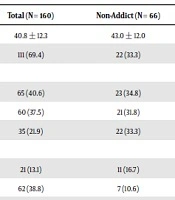
Table 1 depicts the demographics of both groups, as well as the histories of the patients. As can be seen from this table, there was a significant difference between the two groups in gender, education level, occupation, and marital status (P < 0.05). Table 2 shows the results of the binary logistic regression after adjustment for all demographics, as well as the summary of the model. Based on the results, there was a significant positive relationship between all personality types, except for type 3, and drug addiction (P < 0.05). In other words, for each unit increase in the scores of personality types, the likelihood of being addicted to drugs increased significantly. The most important personality types explaining drug addiction were types 5, 4, and 1, in sequence. Compared to the normal population, an increase in the scores of these personality types would increase the likelihood of drug addiction by 22.5 to 41.5 times. In contrast, none of the triads could explain drug addiction. In general, the model could accurately explant 78.8% of the group membership and 39 to 52.6% of the variance in the criterion variable.
Table 1.Demographics and Histories Separated by Groups
| Variable | Total (N = 160) | Non-Addict (N = 66) | Addict (N = 94) | P Valuea |
|---|---|---|---|---|
| Age, mean ± SD | 40.8 ± 12.3 | 43.0 ± 12.0 | 39.3 ± 12.4 | 0.063 |
| Sex, male, No. (%) | 111 (69.4) | 22 (33.3) | 89 (94.7) | 0.001 |
| Education level, No. (%) | 0.013 | |||
| Under diploma | 65 (40.6) | 23 (34.8) | 42 (44.7) | |
| Diploma | 60 (37.5) | 21 (31.8) | 39 (41.5) | |
| Academic degree | 35 (21.9) | 22 (33.3) | 13 (13.8) | |
| Job group, No. (%) | 0.001 | |||
| Clerk | 21 (13.1) | 11 (16.7) | 10 (10.6) | |
| Self-employed | 62 (38.8) | 7 (10.6) | 55 (58.6) | |
| Housekeeper | 39 (24.4) | 34 (51.5) | 5 (5.3) | |
| Retired | 18 (11.2) | 7 (10.6) | 11 (11.7) | |
| Unemployed | 20 (12.5) | 7 (10.6) | 13 (13.8) | |
| Marital status, No. (%) | 0.005 | |||
| Single | 40 (25.0) | 11 (16.7) | 29 (30.8) | |
| Marriage | 100 (62.5) | 51 (77.3) | 49 (52.2) | |
| Widowed/separated | 20 (12.5) | 4 (6.1) | 16 (17.0) | |
| Medication type, No. (%) | - | - | ||
| Methadone | 73 (45.6) | 73 (77.7) | ||
| Buprenorphine | 19 (11.9) | 19 (20.2) | ||
| Opium tincture | 2 (1.2) | 2 (2.1) | ||
| Treatment history (%) | 55 (34.4) | - | 55 (58.5) | - |
| Start age of drug abuse, mean ± SD | 26.9 ± 7.6 | - | 26.9 ± 7.6 | - |
| Relation to the patient, No. (%) | - | - | ||
| Parent | 18 (11.2) | 18 (27.3) | ||
| Sibling | 22 (13.7) | 22 (33.3) | ||
| Spouse | 17 (10.6) | 17 (25.8) | ||
| Children | 8 (5.0) | 8 (12.1) | ||
| Other | 1 (0.6) | 1 (1.5) |
aP value of chi-square test for categorical factors and independent t test for continuous factors
| Component | Total (N = 160) | Non-Addict (N = 66) | Addict (N = 94) | ||
|---|---|---|---|---|---|
| Score | OR (95% CI) | Score | OR (95% CI) | ||
| Personality Types, Mean ± SD | |||||
| Type 1, perfectionist | 15.9 ± 4.1 | 16.5 ± 4.1 | 1 | 15.1 ± 4.1 | 22.5 (3.2 - 158.2)c |
| Type 2, giver | 17.5 ± 3.7 | 18.1 ± 3.8 | 1 | 17.1 ± 3.5 | 8.1 (1.5 - 45.0)c |
| Type 3, performer | 14.8 ± 4.0 | 16.6 ± 2.6 | 1 | 13.6 ± 4.4 | 5.5 (0.9 - 32.0) |
| Type 4, romantic | 16.8 ± 4.4 | 14.6 ± 2.7 | 1 | 18.4 ± 4.6 | 38.0 (4.7 - 307.5)c |
| Type 5, observer | 16.6 ± 5.3 | 13.9 ± 3.6 | 1 | 18.5 ± 5.5 | 41.5 (3.6 - 471.7)c |
| Type 6, loyalist | 18.7 ± 3.7 | 17.9 ± 2.8 | 1 | 19.2 ± 4.2 | 7.4 (1.5 - 37.0)c |
| Type 7, enthusiast | 11.1 ± 4.5 | 12.1 ± 4.2 | 1 | 10.4 ± 4.5 | 10.0 (1.4 - 73.4)c |
| Type 8, challenger | 14.5 ± 3.3 | 14.1 ± 3.2 | 1 | 14.7 ± 3.4 | 10.2 (2.1 - 48.5)c |
| Type 9, mediator | 17.4 ± 3.7 | 18.7 ± 4.5 | 1 | 16.5 ± 2.8 | 5.6 (1.0 - 31.5)c |
| Triads, N (%) | |||||
| Feeling triad | 65 (40.6) | 29 (43.9) | 1 | 36 (38.3) | 1.2 (0.3 - 5.2) |
| Thinking triad | 41 (25.6) | 9 (13.6) | 1 | 32 (34.0) | 1.3 (0.2 - 8.3) |
| Instinctive triad | 54 (33.8) | 28 (42.5) | 1 | 26 (27.7) | 1 |
aPersonality factors (standard Z scores) in this table were all included as covariates in developing the binary logistic regression model. The results were adjusted for all demographics (age, sex, education, job, and marital status).
bSummary of model: The model’s fitting information include chi-square = 79.174, P < 0.0005; Pseudo R-square based on Cox & Snell and Nagelkerke = 0.390 to 0.526.
cStatistically significance (P < 0.05).
5. Discussion
The current study was carried out to evaluate and assess the relationship between enneagram personality types and the risk of drug addiction. The results showed a significant positive relationship between all personality types, except for type 3, and drug addiction. In other words, for each unit increase in the scores of personality types, the likelihood of being addicted increased significantly. The most important personality types explaining addiction were types 5, 4, and 1, in sequence, which could increase the likelihood of drug addiction by more than 40 times. Previous studies have focused on the role of imbalance among personality traits such as introversion, negative affect, and particularly neuroticism in increasing the risk of drug addiction (6, 11, 12). Moreover, the roles of personality disorders, where there are some dominant restricting characteristics, have also been mentioned (13-15).
The enneagram model can effectively determine the internal desires, conscious/unconscious motivations, and emotional-perceptual-behavioral patterns of individuals (22). In the Enneagram system, the balance among the nine personality patterns is emphasized as the underlying health indicator. Therefore, imbalances in each one of the personality patterns and the abnormal escalation of personality characteristics can hinder the individual from reaching freedom, which is the ultimate goal in enneagram (22, 25). These conditions may render the individual vulnerable to risky behaviors such as drug addiction. For instance, people with a type 1 personality have a perfectionist character. They are accurate, frank, strict, and highly judgmental people who react extremely to opposing views. Their intolerance, aggressiveness, and rigid body language can create a negative feeling in others. These people are always trying very hard to control their own anger so that others do not judge them in a negative light (16, 26). Anger is related to drug addiction and weak treatment outcomes (27).
People with the characteristics of personality type 5 usually base their interactions and behaviors on rationality instead of emotion. They act very cautiously and by rationalizing their feelings and emotional breakdowns, they try to overcome their inherent fear. These people pursue the feeling of safety by distancing themselves from relations and becoming isolated (16). Social isolation can lead individuals towards drug addiction (28).
People with personality type 4, who have a romantic character, are more involved in their own internal conflicts. Their mood is always fluctuating, making their relations very vulnerable. They often focus on what they lack and their needs are often characterized by envy and jealousy (22, 25). If the self-preservation instinct is active in these individuals, pleasure-seeking will become one of their most important objectives. Mood fluctuations and pleasure-seeking can increase the vulnerability to drug addiction (29, 30).
Another finding of the study showed that none of the centers of human understanding (the triads of feeling, thinking, and instinct) played any role in becoming addicted. Since each triad consists of the scores of three personality types (25), its scores are usually more balanced than those of the personality types. In other words, even if the score of one of the personality types in the triad is high, the other two scores are not usually very high. Therefore, the total score is generally an average score. Furthermore, it is also possible that in some of the participants, the personality type and the dominant triad are not consistent. That is possibly why the triads could not explant the clinical group of the current study.
The most important point to note is the gender difference between the groups. The patient group mainly consisted of men, while the majority of the subjects in the control group were women. It is assumed that heterogeneity in sexual distribution between the groups may have biased the results. There are two issues in this regard; one is the impact of gender on drug addiction and the other is its impact on personality types. Regarding the first problem, although substance abuse starts at younger ages in men than in women (31), females are more likely to develop a preference for some types of illegal drugs (32). In relation to the second problem, some researchers have pointed to differences in personality traits between men and women based on the big-five model (33). However, it is not possible to certainty confirm the gender differences between personality types in typology models such as enneagram. However, these differences are likely to increase the risk of bias, which needs to be controlled in future studies.
5.1. Strengths and Limitations
Although this is a pioneer study in this field and our model could accurately explant 39 to 52.6% of the variance in the criterion variable, there were a number of limitations. Despite controlling for demographic variables in statistical analysis, applying a case-control design with equal matched samples could provide more valuable results. In particular, the gender differences between the two groups were significant. Case-control studies can match the number of men and women in the groups. The number of non-clinical participants was relatively low, which could contribute relatively to biased results. Selecting a larger sample size may resolve this problem in future studies. The sheer length of the questionnaire used in the study was another limitation, causing patients to feel somewhat exhausted when they reached the final questions. While it was possible to fill out the questionnaire in two separate rounds, there was a problem with the availability of the non-clinical participants, so we preferred that the questionnaire was filled out in one session. Therefore, it is recommended that future studies use the 36-item version of the scale. Finally, in this study, we used the dominant triad (in the form of n and percentage) for the statistical analysis; we recommend that future studies use the average scores of triads.
5.2. Conclusions
While all the personality types, except for personality type 3, were positively related to drug addiction, the most important personality types for explaining drug addiction were personality types 5, 4, and 1, in sequence, which could increase the likelihood of drug addiction by more than 40 times. Based on the fact that the enneagram system emphasizes the balance among the nine personality patterns as the underlying indicator of health, imbalances in each of the personality patterns and the abnormal increase of the characteristics could pave the way for drug addiction. High-risk types at risk of drug addiction identified in this study can be the focus of interventions for therapists and clinicians. While it seems that the enneagram system is an efficient model for explaining drug addiction, future studies can be useful.