
1. Background
Arbaeen is a movement of love and faith; it is a combination of intellect and emotion, blending these two elements seamlessly (1). Arbaeen has several important aspects, including the culture of resistance, walking and health, politics, unity, solidarity, sympathy, and many other hidden and unknown layers, which highlight its multidimensional nature. This event can be categorized as a mass religious gathering, a term used to describe events where large numbers of people come together for a shared religious purpose. Such gatherings, like Arbaeen, are not only spiritual in nature but also have significant social, political, and logistical implications.
Each year, despite the restrictions on pilgrimage during the final days, there is a relative increase in the number of participants from around the world. This growth presents significant challenges for providing services to the pilgrims, particularly given resource limitations. One of the primary challenges is the limited geographic space available to accommodate the massive influx of people, creating logistical difficulties in managing such a large-scale gathering effectively. Therefore, the most important objective of this research is to assess the feasibility of using a photo-map or spatial photo map along the Arbaeen walking route to identify unused lands for the development of geographical space in future planning.
Arbaeen walks have many positive effects, fostering social solidarity, strengthening the sense of belonging and collective identity at different levels of the family, street, and neighborhood, and attracting the participation of social and religious groups, among others (2).
Taleb Elm et al. analyzed the spatial quality of the Arbaeen Hosseini walking route based on the needs of pilgrims on the Najaf-Karbala route. They concluded that the Arbaeen walking route is safe enough and provides a suitable platform for social interactions, albeit with some limitations (3).
Hadi and Abed researched multifunctionality as a tool to accommodate the needs of "Ziyarte Al-Arbaeen" visitors. Their results showed that multifunctional spaces can enhance the efficiency of urban areas during events with high densities (4).
There are four land borders for entering the territory of Iraq, and the map of Iran's borders for Hosseini's Arbaeen, along with their distance to Karbala, is shown in Figure 1 (5).
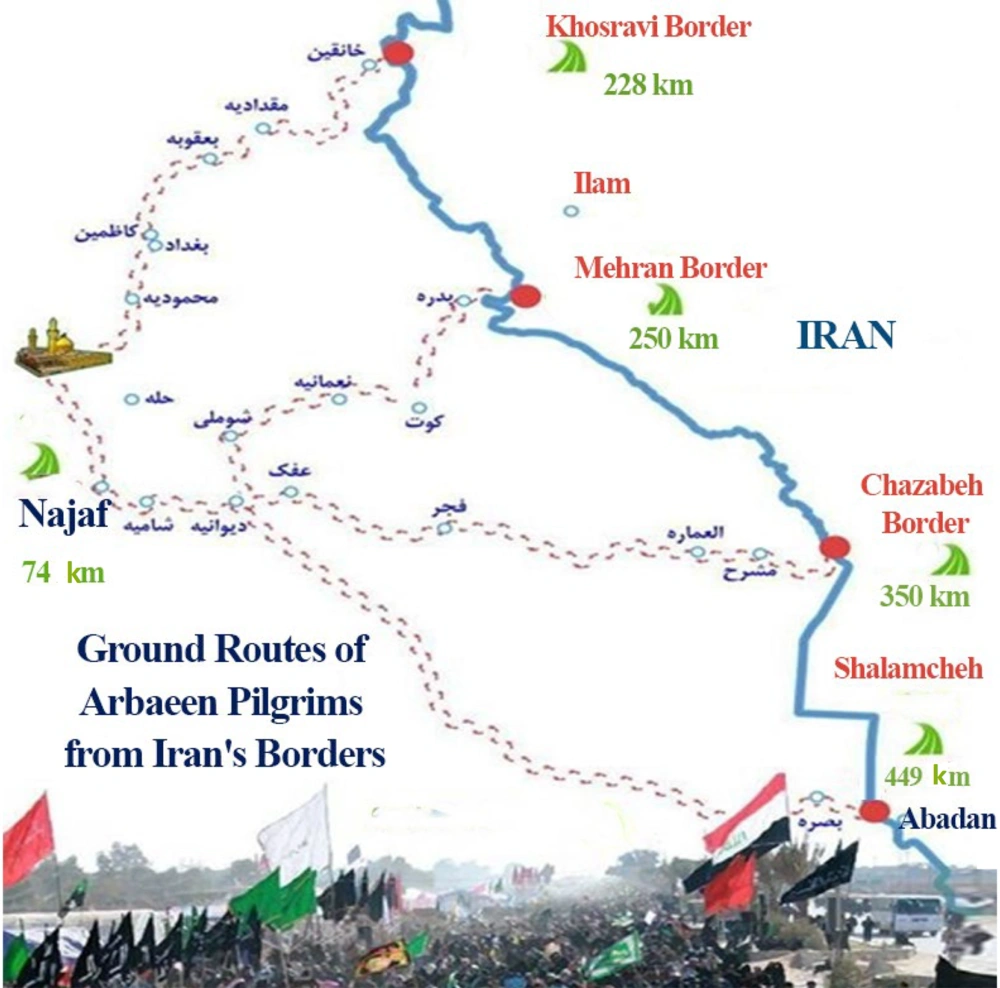
Figure 1.
The map of Iran's borders for Hosseini Arbaeen along with their distance to Karbala (5)
One of the important and practical methods for investigating the extent of population surveillance is the use of field of view maps. The field of view refers to a geographical area that can be monitored and controlled from a specific location (such as an observation tower) and is also widely used in surveillance and military contexts. Therefore, understanding the areas under observation and surveillance control is of significant importance and necessity for this research. Bayn al-Harameen has been chosen as the study area or target community for this part of the research due to its strategically important location within the city, as well as its designation as the maximum population density line during Arbaeen. Thus, the importance of this research lies in achieving thorough monitoring during peak pilgrim population conditions. This issue has been addressed in this paper by providing a site selection map and conducting visibility analysis. In general, research conducted in the field of visibility analysis has utilized geographic information system (GIS) and related software. Jafarzadeh and Valizadeh Kamran combined GIS, remote sensing, and multi-criteria decision-making to locate military barracks in Ardabil city. They concluded that GIS is effective for identifying suitable locations for military barracks (6). Ahmadi and Karimi Moshaver employed visual field analysis to evaluate the visibility of high-rise buildings. They concluded that visibility analysis is an effective tool for modeling visibility in the design of high-rise buildings prior to their construction (7). Oroji et al. used visibility analysis in ArcGIS to evaluate the tourist field of view for geomorphosites in Qeshm Island Geopark. They found that the geomorphosites of the Valley of Statues, Chah Kouh Gorge, and Bam Qeshm had the best conditions for tourist visibility (8). Ruzickova et al. proposed a new method for preparing field of view maps in GIS software by considering permeable obstacles and their effects. Their method facilitates the creation of field of view maps in various fields, including military, architecture, archaeology, and radio communication (9). From the review of prior research, it is evident that visibility analysis is widely utilized in security and military contexts, as well as in other scientific fields such as architecture, geography, urban planning, and urban development.
1.1. Definitions and Concepts
The field of view, or viewshed, is the geographical area that can be seen from a specific location. This includes all surrounding points that are within the line of sight of that location, while excluding points that are beyond the horizon or obstructed by terrain and other features, such as buildings and trees. Conversely, it can also refer to an area from which an object can be seen (10). A view is not necessarily limited to the visible spectrum for humans; it may include the invisible spectrum, such as radio and television waves.
These maps are widely used in military science, urban planning, and archaeology. With the help of a digital elevation model (DEM), the field of view or viewshed can be determined. This approach can be useful for locating telecommunications masts, observation posts, and similar structures. For example, if we examine Tehran's watershed from the top of Damavand Peak, the visible areas would appear as shown in Figure 2 (11).
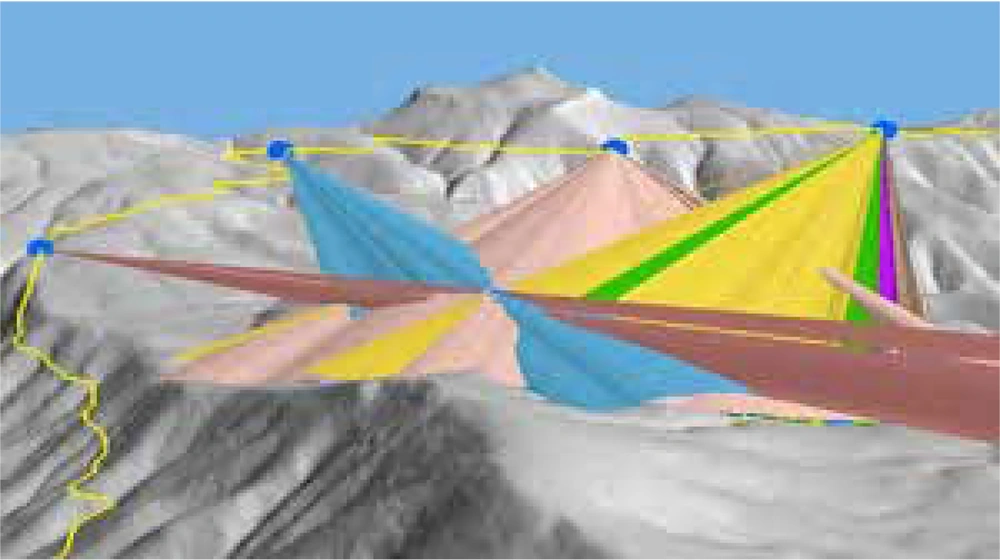
Figure 2.
Determining the field of view is one of the important applications of the digital height model (11)
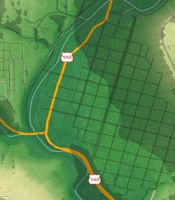
In the above figure, the blue dots indicate the positions of the observers, and the colored areas represent the field of view for each observer. Scientists utilize field of view maps for various purposes, including military applications, telecommunication planning, and other scenarios where the field of view is critical (12). For instance, in the United States, the following field of view map was used to determine the location of a proposed tower (Figure 3) (13). In this figure, the dark and shadowed areas indicate locations where the proposed tower would be hidden or not visible.
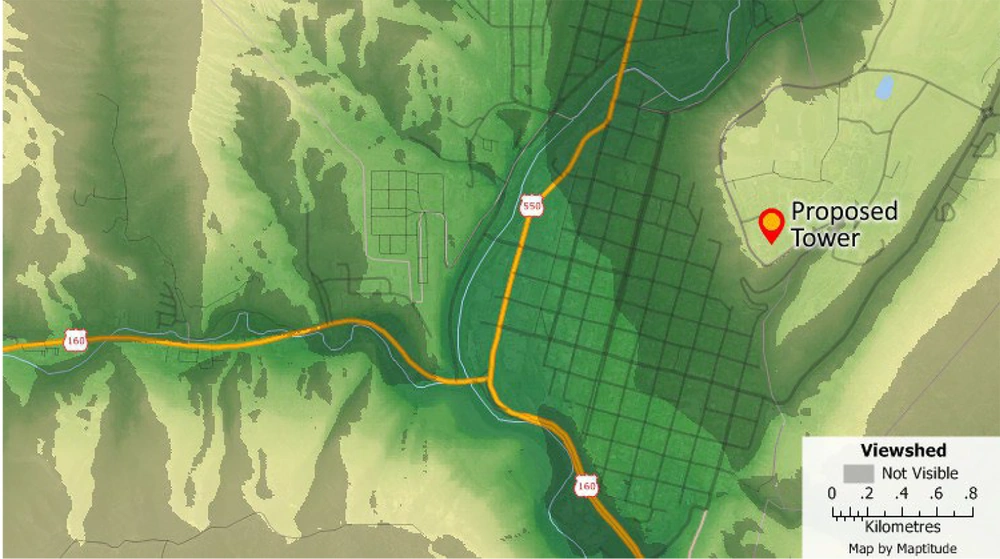
Figure 3.
The shaded areas on the map show the areas outside the view of a proposed tower. The tower will not be visible in these shaded areas (13)
Viewshed or determining the field of view is created using one of two elevation models: Digital elevation model or vector (TIN) raster. This map is prepared by using one of these layers and specifying the point for which the field of view is to be calculated. In this analysis, a point is determined on the region's surface, and based on that, the visible regions are identified. Therefore, in addition to the elevation raster layer, a point layer is also required (14).
Field of view maps are generally represented in two modes: (1) Visible areas, typically shown in green or as the number one {1} in raster space, and (2) invisible areas, usually shown in red or as zero in raster space. The colors are conventional; for example, non-visible areas may be left colorless, and only visible areas are shown in green, as in the field of view map discussed in this article.
Geographic information systems work with data related to geographic locations. In other words, GIS collects, produces, maintains, retrieves, and analyzes data that occupies space in the real world (15). It is a computer-based system for managing and analyzing geographic information, capable of collecting, storing, analyzing, and displaying geographic data (National Geoscience Database of Iran).
Geographic information system is a location-based system that answers the key question of "where." For instance, where should an observation tower be built to maximize visibility, or which areas in a city are most suitable for constructing educational, military, or other facilities? Both active and passive defense strategies should be considered to fulfill its inherent duties. Consequently, optimal management is a key consideration within this system.
A raster consists of a set of points or cells that represent the features of the Earth's surface in a regular grid (16, 17), addressed by their row and column numbers. The smallest unit in a raster is called a pixel or cell (15). A digital elevation model is a type of raster that contains important elevation data. This data is essential for extracting field of view maps in GIS programs.
The earth's surface phenomena are perceived in three-dimensional (3D), making the simulation of landscapes a crucial goal of 3D models. The digital elevation model provides digital data used for preparing the topographic model of the earth's surface (15).
Digital elevation models have specific applications in observational analysis, such as determining the visibility of features from a particular point and angle or identifying which effects will be visible in a specific direction (15).
2. Methods
The approach of this research is descriptive-qualitative, aiming to explore and analyze the spatial characteristics of the walking route from Najaf to Karbala. This approach focuses on describing the observed phenomena and interpreting the spatial relationships along the route without relying on statistical quantification. Qualitative methods, such as visual interpretation and spatial analysis, are employed to provide in-depth insights into the visibility and blind spots along the route. The research combines field observations with GIS and Google Earth data to produce a comprehensive spatial analysis.
2.1. Library Studies and Web Search
At the outset, an extensive review of existing literature and related studies was conducted. The purpose of this phase was to establish a solid theoretical foundation and identify key concepts related to GIS, spatial analysis, and the significance of the Najaf to Karbala pilgrimage route. Online databases, peer-reviewed journals, books, and credible web sources were utilized to gather relevant data. This preliminary step was essential for framing the research questions and defining the scope of the spatial analysis.
2.2. Data Collection and Conceptual Model Development
The core of this research involved the collection of spatial data using both primary and secondary sources. The secondary data included high-resolution spatial images from Google Earth and pre-existing GIS datasets, which provided detailed geographical information on the Najaf to Karbala route. A conceptual model was then created within a GIS environment, enabling the integration of multiple data layers, including geographic coordinates, elevation data, and land use information. This model was critical for visualizing the route and identifying key spatial features.
2.3. Visual Interpretation
A qualitative analysis method known as visual interpretation was applied to the spatial images and GIS data. This technique involved manually examining the spatial imagery to identify significant features along the route, such as infrastructure, resting points, and natural obstacles. The interpretation aimed to distinguish visible areas from blind spots, where observers (such as security personnel) might face challenges in monitoring the route. The visual interpretation process played a crucial role in defining the focus of subsequent analyses, ensuring that the most critical areas were highlighted for further investigation.
2.4. Three-Dimensional Spatial Analysis
A key aspect of this research was the 3D analysis, which incorporated not only the horizontal dimensions (latitude and longitude) but also the vertical dimension (elevation). In 3D analysis, the height of the landscape and other objects (such as observation towers, buildings, and natural terrain) was taken into account. This approach allowed for a more precise calculation of visible and non-visible areas compared to traditional two-dimensional analysis. For instance, a hypothetical 5-meter observation tower located in Bin al-Haramein was used as a reference point to conduct the visibility analysis, examining both the visible points under observer control and the blind spots.
2.5. Field of View and Blind Spot Analysis
The visibility analysis was a critical component of this research. Using GIS tools, visibility from various observation points was simulated to evaluate the effectiveness of surveillance along the pilgrimage route. The research specifically focused on identifying visible areas (those under direct observation) and blind spots, where obstacles such as buildings, terrain features, or vegetation blocked the line of sight. The 3D model, combined with visibility algorithms, enabled an accurate representation of the observer's view from a 5-meter-high observation tower. This analysis offered valuable insights into enhancing security by strategically placing observation posts or monitoring stations.
2.6. Applied Nature of the Research
This research is applied in nature, meaning its findings have practical implications for security planning and management of the pilgrimage route. The identification of blind spots and the optimization of visibility along the route can guide decision-makers on where to position observation towers, cameras, or other surveillance equipment. Furthermore, the results could inform infrastructure planning by identifying areas where changes to the landscape or construction of new facilities might affect visibility and security.
2.7. Study Area
The study area for this research encompassed the pilgrimage route from Najaf to Karbala, with particular emphasis on the region known as Bin al-Haramein. This area was selected due to its religious and cultural significance, as well as the high concentration of pilgrims. The research aimed to address the spatial and security challenges encountered by the millions of people who participate in the annual pilgrimage. By focusing on this specific area, the findings are directly applicable to improving the safety and organization of this significant event.
3. Results
A spatial photo map is presented in Figure 4. According to this map, firstly, in the southwest of Najaf city and in the west of Karbala city, there are two important water areas, namely the Najaf Sea (Bahr al-Najaf) and the Razaza River in the west of Karbala, which can be promising points for the development of the geographical space of both strategic cities of the Shiite world. Secondly, from an aerial perspective with a spatial scale, it can be concluded that the western part of the walking path includes barren and unused lands, which have significant potential for the development of essential infrastructure and necessities required by pilgrims and nearby residents. On the contrary, on the eastern side of this route, due to the saturation of the geographical space, any further infrastructure development is not recommended.
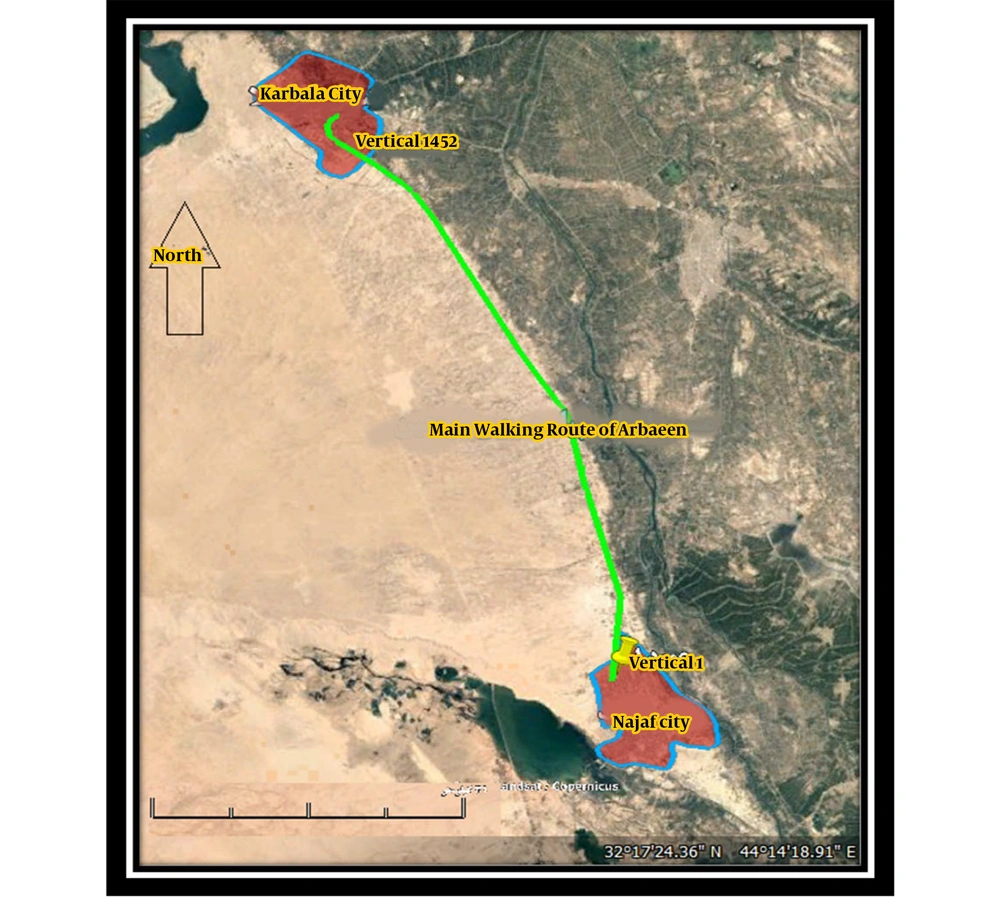
Figure 4.
Spatial photo map of the main walking route of Arbaeen
Based on Figure 5, which illustrates the map of sustainable and temporarily developable space for short-term and long-term planning, it can be concluded that approximately 206 square kilometers (yellow area in Figure 5) in the west of Karbala city, due to its proximity to Rezazeh Lake located between the Karbala and Anbar provinces, and about 60 square kilometers (yellow area in Figure 5) in the west of Najaf city, due to its proximity to Najaf Lake, should be allocated for sustainable development in long-term planning. Additionally, the temporarily expandable space with short-term objectives (grey area) is shown in the figure. Unlike the lands on the eastern side of the pedestrian route, which have reached saturation in terms of geographical space, the mentioned area can be utilized and developed to support the expansion and development of Arbaeen Hosseini.
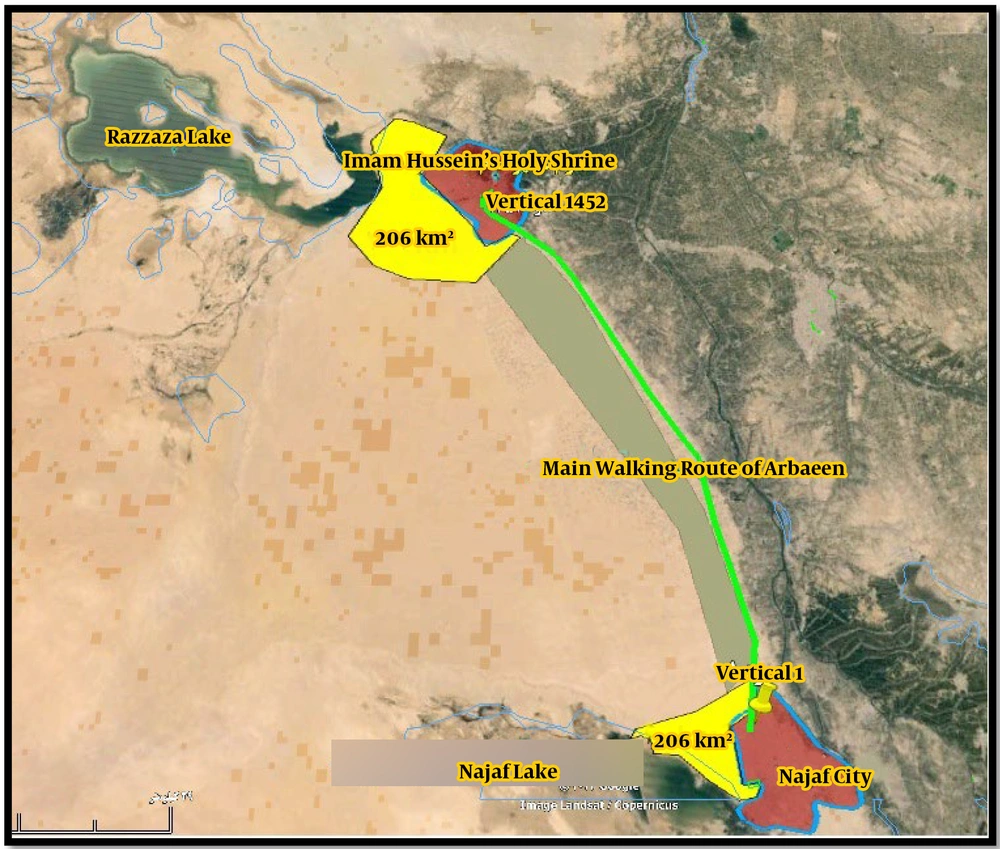
Figure 5.
Sustainable and temporary developable map for short-term and long-term planning in Arbaeen Hosseini
Figure 6 illustrates the spatial position of the studied area within the Holy Mosque, including the location of the observation tower and other measurements. Based on the measurements, the distance between the two shrines, where the maximum population density during Arbaeen is observed, is approximately 378 meters. This distance was determined using the measurement tool in the software, as indicated in the black box at the bottom of the figure below.
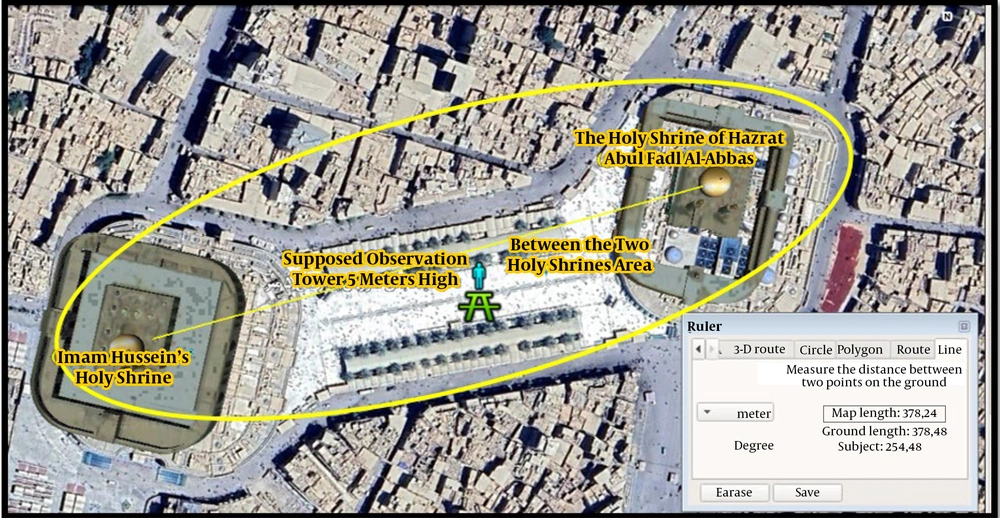
Figure 6.
The location and spatial shape of the Holy Shrine of Imam Hussein (AS) and the Shrine of Hazrat Abbas (AS) and the position of the observation tower located between the two shrines along with other measurements
In this research, we aim to determine whether a Guardian placed at a height of 5 meters in the holy city can effectively control and protect certain areas, as well as identify which areas are outside their control or constitute blind spots. This question is addressed through a spatial analysis known as a field of view map. According to the field of view map generated in this research, all areas between the two shrines and the southern space, shown in green, can be controlled and monitored by the supposed Guardian at the shrine. However, the northern space and most of the southern door of the Holy Shrine of Hazrat Abbas (AS), along with a portion of the southern door of the Holy Shrine of Imam Hossein (AS), are out of the Guardian's line of sight and supervision. These areas are considered blind spots relative to the Guardian's position and are shown in gray on the map in Figure 7. These blind spots could potentially serve as entry points for vandals or enemies. It is emphasized that all results of this part of the research were calculated relative to the position and height (three-dimensional position) of the supposed Guardian in the Holy Mosque, represented by the dummy in the figure above.
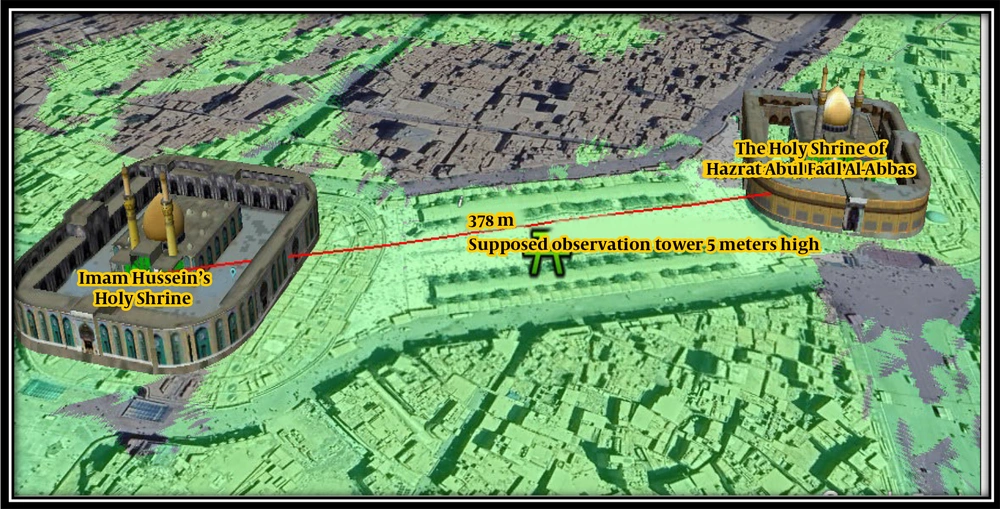
Figure 7.
Three-dimensional (3D) map of the field of view from a 5-meter high observation tower located in Bin al-Haramein. Visible areas are shown in green and non-visible areas are shown in gray
4. Conclusions and Suggestions
The field of view map is one of the most cost-effective methods for identifying visible points or blind spots. Blind spots often serve as potential penetration points for the enemy into important religious, administrative, military, and other strategic centers. By utilizing the field of view map, optimal management of monitoring and physical protection for such critical centers can be achieved. Additionally, the field of view map has applications in other areas, such as locating telecommunication masts, flight control towers, observation towers, and radio and television stations.
Based on the findings from the previous part of this research, it can be concluded that one of the key methods for managing and developing geographical space is the use of site selection and spatial analysis within geographic information systems. This approach can significantly enhance preparations for attracting religious tourists beyond previous efforts. Experience has demonstrated that restrictive methods, such as imposing travel limitations to holy shrines during special occasions like Arbaeen, cannot adequately address the substantial challenge of geographical constraints. Therefore, developing and managing geographical space is essential for facilitating large, unpredictable, and challenge-free gatherings in the future.
Moreover, based on the output maps in this research, it can be concluded that a three-dimensional field of view map is more effective for understanding the concept of visibility analysis than traditional two-dimensional analyses. For instance, as shown in Figure 7, preparing a 3D map provides critical visibility insights for managers and decision-makers, offering an informative, straightforward, and practical understanding.
It is recommended to use additional space-based software (e.g., QGIS, Global Mapper) to prepare the field of view map and compare the outputs of these models. This approach allows for an understanding of their differences and similarities, as well as their respective advantages and disadvantages. Lastly, to focus on location intelligence, the software ENVI is highly useful. This software enables various spatial analyses, such as site selection, to support optimal management of Arbaeen.