1. Background
The present study aimed to investigate the experienced knowledge of healthcare services during the pilgrimage of Imam Hussein in Iraq. By responding to questions such as "What is your understanding of the congregation during these ceremonies?" and "What has been your experience with healthcare services? What healthcare services did people use?" we will attempt to answer these questions by contacting the leading writers of sermons, preachers, and individuals who have participated in these ceremonies over the years (1-3). There are many ceremonies to mourn Imam Hussein, including Muharram al-Haram and Safar al-Haram, as well as visits to the holy shrine of Imam Hussein during these days marking the fortieth day of the martyrdom. Large numbers of people attend these ceremonies, especially in Mid-Muharram and Safar of the ritual. The Mid-Muharram ceremony is called Arbaeen, the fortieth day after the martyrdom of Imam Hussein in Arabic. Arbaeen is one of the goals of the pilgrimage, the peak of the fortieth day after the martyrdom of Imam Hussein. It is here that the pilgrimage to Imam Azam reaches its target (4, 5).
There are several pilgrimage sites for pilgrims to Imam Hussein, two of which are of particular importance. The first is the pilgrimage and pilgrimage site, and the second is the sacred place. Participation in known sites for personal participation, religious charity, and proximity to God are important. However, the shrine of Imam Hussein does not only have religious and spiritual meanings. During the uprising, only the smallest group of companions and relatives of Imam Hussein were killed, and after the completion of the kidnapping, ISIS did not win the holy place of Imam Hussein. After the battle with ISIS began, the psychology of soldiers and security forces affected the willingness and power of commanders to continue the battle, knowing that Imam Hussein's presence gives them courage and strength. The same studies were of interest to the healthcare staff who accompanied him. The researchers were present every day at the site to collect data using tools such as observation and field notes. Data was collected through eleven written and four oral interviews with participants, including Yazidi activists in London, England, healthcare providers in Saudi Arabia close to the place of pilgrimage, and researchers and university professors living in Iran who studied the pilgrimage. The data was analyzed using content analysis techniques and then validated using method criteria developed by Reifferscheid and Werthen (2014). The results of the aforementioned factors in the subsequent research resulted in the main decision of the researchers to conduct this new research in the pilgrimage field. It should be noted that the importance of conducting this research is due to the interests and requests of the pilgrimage participants, and we hope that the results of this research help healthcare staff provide services during the pilgrimage period and also help plan and manage several pilgrimage sites related to pilgrims. The data that will be derived is general to other places of pilgrimage (6, 7).
1.2. Literature Review
Pilgrimage is an existential journey that helps people find meaning in life, away from everyday life. For many Shia Muslims, visiting Imam Hussein’s shrine in Karbala, Iraq, is considered the pilgrimage of a lifetime. Each year, more than 30 million pilgrims from various backgrounds and languages visit the holy shrine that hosts Ashura-related rituals. With millions of pilgrims attending annual ceremonies, Karbala’s border attendance may reach up to 25 million pilgrims at one time; this raises concerns about the emergency response capacities in case of natural or man-made disasters, especially given that a significant number of pilgrims are elderly and young people who may experience re-stratification issues during the journey. Despite the social, religious, and psychological benefits of participating in such rituals, attending these crowded ceremonies has limitations, including, but not limited to, health and safety risks as well as security, logistical, and health-service-related challenges (8, 9).
The healthcare service provision system is one of these essential systems. Emergency response capacity is crucial for the yearly gathered pilgrims who attend despite a range of social, economic, region-specific, and pilgrimage-specific concerns. Times of crisis, such as the COVID-19 pandemic, have highlighted the importance of the healthcare system during large religious activities. Individuals from different backgrounds who believe in different ideologies may be present, with language barriers further challenging communication processes. To ensure the safety of such a large group of musafirs, an immediate emergency response should be available. However, this type of organization demands careful planning, and the success of the emergency response depends on the implementation of plans as well as coordination among involved organizations. Additionally, the role of cultural and religious beliefs and the religious aspects of the pilgrims should not be neglected. In light of these data, we planned to clarify what kind of strategy was developed in the actual service provision system and to understand the role of religious and cultural beliefs affecting the community and the musafirs. This clarification will particularly support the establishment of a planned collaborative service delivery system for possible emergency responses to the pandemic’s current and future challenges. Therefore, this study evaluates the provision of healthcare services and emergency responses during the pilgrimage in non-Wahhabi ziyara centers via a qualitative approach (10-13).
1.3. Healthcare Services in Religious Pilgrimages
It is necessary for every country to provide the best healthcare services comprising all approved healthcare measures for their citizens. Iran is a pilgrim-receiving country, and every year millions of religious pilgrims, intending to visit several religious shrines, including the shrines of Ahl al-Bayt in Iran and Iraq, enter and exit the country. According to statistics, the pilgrimage to the shrine of Imam Hussein in Karbala is the greatest religious ritual in the world. Various reasons, such as participation in religious ceremonies, the sense of reward and forgiveness, severance of attachment to life problems, and fulfillment of promises made in hardship situations, are among the motivating reasons. The performance of religious pilgrimages is a personal issue and relates to the beliefs and faith of the people, but it is necessary to provide essential healthcare during any non-communicable event to maintain the physical well-being of the religious pilgrims (14, 15). It is the primary official responsibility of the medical policyholder to ensure better healthcare during religious pilgrimages. Moreover, the Islamic Republic of Iran supports this policy and, with regard to religious pilgrimages, organizes the initial entry into Iraq and the return of pilgrims by providing police facilities and security at the borders to ensure a peaceful and secure pilgrimage. According to the new plans of the Iranian government, all necessary services, including providing health insurance, equipping and preparing the border medical centers, and implementing health educational programs, began six months before the starting date of the customs process.
2. Objectives
This study is the first to explore the special healthcare services and health-threatening situations benefiting from the particular religious places in the pilgrimage process to Imam Hussein's graveyard in Karbala and examine all the effective organizational problems. The results of the present study can serve as a basis for related officials to prepare further and respond appropriately to the essential situations of the religious pilgrims. The always-relevant cultural and social status of the site for Shi'is emphasizes that it could particularly apply for related purposes around the world.
3. Methods
From October 20 to November 2, 2018, we conducted a qualitative study at a temporary healthcare center located on the outskirts of Karbala, near the Mathaf Alqadimah (the old museum). The center is accredited by the Karbala Health Department and local NGOs (Iraqi and non-Iraqi), as well as the Medical Regional Operation Center (ROMED) from Najaf city, south of Iraq. It receives all patients regardless of nationality, with 55 to 75 medical and nursing workers. The main conditions treated by this health center include trauma, dehydration, food poisoning, dyspepsia, and communicable diseases (16-19). To quickly explore healthcare services and emergency response delivered to the patients during the pilgrimage, the research team posted posters at different places within the center and asked the patients or accompanying persons about their difficulties. We observed on-site healthcare performance, including refinement of access to healthcare, provision of healthcare services, and emergency response to evaluate whether medical and health teams were adequately prepared and had implemented an appropriate stance in case of patient overload (20, 21). To facilitate communication with the patient or accompanying person, an informed verbal consent form was first given and explained. At that time, the patient or accompanying person was asked to accept or refuse to use the information, and we agreed. The inclusion criteria were consistent with the standard operating procedures adapted by the medical relief division for service provision at health centers, secondary care clinics, and service centers during the season. The principle of the capacity was to admit all medical emergencies that could be managed and treated within the existing capabilities of the health center. The questionnaire was conducted by all investigators, including assistant medical and nursing workers. The data consisted of open questions, and the content was analyzed using thematic qualitative analysis assisted by the Lexicoder software package.
3.1. Research Design
In this qualitative study, we focused on understanding healthcare services and emergency response during the pilgrimage to the shrine of Imam Hussein in Karbala by Iraqi pilgrims. The study was carried out in Karbala. We used inductive content analysis to analyze the qualitative data obtained from a significant number of in-depth interviews (IDIs) with Iraqi pilgrims who had the opportunity to visit the shrine of Imam Hussein in Karbala. First, we shared the information with the interviewee and began asking open questions based on the study objectives, trying to ascertain as much as possible of their experiences and perspectives. Moreover, data were collected after obtaining verbal consent from every participant before the in-depth questioning. We chose interview locations such as walking paths, restaurants, and other recreational areas to minimize disturbances or distortions during the interviews. Data were analyzed thematically using open, axial, and selective coding (22-26). Reflexivity was considered by the research team, which included individuals with experience in emergency response programs and a public health specialist who conducted the data collection and most of the data analysis. They were both very cautious during the data collection. The study was limited to finding healthcare services and the ambulance system in Karbala specifically during the pilgrimage to Imam Hussein from the pilgrims' perspectives. For a comprehensive understanding of services, service managers working for both governmental and non-governmental health sectors, in addition to pilgrims from other countries, should be included. Collecting data from other stakeholders would allow for identifying both gaps and opportunities in the healthcare services response for serving other pilgrimages.
3.2. Data Collection
The 77 acquired interview guides were used to collect data by conducting in-depth individual interviews. The first interview took place on the 2nd of Moharram 1441, while the last interview took place on the 28th of Safar 1441. Additional interviews were conducted only when new responses were not received. The interviews were held during all four altitudes of the pilgrimage, and each interview lasted between 15 to 60 minutes, as preferred by the interviewee. In cases of non-response within a few days, a maximum of two follow-up messages were sent to the participants as the final follow-up. Directed open questions were used for the interviews, with no time limitations on the dialogues, allowing for the development and asking of insightful and interesting questions. Moreover, conditions appropriate for the interviewee were observed, primarily by announcing the purpose and importance of the research and obtaining permission to record the interviews on a mobile phone. The interviews were conducted at popular locations such as Teke Meydan, the Iranian Health Ministry's daily food delivery site, health centers and hospitals in Karbala, the Iran-Iraq border, and the Mehran border terminal. For Iranian residents, interviews were conducted at Teke Meydan, and the Iranian Health Ministry Hospitality service provider was also targeted for interviews. Citizens of Karbala and Iraqi health officials and personnel were interviewed in places including health centers and hospitals around Hussein's holy shrine estate. The first and second authors conducted the interviews, alternating between Arabic and Persian. The purpose of the study and the permission for recording the interviews were introduced in the opening remarks, and participants were informed of their right to end the interview at any time.
3.2.1. Interviews with Pilgrims and Healthcare Providers
The data were analyzed step by step for both interviews. The researchers carefully reviewed the texts to distill meanings about and related to the role of healthcare services. In this qualitative content analysis, the process of data collection and coding was repeated iteratively for each of the interviews. This researcher triangulation was performed to ensure content consistency. Disagreements were presented to the participants to fit the emerging qualitative responses. This concept or theme under consideration was then discussed with previous research and further developed and refined. Repeating this process, with further consultation with additional students and specialists in the area, either revealed the variability in the situation described or a possible convergence of attitudes and behaviors (27, 28). During two months of conversations, social events such as religious feasts, and gatherings in the holy shrines and their neighborhoods, we conducted informal and semi-structured IDIs with pilgrims on a regular basis. These regular conversations allowed us to seek a consensus on key themes and to process the information in a cyclical methodology for research agreement. Topic by topic, we talked with pilgrims, and by comparing their responses and adding further interviews and physical inquiry trips, we attempted to increase our understanding. Concurrent data collection and qualitative thematic analysis of the collected data then enabled us to identify the point of saturation in the emergent themes (29, 30).
3.3. Data Analysis
The posts on social media received via the hashtag #AskHussein were entered into a program called HyperRESEARCH software, which was used to trace and manage the data. Two standard content analysis methods of deductive and inductive were deployed. Accordingly, the textual content was analyzed by manually encoding each transcribed interview, under what first emerged, which was then subjected to a separate approach for theoretical reflection and conceptualization. By using this content analysis method, a selective data-driven principle was applied. Data coding included both deductive and inductive approaches. Examples of deductive coding are related to specific research questions and consist of the number and nature of healthcare inquiries received and emergency events experienced. The inductive coding process assisted in identifying new areas of focus, new characteristics of the theme, and newly formed categories, painting a broader picture. Data analysis was conducted in Arabic, where initial themes emerged, and a final translated version was used for the study. The data were analyzed in continuous periodic stages to ensure analytical rigor and depth. Engaging in classic content analysis enabled the researchers to transform text data into themes, extracting meaning patterns reported from the respondents. Regular meetings were conducted where transcribed interviews were discussed, and the integration and synthesis of emerging themes were undertaken. Additionally, two independent researchers read and reread the entire translated data to familiarize themselves and summarize the overall educational contact themes. Then, with pen and paper, the interviewees' responses were manually coded. Upon completion, during the second phase of analysis, the researchers refined the first code into broader themes, which may have included various subcategories. The process concluded with the final iteration.
3.3.1. Qualitative Coding
The main bulk of analysis on the transcripts was qualitative in nature. Codes were mostly defined based on the interviews and literature. Initial codes for analysis were developed through the reading of two selected posts, allowing for familiarity with the data. The data included issues related to emergency care in the event of any type of unwanted accidents. The considered data indicated that for all countries, the vast majority of the data were on researchers and especially for qualitative codes for this study; opinions of national societies. To ensure that no relevant data were overlooked, one researcher read and re-read the transcripts, literature, and field notes. Each sentence in the final transcripts was considered a data point to record. Text was then broken down into smaller text units in this work. Strategies for helping people were evaluated in multiple stages, and notes were taken where themes were discovered. At the initial stage, different qualitative assertions were also noted by researchers (1, 31). The qualitative assertions include reliability in care quality, harm reduction in care, "Making a pact to do no harm and help people survive", and the conversion of collective notions with the help of implemented jurisdiction and authority. According to the results, urgent improvements needed include redesign and leadership issues in emergency department care for locals. Accessibility is important in healthcare emergency services. Efforts in emergency department networks were defined as operations. Local inhabitants see easily accessible care as an empowerment example. In Appalachia, consideration of the meaning of emergency care for a 28-year-old insured woman underlies variations in the relationship between locals and hospital administrators. During ambulance emergencies, response data collection is difficult. As hospital units have patterns that cluster emergency responses in attempts to reduce variation, Hernandez, throughout discussions about the effects of timeliness, the hospital administrator, acknowledges variability among patients.
4. Results
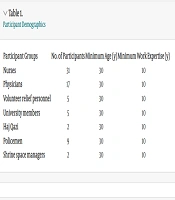
This study was the first qualitative research on pre-hospital services during Aashura and Sham-e-Ghareeban. The results of this study provide a deep understanding of the healthcare services, experiences, challenges, and strategies of the emergency medical services (EMS) in Karbala during Aashura and Sham-e-Ghareeban that have not been adequately studied. The main theme and two sub-themes emerged from the experiences of participants in providing and receiving pre-hospital services. The main theme presents "at the moment of humanity", with sub-themes including "value provided" and "emergency shelter". In this study, the participants for experience exchange have been introduced as the first qualitative study on the subject of pre-hospital emergency care. For a full understanding of the issue and to determine the challenges and strategies in providing services, more qualitative studies are suggested (Tables 1 and 2).
Table 1.
Participant Demographics
| Participant Groups | No. of Participants | Minimum Age (y) | Minimum Work Expertise (y) |
|---|---|---|---|
| Nurses | 31 | 30 | 10 |
| Physicians | 17 | 30 | 10 |
| Volunteer relief personnel | 5 | 30 | 10 |
| University members | 5 | 30 | 10 |
| Haj Qazi | 2 | 30 | 10 |
| Policemen | 9 | 30 | 10 |
| Shrine space managers | 2 | 30 | 10 |
Table 2.
Educational Level of Participants
| Educational Level | Criteria |
|---|---|
| Minimum | Bachelor's degree and higher |
Thirty-one nurses, 17 physicians, 5 volunteer relief personnel, 5 university members, 2 Haj Qazi, 9 policemen, and 2 shrine space managers participated in the present research. The minimum age of the subjects was 30 years, with at least 10 years of work expertise in the work environment as a condition for entrance into the research. The educational level of the interviewees was a bachelor's degree or higher. The meaning model was used to acquire data, and the regulation of Straussian was used for data-drawing. Data were collected via semi-structured interviews, and guided dialogue was employed in categories that required deeper inquiry. Data were examined using the seven stages of the Strauss-Corbin model. Themes such as guarding and clinic management, facing emergencies with diversity, emergency disaster timely dispatch and command center, training management, ethics-based and knowledge-centered actions, complete patient care, and kind hospital operations were extracted (Tables 3, 4 and 5).
Table 3.
Data Collection and Analysis Methods
| Methods | Descriptions |
|---|---|
| Data collection | Semi-structured interviews and guided dialogue |
| Data analysis model | Seven stages of the Strauss-Corbin model |
Table 4.
Main Theme and Sub-themes
| Theme | Sub-themes |
|---|---|
| At the moment of humanity | Value provided<br> emergency shelter |
Table 5.
Extracted Categories
| Categories | Descriptions |
|---|---|
| Guarding and clinic managing | Ensuring the safety and managing clinics during events |
| Facing emergencies with diversity | Handling various emergency situations |
| Emergency disaster timely dispatch and command center | Coordinating timely responses to emergencies |
| Training management | Managing and providing training for emergency personnel |
| Ethics-based and knowledge-centered actions | Focusing on ethical practices and knowledge in emergency care |
| Complete patient care | Providing comprehensive care to patients |
| Kind hospital operations | Ensuring compassionate and efficient hospital operations |
4.1. Overview of Healthcare Services During the Pilgrimage
Every year, millions of devotees visit Imam Hussein, and for a limited period, the holy shrines serve complementary purposes, including delivering free healthcare services. From the first day of Moharram, devotees begin to arrive in the city of Karbala, resulting in a substantial increase in the city's population from 1.2 to 5 million. During the extended ten days of Moharram, for 12 hours a day, all governmental, as well as some private healthcare facilities, provide health services to the visitors. Each team, working 24/7, consists of a physician, two nurses, an emergency medical technician, a primary care technician, a senior student, and a junior student. Each of the paramedics is equipped with automated portable and computer register software (8). Once the Iraqi government officials, in addition to local NGOs, perform significant financial activities to support large numbers of additional foreign independent healthcare teams, which provide healthcare services. The healthcare services include managing chronic diseases, wound dressings, mental healthcare, and life-threatening issues (e.g., cardiovascular diseases, daily life accidents, triage, and transportation of patients), in addition to dental healthcare. However, the healthcare services vary widely among different holy emergencies and official healthcare teams, while certain healthcare services were mainly dependent on international or national independent healthcare teams, which serve during the first day.
5. Discussion
This study was conducted to explore healthcare services and emergency response during the pilgrimage to Imam Hussein. Salient features of health issues, healthcare services, and emergency response during the pilgrimage to the Imam Hussein shrine in Iraq were explored. The IDIs were conducted with healthcare providers and pilgrim visitors (32, 33). Our study found several significant gaps in health services in the holy shrines and city, particularly in emergency services. The need for effective leadership and central direction, lack of reliable data and information in Kbusa city, limited public health research, lack of interagency cooperation and collaboration, inequality issues, and the need for community engagement on the matter were identified. However, these gaps will not be addressed unless adequate health infrastructure, resources, and resourced agencies and authorities are mobilized. Addressing the gaps in emergency response in this region is a problem of coordination and system thinking (1, 30, 34). The study identified actual or potential interagency conflict as a major health threat during the pilgrimage, resulting from poor coordination among governmental sectors and religious leaders. A triage system was shown to be associated with hospital specialty and demographic and health characteristics, such as gender, departing countries, leads to Riyadh, distance, and hospital utilization. The discussion provides insight that could be used to develop or implement strategies to effectively deliver health services to the community. The findings have clear implications for informing the development and implementation of community preparedness and continuity of government (COG) strategies to address the healthcare needs of this population during the pilgrimage, contributing to the existing evidence base on healthcare services. Clear protocols and strategies for addressing healthcare services are needed, as well as a clear band of authorities responsible for enacting them, as the lack of such direction was identified as a key contributing barrier to effective service delivery (30, 35).
5.1. Challenges and Improvements in Emergency Response
The findings of the present study also showed the necessity of informing the pilgrimage department staff and contractors on emergency response in the absence of emergency preparedness systems (EPSs). Lack of effective notification of reinforced EPSs in the event of emergencies was another reason for poor service utilization by pilgrims. Improving such measures as public boarding, allocating spaces to operational units, and installing a powerful audio system could help reach the target audiences and quickly manage the situation. Increasing equipment and identification tools and the need for emergency response and the number of EPSs have been an important concern of the Imam Hussein Shrine. Regarding the large number of visitors and the circumstances around the shrine, the relevant organizations, such as the Housing Foundation and the Holy Shrine Organization, need to review the related programs to not only arrange, build, improve, and enhance appropriate spaces and tools for the mentioned purposes but also explore new accompanying methods. The need for more awareness about the existence of the EMS program and its management was also taken into account to provide the necessary equipment and personnel (30, 34, 36).
The majority of the participants in this study believed that the lack of a design for the designated paths was problematic. There were pathways to the left and right of many of the entrances to the shrine, which individuals visited on the way to the main entrance. In many instances, fast movement down these pathways was blocked, such as by debris and the digi shops (the word "digi" is taken from a foreign language and means spiritual prayer), making evacuation difficult. The digi shops in the vicinity of the shrine's entrances were so close to each other that secretion of the residue without condensation, monitoring the visitors, and providing safe routes were problematic. The presence of barriers along with a whistle and warning bells could prevent many potential incidents. The pathways were also narrow closer to the shrines. Pilgrims who stopped to rest or made their way slowly made it difficult for those behind to pass, often leading to pushing and shoving and blocked pathways. Also, when describing pathways, it is crucial that they adhere to universal design guidelines. The need for more awareness about the existence of the design for pilgrims and its incorporation is necessary, as well as directives to improve the vicinities of the shrines.
5.2. Conclusions
The overwhelming number of pilgrims and visitors to holy sites causes mayhem and many challenges, particularly in Iraq. This research study was designed to explore the services and emergency response operations during the pilgrimage season from the beginning of Ramadan to the annual ceremony at Imam Hussein shrine in Karbala. The goal was to offer qualitative data to help these services effectively function through the insights of healthcare professionals during the season (37, 38). Interviewing healthcare providers highlighted special healthcare services available to accommodate and serve the health needs of the pilgrims visiting Imam Hussein shrine. Responses from the primary research questions, the types of new or additional patient services, as well as implications for the future of pilgrim care, were collectively analyzed using a qualitative method of exploring the topics and reviews of the researchers. Our study benefits from the proposition that its collective findings and suggestions can be utilized to improve healthcare services during the pilgrimage season in both Imam Hussein and Aba Al-Eltemeye. The results of the interviews provided strong evidence that even though physicians were the most common professionals to give healthcare services, many other professionals collaboratively provided healthcare services. Considering the continuous yearly increase in the number of pilgrims during Arba'een and the Ramadan months, along with the surge in the popularity of pilgrimage attendance of both able-bodied and elderly individuals, the provision of healthcare services is highly essential. Our research indicates the necessity of staff preparedness in such emergencies to efficiently manage and coordinate the health services provided to pilgrims.
5.3. Summary of Findings
The current study aimed to describe healthcare and emergency response during the pilgrimage of Imam Hussein from the perspective of cross-sectional analysis. During Ashura, the importance of religious events, visitors attending cities involved, unmet supply needs, poorly ventilated spaces, unsuitable nutrition, and inadequate health facilities are the most important factors during ceremonies due to the rendering of first aid services. These factors may put the health of people at risk, especially the most vulnerable, such as pregnant women, the elderly, and teenagers. Therefore, accurate recognition, planning, and health interventions are essential.
In this study, to explore healthcare and emergency response during the pilgrimage to Imam Hussein from the perspective of relevant experts, an exploratory qualitative study was carried out in Imam Hussein's holy shrine, general hospitals, and first aid centers that provide healthcare and emergency response to visitors. Participants were from various allied health service providers and were chosen by a purposeful sampling method with consideration of maximum variation. The major challenge in providing healthcare for these large crowds is the denial of assistance by some who prefer to depend on traditional and experimental resources. Lack of forecasting, assessment, and planning for potential threats can increase the risk of poor health and incidents during travel and ceremonies on pilgrimage.
The results of this qualitative study will result in creating, promoting, and preserving written knowledge in the area of religious tourism. The aim of the present study was to explore healthcare services provided for the participants and the facilitating factors and barriers during the pilgrimage to the Imam Hussein (PBUH) holy shrine. This is the first qualitative study that uses a second-hand data analysis approach to explore healthcare and emergency response during a large pilgrimage. This research provides important insights into the contemporary healthcare and emergency response provided for the Arbaeen pilgrims from the perspective of allied healthcare service providers, as well as the facilitating factors and challenges they encounter.