Full Text
Full text is available in PDF
Authors
Background and Aims: We compared two treatment methods on patients with advanced prostatic carcinoma in two treatments groups: primary metastatic prostatic carcinoma and metastasized recurrent tumor after primary treatment.
Methods: A retrospective review was performed on a total 302 patients with distant metastases between 1986 and 1995: 146 patients with systemically recurrent prostate cancer (group 1) and 156 patients with primary metastasized carcinoma (group 2). In each group the patients were treated by chemo-hormonal therapy or only by hormonal therapy. In Group 1 patients were treated with hormone deprivation alone by fosfestrol (n=68) and a combination of polychemotherapy and fosfestrol (n=78). In Group 2 only hormonal treatment had 62 (39.7 %) and a combined chemo-hormonal therapy had 94 (60.3%) patients. The patients were also grouped by the load of metastases, in low (< 5 metastases), intermediate (> 5 metastases confined to one organ or skelet) and high (multiorgan metastasis).
Results: A statistically significant prolonged survival was found in Group 1 patients treated with chemo-hormonal therapy compared to the patients treated with hormonal therapy alone. The median survival in the chemo-hormonal group was 24.5 months compared to 8 months in hormone group (p < 0.0001). The amount of metastases did not change the significant disease specific survival advantage of the combined chemo-hormonal treatment. The same significant survival advantage was demonstrated in Group 2 for the combination treatment compared to estrogen treatment alone. The median overall survival in the chemo-hormonal group was 25 months, compared to the 10.5 months for the patients treated with hormone ablation alone (p < 0.0001). This difference was also maintained after stratification for tumor grade or metastasis load.
Conclusions: Chemo-hormonal therapy significantly prolonged overall and disease specific survival over hormonal therapy alone in recurrent metastasized and primary metastasized cancers. Combined chemo-hormonal treatment should be started early in metastasized cancer, before the outgrow of hormone refractory tumor cell clones.
© 2010, Author(s). This open-access article is available under the Creative Commons Attribution 4.0 (CC BY 4.0) International License (https://creativecommons.org/licenses/by/4.0/), which allows for unrestricted use, distribution, and reproduction in any medium, provided that the original work is properly cited.
Ghafoori M. Imaging Evaluation of Recurrence in Treated Prostate Cancer. I J Radiol. 2014;11(30th Iranian Congress of Radiology):e21413. doi: https://doi.org/10.5812/iranjradiol.21413
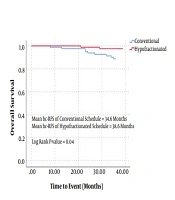
Rakhsha A, Mofid B, Yousefi Kashi AS, Taghizadeh-Hesary F, Sajjadi rad M. Comparison of Survival Between Hypofractionated and Conventional Radiotherapy in Clinically Localized Prostate Cancer: A Single-Center Retrospective Cohort. Int J Cancer Manag. 2020;13(7):e105762. doi: https://doi.org/10.5812/ijcm.105762
Saeidi Saedi H, Seilanian Toosi M, Mirsadraei M, Roodbari S. Evaluation of Prognostic Factors In Patients with Metastatic Breast Cancer. Int J Cancer Manag. 2008;1(3):e80475. doi:
Foroughi Moghadam MJ, Taheri S, Peiravian F. A Systematic Review of Clinical Practice Guidelines for Castration-Resistant Prostate Cancer. Iran J Pharm Res. 2018;17(Suppl):e124754. doi: https://doi.org/10.22037/ijpr.2018.2217
Saeedi Saedi H, Ghavam Nasir M, ShahidSales S, Taghizadeh A, Mohammadian N. Comparison of Hormone Receptor Status in Primary and Recurrent Breast Cancer. Int J Cancer Manag. 2012;5(2):e80803. doi:
More by these authors
Last Update: 1 month ago
Last Update: 1 month ago
Last Update: 1 month ago
Last Update: 4 days ago