Full Text
Full text is available in PDF
Authors
Background and Aims: The Doppler resistive index was advanced as a useful parameter for quantifying the alterations in renal blood flow that may occur with renal diseases. The presence of splenomegaly is very significant in the diagnosis of several groups of diseases: immunological, inflammatory, reticuloendothelial proliferations, storage diseases and portal hypertension. This prospective study is designed to investigate whether there is an effect of splenomegaly on renal resistive index value of extrinsically compressed left kidney by using renal Doppler US.
Methods: A total of 48 patients (22 male and 26 female) with splenomegaly (>130 mm) were evaluated by renal Doppler US examination. The etiologies and durations of splenomegaly were found to be different. Renal sphericity indices were calculated for demonstration of extrinsic compression (long axis/short axis). The resistive index values obtained via both compressed left kidney by splenomegaly and contralateral right kidney were measured. Mean values were calculated and difference of mean resistive index between both kidneys were compared.
Results: The sphericity indices were higher in compressed left kidney (mean +/-SD) (2.4 +/- 0.4) than contralateral normal side (2.3 +/- 0.3). The mean RI of the compressed and contralateral kidney were 0.67 +/- 0.5 and 0.65 +/- 0.4, respectively. The mean RI value of the left side is statistically higher than right side (p< 0.01).
Conclusions: During renal Doppler examinations it should be kept in mind that the extrinsic pressure caused by enlarged spleen may significantly alter renal RI measurements.
© 2010, Author(s). This open-access article is available under the Creative Commons Attribution 4.0 (CC BY 4.0) International License (https://creativecommons.org/licenses/by/4.0/), which allows for unrestricted use, distribution, and reproduction in any medium, provided that the original work is properly cited.
Ghafoori M, Shiva S. The Relation between Serum Creatinine and Renal Resistance Index in Parenchymal Kidney Disease . I J Radiol. 2007;4(2):e79115. doi:
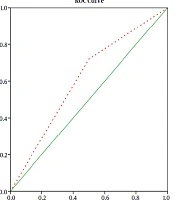
Jalili J, Tayebi Khosroshahi H, Shakeri Bavil Olyaei A, Gharebaghi B, Mostafavi S, et al. Using Ultra-Sonography in Acute and Chronic Renal Pathologies: A Cross-Sectional Study. Nephro-Urol Mon. 2020;12(1):e99396. doi: https://doi.org/10.5812/numonthly.99396
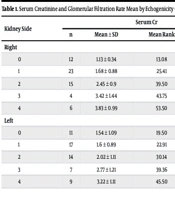
Dahmardeh H, Teimouri N, Sanei Sistani S, Alidadi A, Teimouri A. Correlation Between Ultrasound Findings and Serum Creatinine Level in CKD Patients. Zahedan J Res Med Sci. 2025;27(3):e162369. doi: https://doi.org/10.5812/zjrms-162369
Jalili M, Farshchian N, Siahmaki S, Rezaei M. Diagnostic value of kidney length and volume in sonography for determining kidney scar among infants with urinary infection. J Kermanshah Univ Med Sci. 2012;15(5):e79023. doi:
Zojaji S, Moradinejad S. Sonographic accuracy in diffuse renal parenchymal diseases. J Inflamm Dis. 2024;5(1):e154807. doi:
Last Update: 1 month ago
Last Update: 1 month ago
Last Update: 1 month ago
Last Update: 3 days ago