
1. Background
Heavy vocal demands that are in a relationship with a particular profession can increase the risk of facing voice disorders (1). Professional voice users are those whose voice’s efficiency, endurance, and quality can be considered the main tool in their careers, and if they face a vocal problem, their careers can be jeopardized (2). According to the results of a study conducted by Gottliebson et al., the rate of voice problems among future SLPs was 12%, which was similar to that of teachers, previously reported to be 11%. Therefore, compared with the general population (3% to 9%), future SLPs are more susceptible to voice disorders (3). Because speech therapy requires greater use of voice throughout the day and is very dependent on the therapist’s voice, speech language pathologists (SLPs) could be considered as professional voice users compared with other occupations (3). Clinically, phonation exercises, such as vocal warm-up exercises, are useful to the objective vocal quality and the vocal performance in future professional voice users training (4).
Semi-occluded vocal tract exercises and approaches aimed at reducing excessive tension on the vocal tract and facilitating resonant voice quality have long been done by therapists to therapeutic targets (5). Exercises of phonation in resonance tube are considered among semi-occluded vocal tract exercises that have been used for many years by singers for vocal warm-up, and in the recent years, have attracted much attention of scientists in the field of voice science. This exercise includes phonation through a tube whose distal part is placed in water, and by equalization of supraglottic pressure with subglottic pressure causes impedance matching and balancing of the source-filter. This balance reduces the vibration dose as well as vocal fold impact (collision) force and optimizes the vibration of vocal folds (6-8).
There are several methods to objectively evaluate vocal quality, and one of these is the “dysphonia severity index” (DSI). The ability to perform a multi-parametric evaluation has altered this index to one of the most valuable clinical tools for quantitatively describing voice disorders (9). The results of the index vary between +5 (for a perfect and perceptually normal voice without dysphonia) and -5 (for a severe dysphonia). Of course, this does not mean that the DSI between these 2 values is limited. A DSI of +1.6 was determined to be the cutoff for perceptually normal voices (10). The index can be used to compare vocal quality in different groups of people and evaluate the results of voice therapy and vocal training programs, such as vocal warm up exercises (11).
Therefore, the purpose of this paper was to examine the impact of phonation into tube exercise program to improve dysphonia severity index as an objective and quantitative correlate of perceived vocal quality and vocal fatigue at the end of a clinical training day.
2. Methods
2.1. Subjects
Participants were 11 speech therapy students (7 females and 4 males) of Ahvaz Jundishapur University of Medical Sciences that complained of vocal fatigue at the end of the clinical training day. The inclusion criteria were complaints of increased effort to talk or to sustain speech, feeling tired, and having a weak voice (12).
According to information of Van Lierde et al.’s study (2011) (4) that reported mean and standard deviation of DSI before and after vocal warm-up changes from 3.21 ± 2.14 to 4.7 ± 2.2, the following formula was used to calculate the sample size with α = 0.05 and β = 0.2 and total sample of 11 people:
The sample had an average age of 22.5 ± 1 and participated in this study at the end of a clinical training day. Inclusion criteria for this study were lack of smoking, and no history of neurological diseases and hearing defects. After enrolling in the study, the vocal tasks of DSI’s parameters were first recorded, and then phonation in tube exercise program was performed for 15 minutes. At the end, the objective assessment technique was repeated and perceptual self-evaluation of phonatory comfort was evaluated.
In this study, the immediate effects of phonation in tube exercise program were evaluated by dysphonia severity index (DSI) and self-evaluation of perceived phonatory comfort.
2.2. Measurement and Analysis
Voice samples were recorded in an acoustic anechoic chamber. Recordings were made on an external sound card (Steinberg UR-12) that was attached to a laptop with a microphone (model C-1; Behringer). A microphone was set at a distance of 10 cm from the mouth of each participant with an angle of 45 degrees.
In order to determine the effect of phonation in tube program on vocal quality, the DSI was used. Dysphonia severity index is an objective and quantitative correlate of perceived vocal quality. Before recording the vocal tasks, one of the authors, who was a speech therapist, explained the procedure of executing work for the participants and implemented it practically.
To calculate the DSI, each participant was asked to complete the following tasks (13):
Maximum phonation time (MPT): The participants were asked to take a deep inhalation and sustain the vowel / a / in the most comfortable pitch and loudness, according to the examiner’s hint, and after taking a deep inhalation, they continued phonation as long as they could. The MPT for each participant was measured 3 times by a stopwatch (Casio HS-3V-1BRD) and the highest obtained value was considered for analysis.
Highest frequency (F-high): After teaching the correct pattern of performing a high pitch voice to participants following the examiner’s hand, the participants were asked to begin sustaining the vowel / a / at a usual frequency. Then, they would go up to the highest pitch without increasing the intensity and producing the highest pitch that they could. Then, using the Praat software (developed by Paul Boersma and David Weenink from the University of Amsterdam, available for free use at http://www.fon.hum.uva.nl/praat/), the value of the highest frequency was entered in the final formula.
Lowest intensity (I-low): To calculate this parameter, the participants were asked to pronounce the vowel /a/ at a comfortable pitch and gradually reduce the sound before reaching whispering. After recording the sound, the lowest value was established using a decibel meter (UNI-T-UT353).
Jitter (%): The subjects were asked to sustain the vowel / a / in their most comfortable pitch and for at least 5 seconds and 3 consecutive times. Each repeated vowel was recorded at the sampling rate of 44.1 KHZ and 16 bits. The middle part of each record, lasting approximately 2 seconds, was analyzed using the Praat software, and the best value was considered for analysis.
The DSI was calculated using the maximum performances for F0 high and MPT, the lowest intensity, and the lowest jitter. The results were entered in the following equation (9):
2.3. Phonation into Tube Exercise Program
For each participant, 27-cm long and 9-mm diameter tubes, whose distal part was immersed 5 cm in water, were used (14, 15). For the tube to be kept in the desired depth, the tubes were marked. The participants were instructed to flow the airflow only through the tube and not through the nose or around the tube, and they were encouraged to use an abdomino-thoracic breathing pattern with as little neck tension as possible.
Each participant carried out these exercises for 15 minutes at 4 separate sets with a one-minute break between each, in order to prevent vocal fatigue (16):
A, Completing 10 pitch glides from the lowest pitch to the highest pitch and return to the lowest pitch of vocal range based on the vowel / u /.
B, Performing accent exercise through building hills of pitch and loudness for 5 to 7 times, using increased breath support.
C, Singing 10 short melodies (melody but no words) through the tube.
D, Reading 5 medium paragraphs (5 to 10 sentences) through the tube without articulation and only emphasizing prosody.
2.4. Self - Evaluation
For self-evaluation, immediately after the recording of the sample vocal tasks of DSI’s parameters after phonation in tube program, the participants were asked to express their feeling about the phonatory comfort: “Please focus on vocal tract comfort and tell us if you feel better, equal to or worse than before the exercises.” The participants did not have permission to recheck their previous recordings (6).
2.5. Statistical Analysis
In order to perform the statistical analysis, the SPSS version 17.0 software was used. Normality of quantitative variables was assessed using the Kolmogorov-Smirnov test. After ensuring normality of data of all parameters, the paired t-test was used to assess significant changes. P values of < 0.05 were considered significant.
3. Results
Results of the paired t-test showed that the variables MPT (P = 0.02), F-high (P = 0.001), i-low (P < 0.001), Jitter (%) (P < 0.001), and DSI (P < 0.001) before and after the phonation in tube program significantly changed, respectively.
The results of vocal evaluation before and after phonation into tube exercise program are given in Table 1:
Table 1.
The Result of Objective Assessment Techniques Before and After Phonation into Tube Programa
| Parameters | Pre-Phonation in Tube | Past-Phonation in Tube | P Value |
|---|---|---|---|
| MPT, s | 20.50 ± 2.38 | 22.60 ± 4.51 | 0.020b |
| F0High, Hz | 471.70 ± 124.89 | 527.30 ± 126.68 | 0.001b |
| ILow, dB | 51.80 ± 2.16 | 49.80 ± 2.02 | < 0.001b |
| Jitt, % | 0.42 ± 0.087 | 0.3 ± 0.088 | < 0.001b |
| DSI | 3.59 ± 0.63 | 4.82 ± 1.02 | < 0.001b |
aValues are expressed as mean ± SD.
bSignificance level < 0.05.
Self-evaluation after phonation into tube exercise program showed that most participants, i.e. 7 (64%), reported improved phonatory comfort, while 3 (27%) did not feel any changes in comfort and 1 (9%) reported less phonatory comfort after the phonation into tube exercise program.
4. Discussion
This research studied 11 senior speech therapy students (7 females and 4 males) with an average age of 22.5 ± 1, at the end of a clinical training day for the evaluation of DSI, and perceptual self-evaluation before and after the phonation into tube exercise program.
The first goal of this study was to investigate the effect of phonation in tube exercise program on the improvement of DSI, as an objective and quantitative correlate of perceived vocal quality at the end of a clinical training day. The results indicated a significant improvement in objective vocal quality after the phonation into tube exercise program. The DSI, as an objective multiparametric approach for measuring voice quality, after phonation into tube exercise program changed significantly from 3.59 to 4.82 (P < 0.001).
Changes in the value of DSI in this study are consistent with those found by Van Lierde et al.’s study (2011) (4). Vocal warm-up program in their study consisted of 3 stretching exercises and 7 vocal exercises within 30 minutes. However, the current study involved a 15-minute phonation into tube exercise program suggesting that we could also reach such good effect using this protocol in a shorter period.
In addition, in the present study, the jitter parameter significantly decreased (P < 0.001), and this finding is consistent with studies conducted on semi-occluded vocal tract exercises (17-19). In particular, it is consistent with Guzman et al.’s study (2016), where they studied the impact of depth of immersion of tube in the water on perturbation measures and concluded that immersion to a depth of 5 cm reduces jitter (19). According to previous studies, after vocal fatigue, jitter increases (20-22), which may be associated with a reduction in sensory-motor control (23). Thus, reducing jitter can be associated with improved sensorimotor control and reduced vocal fatigue (19, 23). Reduced jitter was not observed in Van Lierde et al.’s study (2011) because in their study, jitter significantly increased, and the authors argued that this difference may have been due to different methods of assessment, difference in time and content of warm-up exercises, and difference in the number of the participants in the study and their vocal background (4).
The second goal of this study was to evaluate the effects of phonation into tube exercise program on reducing vocal fatigue. One of the primary causes of vocal fatigue is long-term phonation, thus future SLPs, as professional voice users, are vulnerable to vocal fatigue. In particular, voice users, over time, face increase in phonatory effort that may be accompanied by decreased phonatory function. Perceived phonatory effort (PPE) was used as a subjective index of vocal fatigue (20, 24). According to Figure 1, self-evaluation after phonation into tube exercise program showed that most participants (64%) reported improvement of phonatory comfort. This finding is consistent with Paes et al.’s study (2013) concerning the effect of phonation into tube exercises for teachers with behavioral dysphonia (6). The increase in phonatory comfort by these exercises can be due to the impact of the exercises on releasing vocal tract tension (7, 25, 26).
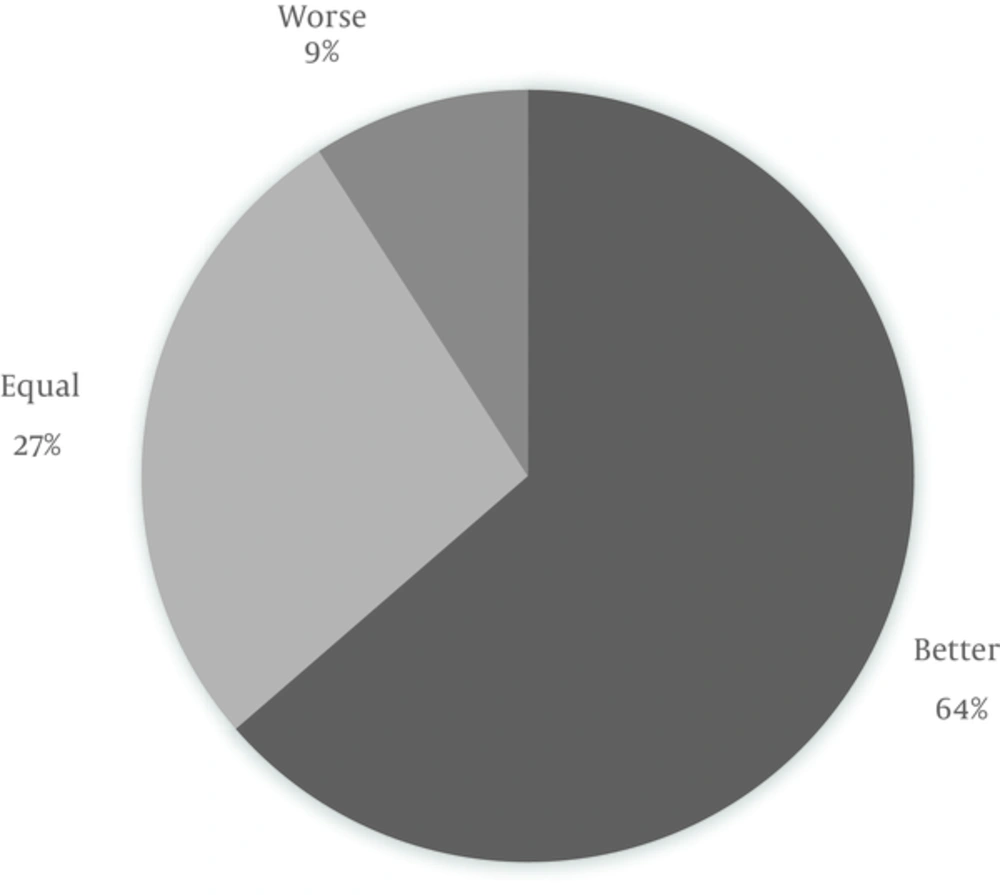
Figure 1.
Self- evaluation of phonatory comfort
Another goal of this study was paying more attention to the employed protocol. In this study, the researchers used the protocol introduced by Kapsner-Smith et al. (2015). In their study, they used this protocol with phonation in straw, which led to a significant reduction of roughness in auditory-perceptual evaluation, significant improvement in the score of the VHI, and improvement in the quality of life of subjects with mild to moderate dysphonia and/or vocal fatigue (16). Further research on the therapeutic effectiveness of this protocol is recommended, regarding the use of a straw or tube.
4.1. Conclusions
In the present study, phonation in tube exercise program was an effective protocol for increasing DSI, as an objective multi-parametric approach for measuring voice quality as well as increasing the perception of the phonatory comfort. The results of this study suggest that the phonation in tube exercise program may lead to an improvement of vocal quality and voice fatigue, which could be useful for future SLPs.