


1. Background
Afflicting more than one-third of males, premature ejaculation is the most common sexual problem (1). The main symptom of premature ejaculation is uncontrolled ejaculation before making sexual intercourse or within a few minutes after that with low levels of stimulation and contrary to the desire of the individual (2). Premature ejaculation can cause sexual dissatisfaction on both sides and it demonstrates the need for early referral for treatment and prevention of the consequences (3, 4). Currently there are many treatments for this problem that many of them are commercial drugs and are not approved by the world health organization (WHO).
2. Objectives
The current study aimed to compare the effects of tramadol (synthetic opioid that inhibits premature ejaculation by affecting opioid receptors in different systems) and fluoxetine (that selectively inhibits serotonin reuptake) on the treatment of males with premature ejaculation in order to identify the most effective drug with the least side effects.
3. Patients and Methods
In this randomized clinical trial, among the males referring to Booali and Chamran hospitals in Tehran, Iran, with premature ejaculation in 2013, 36 subjects were selected by random sampling after receiving the ethics approval and patient informed consent. Premature ejaculation was diagnosed by an urologist with 10 years of experience. Subjects were divided into two groups with 18 members. One group received 50 mg tramadol and another received 20 mg fluoxetine. Some previous studies reported safety of more doses of these drugs (100 mg for tramadol and 40 mg for fluoxetine) (5, 6). IELT was compared. Time of drug administration in both groups was 3 - 6 hours before sexual intercourse. Ejaculation time before treatment (average time of at least three sexual intercourses) and in the fourth week after treatment were measured by partner, continued until the 12th week. Patients were advised to record time from vaginal penetration to ejaculation.
The inclusion criteria were age range 22 - 62 years, the primary form of premature ejaculation, sexual intercourse with the partner more than six months and the ability to perform sexual intercourse at least once a week . Subjects with erection disorder, anatomic and organic disorders of the urinary-reproductive system, urinary-reproductive system infection, disruption of sex hormones, diabetes, chronic depression, physical or mental disorders, drug or alcohol abuse, use of psychotropic and antidepressant drugs, contraindications to fluoxetine or tramadol, having allergy to fluoxetine or tramadol, previous use of medication affecting premature ejaculation and lack of consent to participate in the study were excluded.
Individuals were asked to sign an informed consent form before answering the questionnaire. All the personal information remained anonymous. Data were analyzed using SPSS software, version 16 (SPSS Inc. Chicago, IL). Normal distribution variables (approved by one-sample Kolmogorov-Smirnov test) were compared using independent sample t-test between the groups and paired sample t-test within the groups. Chi-square test was also used to compare categorical variables in the two groups. P value < 0.05 was considered statistically significant.
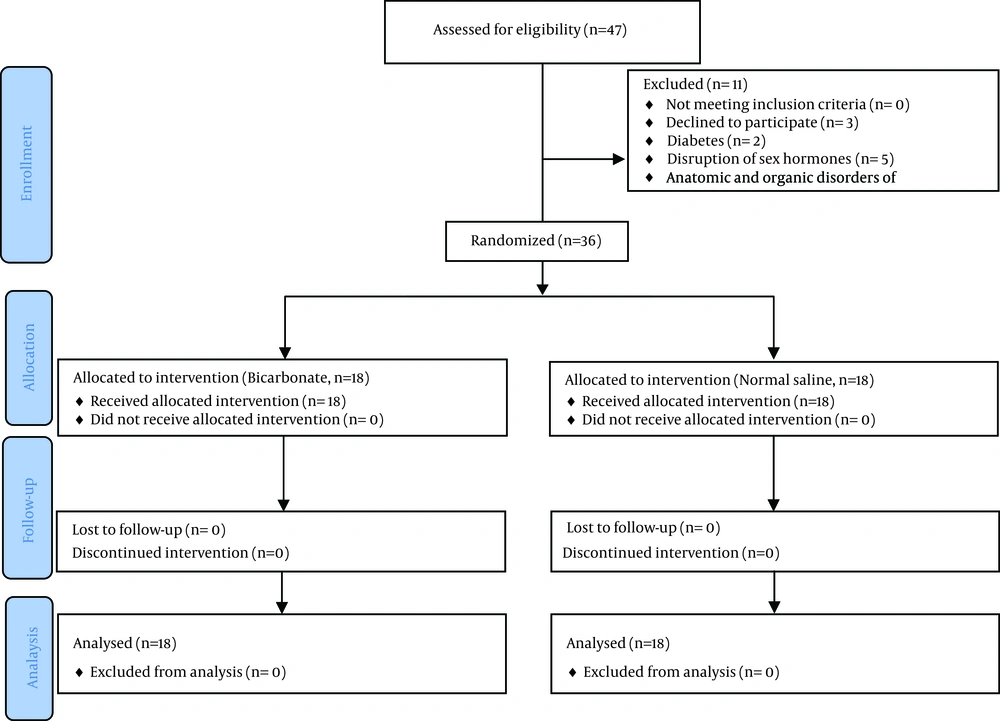
Figure 1.
Diagram of Clinical Trial
4. Results
Eventually 36 subjects with the mean age of 44 ± 19.3 years underwent analysis. Eighteen subjects were treated by fluoxetine and 18 by tramadol. Age distribution was similar in the two groups (P > 0.05) (Table 1). Subjects in both groups had similar educational distribution (P > 0.05); most of the subjects in both groups had college education.
Table 1. The Age Distribution of Subjects in Both Groups a
| Groups | 20 - 30, y | 30 - 40, y | 40 - 50, y | 50 - 60, y | > 60, y | Total |
|---|---|---|---|---|---|---|
| Tramadol | 5 (27.8) | 5 (27.8) | 4 (22.2) | 1 (5.6) | 3 (16.7) | 18 (100) |
| Fluoxetine | 5 (27.8) | 8 (44.4) | 3 (16.7) | 1 (5.6) | 1 (5.6) | 18 (100) |
| Total | 10 (27.8) | 13 (36.1) | 7 (19.4) | 2 (5.6) | 4 (11.1) | 36 (100) |
a Values are presented as No. (%).
The efficacy of treatment in the two groups showed no significant difference (P > 0.05); therefore, effectiveness of treatment was noted in 66.7% of the subjects treated by tramadol, while this value was 61.1 % for the other group (Table 2).
Table 2. Distribution of Treatment Effectiveness in Both Groups a
| Groups | Positive Efficacy | Negative Efficacy | Total |
|---|---|---|---|
| Tramadol | 12 (66.7) | 6 (33.3) | 18 (100) |
| Fluoxetine | 11 (61.1) | 7 (38.9) | 18 (100) |
| Total | 23 (63.9) | 13 (36.1) | 36 (100) |
a Values are presented as No. (%).
There was no significant difference between the two groups regarding intra-vaginal ejaculation latency time (IELT) (P > 0.05), but IELT in both groups had increased markedly with the same rate (Table 3).
Weekly frequency of sexual intercourse in the two groups showed no significant difference (P > 0.05). A majority of subjects in the two groups were listed to have more than two times of sexual intercourse a week (Table 4).
Table 4. Frequency of Weekly Sexual Intercourse a
| Groups | Intercourse Time | |||
|---|---|---|---|---|
| 1 Time | 2 Times | 3 Times | > 4 Times | |
| Tramadol | 33.33 | 38.89 | 22.22 | 5.56 |
| Fluoxetine | 27.78 | 44.44 | 27.78 | 0 |
| Total | 61.11 | 83.33 | 50 | 5.56 |
a Values unit is %.
5. Discussion
No significant difference was observed in terms of effectiveness and IELT between tramadol and fluoxetine groups; these findings are important because other factors were similar in the two groups.
Kendirci et al. (7) concluded that among selective serotonin transport inhibitors (SSRIs), paroxetine was most effective to treat premature ejaculation in males. In the current study, using fluoxetine before intercourse was effective in more than 50% of the subjects.
A review article showed that although SSRIs have a moderate effect on the treatment of premature ejaculation, there is no consensus on the type, dose, and duration of their treatment protocol. However, many types such as fluoxetine, sertraline, paroxetine and citalopram are widely used to treat premature ejaculation (8). This review article suggested performing other clinical trials to determine the best dosage of these drugs in males with premature ejaculation.
A review article concluded that paroxetine, fluoxetine, sertraline and citalopram significantly increase the ejaculation time in comparison with placebo (9). The current study considered a placebo, but fluoxetine was found as an effective agent to treat premature ejaculation.
Eassa and El-Shazly (5) concluded that 25, 50 and 100 mg doses of fluoxetine were effective to treat premature ejaculation and significantly increased IELT. In the current study, a dose of 50 mg showed good efficacy.
Salem et al. (10) studied 60 males with premature ejaculation who received 25 mg of tramadol , 1 - 2 hours before intercourse compared with placebo, and tramadol significantly increased the ejaculation time, confirming the results of the current study.
Khan and Rasaily reported that tramadol was more effective than placebo but no differences were observed between the continuous administration of tramadol and its use before sexual intercourse (11). Safarinejad and Hosseini (12) concluded that tramadol seems to provide significantly better results in terms of IELT and intercourse satisfaction versus placebo.
Wong et al. (8) concluded that more studies are needed in patients with premature ejaculation to compare tramadol with SSRIs in order to determine the therapeutic role of these two drugs to treat premature ejaculation, which shows the importance of studies similar to the current one.
In conclusion, tramadol and fluoxetine efficacy in males with premature ejaculation are the same and both are effective. Both of these drugs are safe to treat premature ejaculation. Finally further studies with larger sample sizes are suggested to confirm the results of the current study. Also it is recommended to determine the minimum effective dose of both fluoxetine and tramadol in future studies.
