1. Background
Medical students are exposed to a stressful environment during their academic career, which influences their physical well-being, psychosocial health and also their career (1). Formal mentoring programs are increasingly developed for academic medical settings (1, 2) aimed at improving personal development, career guidance, career choice, and research productivity (2, 3).
A strong mentor-mentee relationship exerts particular advantages for both mentors and mentees (1, 4). It improves the orientation of medical students toward the medical community and the future of their career. Such a relationship also improves their thinking and decision making skills. In addition, it helps to keep a balance between their personal life and professional career (2, 5).
Under the light of the available scientific evidence (6, 7), mentors and mentees are often matched by career function or some other career-related characteristics. Proper match-making significantly influences the satisfaction of mentorship and facilitates the achievement of mentorship goals (6, 8, 9). The guidelines of match-making might be based on several criteria such as the expertise, style, experience, availability, behavior, professional interest, personality, education, gender, motivation, and adaptation (6).
The importance of temperament-based mentor-mentee matching to link interns with their supervisors is indicated (9). There are controversial findings concerning the relationships between similar or dissimilar personality traits and a successful mentorship (10). Mentees tend to prefer mentors with shared cultural and personal similarities (11), though some degrees of dissimilarity in personality help the progression of mentees. It is observed that in the personality of mentors and mentees improve the grade average, school attendance, and social connectedness in comparison with similar personality matched pairs (8).
However, similar mentor-mentee temperament was associated with better teaching dyads (9). Altogether, insufficient attention is paid to personality-based match-making of 1st -year medical students and their mentors. A more in-depth examination of what attributes to the high-quality mentorship is necessary.
Therefore, the current prospective observational study aimed at investigating the relationships between satisfaction of 1st -year medical students with mentoring program and the mentor/mentee characteristics of temperament and character.
2. Methods
2.1. Description of Program
Mentoring program is one of the supportive schemes for the 1st-year medical students entering the School of Medicine, Tehran University of Medical Sciences (TUMS), since 2011. Participation in mentoring is optional, and students can register for the program by filling the forms, after a brief description of the program. Then, the registered students are assigned to mentors prepared to provide support and guidance in the technical fields of medical education and also concerning the psychosocial aspects. The current study was conducted on the 1st -year medical students in September 2012 TUMS, after they finished the mentoring program. Mentees and mentors were free to participate in this study.
2.2. Ethics
The protocols of the current study were approved by ethics committee of Tehran University of Medical Sciences (No. 1393-7-22-17). Concerning confidentiality, we used anonymous forms and questionnaires were used. The students participated voluntarily.
2.3. Procedures
All evaluations were performed 1 year after the initiation of mentoring. A self-report questionnaire was designed to evaluate the mentees’ satisfaction with the availability of mentors, their confidentiality and reliability, advising proper styles of studying particular subjects, motivation, helping for psychosocial adjustment during the 1st year of education and informing students about university programs and services. A translated version of the items of this questionnaire is provided in the supplementary Table 1.
Table 1.
The Mentees’ Satisfaction Questionnaire Items with Characteristics of Rotated Component Matrix Based on Exploratory Factor Analysisa
| Items | Scores | Latent Variables (Factors)b | |||
|---|---|---|---|---|---|
| Factor 1 | Factor 2 | Factor 3 | h2c | ||
| Availability | 4.65 ± 0.54 | 0.143 | 0.256 | 0.594 | 0.44 |
| Appropriate manner | 4.87 ± 0.34 | 0.187 | -0.016 | 0.797 | 0.67 |
| Confidentiality | 4.84 ± 0.37 | 0.020 | 0.179 | 0.770 | 0.63 |
| Patience | 4.77 ± 0.45 | 0.171 | 0.155 | 0.773 | 0.65 |
| Understanding | 4.46 ± 0.65 | 0.402 | 0.410 | 0.548 | 0.63 |
| Practicality of responses | 4.24 ± 0.73 | 0.547 | 0.440 | 0.413 | 0.66 |
| Feasibility of advice | 4.37 ± 0.59 | 0.636 | 0.239 | 0.360 | 0.59 |
| Encouragement and support | 4.43 ± 0.65 | 0.553 | 0.322 | 0.416 | 0.58 |
| Motivation | 4.09 ± 0.87 | 0.313 | 0.683 | 0.249 | 0.63 |
| Considering personal differences | 4.49 ± 0.60 | 0.390 | 0.611 | 0.299 | 0.61 |
| Following | 4.57 ± 0.63 | 0.497 | 0.194 | 0.378 | 0.43 |
| Feedback | 4.13 ± 0.82 | 0.777 | 0.178 | -0.008 | 0.64 |
| Stress coping | 4.21 ± 0.84 | 0.716 | 0.311 | 0.120 | 0.62 |
| Decision facilitating | 4.31 ± 0.74 | 0.581 | 0.564 | 0.173 | 0.69 |
| Independence | 4.39 ± 0.65 | 0.496 | 0.545 | 0.118 | 0.56 |
| Resources and references | 4.25 ± 0.83 | 0.733 | 0.206 | 0.181 | 0.61 |
| Learning styles | 4.13 ± 0.89 | 0.555 | 0.535 | 0.218 | 0.64 |
| Increasing self-confidence | 4.23 ± 0.83 | 0.246 | 0.781 | 0.266 | 0.74 |
| Adaptation | 4.25 ± 0.76 | 0.180 | 0.810 | 0.175 | 0.72 |
| Balance of activities | 3.89 ± 1.00 | 0.499 | 0.644 | -0.033 | 0.66 |
| Positive effect | 4.51 ± 0.65 | 0.129 | 0.536 | 0.526 | 0.58 |
| Initial eigenvaluesd | 9.911 | 1.958 | 1.118 | ||
| Rotation sums of squares | 4.660 | 4.562 | 3.765 | ||
| Percent of variance explained | 22.189% | 21.722% | 17.928 | ||
| Cronbach’s αe | 0.903 | 0.886 | 0.810 | ||
| Total satisfaction scores | 90.28 ± 25.88 | ||||
| Total variance explained, % | 61.839 | ||||
| Total Cronbach’s α | 0.940 | ||||
aExtraction method: Principal component analysis, Rotation method: Varimax with Kaiser normalization, Kaiser, Meyer-Olkin measure of sampling adequacy = 0.890, The Bartlett test of Sphericity χ2=1184.003; P < 0.0001.
bFactor 1: Usefulness of mentoring; Factor 2: Empowerment of mentees; Factor 3: Respectful behavior of mentors.
ch2 extractions: Final item communalities (row sums of squared loadings).
dEigenvalues: Pre-rotation column sums of squared loadings.
eCronbach’s α are reported for primary loadings of each factor (bold type).
The scores of temperament and character traits of mentees and mentors were determined by temperament and character inventory with 125 items (TCI-125 validated Persian version (12) expressed as a 5-point Likert scale from 1 (absolutely false) to 5 (absolutely true). The questionnaire has 4 dimensions concerning temperament (ie, novelty-seeking, harm avoidance, reward dependence, and persistence) and 3 dimensions of character (ie, self-directedness, cooperativeness, and self-transcendence). TCI rests upon the Cloninger psychobiological theory of personality, in which personality domains of moderately stable temperament traits and character are differentiated (13). TCI is validated in adult populations worldwide, including Iran (12).
The current study investigated the associations between mentees’ satisfaction and particular patterns in temperament and character. All questionnaires were placed in an envelope and sealed (a bigger envelope was used to collect the forms of the mentees of each mentor, and so for the mentor). The information of each mentor-mentee pair was analyzed later.
2.4. Statistical Analysis
Data are expressed as mean ± standard deviation (SD) for continuous variables, while the qualitative characteristics are shown as frequencies. The statistical analysis was performed by the Stata statistical package program version 13 (Stata Corp. 2013. Stata Statistical Software: Release 13. College Station, TX: Stata Corp).
To analyze the results of the TCI-125, both crude scores and t scores according to the normative data of Iranian population (12) were employed. The internal consistency reliability of scales was determined using Cronbach’s alpha. For dimension reduction, the exploratory factor analysis was used, considering the adequacy of the sample size (Kaiser-Meyer-Olkin (KMO) > 0.8) and the Bartlett test of sphericity. Principal component analysis was conducted and the Bartlett factor scores were recorded for further analyses. Linear regression analysis and logistic regression were used to obtain the prediction models of mentees` satisfaction.
For a better elucidation of non-linear multivariate association of TCI-125 in the correct prediction of the highest (Q4) and lowest (Q1) quartiles of mentoring satisfaction, artificial neural networks (ANN) were conducted with radial basis function analysis using SPSS 20 (SPSS, Chicago, IL, USA). A P-value of less than 0.05 was considered statistically significant.
3. Results
From a total of 150 first-year medical students who voluntarily participated in the mentoring program during September 2012 - 2013, 99 first-year medical students (59.6% female) with mean ± SD grade point average of 16.09 ± 1.27 (the maximum score in Iranian education system is 20) were enrolled in the current study. Every 11 mentees were in contact with 3 mentors (mentee/mentor ratio: 3.67). The mentees and mentors were gender-matched. The housing status of mentees and mentors were not significantly different; therefore, the majority of them were living in the dormitory (67.78%) or with their families (21.21%). Most of the mentees had academic grades D (40.4%) and B (34%), but only 17% of them had an A grade.
The number of annual mentoring sessions was more than 15 sessions according to 42.1% of mentees, 10 to 15 sessions for 34.7% mentees, 5 to 10 sessions for 22.1% of mentees, and less than 5 meetings only for 1 mentee. Moreover, 96.5% of mentees reported that the frequency of the mentoring meetings was sufficient. The sum of Likert-scale scores (1 to 5) of the mentees’ satisfaction questionnaire (21 items) was calculated as total satisfaction score of 90.28 ± 25.88.
The crude item scores of mentees’ satisfaction questionnaire and the structural characteristics of the questionnaire are displayed in Table 1. Excellent internal consistency reliability was observed in the mentees’ satisfaction questionnaire (Cronbach’s α = 0.940). KMO measure of sampling adequacy of 0.890 and significant the Bartlett test of sphericity (P < 0.0001) were employed to run the exploratory factor analysis. Rotated component matrix was obtained based on varimax rotation with Kaiser normalization displayed in Table 1.
In dimension reduction, 3 latent variables were discovered with good variance explaination (cumulative ~ 62%). Based on the items of each factor, the variables were named as usefulness of mentoring, empowerment of mentees, and respectful behavior of mentors. The Bartlett factor scores of these 3 variables were computed and used in the subsequent analyses.
The trait scores of mentees and mentors are shown in Table 2. Neither mentees nor mentors showed extreme levels of TCI scores or features of personality disorders. Mentors showed significantly higher persistence and self-directedness (P < 0.01) compared to mentees, while the novelty-seeking of mentees were slightly greater than that of mentors (Table 2).
Table 2.
The Temperament and Character Inventory Scores of Mentees and Mentors
| Temperament Traita | Mentee | Mentor | Paired-Statusb | P Valuec |
|---|---|---|---|---|
| Novelty-seeking | 8.94 ± 3.05 | 7.76 ± 3.95 | Mentee > Mentor | 0.012 |
| Low/medium/high, % | 2/92.9/5.1 | 7.5/81.3/11.2 | ||
| Harm avoidance | 9.05 ± 4.26 | 9.06 ± 5.07 | Mentee ⋚ Mentor | 0.433 |
| Low/medium/high, % | 1/95.9/3.1 | 0/92.5/7.5 | ||
| Reward dependence | 9.61 ± 2.37 | 9.44 ± 2.29 | Mentee < Mentor | 0.044 |
| Low/medium/high | 2/88.8/9.2 | 0/92.5/7.5 | ||
| Persistence | 3.20 ± 1.63 | 3.10 ± 1.74 | Mentee < Mentor | < 0.001 |
| Low/medium/high, % | 0/100/0 | 0/100/0 | ||
| Character Traitsa | ||||
| Self-directedness | 14.52 ± 4.06 | 15.52 ± 4.97 | Mentee < Mentor | 0.003 |
| Low/medium/high, % | 8.2/91.8/0 | 11.2/88.8/0 | ||
| Cooperativeness | 17.45 ± 3.59 | 17.74 ± 4.01 | Mentee ⋚ Mentor | 0.094 |
| Low/medium/high, % | 10.2/89.8/0 | 11.2/88.8/0 | ||
| Self-transcendence | 9.59 ± 3.26 | 9.82 ± 3.09 | Mentee ⋚ Mentor | 0.092 |
| Low/medium/high | 1/82.7/16.3 | 0/85/15 |
aData are expressed as mean ± SD for crude scores, while the low/medium/high scores based on t scores are reported as frequencies.
bThe comparison of traits of mentees and mentors are displayed > denotes higher, < denotes lower, and ⋚ denotes neither of them.
cWilcoxon signed ranks test.
Table 3 shows the multivariate linear regression analysis to predict mentees’ satisfaction scores based on TCI-125 scores of mentees and mentors. The mentee cooperativeness and mentor novelty-seeking were positively correlated with the total satisfaction score. When the novelty-seeking of mentors was higher than that of mentees, the overall satisfaction was greater. On the contrary, for pairs of mentees with higher self-transcendence in comparison with the mentors, a higher score of satisfaction was achieved. Interestingly, similar harm avoidance was significantly associated with reduced satisfaction (Table 3, A. Total satisfaction).
Table 3.
Stepwise Multivariate Linear Regression Models to Predict Satisfaction from Mentoring Program Using the Temperament and Character Inventory of Mentors and Mentees
| Models | Unstandardized Coefficients | P Value | 95.0% Confidence Interval for B | |||
|---|---|---|---|---|---|---|
| B | Std. Error | Lower Bound | Upper Bound | |||
| A) Total satisfaction | ||||||
| R2 = 0.131 | (Constant) | 46.776 | 12.537 | < 0.001 | 21.889 | 71.662 |
| Mentee CO | 1.910 | 0.694 | 0.007 | 0.532 | 3.288 | |
| Mentor NS | 1.296 | 0.600 | 0.033 | 0.105 | 2.487 | |
| R2 = 0.274 | (Constant) | 85.517 | 3.481 | < 0.001 | 78.606 | 92.428 |
| NS mentor > mentee | 10.734 | 5.018 | 0.035 | 0.772 | 20.697 | |
| ST mentee > mentor | 12.458 | 4.818 | 0.011 | 2.893 | 22.023 | |
| HA mentor = mentee | -40.648 | 8.956 | 0.000 | -58.428 | -22.868 | |
| R2=0.372 | (Constant) | 46.547 | 11.239 | < 0.001 | 24.229 | 68.864 |
| HA mentor = mentee | -38.847 | 8.427 | < 0.001 | -55.581 | -22.112 | |
| Mentor impulsiveness | 3.700 | 1.311 | 0.006 | 1.096 | 6.304 | |
| Mentee sentimentality | 3.879 | 2.017 | 0.058 | -.127 | 7.884 | |
| Mentor spiritual acceptance | 6.061 | 1.991 | 0.003 | 2.109 | 10.014 | |
| ST mentee>mentor | 14.045 | 4.856 | 0.005 | 4.402 | 23.687 | |
| B) Usefulness of mentoring | ||||||
| R2 = 0.046 | (Constant) | -0.090 | 0.104 | 0.389 | -0.298 | 0.117 |
| PER mentor = mentee | 0.560 | 0.260 | 0.034 | 0.044 | 1.075 | |
| R2 = 0.088 | (Constant) | -0.379 | 0.158 | 0.018 | -0.692 | -0.066 |
| NS to HA ratio of mentee | 0.295 | 0.097 | 0.003 | 0.102 | 0.488 | |
| C) Empowerment of mentees | ||||||
| R2 = 0.051 | (Constant) | -0.780 | 0.355 | 0.031 | -1.485 | -0.074 |
| SD mentee | 0.054 | 0.024 | 0.025 | 0.007 | 0.101 | |
| R2 = 0.103 | (Constant) | -0.336 | 0.137 | 0.016 | -0.609 | -0.063 |
| ST mentee > mentor | 0.514 | 0.199 | 0.011 | 0.119 | 0.909 | |
| NS mentor > mentee | 0.508 | 0.204 | 0.014 | 0.104 | 0.913 | |
| D) Respectful behavior of mentors | ||||||
| R2 = 0.092 | (Constant) | -0.554 | 0.200 | 0.007 | -0.952 | -0.157 |
| NS mentor | 0.071 | 0.023 | 0.002 | 0.026 | 0.115 | |
| R2 = 0.050 | (Constant) | -0.436 | 0.215 | 0.046 | -0.864 | -0.009 |
| NS to RD ratio of mentor | 0.508 | 0.226 | 0.027 | 0.059 | 0.957 | |
>Abbreviations: CO, Cooperativeness; HA, Harm Avoidance; NS, Novelty-Seeking; PER, Persistence; RD, Reward Dependence; SD, Self-Directedness; ST, Self-Transcendence.
Moreover, the predictors of subscales of satisfaction including the usefulness of mentoring program (Table 3, B. Usefulness of mentoring), empowerment of mentees (Table 3, C. Empowerment of mentees), and respectful behavior of mentors (Table 3, D. Respectful behavior of mentors) were observed.
Multivariate binary logistic regression was also performed to find the most important factors related to the highest quartile (Q4) of mentoring satisfaction compared to the lowest one (Q1). Higher scores of novelty-seeking to reward dependence ratio of mentors were significantly associated with a Q4 satisfaction (Table 4).
Table 4.
Multivariate Binary Logistic Regression Models for the Prediction of Highest Quartile of Mentoring Satisfaction Compared to the Lowest Quartile, Using the Temperament and Character Inventory of Mentors and Mentees
| Variables | OR | P Value | 95% CI | Model Accuracy |
|---|---|---|---|---|
| NS to HA ratio of mentor | 1.29 | 0.816 | 0.16 - 10.63 | Pseudo R2 = 0.436 |
| NS to HA ratio of mentee | 1.82 | 0.660 | 0.13 - 26.40 | |
| NS to RD ratio of mentor | 37.73 | 0.029 | 1.46 - 973.13 | |
| NS to RD ratio of mentee | 0.12 | 0.140 | 0.01 - 2.04 | |
| RD to HA ratio of mentor | 1.95 | 0.304 | 0.55 - 6.98 | |
| RD to HA ratio of mentee | 1.26 | 0.804 | 0.20 - 7.94 | |
| NS mentor>mentee | 380.95 | 0.028 | 1.93 - 75247.11 | Pseudo R2 = 0.497 |
| NS mentee>mentor | 3.40 | 0.520 | 0.08 - 142.51 | |
| NS mentor=mentee | Referent | |||
| HA mentor>mentee | 1.58 × 10⁷ | < 0.001 | 174952.6 - 1.43 × 10⁹ | |
| HA mentee>mentor | 1.01 × 10⁷ | < 0.001 | 286839.7 - 3.59 × 10⁸ | |
| HA mentor=mentee | Referent | |||
| SD mentor=mentee | 7.36 | 0.321 | 0.14 - 378.55 | |
| SD mentee>mentor | 2.52 | 0.570 | 0.10 - 61.40 | |
| SD mentor>mentee | Referent | |||
| CO mentor=mentee | 9.05 | 0.431 | 0.04 - 2183.33 | |
| CO mentee>mentor | 0.89 | 0.914 | 0.12 - 6.92 | |
| CO mentor>mentee | Referent | |||
| RD mentor=mentee | 2.21 | 0.520 | 0.20 - 24.88 | |
| RD mentee>mentor | 0.96 | 0.974 | 0.06 - 15.26 | |
| RD mentor>mentee | Referent | |||
| PER mentor=mentee | 0.66 | 0.773 | 0.04 - 11.36 | |
| PER mentee>mentor | 0.08 | 0.108 | 0.004 - 1.73 | |
| PER mentor>mentee | Referent | |||
| ST mentor>mentee | 1.09 | 0.946 | 0.10 - 11.93 | |
| ST mentee>mentor | 34.68 | 0.026 | 1.52 - 792.93 | |
| ST mentor=mentee | Referent | |||
| NS mentor | 2.96 | 0.023 | 1.17 - 7.60 | Pseudo R2 = 0.648 |
| HA mentor | 0.52 | 0.010 | 0.31 - 0.86 | |
| SD mentor | 0.96 | 0.826 | 0.69 - 1.35 | |
| CO mentor | 1.62 | 0.051 | 0.10 - 2.63 | |
| RD mentor | 0.90 | 0.692 | 0.52 - 1.55 | |
| PER mentor | 2.05 | 0.069 | 0.95 - 4.44 | |
| ST mentor | 0.43 | 0.041 | 0.19 - 0.97 | |
| NS Mentee | 0.57 | 0.094 | 0.29 - 1.1 | |
| HA Mentee | 1.001 | 0.997 | 0.72 - 1.40 | |
| SD Mentee | 2.29 | 0.019 | 1.15 - 4.59 | |
| CO Mentee | 0.83 | 0.470 | 0.51 - 1.37 | |
| RD Mentee | 1.24 | 0.563 | 0.60 - 2.60 | |
| PER Mentee | 0.39 | 0.305 | 0.06 - 2.38 | |
| ST Mentee | 1.97 | 0.036 | 1.05 - 3.72 |
Abbreviations: CO, Cooperativeness; HA, Harm Avoidance; NS, Novelty-Seeking; PER, Persistence; RD, Reward Dependence; SD, Self-Directedness; ST, Self-Transcendence.
With an excellent prediction accuracy (Pseudo R2 = 0.648); the higher scores of mentors’ novelty-seeking, mentees’ self-directedness, and mentees’ self-transcendence were the significant predictors of Q4. In contrast, higher scores of mentors’ self-transcendence and harm avoidance predicted Q1.
In line with the linear regression results, higher novelty-seeking of mentors compared to mentees, and higher self-transcendence of mentees in comparison with that of the mentors, were correlated with Q4. More interestingly, the non-similar harm avoidance among mentors and mentees was significantly associated with Q4.
ANN with RBF analysis was performed for better elucidation of non-linear multivariate association of TCI-125 with the correct prediction of the highest (Q4) and lowest (Q1) quartiles of mentoring satisfaction. Seven hidden layers were automatically determined by the testing data criterion defined as the best number of hidden units. It is the one that yields the smallest error in the testing data. With a training time of 7 seconds, 84.4% and 83.3% of correct predictions were performed in training and testing, respectively. ROC curve showed an area under the curve (AUC) of 0.947 (Figure 1A). The importance of input variables from TCI-125 is shown in Figure 1B.
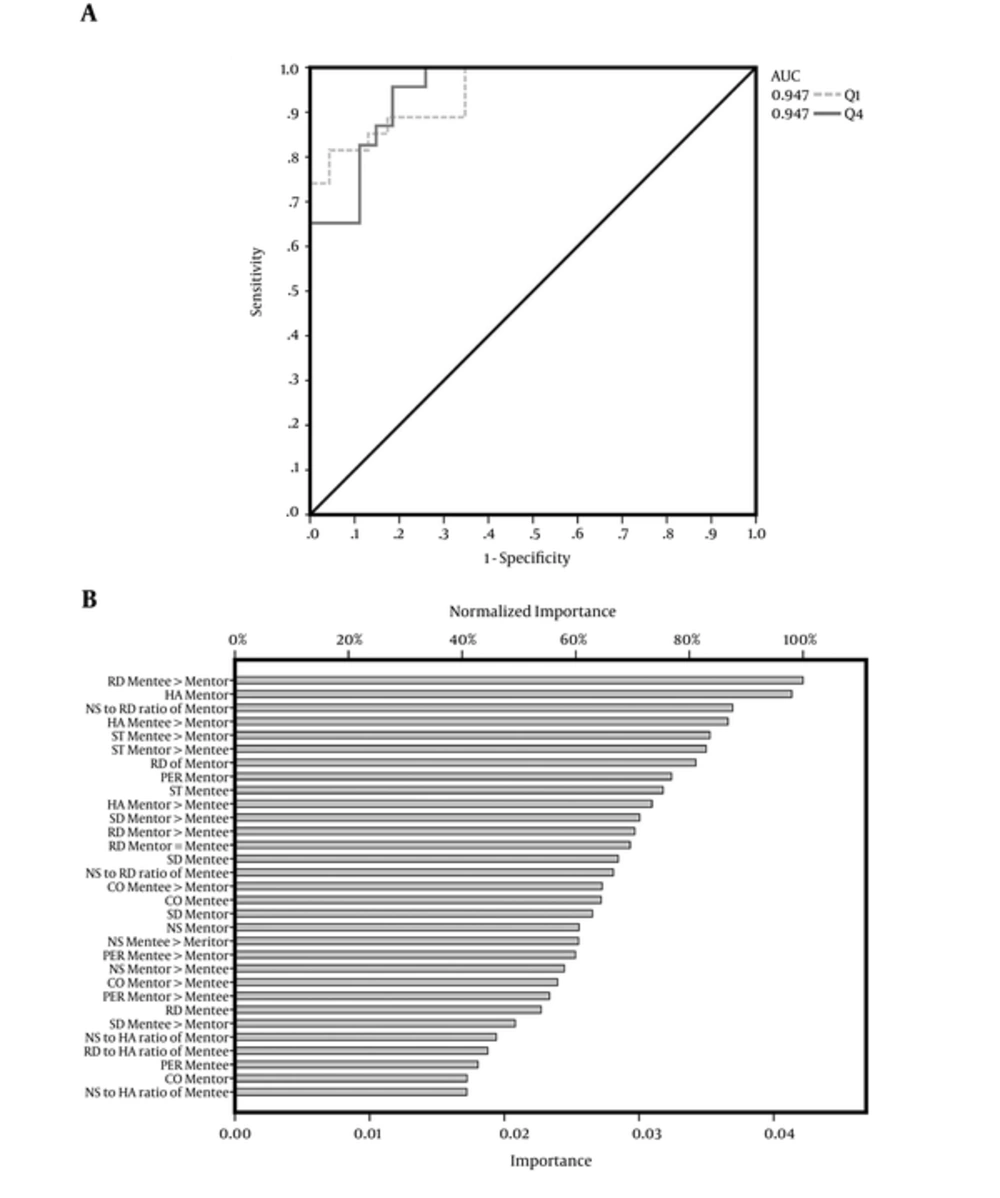
Figure 1.
The Results of Artificial Neural Network with Radial Basis Function Analysis are Displayed; A, Receiver Operating Characteristic Curve Shows an Area Under the Curve of 0.947 for the Correct Prediction of Highest and Lowest Quartiles of Mentoring Satisfaction. The Accurate Predictions of Training and Testing Were 84.4% and 83.3%, Respectively. B, The Importance of Input Variables from Temperament and Character Inventory) Is Shown
4. Discussion
To the best of the authors` knowledge, the current study seems to be the 1st prospective study trying to integrate the personality-based match-making of mentorship and the satisfaction of 1st-year medical students with the mentoring program. Overall, by employing the temperament and character inventory, the study correctly predicted the satisfaction of a mentoring relationship to the extent of 65% to 84% through linear, logistic, and non-linear models.
It was observed that the mentees’ cooperativeness and mentors’ novelty-seeking were positively linked with a more satisfying mentorship. It is known that people with high scores of novelty-seeking are explorer, curious, and challenge-seeker (14). It is also observed to be linked with extraversion and openness (15), which is necessary for a successful mentoring. Moreover, cooperativeness relates to agreeableness. The low scores of cooperativeness represent intolerance, being unhelpful, opportunistic, and critical. Therefore, it is entirely reasonable that mentees’ cooperativeness and mentors’ novelty-seeking are associated with higher scores of mentoring satisfaction.
Regarding the dissimilarities, when the novelty-seeking of mentors was greater than that of mentees, the total satisfaction was higher. It might be justified by the fact that a person with lower novelty-seeking is more easily controlled and reserved in a relationship (16, 17). Therefore, higher novelty-seeking of mentors in comparison with mentees not only influences mentoring through exploratory, curious, and challenge-seeking behaviors of mentors; but also exerts its role through control.
It was observed that higher self-transcendence scores of mentees in comparison with those of the mentors was linked with a better satisfaction. This effect might be explained by the fact that people with higher self-transcendence scores are more patient, humble, spiritual, and creative (14, 16, 17).
Interestingly, similar harm avoidance was significantly associated with reduced satisfaction. The current study mentor-mentee dyads with similar harm avoidance had average scores of this temperament trait. It is known that people with average scores of harm avoidance have transient worries and tensions in proportion to objective risks (14, 16, 17). It may be hypothesized that in a relationship with non-similar harm avoidance, the confidence and risk/uncertainty acceptance by one person can overcome the anxiety and worries of the other person.
In contrast, the usefulness score of mentoring program was higher when the persistence of mentors and mentees were similar. It is known that persistence is correlated with resilience and psychological maturity (14), which is necessary for a successful relationship.
It was observed that the empowerment of mentees was significantly associated with self-directedness of mentees. Empowerment was determined by motivation, self-confidence, adaptation, the balance of activities, and the positive effect of mentoring. Also, self-directedness represents responsibility, goal orientation, and self-confidence (14, 16). Self-directedness is also strongly correlated with resilience (14). Therefore, it is not strange to see that self-directedness of mentees is correlated with their empowerment through the program.
Moreover, the mentors’ respectful behavior was positively associated with the novelty-seeking to reward dependence ratio of mentors. It might be elucidated by the fact that along with the increases in novelty-seeking to reward dependence ratio, people become more skillfully charming and explorer (13, 16, 17).
Nowadays, mentoring is indispensable to academic environments (18), especially for junior students who face a stressful beginning at medical school; hence, they are expected to master an avalanche of extensive knowledge (19). Mentoring, which is a dynamic, collaborative, and reciprocal relationship (3) is crucial to improve the confidence of mentees (1). The mentorship involves 2 individuals and consequently its success rests upon the characteristics of both individuals. Therefore, for a successful mentorship relationship, the mentor and mentee should exhibit mutual goals, respect, trust, and their commitment to the mentoring relationship so as to be successful (18).
However, finding the appropriate mentor is always challenging for both informal and formal mentoring relationships (20). There is ample evidence about the characteristics of good mentors (21, 22), including personal features, interpersonal abilities, and professional status (18). However, there is no universal recommendation for match-making of mentors and mentees based on the perceptions, and most importantly regarding the personality similarities or dissimilarities (10).
Personality is a stable indicator of an individual’s behavior interpreted based on how the person reacts to actions of others and also based on individual’s pro-active behavior in the social environment (23, 24). It is suggested that the personality of mentors affects their involvement in mentoring relationships. The identification of personality features that relate to mentoring provided by mentors has notable practical implications (25).
Recently, greater attention was paid to the genetic aspects of personality leading to the development of the Cloninger psychobiological model (17), which suggested that personality development is influenced by both biological and psychological processes. Cloninger proposed that personality has 2 components: temperament and character. Temperament is related to the biological aspect of personality; therefore, it is genetically inherited and develops at a young age. Processes such as memory, habit formation, emotional response, and information processing are all influenced by temperament (16). Character development, on the other hand, is a continuous process influenced by the life experience. Accordingly, the character aspect of personality is related to different aspects of the self; ie, who we are, why we are here (16). The inclusion of both temperament and character ensures that both stable and changing aspects of personality are measurable by the Cloninger model.
The current study used self-report questionnaires of temperament and character inventory (TCI-125 (12, 13)) and a reliable structured questionnaire of mentees’ satisfaction. The most significant pattern regarding the success of mentoring from the standpoint of mentees was associated with the dissimilarities of temperament and character between mentors and mentees. It should be noted that no personality disorders or extreme scores of TCI were observed in the participants. The current study findings regarding the importance of personality dissimilarities were in line with those of Jolevski (8) and Tripp and Eick (9).
Similar personalities of mentors and mentees are less effective than different personalities (26). However, matching based on gender is suggested and was conducted in the current study program (27). The current study was a primary one, and the TCI-based matching of mentors and mentees is not addressed properly yet, and should be tested in prospective and interventional designs.
The studies in support of similar personality matching are influenced by the timing of the relationship. These studies showed that homogeneous pairs were more successful in short periods of time, while heterogeneity worked in favor of a longer relationship (11). Cuperman and Ickes (28) used big 5 personality scores and showed that participants, who were similar (introvert or extrovert), had a better start in a relationship, in comparison with the cases in which one person was introvert and the other one extrovert. However, these findings were not confirmed in cases with low disagreeableness (28), which might be in line with the current study results indicating a positive influence of higher cooperativeness of mentees.
The current study faced some limitations as it did not evaluate the satisfaction of mentors. However, considering that much of the literature focuses on the mentors, the current study adds valuable information concerning the influence of mentee-mentor personality match-making on the satisfaction from mentoring. Also, the data were obtained by self-reported scales from volunteers of the mentoring program, which may introduce bias from participants with a greater interest in this program.
In summary, the current study results indicated that personality dissimilarities of mentors and mentees considerably influence the satisfaction of mentees; therefore, mentee cooperativeness and mentor novelty-seeking, non-similar harm avoidance, higher novelty-seeking of mentors than mentees, and higher self-transcendence scores of mentees than mentors were significant predictors of mentees’ satisfaction. It should be noted that these results should be confirmed in interventional studies.