
1. Background
Diabetes is one the diseases that endangers most people’s health. Diabetes appears with disturbances in the metabolism of glucose, fat, and protein, which especially includes disruptions in producing and using insulin hormone that is necessary in glucose metabolism (1). Iran is one of the countries that is at increased risk of diabetes, thus, 14% - 23% of Iranians 30-year-olds and above have diabetes or impaired glucose tolerance (IGT). Nearly 25% of IGT would get diabetes in the future (2). The main causes are obesity and immobility, which are related with increased risk of type 2 diabetes (3, 4). Stress has a negative effect on their body, psychological, and also endangers their mental health (5). In addition to stress, depression (6) and anxiety (7) are respectively the most mental disorders in patients with diabetes. Considering the last studies in Yazd, the rate of depression in type 2 diabetic patients is 46%, where 70.4% are female and 48% male (8). These psychological factors might have a significant impact on the mental well-being of patients with diabetes. Well-being is a psychological component that is considered as freshness and life satisfaction (9). Mental well-being is a multidimensional structure, which is marked with social, mental, and physical freshness (10, 11). Today tendency to study psychological well-being as one of the therapeutic process in former decades was increased (12). Positive psychotherapy is one of the approaches that engage scientists to consider well-being and mental health (13). Therefore, positive psychotherapy movement emphasizes on positive features and potentials growth in a person. Hence, a group of psychologists used mental health instead of psychological well-being because they believed that this word brings more positive aspects to someone’s mind (14, 15). Seligman believes that positive psychology is a new method in psychotherapy that pays attention to potentials, talent, and positive emotions (16). Indeed, positive approach suggests therapists not only try to eliminate symptoms of an illness but also try to enhance patient’s quality of life. Hence most of psychologists use some interventions in their positive therapeutic method, which was based on patient’s thought, feeling, behavior, and positive cognition (17). Positive psychotherapy focuses on increasing the level of well-being, happiness, and quality of life. It believes that increasing positive emotions can decrease mental pressures and shortages as well as have a positive effect on mental health (18 - 20). The effectiveness of positive psychotherapy has been checked on different illnesses. For example, Seligman et al. (15) reported that positive psychology tasks decreased depression symptoms for at least 6 months. Senf and Liau (21) and Asgharipoor et al. (22), showed that positive therapy is effective in treating mental features and can also increase happiness and decrease depression symptoms. The mechanism of blood sugar reduction in participants can be explained such that positive psychotherapy training with positive motivational techniques on hypothalamic-pituitary-adrenal axis reduces Cortisol in response to stress. On the other hand, improvement of anxiety can decrease catecholamine release and lead to better glycemic control in diabetic patients (23). It seems that these trainings can lead to better control of diabetes by suppressing or reducing the levels of Cortisol secretion. Therefore, participating in positive training courses leads to the reconstruction of individual belief and cognition about diabetes. Up to now, there wasn’t any research that has been done in regards to the effectiveness of group positive psychotherapy on improving psychological health of patients with type 2 diabetes.
2. Objectives
Considering the special cultural condition, it seems necessary to do proper, affordable, and effective researches to increase diabetics’ health in Iran. Hence, present research aims to study the effectiveness of group positive psychotherapy on increasing general well-being and decreasing blood sugar of type 2 diabetic patients.
3. Methods
3.1. Study Type and Participants
This study was a randomized, single-blinded clinical trial from January 2016 to February 2017 where the interviewer did not know about the control or testing of the patients. The research community consisted of all diabetic patients who referred to Yazd Diabetes Research Center. Therefore, the sample size was calculated with the mean and standard deviations of previous studies (24, 25). The sample required for this study was 24 people (12 in each group); however, 15 were considered for each group because of the probability of dropping out of the subjects.
After visiting the diabetes center, each of the diabetes patients took necessary explanation of the research methods and goals. Those who wanted to participate (after confirming the consent form) were being interviewed. The sampling method was purposeful. The inclusion criteria for selecting participants included having at least six months of history of type 2 diabetes, being 30 - 55 years old, getting poor to moderate mental well-being scores on the GWB scale, having at least a diploma and over, and HbA1c was between 5.7 to 10. In addition, the exclusion criteria included getting very good mental well-being scores on the GWB scale, not completing of informed consent form, having physical problems, which interfere psychotherapy process, and using other psychiatric or psychotherapy treatments simultaneously.
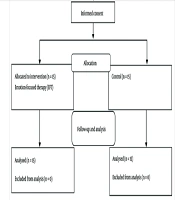
Out of 110 questionnaires collected from the participants, 35 of them had the entry criteria. Of these, five individuals were excluded from the study due to the exclusion criteria. Finally, the participants were 30; randomly two groups of 15, one experimental and one control group were established. While participants of both groups continued their drug therapy, the intervention group received 10 sessions of 90 minutes (a session per week) positive psychotherapy and the control group remained on the waiting list. CONSORT flowchart is indicated in Figure 1.
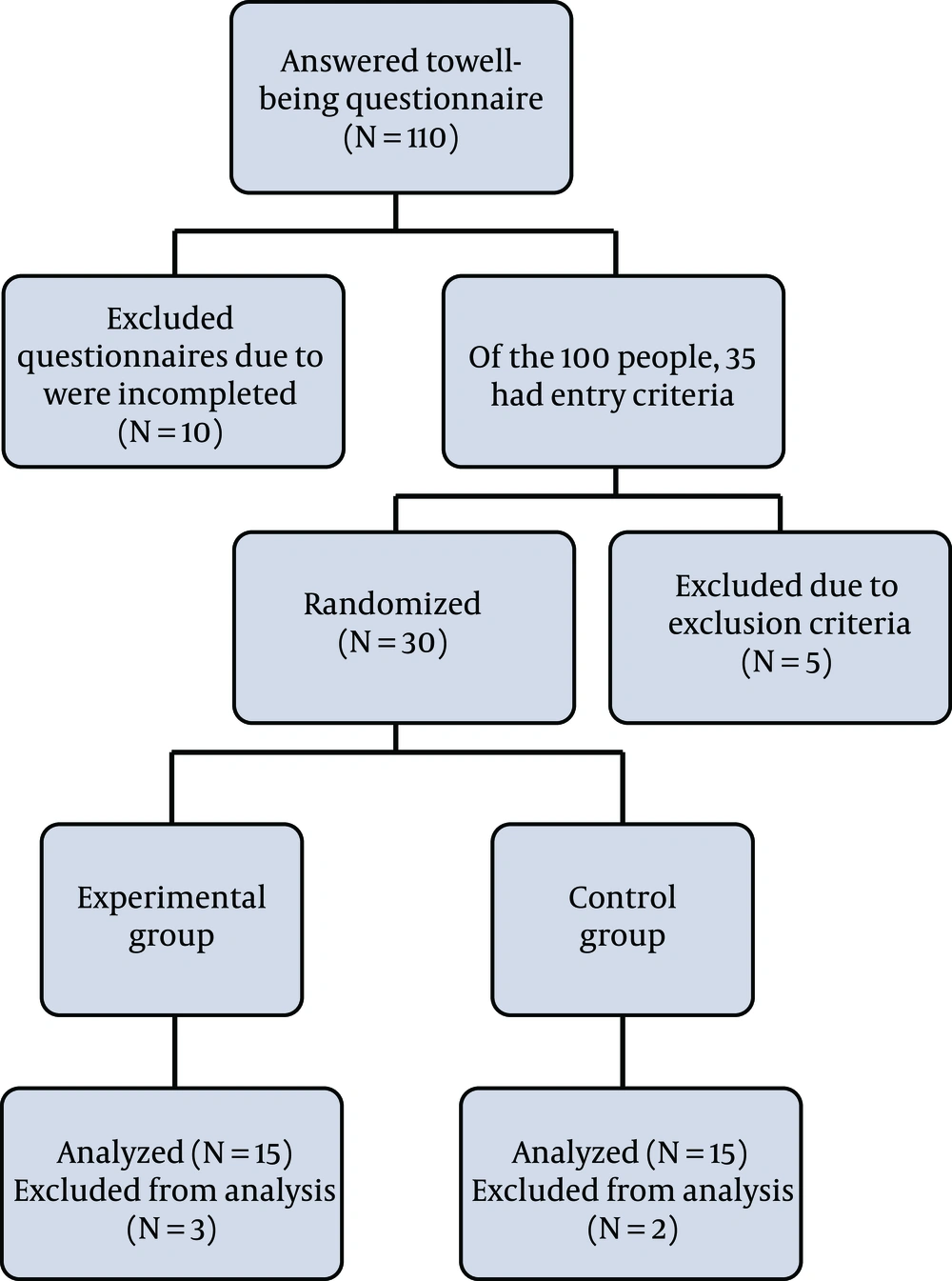
Figure 1.
CONSORT flowchart of patients enrolled in this study
Questionnaire and glycemic test were used for gathering data. Therefore, each examinee of both groups completed the mental health questionnaire before the first intervention session and after the last one. Also, glycemic tests were taken before the first session and two weeks after the last session (within two months) of psychotherapy intervention. The tools for gathering data were as below.
1) Demographic Form: This questionnaire was made by the examiner and used for gathering patients’ characteristics of type 2 diabetic patients such as sex, age, education level, job, disease length, and so on.
2) General Well-Being Questionnaire (GWB-18): This questionnaire was made by Harold J. Dupuy in 1977 and includes some statements about personal attitude and important aspects of patients’ psych. It includes six scales of anxiety, depression, positive well-being, self-control, a sense of vitality, and general health (26). It consists of 18 items and six options that wanted examinees to declare their agreement by choosing one of the options. This questionnaire was normalized in Iran in 2015 and its correlation coefficient for test-retest was between 0.77 - 0.93. Cronbach’s alpha for all sub-scales were respectively 0.76 and 0.74 (27). In addition, general Cronbach’s alpha of this scale in the present study was 0.79.
3) HbA1c Test: Glycosylated hemoglobin (HbA1c) is an indicator for being aware of how to control diabetes. Glucose binds to hemoglobin in a process called glycosylation. HbA1c test shows the amount of glycosylation or average blood glucose level over the past 8 to 12 weeks. Normal range of glycosylated hemoglobin in normal people is 4 to 5.9. People with diabetes generally have high levels of HbA1c (28).
3.2. Interventions
Indeed, the group positive psychotherapy composed of 10 sessions of 90 minutes (a session per week) that was performed in 10 weeks. The participants learned the positive attitude skills toward themselves and others by the help of a therapist and one instructed cooperator. Also, it should be noticed that positive psychotherapy refers to two types. The first one is the general meaning of positive psychotherapy, which predicates to all positive psychotherapies. The second type is the therapeutic method, which was introduced for the first time by Seligman et al., in 2006, and that method was used in this research (15). During the intervention, examinees completed the written specified practices in a work form of each session. Table 1 shows a brief review of each session’s content.
Table 1.
Method of Group Positive Psychotherapy
| Time | Task |
|---|---|
| First week | Establishing pre-group in order to take written testimonial of patients and become familiar with each other. Also, initial speaking about mental pressures. |
| The second and third week | Teaching how to use abilities and VIA performance. Task: evaluating 5 dominant abilities and find some ways to use them in their routine life. |
| Third week | Teaching three good things. Task: write down three good things that happen every day and why they happened. |
| The fourth and fifth week | Teaching life summary. Task: imagine that you were died after a very satisfying life. What are you going to write in your obituary? Write whatever you like to be remembered about you in 1 or 2 pages. |
| The sixth and seventh week | Teaching gratitude visit. Task: find someone whom you are very gratitude but you never thank him/her well. Write a letter that describe your gratitude and read it for him/her on the telephone or face to face. |
| Eighth week | Teaching active response. Task: one response: answer someone whom you know very actively at least once a day. |
| The ninth and tenth week | Teaching relish feeling. Task: each day devote some time enjoying those activities you like such as eat meat, take a shower, and take a walk. At that time you do them, write down what did you do. How did you do it and what was your feeling. |
3.3. Statistical Methods
The primary outcomes of our analysis were the rate of well-being and HbA1c in patients with type 2 diabetes. Also, the secondary outcome from the analysis was the effect of positive psychotherapy on well-being and HbA1c in the patients. SPSS software, version 16, with P = 0.05 level was used for analyzing data. Kolmogorov-Smirnov (K-S) test was used for evaluating the normality of numerical data and the results showed that all variables had normal distribution. In addition, chi-square and analysis of covariance (ANCOVA) were used in this research.
4. Results
4.1. Demographic Characteristics
In the beginning of the study, the data of 30 patients were collected, however, the results of three of the intervention group and two of the control group were excluded from the study for not participating in the post-test. From these 25 patients, 52% were female and 48% male. Chi-square showed that there was no significant difference between the two groups in terms of gender, economic status, occupation and type of drug. It can be concluded that both groups are similar in terms of demographic characteristics (Table 2).
Table 2.
Demographic Comparison in Test and Control Group by Means of Chi-Square (N = 25)a
| Variable, Classification | Test Group | Control Group | Total | P Value |
|---|---|---|---|---|
| Gender | > 0.543 | |||
| Males | 6 (50) | 6 (42.6) | 12 (48) | |
| Females | 6 (50) | 7 (53.8) | 13 (52) | |
| Economic status | > 0.703 | |||
| Good | 2 (16.7) | 4 (30.8) | 6 (24) | |
| Average | 7 (58.3) | 6 (46.2) | 13 (52) | |
| Weak | 3 (25) | 3 (23) | 6 (24) | |
| Job | > 0.845 | |||
| Jobless | 6 (50) | 5 (38.4) | 11 (44) | |
| Worker | 3 (25) | 4 (30.8) | 7 (28) | |
| Housekeeper | 3 (25) | 4 (30.8) | 7 (28) | |
| Drug type | > 0.571 | |||
| Tablet | 7 (58.3) | 9 (69.2) | 16 (64) | |
| Tablet - insulin | 5 (41.7) | 4 (30.8) | 9 (36) |
aValues are expressed as No. (%).
4.2. Analyzing Data Using ANCOVA
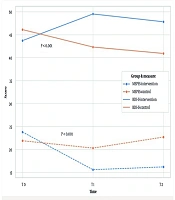
Results showed that the mean scores of general well-being and its subscales in the posttest phase of experimental group was more than the pretest phase while the mean scores of general well-being and its subscales in the posttest phase of clinical control group was nearly the same as the pretest phase. In addition, the mean score of HbA1c in the posttest phase of the experimental group was less than the pretest phase while the pre-post test scores of the clinical control group were nearly the same. The contents of Wilks’ lambda showed that there was a significant difference between both groups in terms of dependent variables in P < 0.01 level (F = 8.741, Value = 0.314, df = 16). Accordingly, it can be stated that there was significant difference between the experimental and control groups at least in terms of the dependent variables (well-being and HbA1c) in patients with type 2 diabetes.
Table 3.
Mean Results of ANCOVA on the Study Variable in the Experimental and Control Groups
| Variables | Experimental Groupa | Control Groupa | Mean Squares | F | Eta Squared | P Value | ||
|---|---|---|---|---|---|---|---|---|
| Pretest | Posttest | Pretest | Posttest | |||||
| General well-being | 55.66 ± 8.32 | 72 ± 8.17 | 62.61 ± 9.5 | 61.46 ± 7.41 | 660.78 | 21.09 | 0.526 | < 0.001 |
| Anxiety | 12.70 ± 3.01 | 15.91 ± 1.92 | 14.23 ± 3.85 | 13.07 ± 3.04 | 79.63 | 25.94 | 0.577 | < 0.001 |
| Depression | 8.5 ± 1.93 | 12.66 ± 1.74 | 10.76 ± 2.04 | 10.61 ± 1.5 | 61.57 | 18.34 | 0.491 | < 0.001 |
| Positive well-being | 9.08 ± 2.23 | 12.16 ± 1.74 | 9.7 ± 1.84 | 9.9 ± 1.38 | 35.96 | 18.37 | 0.492 | < 0.001 |
| Self-control | 11.58 ± 1.83 | 12.33 ± 1.54 | 10.23 ± 2.52 | 10.38 ± 1.93 | 7.34 | 4.95 | 0.207 | < 0.038 |
| Vitality | 8.5 ± 1.73 | 11.66 ± 2.1 | 9.53 ± 1.98 | 9.46 ± 1.66 | 25.81 | 21.56 | 0.532 | < 0.001 |
| General health | 5.25 ± 1.6 | 7.25 ± 1.35 | 8.15 ± 1.72 | 8 ± 1.22 | 2.491 | 2.57 | 0.120 | 0.125 |
| HbA1c | 7.78 ± 1.6 | 7.20 ± 1.5 | 7.6 ± 1.35 | 7.58 ± 1.3 | 1.28 | 5.16 | 0.214 | < 0.035 |
aValues are presented as mean ± standard deviation.
Analysis of covariance (ANCOVA) on dependent variables was used to examine the differences between experimental and control group post-test results. Table 3 showed the ANCOVA results for comparing post-tests of two dependent variables (general well-being and HbA1c) with controlling pretests in both groups. The results listed in Table 3 showed that analysis of covariance ANCOVA was significant in variables as HbA1c (F = 16.5 and P = 0.035), general well-being (F = 21.09 and P = 0.001) anxiety subscales (F = 25.94 and P = 0.001), depression (F = 18.34 and P = 0.001), positive well-being (F = 18.37 and P = 0.001), self-control (F = 4.59 and P = 0.038), and vitality (F = 21.56 and P = 0.001). Therefore, the hypothesis on the impact of group positive psychotherapy on increasing general well-being and its factors in patients with type 2 diabetes were being confirmed (P < 0.01). Also, the other hypothesis based on the impact of group positive psychotherapy on decreasing blood sugar was being approved (P < 0.05).
5. Discussion
The results showed that group positive psychotherapy significantly increased the general well-being in patients with type 2 diabetes and that increase was significant in comparison with the control group. These findings are in line with the results of Sorbi et al. (25), Tanaka et al. (9), Senf and Liau (21), and Dowlatabadi and et al. (24). Also Wing et al. (29) and Parks-Sheiner (30) had obtained similar results about the effectiveness of positive interventions on mental well-being and life satisfaction.
It should be mentioned that positive psychotherapy focuses mainly on the abilities and positive emotions of the people. This intervention is positive individual characteristics and institutions that facilitate their growth. Accordingly, this view of the matter and awareness of the positive abilities can help patients cope with depression and prevent its relapse. Positive psychotherapy tasks are designed in such a way that can increase well-being. For example, “three good things” task absorbs depressed person intrusive thoughts toward negative events. In addition, “gratitude visit” task can change the memory of past negative aspects into enjoying the good things that friends and family have done for him/her (15).
Layous et al. (18) presented a new model for the effectiveness of positive interventions. They believe that positive interventions not only directly increase the well-being and reduce symptoms of depression, however, they also indirectly increase the positive thoughts, positive behavior, and positive emotions. Therefore, during therapy sessions these two goals are pursued simultaneously, which increases the effectiveness of this treatment and thus, enhances the well-being of patients.
Other results showed that group positive psychotherapy significantly decreased the blood sugar in type 2 diabetic patients. The obtained results are in line with the researches of Yi-Frazier et al. (31), Celano et al. (32), Robertson et al. (33), and Snoek and Skinner (34). Furthermore, the obtained results are in line with other known therapies in psychology such as stress management with cognitive-behavioral method (35); mindfulness (36) and relaxation (21), which can almost control blood sugar in type 2 diabetic patients.
As a result, it will bring strengthening positive beliefs and promising and reducing stress in patients. In this regard, Joyce et al. (31), had done a review research about the effectiveness of positive psychology on diabetes outcomes. The results showed that positive personal characteristics such as self-confidence, self-efficacy, and also positive environmental factors, such as monitoring and others supporting, are important predictors for controlling blood sugar and managing diabetes over the life.
5.1. Conclusions
This research addressed the effectiveness of positive psychology interventions on physical and mental health of patients with type 2 diabetes for the first time by considering the advantages and disadvantages of previous researches. Overall, the findings indicate that this method of treatment has beneficial effects on the health and well-being of patients with type 2 diabetes. Hence this affordable therapy, in terms of time and cost, can be used widely used in Diabetes Treatment Centers to improve the health of patients. As the researchers in this study have found the strengths and weaknesses of their study, they also propose that in future studies the group positive psychotherapy in comparison with other treatments on well-being and happiness determine better effective treatments. Also, this therapy examines the stability of treatment effects on mental and physical characteristics with long-term follow up (1 year) and if it becomes effective it would use it for treating patients. On the other hand, the present study has some limitations and shortcomings. The main reasons for the limitations of this study are lack of control of confounding variables such as personality, physical, and also socio-cultural variables, the lack of cooperation from many participants, no placebo control group in order to control the nonspecific effects of treatment, lack of time, low cost of finance, lack of facilities, and lack of treatment space to follow-up study for the stability of treatment effects.