Fulltext
Fulltext is availale in the PDF.
Zahedan Journal of Research in Medical Sciences
The Official Journal of Zahedan University of Medical Sciences
Authors
Background: In the recent decades, the positive psychology considered as an ability of human being which are provided appropriate studies in well-being and happiness domains. In this way, the purpose of current research was to identify the effect of aerobic dancing on psychological well-being of non-athletic male students.
Materials and Methods: The research method was of a quasi-experimental nature in the form of a time-series design using experimental and control groups. 40 non-athlete students (21.6±1.82 years old) from General physical Education 1 course in Birjand University were randomly selected and assign to two groups. The Ryff's scales of psychological well-being were used to analyze the psychological well-being parameters in the pre-test and post-test of training. The training protocol was including 12 weeks, and 3 seasons (60 minutes) per week that each subject in experimental group received 15 minutes warm-up, 30 minute aerobic training and 15 minutes cool-down and relaxation training.
Results: The results of repeated measure analysis of variance indicated significant differences in psychological well-being and its subdivisions in the 3 phases of tests in the experimental group (p<0.01). Moreover, the results of t-test showed the positive influence of 12 weeks aerobic training on psychological well-being of the student boys (first post-test, p<0.001; second post-test, p<0.001), and well-being scores of aerobic group was higher than control group.
Conclusion: The result of the present research emphasizes the factors affecting on psychological well-being as well as its ways to promote of well-being. Implications of these findings are discussed among exercise psychologists.
© 2014, Author(s). This open-access article is available under the Creative Commons Attribution 4.0 (CC BY 4.0) International License (https://creativecommons.org/licenses/by/4.0/), which allows for unrestricted use, distribution, and reproduction in any medium, provided that the original work is properly cited.

Kianian T, Kermansaravi F, Saber S, Aghamohamadi F. The Impact of Aerobic and Anaerobic Exercises on the Level of Depression, Anxiety, Stress and Happiness of Non-Athlete Male. Zahedan J Res Med Sci. 2018;20(1):e14349. doi: https://doi.org/10.5812/zjrms.14349
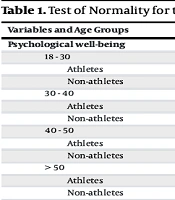
Kavehfarsani Z, Raeissi P. Psychological Well-Being, Happiness, and Life Satisfaction Across Age Groups of Athletes and Non-athletes. J Kermanshah Univ Med Sci. 2025;29(4):e165725. doi: https://doi.org/10.5812/jkums-165725
Solgi Z, Saeedipoor B, Abdolmaleki P. Study of psychological well-being of physical education students of Razi university of Kermanshah. J Kermanshah Univ Med Sci. 2009;13(2):e79805. doi:
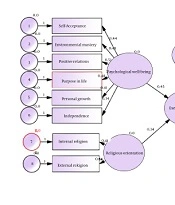
Azimkhani A. Presenting a Model of Structural Equations Between Psychological Well-being, Religious Beliefs, and Adherence to Recreational Sports Activities. J Motor Control Learn. 2023;5(4):e146114. doi: https://doi.org/10.5812/jmcl-146114
Karimy M, Eshrati B. The effect of health promotion model-based training on promoting students’ physical activity. J Kermanshah Univ Med Sci. 2012;16(3):e78795. doi:
Last Update: 1 month ago
Last Update: 1 month ago
Last Update: 1 month ago
Last Update: 5 days ago