


1. Background
Brucella bacteria are Gram-negative, small, aerobic, non-motile spores with no capsule and the species that affects humans consist of Brucella abortus, B melitensis, B. suis, and, in rare cases, B. canis [1].
This disease has several names including undulant fever, Mediterranean fever, Malta fever, and Bang, s disease. Brucella was firstly reported in 1859 by Marston in Malta [2]. This disease is more endemic in Mediterranean areas, the south and center of America, Africa, Asia, Arab peninsula, Indian subcontinent, and the Middle East [3].
In countries like Iran that its economy is dependent on the livestock industry, it is a major economic challenge [1, 4].
The usage of raw milk by people in countries of the Eastern Mediterranean is a major problem which results in increasing the incidence of brucellosis [5, 6].
Human is suffering from the disease by contacting with infected domestic animals such as cattle, sheep, and goats, or using raw milk or unpasteurized products obtained from the milk of these animals [4].
Determining the prevalence of brucellosis cases is difficult because of the incomplete reports but with the caring system, the current reports can reflect the true incidence of the disease.
Thanks to the successful increasing of vaccination coverage of livestock, the disease is declining. Intersect oral coordination, standardizing the definition of disease, educating the society and health workers, increased reporting, increased manufacturing pasteurized dairy products, and livestock vaccination coverage are the main factors in controlling and preventing diseases in livestock and, consequently, in human [6].
Khorasan Razavi, with a wide area and active livestock industry, is one of provinces to which the brucellosis is endemic. Two studied regions contained the most reported brucellosis due to the rural sparsely and frequent droughts which have made people be animal farmers and use their own raw dairy products.
2. Objectives
The purpose of this study is to identify factors affecting the incidence of brucellosis in the studied region, Soutern cities of Khorasan Razavi, Iran. Then, we will present an operational plan for reducing the burden of this disease in society. Also, proper planning for education to prevent of the disease and coordination with veterinary for the livestock vaccination, on the basis of a program can be carried out in future.
2. Methods
This cross-sectional study was performed over a period of 5 years (2009 - 2014) and the demographic and clinical data such as age, sex, occupation, contact with animals, and consumption of dairy products were collected. A questionnaire form was prepared based on the world health organization (WHO) and was provided for all patients referring to medical offices, health centers, and hospitals. The criteria of this study, based on national standards, included all those who had suspicious symptoms of positive 80/1 right titration and Coombs Wright. In this study, patient’s privacy is respected.
2.1. Statistical Analysis
The questionnaire data were prepared through the Excel software. For data analysis, t-test and non-parametric analysis was performed using the SPSS 20 software and descriptive statistics.
3. Results
In total, 438 cases of brucellosis were reported during 5 years, which 263 cases (60.4%) of patient population were from Bajestan and 176 cases (39.6%) were from Gonabad. In Bajestan, from 263 cases of brucellosis, 3.86% of the people in rural areas and 13.7% in the urban were infected by this disease (Figure 1).
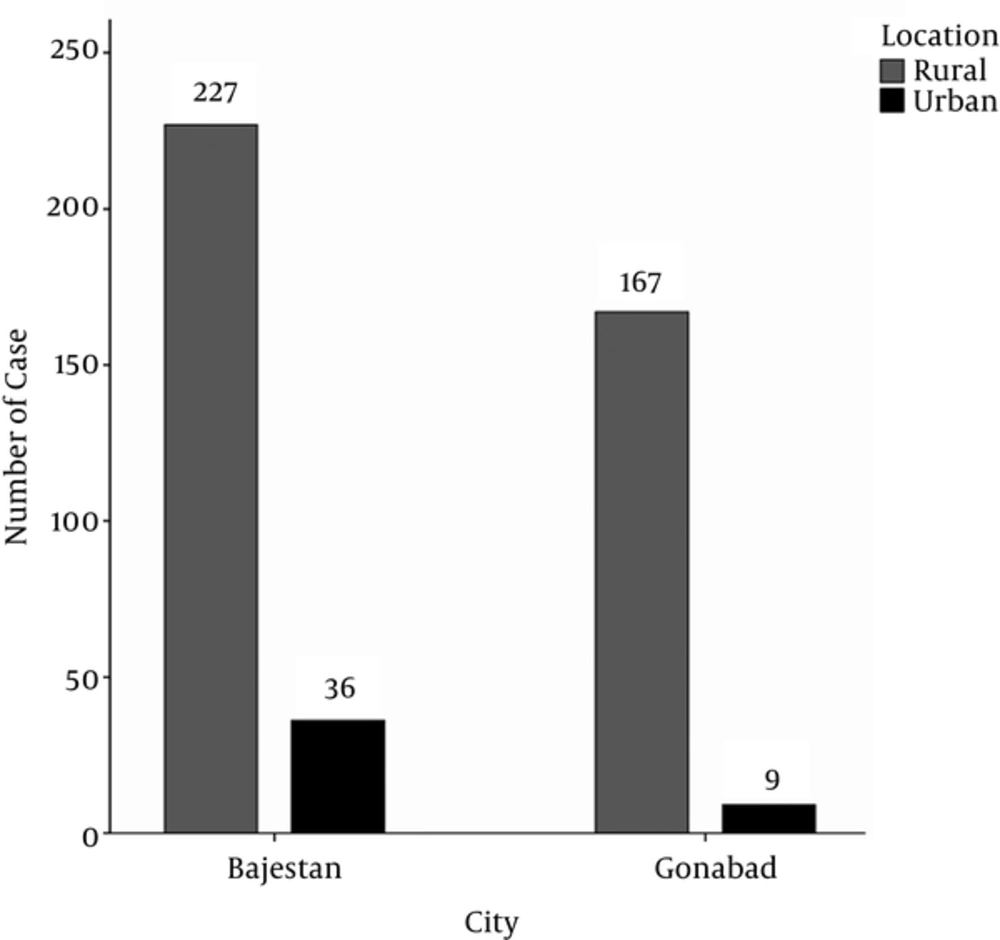
Figure 1.
The Prevalence of Brucellosis in Patients Due to Living Area and City, in 2009 - 2014
Also in Gonabad, from 176 patient cases, 94.8% of the people lived in rural areas and 5.2% lived in the urban. Most reported cases were in June and July and the lowest statistic was occurred in January. It seems that the disease process starts in the spring and in the summer reaches its peak and, then, begins to decline in autumn.
Among the variable age and sex of the patients, there was a significant difference (P = 0.000) and the incidence in the 1 - 30 years old group in males was 2.2 times more than females, but for the 31years and more group, Overall, the highest incidence was in those who were 50 years old and above (30%) and the least one was occurred in the 31 - 40 years group (12.3%). There was no significant statistical difference between age and place of residence (P = 0.416) but there was high significant difference between age and job of the patients (P = 0.000).
In terms of jobs, the housekeeper (35.3), farmer-rancher (24.2), student (16.8%) and rancher (6.6%) had the highest incidence, respectively. By reviewing the relationship of sex with job and area of residence of the patients, there was a significant difference (P = 0.000) between the variable age and job of the patients, while the relationship between sex and location of patient was not significant (P = 0.753) (Table 1).
Table 1.Assessing the Relationship Between Variables of Gender, Living Area, and Occupation with Age of Patients with Brucellosis in Two Studied Cities (Gonabad and Bejestan) During 2009 to 2014
| Characteristics | Scale | Frequency | P Value |
|---|---|---|---|
| Sex | Male | 242 | 0.000 |
| Female | 194 | ||
| Area | Urban | 45 | 0.416 |
| Rural | 393 | ||
| Occupation | Housewife | 155 | 0.000 |
| Housekeeper and Shepherd | 4 | ||
| Housekeeper and Farmer | 2 | ||
| Shepherd | 29 | ||
| Staff-Farmer | 1 | ||
| Farmers | 11 | ||
| Worker | 15 | ||
| Employee | 2 | ||
| Farmer-rancher | 106 | ||
| Children | 20 | ||
| Student | 74 | ||
| Military | 1 | ||
| Others | 18 |
Most symptoms in females were loss of appetite, muscle aches and bone pain (54.1%). 21.6% of the patients only had muscle aches and bone pain and 10.3% had fever, muscle aches, and bone pain. In males, 58.4% suffered from loss of appetite, muscle aches and bone pain while 22% mentioned to have muscle aches and bone pains and 8.6% of them had back pain, muscle sches, and bone pain. The analysis also showed that there was no difference between sex and type of symptoms (P = 0.292). One of the causes of brucellosis is the use of unpasteurized livestock productions. Hence based on the reports, the patients had used unpasteurized milk (19.4%), unpasteurized milk and colostrum (6.2%), unpasteurized cheese (5.5%), colostrum (5.2%), and unpasteurized milk, colostrum, and cream (4.3%).
63.9% of the patients had contact with live animals and 10.7% of them, had also been keeping livestock in their local residence, in addition to having contact with them.
The majority of the patients had Wright test titre = 1:320 and 2ME test titre = 1:160 (14%) in serological titration (14%) and 1% failed to be cured.
4. Discussion
Due to the professional development of animal husbandry in rural areas, the disease has been seen in southern towns of Khorasan Razavi province. One of bad customs in these areas is eating colostrum in the spring coincident with the birth of animals which, according to the results, it’s stated in all causes of brucellosis.
One of the causes of brucellosis in these two cities is the import of unhealthy livestock from south parts of the country which in some cases are illegally imported. The incomplete coverage of domestic livestock vaccination can be a factor for causing brucellosis in livestock. In this study, the overall incidence of the disease was two times more in males than females due to their jobs related to livestock and using unpasteurized milk. Most incidences were observed in male youths and females who were 50 years old and above which this could be due to more contact of youths with livestock and less care for ways of preventing this disease. In the case of females, since most females in villages are usually in contact with livestock and have the responsibility of boiling milk, they are more infected by this disease and most of these people are old and due to having no financial income, they are forced to consume their livestock production.
In the study (2006 - 2009) published by Dastjerdi et al. the incidence brucellosis was in the young groups more than the elderly groups. The average age of patients was 31 years old which was reported 29 in men and 35 years old in women [6].
In this study, similar to other studies, home businesses, farmers, and ranchers had the greatest risk of infection. This implies the most contact with livestock and animal products compared to other businesses. Based to the culture and beliefs of people in rural areas, they pay less attention to the importance of boiling raw milk as the first infected livestock product and ladies, who are usually older, milk the livestock in a traditional way which this would be the main risk factor of the incidence of brucellosis.
The dust and dirt on the ranch that has the possibility of containing brucellosis microbes also causes infection for the rancher and her/his family. As the results indicate, the brucellosis incidence is not peculiar for a certain age group or a certain place and all of the people whether they are living in a city or a village can be infected by consuming unpasteurized milk and infected local cheese. Clinically, symptoms that occur in males and females are loss of appetite, muscle aches and bone pain which have been reported.
In Kassiri’s study in western Iran, the most contagious seasons were summer and spring (60.3%) [7].
In mainland China, 162,329 cases of human brucellosis were reported during 2004 - 2010. The annual incidence had sharply increased by approximately 4 times from 0.63 to 2.72 per 100,000 population during the 7-year period, and the monthly incidence showed a significant seasonal pattern peaking in the spring and summer season [8].
Farahani et al. reported the mean incidence rate of brucellosis as 60 per 100,000 population in the Arak county during 2001 - 2010 [9].
In a study from Germany, Only 16% of patients were under 20 years and the most prevalent diseases were in people 60 - 69 years of age [10].
In Issa and Jamal report, arthralgia (78%), fever (75%), and sweating (60%) were consecutively the most common clinical presentations. The most frequent complications were limping (75%) and arthritis (54%), respectively [11].
In Arak, 55.3% of the patients were male and 44.7% were female [9]. In other parts of Iran including Kashan, Qazvin, and Gonbad-e kavus the brucellosis was more prevalent in men [12]. In the study conducted in Gonbad-e kavus, the number of the disease (26.2%) was reported for the age group of 10 - 69 years old [13]. In a study conducted in northern Iran, eating the local cheese (22.4%) and breeding (11.3%) were the most important factors of the disease [14].
4.1. Conclusions
Based on the results, in order to prevent Brucellosis it’s necessary to educate public, specifically rural, well to promote the use of pasteurized milk products.
