
1. Background
Postoperative nausea and vomiting (PONV) remains one of the most common and distressing complications after cesarean delivery under spinal anesthesia (1). Its incidence in parturients is influenced by pregnancy-related physiological changes, delayed gastric emptying, hormonal alterations, intraoperative hypotension, uterotonic administration, and the use of neuraxial opioids (2-6). Although PONV is rarely life-threatening, it can substantially impair maternal comfort, delay breastfeeding initiation, increase anxiety, prolong recovery, and reduce overall patient satisfaction; therefore, effective prophylaxis remains an important clinical goal in obstetric anesthesia (7-9).
Among available pharmacologic strategies, dexamethasone is widely used for PONV prophylaxis because of its established antiemetic efficacy and favorable clinical profile (10-16). Proposed mechanisms include the inhibition of prostaglandin synthesis, modulation of neuroinflammatory pathways, and reduction of serotonin activity within the gastrointestinal tract and central emetic pathways (7, 14, 16). Intravenous dexamethasone is frequently incorporated into multimodal antiemetic protocols, either alone or in combination with other agents, such as 5-HT3 receptor antagonists (14, 16-18). However, despite its widespread use, the optimal prophylactic dose of dexamethasone for cesarean delivery under spinal anesthesia remains insufficiently defined, particularly regarding dose-response effects on PONV prevention (11).
Dexmedetomidine, a highly selective alpha-2 adrenergic agonist with sedative, analgesic, and sympatholytic properties, has also emerged as a potentially useful adjunct in cesarean anesthesia (12, 19-21). By attenuating sympathetic activity, improving hemodynamic stability, and reducing perioperative analgesic requirements, dexmedetomidine may contribute to a lower risk of nausea and vomiting. Both intravenous and intrathecal routes have been investigated. Intrathecal dexmedetomidine has been associated with improved block characteristics and reduced PONV, whereas intravenous administration may provide benefit through systemic sympatholytic and opioid-sparing effects (20, 22-24). Nevertheless, direct comparisons between intravenous and intrathecal dexmedetomidine for PONV prophylaxis in obstetric patients remain limited, and their relative performance compared with different doses of intravenous dexamethasone has not been adequately characterized (12, 25).
2. Objectives
Given the distinct mechanisms of dexamethasone and dexmedetomidine, comparative evaluation of these regimens within a unified randomized framework is clinically relevant. This six-arm randomized triple-blind trial was designed to compare different doses of intravenous dexamethasone with intravenous dexmedetomidine and intrathecal dexmedetomidine for the prevention of PONV after elective cesarean delivery under spinal anesthesia. The primary outcome was the incidence and severity of PONV during the first 24 postoperative hours. Secondary outcomes included hemodynamic changes and other perioperative adverse effects. Identification of the most effective prophylactic strategy may improve maternal recovery and support enhanced recovery approaches in obstetric anesthesia.
3. Methods
3.1. Study Design and Setting
This randomized, triple-blind clinical trial was conducted at Shahid Beheshti Hospital, Isfahan, Iran, during the 2025 calendar year. The study protocol was approved by the Institutional Ethics Committee of Isfahan University of Medical Sciences (Ethics Ref: [IR.ARI.MUI.REC.1404.214]) and registered in the Iranian Registry of Clinical Trials (IRCT Registration Ref: [IRCT20240221061070N10]). The study adhered to the Declaration of Helsinki, and written informed consent was obtained from all eligible participants before enrollment.
3.2. Participants and Sampling
Eligible participants were pregnant women aged 18 - 45 years, classified as American Society of Anesthesiologists (ASA) physical status II, who were scheduled for elective cesarean delivery under spinal anesthesia.
3.2.1. Sample Size Estimation and Sampling Process
Based on preliminary data and previous clinical trials, assuming an expected PONV incidence of approximately 55% in the control group and an anticipated reduction to 15% in the most effective prophylaxis arm, a sample size of 25 patients per group was estimated to provide 80% power at a two-tailed alpha level of 0.05. However, given the 6-arm parallel design, multiple comparative evaluations, secondary ordinal severity metrics, and the need to buffer against potential intraoperative exclusions, surgical conversions, or protocol deviations, the final recruitment target was set at 50 patients per arm (total planned sample size of 300 patients).
3.2.2. Inclusion Criteria:
- Age 18 - 45 years
- ASA physical status II
- Elective cesarean delivery under spinal anesthesia
3.2.3. Exclusion Criteria (Pre-randomization):
- Significant cardiopulmonary, hepatic, or renal disease
- History of psychiatric disorders or chronic use of central nervous system drugs
- Gestational diabetes mellitus or thyroid dysfunction
- History of substance or alcohol abuse
- Preoperative body temperature < 36.5 C or > 37.5 C
- Chronic use of antiemetic or vasodilatory medications
- Receipt of labor analgesia before surgery
- Known hypersensitivity or contraindication to study medications (bupivacaine, dexamethasone, or dexmedetomidine)
3.2.4. Post-Randomization Exclusion/Withdrawal Criteria (Per-Protocol Analysis):
Patients were excluded from the final per-protocol analysis if any of the following intraoperative events occurred:
- Inadequate spinal anesthesia block requiring conversion to general anesthesia
- Unforeseen surgical complications requiring emergency administration of non-protocol medications
- Duration of surgery exceeding 90 minutes
- Intraoperative blood transfusion or administration of tranexamic acid
- Patient request to withdraw consent during the perioperative period
3.3. Randomization, Allocation Concealment, and Blinding
3.3.1. Sequence Generation and Allocation Concealment
Participants were randomly assigned to one of six parallel treatment groups in a 1:1:1:1:1:1 ratio. The random allocation sequence was generated by an independent biostatistician who was not involved in patient recruitment, clinical care, or data collection, using computer-generated block randomization with permuted block sizes of 6 and 12. Allocation concealment was ensured using sequentially numbered, opaque, sealed envelopes.
3.3.2. Operational Blinding and Preparation
Eligible patients were enrolled before surgery. After confirmation of written informed consent, an independent anesthesiologist who was not involved in patient care, anesthesia administration, data collection, or statistical analysis opened the corresponding envelope in a separate preparation area and prepared all study medications in identical, unlabeled syringes.
- Intravenous syringes: identical 2 mL syringes containing either the active drug (dexamethasone or dexmedetomidine) or normal saline, according to group assignment
- Intrathecal syringes: identical syringes containing the hyperbaric bupivacaine mixture
3.3.3. Implementation of Blinding Across Routes (Double-Dummy Technique)
To maintain the triple-blind design and mask the route of administration, a double-dummy protocol was used, whereby all participants received both an intravenous and an intrathecal intervention.
For the intravenous route, all patients received a 2 mL bolus of identical appearance immediately after spinal anesthesia. For the intrathecal route, all patients received spinal anesthesia. In Groups 1 - 5, the intrathecal syringe contained hyperbaric 0.5% bupivacaine 2.4 mL (12 mg) without additives. In Group 6, the intrathecal syringe contained hyperbaric 0.5% bupivacaine 2.4 mL (12 mg) plus dexmedetomidine 10 µg (0.1 mL), for a total volume of 2.5 mL.
The attending anesthesiologist performing the spinal block and administering the intravenous solution, the patients, and the postoperative nurses responsible for outcome assessment and data collection were blinded to treatment allocation. Blinding was maintained until completion of the statistical analysis.
3.4. Intervention Groups
Parturients were allocated to six prophylactic groups:
- Group 1 (Placebo): IV normal saline 2 mL + IT hyperbaric bupivacaine 0.5% (2.4 mL)
- Group 2 (Dexamethasone 2 mg): IV dexamethasone 2 mg (in 2 mL saline) + IT hyperbaric bupivacaine 0.5% (2.4 mL)
- Group 3 (Dexamethasone 4 mg): IV dexamethasone 4 mg (in 2 mL saline) + IT hyperbaric bupivacaine 0.5% (2.4 mL)
- Group 4 (Dexamethasone 6 mg): IV dexamethasone 6 mg (in 2 mL saline) + IT hyperbaric bupivacaine 0.5% (2.4 mL)
- Group 5 (Intravenous Dexmedetomidine): IV dexmedetomidine 10 µg (in 2 mL saline) + IT hyperbaric bupivacaine 0.5% (2.4 mL)
- Group 6 (Intrathecal Dexmedetomidine): IV normal saline 2 mL + IT hyperbaric bupivacaine 0.5% (2.4 mL) plus dexmedetomidine 10 µg (0.1 mL), total volume 2.5 mL
After delivery and umbilical cord clamping, all patients received IV midazolam 1 mg to provide standardized anxiolysis and minimize intraoperative maternal anxiety. Administration was intentionally delayed until after neonatal delivery to avoid affecting Apgar scores. All participants received standardized intraoperative care, including supplemental oxygen (5 L/min via face mask) and prewarmed intravenous fluids.
3.5. Outcome Measures
The primary outcome was the incidence and severity of PONV during the first 24 hours postoperatively, assessed by a blinded investigator using a validated 4-point ordinal scale (0 = none, 1 = mild nausea, 2 = moderate to severe nausea, 3 = vomiting or retching). Rescue antiemetic therapy (IV ondansetron 4 mg) was administered for severity scores ≥ 2.
Secondary outcomes included the requirement for rescue antiemetics, the patient satisfaction score (assessed on a 5-point Likert scale), adverse events (hypotension and bradycardia), and perioperative hemodynamic parameters. Hemodynamic parameters, including systolic blood pressure (SBP), mean arterial pressure (MAP), and heart rate (HR), were recorded at baseline and at 5, 15, 30, 60, and 120 minutes after spinal injection.
3.6. Statistical Analysis
The primary analysis followed the per-protocol principle. Continuous variables were expressed as mean +/- standard deviation (SD) or median with interquartile range (IQR), depending on data distribution, whereas categorical variables were presented as frequencies and percentages. Baseline clinical and demographic characteristics were compared using one-way analysis of variance or the Kruskal-Wallis test for continuous variables, and the chi-square test or Fisher exact test for categorical variables.
The primary outcome (PONV severity score) was analyzed using multivariable ordinal logistic regression adjusted for baseline covariates, including BMI and gravidity, and is reported as adjusted odds ratios (ORs) with 95% confidence intervals (CIs). Absolute risk reduction (ARR) and number needed to treat (NNT) were calculated relative to placebo.
Hemodynamic parameters over the 120-minute observation period were analyzed using linear mixed-effects models to account for within-subject repeated measurements and incomplete repeated-measures data under the missing-at-random assumption. The models included group, time, and group-by-time interaction as fixed effects, with a subject-level random intercept. All tests were two-sided, and P < 0.05 was considered statistically significant. Statistical analyses were performed using R software version 4.2.0.
3.7. Ethical Considerations
The study protocol was approved by the Institutional Ethics Committee of Isfahan University of Medical Sciences (IR.ARI.MUI.REC.1404.214) and registered in the Iranian Registry of Clinical Trials (IRCT20240221061070N10). The study adhered to the Declaration of Helsinki, and written informed consent was obtained from all eligible participants before enrollment.
4. Results
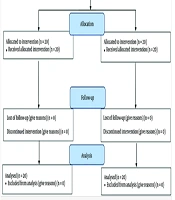
A total of 300 parturients were initially randomized into six study groups (n = 50 per group). Overall, 14 patients (5%) were excluded post-randomization because of a surgical duration exceeding 90 minutes (n = 5), intraoperative blood transfusion (n = 4), use of rescue tranexamic acid (n = 3), conversion to general anesthesia due to an inadequate spinal block (n = 1), or withdrawal of consent (n = 1). Consequently, 285 participants completed the study according to protocol and were included in the primary per-protocol analysis (Figure 1). The analyzed population in each group was as follows: placebo (n = 47), dexamethasone 2 mg (n = 48), dexamethasone 4 mg (n = 46), dexamethasone 6 mg (n = 49), intravenous dexmedetomidine (n = 47), and intrathecal dexmedetomidine (n = 48).
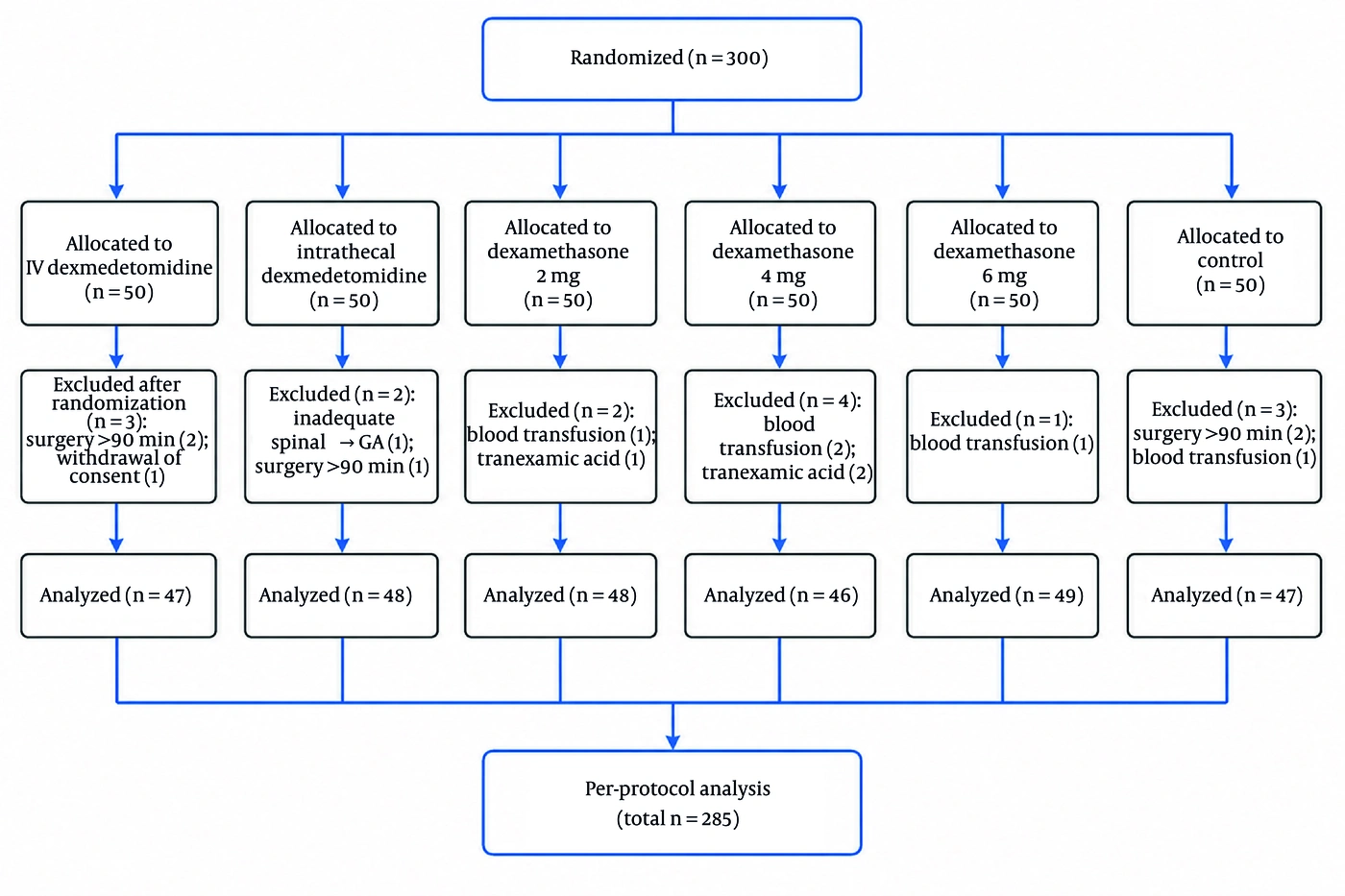
Figure 1.
CONSORT flow diagram of patient enrollment, allocation, and analysis.
As shown in Table 1, baseline demographic and clinical characteristics, including maternal age, BMI, gestational age, and history of motion sickness, were comparable across the six groups (all P > 0.05), indicating balanced baseline risk profiles.
Table 1.
Baseline Demographic and Clinical Characteristics of the Study Participants a
| Characteristics | Placebo (n = 47) | Dexamethasone 2 mg (n = 48) | Dexamethasone 4 mg (n = 46) | Dexamethasone 6 mg (n = 49) | Intra Venous Dexmedetomidine (n = 47) | IT Dexmedetomidine (n = 48) | P-Value |
|---|---|---|---|---|---|---|---|
| Age (y) | 30.1 ± 5.3 | 29.8 ± 5.1 | 30.4 ± 4.9 | 29.6 ± 5.0 | 30.5 ± 5.4 | 29.9 ± 4.8 | 0.912 |
| Weight (kg) | 74.8 ± 11.2 | 73.9 ± 10.8 | 75.1 ± 11.5 | 74.2 ± 10.9 | 76.3 ± 12.1 | 73.5 ± 11.0 | 0.874 |
| Height (cm) | 161.8 ± 5.6 | 162.3 ± 5.4 | 161.5 ± 5.8 | 162.0 ± 5.2 | 161.9 ± 5.7 | 162.5 ± 5.3 | 0.963 |
| BMI (kg/m²) | 28.6 ± 4.1 | 28.1 ± 3.9 | 28.8 ± 4.2 | 28.3 ± 4.0 | 29.1 ± 4.4 | 27.9 ± 3.8 | 0.781 |
| Gestational Age (wk) | 38.2 ± 1.1 | 38.4 ± 1.0 | 38.1 ± 1.2 | 38.3 ± 1.1 | 38.0 ± 1.3 | 38.5 ± 1.0 | 0.629 |
| Gravidity | 0.894 | ||||||
| 1 (Primigravida) | 15 (31.9) | 14 (29.2) | 16 (34.8) | 13 (26.5) | 17 (36.2) | 14 (29.2) | |
| 2 | 18 (38.3) | 19 (39.6) | 16 (34.8) | 20 (40.8) | 15 (31.9) | 19 (39.6) | |
| 3 | 10 (21.3) | 11 (22.9) | 9 (19.6) | 12 (24.5) | 10 (21.3) | 10 (20.8) | |
| ≥ 4 | 4 (8.5) | 4 (8.3) | 5 (10.9) | 4 (8.2) | 5 (10.6) | 5 (10.4) | |
| Parity | 0.918 | ||||||
| Nulliparous | 17 (36.2) | 16 (33.3) | 18 (39.1) | 15 (30.6) | 19 (40.4) | 16 (33.3) | |
| Multiparous | 30 (63.8) | 32 (66.7) | 28 (60.9) | 34 (69.4) | 28 (59.6) | 32 (66.7) | |
| History of PONV/Motion Sickness | 8 (17.0) | 7 (14.6) | 9 (19.6) | 6 (12.2) | 10 (21.3) | 7 (14.6) | 0.821 |
| Duration of Surgery (min) | 42.3 ± 8.1 | 41.8 ± 7.9 | 43.1 ± 8.4 | 42.0 ± 8.0 | 43.5 ± 8.6 | 41.7 ± 7.8 | 0.912 |
a Values expressed as mean ± SD or No. (%). P-values were derived from one-way analysis of variance (ANOVA) for continuous variables and the Chi-square test for categorical variables. There were no statistically significant differences between the six groups for any baseline characteristic (all p > 0.05), Confirming successful randomization and comparable baseline risk profiles. Abbreviations: BMI, Body Mass Index; PONV, postoperative nausea and vomiting; IV, intravenous; IT, intrathecal.
The primary outcome analysis showed a significant difference in the incidence and severity of PONV among the study groups (likelihood-ratio chi-square = 198.4, P < 0.001). The placebo group had a PONV incidence of 78%, whereas all active treatment groups showed lower incidences. A dose-response pattern was observed across the dexamethasone groups, with the lowest incidence in the dexamethasone 6 mg group (12%; OR = 0.07, 95% CI, 0.03 - 0.13), followed by the dexamethasone 4 mg group (20%) and dexamethasone 2 mg group (29%). Intrathecal dexmedetomidine 10 µg showed comparable clinical efficacy to dexamethasone 6 mg, with a PONV incidence of 14% (OR = 0.08, 95% CI, 0.04 - 0.16). In contrast, intravenous dexmedetomidine was associated with a higher residual incidence of 32%. Severe vomiting (grade 3) was not observed in the dexamethasone 6 mg, dexamethasone 4 mg, or intrathecal dexmedetomidine groups, whereas it occurred in 19.1% of patients in the placebo group (Tables 2 and 3).
Table 2.
Incidence, Ordinal Severity, and Comparative Efficacy Metrics of PONV Across Study Groups (N = 285) PONV Incidence and Severity Distribution a
| Intervention Group | Evaluated | Overall PONV Incidence | Severity Grade | |||
|---|---|---|---|---|---|---|
| None (0) | Mild (1) | Moderate (2) | Severe/Vomiting (3) | |||
| 1. Placebo (Control) | 47 | 37 (78.7) | 10 (21.3) | 13 (27.7) | 14 (29.8) | 9 (19.1) |
| 2. IV Dexamethasone 2 mg | 48 | 14 (29.2) | 34 (70.8) | 9 (18.8) | 2 (4.2) | 1 (2.1) |
| 3. IV Dexamethasone 4 mg | 46 | 9 (19.6) | 37 (80.4) | 6 (13.0) | 3 (6.5) | 0 (0.0) |
| 4. IV Dexamethasone 6 mg | 49 | 6 (12.2) | 43 (87.8) | 4 (8.2) | 2 (4.1) | 0 (0.0) |
| 5. IV Dexmedetomidine 10 µg | 47 | 15 (31.9) | 32 (68.1) | 9 (19.1) | 5 (10.6) | 1 (2.1) |
| 6. IT Dexmedetomidine 10 µg | 48 | 7 (14.6) | 41 (85.4) | 5 (10.4) | 2 (4.2) | 0 (0.0) |
a Values are expressed as number or No. (%).
Table 3.
Incidence, Ordinal Severity, and Comparative Efficacy Metrics of PONV Across Study Groups (N = 285) Efficacy Metrics and Comparative Effect Sizes (vs. Placebo) a
| Intervention Group | Adjusted OR b | Absolute Risk Reduction | Number Needed to Treat |
|---|---|---|---|
| 1. Placebo (Control) | 1.00 (Reference) | — | — |
| 2. IV Dexamethasone 2 mg | 0.15 (0.08 - 0.27) | 49.5 | 2.0 (1.5 - 3.2) |
| 3. IV Dexamethasone 4 mg | 0.10 (0.05 - 0.19) | 59.1 | 1.7 (1.3 - 2.4) |
| 4. IV Dexamethasone 6 mg | 0.07 (0.03 - 0.13) | 66.5 | 1.5 (1.2 - 2.0) |
| 5. IV Dexmedetomidine 10 µg | 0.17 (0.09 - 0.33) | 46.8 | 2.1 (1.5 - 3.6) |
| 6. IT Dexmedetomidine 10 µg | 0.08 (0.04 - 0.16) | 64.1 | 1.6 (1.2 - 2.2) |
a Values are expressed as 95% CI or percentage. Abbreviations: ARR, Absolute Risk Reduction; CI, Confidence Interval; IT, Intrathecal; IV, Intravenous; NNT, Number Needed to Treat; OR, Odds Ratio; PONV, Postoperative Nausea and Vomiting.
b Adjusted Odds Ratios with 95% CIs were derived from multivariable ordinal logistic regression adjusted for baseline age, duration of surgery, and intraoperative hypotension. An OR < 1 indicates lower odds of experiencing higher PONV severity compared to the Placebo control group. Overall difference across groups was statistically significant (Likelihood-ratio χ2 = 198.4, P < 0.001). A significant dose-response relationship was observed across the IV Dexamethasone groups (Ptrend < 0.001).
Regarding hemodynamic outcomes, linear mixed-effects modeling showed better maintenance of systolic blood pressure in the intrathecal dexmedetomidine and dexamethasone 6 mg groups than in the placebo group. Intrathecal dexmedetomidine showed a mean SBP advantage of +1.9 mm Hg versus placebo (P = 0.008) and the smallest maximum mean SBP decline (-8.0 mm Hg). Only 19% of patients in this group experienced clinically significant hypotension. Similarly, dexamethasone 6 mg improved SBP maintenance by +1.4 mm Hg compared with placebo (P = 0.003). Heart rate stability followed a similar pattern; both the dexamethasone 6 mg and intrathecal dexmedetomidine groups showed more stable heart rate profiles during the 120-minute observation period (both P < 0.001 vs. placebo), with no significant difference between these two groups (P = 0.78) (Tables 4 and 5).
Table 4.
Hemodynamic Effects: Systolic Blood Pressure and Heart Rate a
| Parameters and Groups | Overall Difference from Placebo (95% CI) | P-value (Overall) | Key Hemodynamic Finding |
|---|---|---|---|
| SBP | |||
| IV Dexamethasone 2 mg | -3.2 mmHg | 0.120 | Moderate stabilization. |
| IV Dexamethasone 4 mg | -2.1 mmHg | 0.040 | Good stabilization. |
| IV Dexamethasone 6 mg | +1.4 mmHg | 0.003 | Best SBP maintenance. Max drop: -9.9 mmHg. |
| IV Dexmedetomidine 10 µg | -4.8 mmHg | 0.890 | Less effective than IT route. |
| IT Dexmedetomidine 10 µg | +1.9 mmHg | 0.008† | Excellent SBP maintenance. Max drop: -8.0 mmHg; Only 19% had > 20 mmHg drop. |
| HR | |||
| IV Dexamethasone 2 mg | -2.8 bpm (-5.1 to -0.5) | 0.018 | Mild reduction. |
| IV Dexamethasone 4 mg | -4.2 bpm (-6.8 to -1.6) | 0.002 | Significant reduction. |
| IV Dexamethasone 6 mg | -6.1 bpm (-8.7 to -3.5) | < 0.001 | Best hemodynamic stability (HR). |
| IV Dexmedetomidine 10 µg | -5.5 bpm (-8.3 to -2.7) | < 0.001 | Good reduction. |
| IT Dexmedetomidine 10 µg | -5.9 bpm (-8.6 to -3.2) | < 0.001 | Comparable to Dexamethasone 6 mg (P = 0.78). |
a Hemodynamic data are derived from mixed linear models, comparing the overall mean difference from the placebo group over the entire 120-minute observation period. For Systolic Blood Pressure (SBP), the reported value is the mean difference in overall SBP (where a positive value indicates better maintenance of blood pressure). For Heart Rate (HR), the value is the overall mean difference in beats per minute (bpm), where negative values indicate a lower heart rate compared to placebo. The P-value for SBP reflects the significance of the time × group interaction trend. All active interventions provided superior hemodynamic stability compared to placebo, with IV Dexamethasone 6 mg and Intrathecal Dexmedetomidine demonstrating the most favorable profiles for both SBP and HR maintenance.
Table 5.
Independent Risk Factors for Increased PONV Severity (Multivariable Ordinal Logistic Regression) a
| Risk Factors and Categories | Adjusted OR (95% CI) | P-Value |
|---|---|---|
| Age | ||
| Per year increase | 0.97 (0.95 - 0.99) | 0.012 |
| Weight | ||
| Per kg increase | 1.03 (1.01 - 1.05) | 0.004 |
| Gestational Age | ||
| Per week increase | 0.94 (0.89 - 0.99) | 0.028 |
| Height | ||
| Per cm increase | 1.01 (0.99 - 1.04) | 0.321 |
| Obstetric History | ||
| Gravidity | ||
| 1 (Primigravida) | Reference | - |
| 2 | 0.68 (0.41 - 1.12) | 0.134 |
| 3 | 0.51 (0.31 - 0.84) | 0.008 |
| ≥ 4 | 0.38 (0.22 - 0.66) | < 0.001 |
| P-for-trend | < 0.001 | |
| BMI | ||
| < 25 kg/m² (Normal) | Reference | - |
| 25 - 29.9 kg/m² (Overweight) | 1.31 (0.81 - 2.11) | 0.261 |
| ≥ 30 kg/m² (Obese) | 2.44 (1.49 - 4.01) | < 0.001 |
| P-for-trend | < 0.001 |
a The analysis was performed using a multivariable ordinal logistic regression model, adjusted for the assigned treatment group (the intervention). The model assesses the independent association of each demographic and clinical variable with the odds of experiencing a higher score on the PONV severity scale. An Odds Ratio (OR) greater than 1 indicates an increased risk (risk factor), while an OR less than 1 indicates a decreased risk (protective factor). The 95% Confidence Interval (CI) is provided for each estimate. P-for-trend values are reported for ordered categorical variables (Gravidity and BMI categories), testing for a linear trend in risk across categories. Abbreviations: OR, Odds Ratio; CI, Confidence Interval; BMI, Body Mass Index.
Multivariable ordinal logistic regression identified maternal obesity (BMI ≥ 30 kg/m2) as an independent predictor of greater PONV severity (adjusted OR = 2.44, 95% CI, 1.49 - 4.01, P < 0.001), whereas gravidity ≥ 4 was protective (adjusted OR = 0.38, 95% CI, 0.22 - 0.66, P < 0.001).
5. Discussion
This randomized, triple-blind, controlled trial showed that dexamethasone (2, 4, and 6 mg IV) and dexmedetomidine (intravenous and intrathecal) were associated with a lower incidence and severity of PONV after spinal anesthesia for cesarean delivery than placebo. A dose-response pattern was observed across the dexamethasone groups, with the 6 mg dose showing the greatest protective effect. Intrathecal dexmedetomidine achieved a comparable magnitude of benefit, whereas intravenous dexmedetomidine was less effective than these two regimens. In addition, dexamethasone 6 mg and intrathecal dexmedetomidine were associated with better intraoperative hemodynamic profiles.
Our findings are generally consistent with the existing literature on PONV prophylaxis. The antiemetic efficacy of dexamethasone is well established, and the dose-response pattern observed in our study supports the use of moderate to higher doses in high-risk settings such as cesarean delivery (25-28). De Oliveira et al. demonstrated in a meta-analysis that dexamethasone significantly reduces the incidence of PONV within 24 hours, with both moderate (4 - 5 mg) and higher (8 - 10 mg) doses proving effective in adult surgical populations; these findings support guideline recommendations of 4 - 8 mg IV in high-risk settings (27). The 12% incidence of PONV observed with dexamethasone 6 mg in our study is comparable to or lower than rates reported in recent meta-analyses (27).
The pronounced efficacy of intrathecal dexmedetomidine is particularly noteworthy (29, 30). Whereas intravenous administration showed more modest antiemetic effects, the intrathecal route produced results nearly equivalent to those of dexamethasone 6 mg (31). This may reflect a distinct neuraxial mechanism mediated through spinal alpha-2 adrenoceptor activation and modulation of afferent pathways involved in nausea and vomiting (30, 32). Previous studies have also suggested that the efficacy of dexamethasone may depend on the presence of other emetogenic stimuli. For example, Selzer et al. reported that dexamethasone did not significantly reduce PONV when administered before intrathecal morphine, highlighting the importance of timing and multimodal prophylaxis in obstetric anesthesia (32, 33).
Spinal anesthesia-induced hypotension remains a common concern during cesarean delivery (34). In our study, both dexamethasone 6 mg and intrathecal dexmedetomidine were associated with better hemodynamic profiles than placebo. Mean systolic blood pressure was maintained at higher levels, and the proportion of patients experiencing clinically significant hypotension (> 20 mm Hg decrease from baseline) was lower, particularly in the intrathecal dexmedetomidine group (19% vs. 68% in the placebo group). These findings suggest that these regimens may be associated with both lower PONV and better intraoperative hemodynamic profiles (35).
Multivariable analysis identified obesity (BMI ≥ 30 kg/m2) as the strongest independent predictor of more severe PONV, more than doubling the adjusted odds (OR = 2.44). This finding highlights the need for intensified prophylaxis in obese parturients (36). Conversely, increasing gravidity was protective in our study, with primigravidae showing the highest risk of PONV. These findings are broadly consistent with established clinical risk models for postoperative nausea and vomiting (37).
The differences observed between intravenous and intrathecal dexmedetomidine highlight the complexity of its pharmacologic profile. Intravenous administration produced modest reductions in PONV but was less effective than neuraxial administration (38). This supports the hypothesis that some antiemetic and sympatholytic effects of dexmedetomidine may be mediated through spinal mechanisms (39). Importantly, no severe adverse events, including clinically significant bradycardia requiring intervention or excessive sedation, were observed at the studied doses, supporting the safety profile of both agents in this setting (40, 41). Beyond conventional pharmacological prophylaxis, the ongoing search for multimodal strategies also encompasses alternative therapeutic interventions, such as herbal agents, reflecting the clinical importance of optimizing antiemetic care across diverse surgical settings (42).
5.1. Study Limitations
This study has several limitations. First, follow-up was limited to the first 24 postoperative hours, and delayed antiemetic effects were not assessed. Second, although hemodynamic differences were observed, the study was powered primarily for the PONV outcome. Third, only a single intrathecal dexmedetomidine dose (10 µg) was evaluated; future dose-response studies may help optimize neuraxial dosing. Finally, the single-center design may limit external validity.
5.2. Conclusions
In summary, this six-arm trial suggests that prophylactic efficacy against PONV differs by dose and route of administration. Intravenous dexamethasone 6 mg and intrathecal dexmedetomidine 10 µg showed the most favorable overall profiles, whereas intravenous dexmedetomidine did not outperform these regimens. These findings support a tailored approach to antiemetic prophylaxis in cesarean delivery under spinal anesthesia.