
What is Open Peer Review?
How it sits alongside double-anonymised review
Every Brieflands journal runs both, one after the other. During peer review the process is double-anonymised (double-blind): the reviewer receives a blinded manuscript and neither reviewer nor author knows the other. Open peer review happens after review has finished, when we publish the reports of those reviewers who agreed to it. Reviewers who do not agree remain anonymous and their reports are not published. Open peer review therefore adds transparency after the decision; it does not remove the blinding during it. See Peer Review Process.
How it works, step by step
- It is opt-in. You are asked for consent when you accept the review invitation. If you do not answer, your report is not published — silence is treated as a refusal, never as agreement.
- Declining costs you nothing. A refusal is not shown to the authors, does not affect the weight given to your review, and does not affect future invitations. Your review is used in the editorial decision either way.
- Signed or anonymous is a separate choice. You may consent to publication of the report while remaining anonymous.
- When reports appear. Consented reports are published with the article, on the article page, on the day of publication — never before the decision, and never separately from the article.
- You may withdraw consent at any time before the article is published. Contact the handling editor or submit a support ticket and the report is removed from the publication package.
- After publication the report is part of the record. It cannot be withdrawn, because it is citable and readers may already have relied on it. Decide before publication.
- Blinding during review is unaffected. Consent to open review does not reveal your identity to the author while the review is in progress.
The double-anonymised stage is described in How review works at Brieflands.
Background & aim:
After 12 years of working with reviewers and associate editors, we opened a new window for all our editors and authors titled "Open Peer Review." We hope to motivate our reviewers and satisfy our authors more during this new facility's review process.
We believe that publishing our peer review reports could make a transparent and clear environment for all our efforts within a journal, but not all reviewers tend to post their comments.

What is the "Open Peer Review" process?
An "Open Peer Review" process makes the details of all review processes (including reviewers, associate editors, and EIC comments) as "Public" as it is agreed upon by the EIC, Authors, and reviewers.
Advantages of the "Open Peer Review" process
- More transparency, constructiveness, and tactful comments in the peer review process: lead to an increase in the quality of reviews.
- More motivations for all involved roles in the review process
- Authors' satisfaction from the review process: Increases honesty between authors and reviewers
- Education of both authors and new students
- It prevents reviewers from following their agendas and leads to the detection of reviewers' conflicts of interest.
We started the "Open Peer Review" project on 1 September 2019 in all Brieflands journals, alongside the double-anonymised review that every submission goes through.
Disadvantages of "Open Peer Review"
- In some cases, the "Decline for Review" rate may be increased.
- More claims from some English-speaking authors regarding the quality of comments
- There may be a threat to high-risk authors in their scientific lives.
Types of reviewers in Open Peer Review
- Signed Reviewers: These reviewers agree to declare their names and affiliations on the public journal website.
- Anonymous Reviewers: These reviewers are anonymous to the public but are known to EIC, while only their comments will be publicly available.
Which Publishers are using "Open Peer Review"?
Based on a simple search, we have found the following publishers tried/are trying the "Open Peer Review" process in some of or all of their journals:
- BMJ
- Biomed Central
- EMBO Press
- Publons: Publons maintains a list of journals to display peer-reviewed information, though what information can be displayed varies. However, this is not a complete list of all journals publishing peer-reviewed reports.
- TRANSPOSE: This new initiative provides a framework for collecting journal policies on open peer review, co-reviewing, and preprinting. Contributions from anyone are welcome.
Basic Structure of a Report of Open Peer Review
A report sample from one of the EMBO journals.
- This report could be in HTML or PDF format.
- The report must be linked (included) in the HTML full text of an article.
- A separate DOI is assigned to the report so that the reviewers and authors can easily cite their comments.
- Header: Journal info, article meta
- Title of the article, authors, all important dates (in the Review Timelines), editor's name
- Editor's note
- All editorial decisions, including EIC, AE, and Reviewers (role, date, details)
- Authors' response (date, details)
- Final editorial decisions
The EMBO press described the related issues.
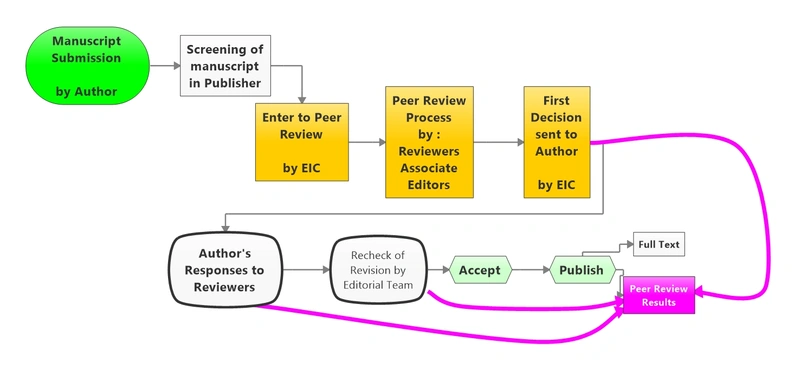
A model of the Peer Review process and contents of an Open Peer Review Report
Here you may find a sample model of the open peer review process in Brieflands journals.
Our ultimate goal
We have developed this option as a new feature of our journal management system under consultation with our editorial board and all our expert reviewers to find the best way to create a transparent environment for both our authors and reviewers. In this challenging way, we need your war messages that are more than welcome. Please be in contact with us via our support portal.
ASAPbio
ASAPbio (Accelerating Science and Publication in Biology) is a scientist-driven nonprofit working to address this problem by promoting innovation and transparency in life sciences communication. In the FAQ pages of this website, you may find much exciting information about Open Peer Review. Read also this commentary.