
1. Background
Decision-making is a complex process, and many factors are involved in any decision-making process for purchasing (1). Consumers get information through various sources such as media, family, friends (word of mouth advertising), and previous purchasing experience of goods and services and make decisions based on the obtained information. Identifying consumer decision-making styles is an important issue that helps the consumers to make insights and use it as a basis for decision-making (2). Consumer decision-making style is defined as: “A mental disposition or tendency that describes consumer orientation toward choice” (3). Consumer literature introduces three methods for describing consumer styles: The psychographic/lifestyle approach, typology approach, and consumer characteristics approach. The psychographic approach identifies more than 100 attributes related to consumer behavior (4). The consumer typology approach defines the types of consumers (5, 6), and the consumer characteristics approach focuses on the cognitive and emotional orientation associated with consumer decision-making (7, 8). The “Consumer Decision-Making List (CSI)” is developed based on the consumer characteristics approach and is the most widely used of various methods to describe consumer decision-making styles (9-11). Various studies conducted in countries with different cultures using the CSI tool have consistently failed to confirm all of its eight dimensions and have stated that consumer decision-making styles are not constant across cultures and times (12). This instability in decision-making styles may be due to the overlap between particular cases (13). A review of various studies using the CSI tool (14-20) shows that most of these studies have identified the decision-making styles of individuals in purchasing goods and have not focused on services, especially health services. The quality determination in health service delivery is always accompanied by specific challenges, and a health service provider is a complex organization due to the subtle nature of the service and the combination of different professional human resources (21).
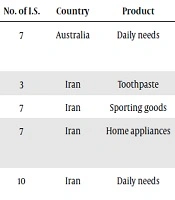
This study investigated the decision-making styles of patients referring to specialty and subspecialty clinics in Iran. If the decision-making styles of patients referring to specialty and subspecialty clinics are identified, then decision-makers can improve services by considering these factors. As shown in Table 1, research shows that consumers in different countries and domains have different styles of decision-making.
Table 1.
Results of Various Research in Identifying Consumer Decision-Making Styles
| Researchers | Identified Styles (I.S.) | No. of I.S. | Country | Product |
|---|---|---|---|---|
| (11) | Perfectionist/high-quality sensitivity, confusion among choices, instant purchases without a pre-program, habitual and brand loyalty shopping, sensitivity to fashion, leisure shopping, rational decision-making | 7 | Australia | Daily needs |
| (22) | Quality, planning, and ambiguity | 3 | Iran | Toothpaste |
| (20) | Sensitivity to famous brands, fun, and demanding shopping and price sensitivity | 7 | Iran | Sporting goods |
| (19) | Sensitivity to quality/idealism, sensitivity to the brand of the store and the store, pleasure and willingness to shop for fun, tenderness without planning and intent, sensitivity to new and trendy goods, habituation and loyalty to a brand, confused/price-driven consumers | 7 | Iran | Home appliances |
| (17) | Brand sensitivity, sensitivity to new and trendy, price and value sensitivity, idealism, unplanned tendencies, habituation and loyalty to a brand, pleasure, confusion over choices, hatred of shopping, scheduling/time allocation | 10 | Iran | Daily needs |
2. Objectives
This study aimed to investigate the decision-making styles of patients referring to specialty and subspecialty clinics in Iran.
3. Methods
3.1. Participants
In the qualitative part, 14 individuals were selected as the members of the Delphi working group through non-probability sampling by the purposeful method. The members of the Delphi working group consisted of clinic managers and supervisors, as well as therapists working in the clinics consisting of physicians, nurses, and medical students in various training courses. In the quantitative part, the statistical population of the study included all patients referring to specialty and subspecialty clinics.
3.2. Study Procedure
The present applied study was done in the framework of a qualitative-quantitative approach using the Delphi and exploratory factor analysis methods.
The Delphi method was performed in three rounds. In the first round, a list of factors based on background research was prepared, and a 40-question five-point Likert-type questionnaire was prepared in two parts. In the first part of the questionnaire, the respondents commented on the extent to which each of these factors influenced the patients’ decision to use different clinics. In the second part, the respondents were asked to list the factors that are involved in patient decision-making other than those listed in the first part of the questionnaire. They added a total of 32 new factors. In the second round of Delphi, all new factors raised in the first round were prepared in a questionnaire with five-point Likert scales, and the respondents were asked to complete it. In the third round, the questionnaire was prepared using a set of factors identified by respondents in the first and second rounds as important factors in patient decision-making in choosing different clinics. For each factor, the average response of the group members in previous rounds was recorded. At this point, the respondent was asked to reiterate his opinion on the extent to which each of the factors could influence patient decision-making in referring to different clinics by choosing one of the available options. Finally, the final questionnaire survey showed that respondents confirmed the influence of 24 factors (out of 40 factors identified based on the background research) in the decision-making of patients, as well as 24 out of 32 new factors introduced in the second round. Then, in the quantitative part of the study, a questionnaire consisting of 48 questions using the factors identified in the qualitative section was prepared to collect data for exploratory factor analysis to summarize the factors and extract decision-making styles.
3.3. Statistical Methods
Due to the unlimited statistical population, the sample size was 384 people based on the Cochran formula. Physical validity and content validity were used to assess the validity of the questionnaire. Exploratory factor analysis using varimax rotation was used to summarize factors and extract decision-making styles, and all factor loads of more than 0.4 remained in the factor matrix. The Bartlett test and the KMO test were used to test the adequacy of the variables. To investigate the reliability of the questionnaire, Cronbach’s alpha coefficient was calculated after applying exploratory factor analysis and identifying patients’ decision-making styles, the results of which can be seen in Table 2.
Table 2.
Research Questionnaire Information
| Variable | Alpha Coefficient | No. of Questions |
|---|---|---|
| Perfectionist/sensitive to the quality of health care | 0.835 | 11 |
| Perfectionist/sensitive to public service quality | 0.763 | 5 |
| Brand sensitive clinic | 0.733 | 5 |
| Cost-sensitive service | 0.722 | 4 |
| Confused among various choices | 0.816 | 5 |
| Brand-sensitive physician | 0.705 | 3 |
| Referral to a physician/habit | 0.762 | 4 |
| Visiting the clinic/loyalty | 0.707 | 3 |
| Immediate decision/low accuracy | 0.814 | 3 |
| No choice | 0.711 | 3 |
4. Results
4.1. Identifying Factors Influencing Patient Decision-Making
The factors identified in the qualitative part of the study are shown in Table 3 as influencing factors in patient decision-making in choosing a clinic.
Table 3.
Factors Influencing Patient Decision-Making
| No. | Identified Factors | No. | Identified Factors |
|---|---|---|---|
| 1 | Quality of health care | 25 | See a doctor by habit |
| 2 | Good and perfect choice | 26 | Resistance to changing the physician |
| 3 | Quality of health care delivery | 27 | Loyalty to the physician brand |
| 4 | Comparison of quality of health services | 28 | Need for special services |
| 5 | Service provider center | 29 | Financial problems |
| 6 | Standards and expectations | 30 | Inaccessibility |
| 7 | Threshold for patient satisfaction | 31 | Lack of information about clinics |
| 8 | The importance of the reputation of the clinic | 32 | Different recommendations |
| 9 | Imitating the behavior of others | 33 | Doctor's reputation |
| 10 | The role of advertising | 34 | Imitating the behavior of others |
| 11 | Importance of specialty centers | 35 | Personal brand of the doctor |
| 12 | Sensitive to cheap services | 36 | Advice from a physician by the onus |
| 13 | Pay attention to cost versus value | 37 | Advice from clinics by those around |
| 14 | Not paying attention to the cost of services | 38 | Lack of information about the disease |
| 15 | Pay attention to cost versus quality | 39 | Attitude of staff and medical staff |
| 16 | Cost control | 40 | Clean equipment |
| 17 | Unplanned lookup | 41 | Ease of processes |
| 18 | Sorry after the visit | 42 | Speed of public services |
| 19 | Speed of decision-making | 43 | Access |
| 20 | Confused at the choice | 44 | Speed of health care |
| 21 | Difficult to choose | 45 | The existence of various specialty services |
| 22 | Going to the clinic out of habit | 46 | Service time |
| 23 | Resistance to clinic change | 47 | Accuracy of diagnostic services |
| 24 | Loyalty to the clinic brand | 48 | Subsidiary health services |
4.2. Determining Patient Decision-Making Styles
The data obtained from the sample in the quantitative part of the study were first analyzed using descriptive statistics in terms of demographic characteristics, and then exploratory factor analysis was used to determine decision-making styles.
• Demographic description of the statistical sample
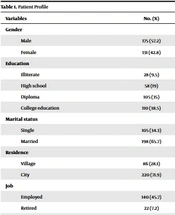
The distribution of special variables in the statistical sample is presented in Table 4.
Table 4.
Demographic Characteristics of the Respondents
| No. | Percentage | |
|---|---|---|
| Gender | ||
| F | 285 | 62 |
| M | 175 | 38 |
| Age | ||
| 20 - 30 | 58 | 12.6 |
| 31 - 40 | 225 | 48.9 |
| 41 - 50 | 177 | 38.5 |
| Education | ||
| High school | 231 | 50.2 |
| Under graduate | 70 | 15.2 |
| Bachelors’ degree | 107 | 23.3 |
| Masters’ degree | 52 | 11.3 |
| Marriage | ||
| M | 335 | 72.8 |
| S | 125 | 27.2 |
| Income of family (Rials) | ||
| Lower than 20 M | 85 | 18.5 |
| 20 - 30 M | 109 | 23.7 |
| 30 - 40 M | 148 | 32.2 |
| More than 40 M | 118 | 25.7 |
• Exploratory factor analysis
Exploratory factor analysis was used to determine patient decision-making styles. The purpose of the exploratory factor analysis was to classify the identified variables into several factors. The KMO index and the Bartlett test were used before factor analysis to ensure data fit. The KMO index value was 0.74, and the Bartlett test was significant, thus confirming that the data were fit for factor analysis. The results of the exploratory factor analysis are shown in Table 5. It should be noted that all factor loadings above 0.4 remained in the factor matrix, and two of the identified factors (numbers 4 and 38 in Table 3) were removed due to factor loads below 0.4. The results showed that the identified 10-style model explained 79% of the patients’ decision-making variance, indicating its validity.
Table 5.
Decision-Making Styles
| No. | Identified Styles | Related Factors | Special Amount | Percent of Variance |
|---|---|---|---|---|
| 1 | Perfectionist/sensitive to the quality of health care | 1-2-3-5-6-7-44-45-46-47-48 | 9.12 | 19.01 |
| 2 | Perfectionist/sensitive to public service quality | 39-40-41-42-43 | 4.19 | 8.73 |
| 3 | Brand-sensitive clinic | 8-9-10-11-37 | 4.09 | 8.52 |
| 4 | Cost-sensitive service | 12-13-14-15-16 | 3.76 | 7.84 |
| 5 | Confused among various choices | 20-21-31-32 | 3.52 | 7.33 |
| 6 | Sensitive to the physician's personal brand | 33-34-35-36 | 3.36 | 7.00 |
| 7 | Referral to a physician/habit | 25-26-27 | 2.93 | 6.11 |
| 8 | Visiting the clinic/loyalty | 22-23-24 | 2.64 | 5.50 |
| 9 | Immediate decision/low accuracy | 17-18-19 | 2.39 | 4.98 |
| 10 | No choice | 28-29-30 | 2.19 | 4.56 |
5. Discussion
The results show that there are 10 decision-making styles among patients referring to specialty and subspecialty clinics in Iran. Compared to previous research and the list of decision-making styles (CSI) presented by Sprols and Kendall (1986), the results showed that there were two ways of being/inclining and paying attention to entertainment/recreation among patients referring to clinics. Considering the nature of health care is justified, people go to service centers when they have a health problem, and the decision to go to a health center for entertainment is meaningless. The results also showed that each of the three styles of perfectionism/high-quality sensitivity, brand sensitivity, and habitual loyalty shopping among clinicians was identified in two separate dimensions such that in the perfectionism/quality sensitive style, in addition to being sensitive to the quality of health care, clinicians also care about the quality of public services, such as the treatment of staff and medical staff, the ease of processes, accessibility, cleanliness of equipment, and speed of service. In the brand sensitivity style, patients were sensitive to both the service center brand and the physician’s personal brand and may decide on each of these factors, and in the habitual and fidelity shopping style, patients may also be habitual. Three styles of instant purchase with no prior program/low accuracy, confusion among different choices, and price sensitivity are in line with the styles identified in previous research, and the style of coercion/lack of choice in this study was identified for the first time. The former is not seen and is due to the specific nature of health care, and in certain cases, patients have no choice and have to see a particular clinic or physician.
One of the most important limitations of this study is the use of a questionnaire that may affect the quality of data collected due to the inherent characteristics and general dislike of Iranian respondents. Another important limitation is the way of data collection since the data were collected from patients at the time of referral to the clinic; the response conditions of the patients may have affected the quality of the data and thus the results of the analyses. In future research, it is suggested that patient decision-making styles be discussed in other medical centers, such as hospitals or private offices, and other countries.