
1. Background
Nowadays, tattoos have a special status as one of the functions of globalization among some populations. Tattoos or stencils on the body have a special charm for the people of different cultures. While such stencils are considered attractive and essential to some people from a specific culture, some other people from the same culture may not consider them essential; this has led to the argument that certain factors make tattoos appealing to some people (1). From psychologists’ perspective, personality characteristics are important for people's behavioral patterns. A tattoo is part of a person's body language hurting his/her body; it is important to identify the reasons why people choose such a body language. The main purpose of tattoos is to create a non-verbal symbol for personal identity and to clarify the status of the person among other members of society. In other words, the high prevalence of tattooing among substance abusers may be due to their rejection by society; however, further studies are required to confirm this issue. Most studies in this area have been in the field of medicine and health (2).
Recent studies have indicated that a tattoo is a tool that can make the identity appear outstanding and unique. From this perspective, people who need a unique and distinct appearance are more likely to get tattoos; the perception of being unique can help an individual to enhance his/her self-esteem (3). Studies showed that people with tattoos have greater levels of extroversion and sensation-seeking compared to people without tattoos (4). In addition, people with tattoos are more likely to be involved in risky activities. Sensation seeking is a personality trait that is associated with arousal and reactivity.
People with special emotions are encouraged to do special activities that increase the levels of arousal (5). Experimental studies on behavioral disorders have emphasized tattooing as well. Among adolescents, tattooing has been constantly reported to be associated with substance and ecstasy use, increased frequency of sexual activities, and illegal and aggressive behaviors. Consistently, having tattoos is associated with high-risk sexual behaviors, the use of illegal substances, and the history of prison among college students. Among adults, having tattoos is associated with risky behaviors such as smoking, more sex partners, and drug abuse (6).
One of the factors related to tattoos is sensation seeking and extroversion. Gary argued that emotions are regulated through different parts of the brain (7). He suggested three different behavioral cerebral systems in the theory of “sensitivity to reinforcement” leading to personality differences as follows: (1) behavioral activation system (BAS); (2) behavioral inhibition system (BIS); and (3) fight-or-flight system. Activation include: Approach (reward-seeking) and active avoidance (taking positive steps to avoid punishment). Inhibition include: Passive avoidance (avoiding punishment by inactivity and submission) and extinction (abandoning behaviors that do not bring reward). Fight/flight include: Fight ('defensive', as distinguished from predatory, aggression) and flight (rapid escape from sources of punishment).
BAS activates behaviors to seek out the reward, pride, and hope of reward in spite of the danger or threat and is known as the system of excitation. This system consists of two components: (1) approach, and (2) active avoidance. The former component represents behaviors that actively seek out reward, and the latter includes behaviors to avoid punishment. Studies have indicated that appearing good-looking is one of the motives for using tattoos (6). Taylor et al. demonstrated that high BAS and poor BIS were associated with prominent characteristics of antisocial personality disorder (8).
The fight-or-flight system activates the escape and avoidance behavior in response to unpleasant conditional and unconditional stimuli. The excitement of fear is a component of this system (9). It is strongly argued that avoidance of fear or anxiety plays an important role in many behavioral disorders such as anxiety disorders. For example, an obsessive person washes his/her hands repeatedly to avoid anxiety (10). A study showed that dissatisfaction with appearance and appearance-related anxiety decreased after tattooing in both men and women.
2. Objectives
Given the importance of this issue, this study aimed to determine and compare BAS, BIS, and fight-or-flight system between tattooed and non-tattooed substance-dependent individuals.
3. Methods
The population of this causal-comparative study consisted of all substance-dependent people referring to rehabilitation centers in Zahedan, Iran. Of this population, 146 individuals (73 tattooed and 73 non-tattooed) were selected by convenience sampling method. The study aim was described to all participants. Data collection was conducted by the short form of the Gray–Wilson Personality Questionnaire (GWPQ).
GWPQ was developed by Wilson et al. in 1989 and consists of 120 items. All the six theoretical components of Gray, including active response to reward, active avoidance of punishment, passive avoidance of punishment, extinction, defensive, and escape were investigated by 20 items. Each item is replied by three choices as follows: (1) yes, (2) no, and (3) no idea. Regarding the reliability of the GWPQ, Barret and Gray reported the Cronbach's alpha coefficients of active response to reward, active avoidance of punishment, passive avoidance, extinction, fight, and flight to be 0.71, 0.61, 0.58, 0.61, 0.65, and 0.65 for men and 0.68, 0.35, 0.59, 0.63, 0.71, and 0.71 for women, respectively, that represent acceptable levels of internal consistency. According to correlation coefficients between the components of the GWPQ and those of Eysenck's Personality Questionnaire, the convergent validity of the GWPQ was confirmed. The GWPQ was translated into Persian by Azad Fallah and conducted on 211 Iranian students (11). Besides, Ashrafi reported the Cronbach's alpha coefficients of turning, active avoidance, passive avoidance, silence, fight, and flight to be 0.60, 0.54, 0.61, 0.66, 0.65, and 0.69 and consistency coefficients of split-half method to be 0.53, 0.57, 0.52, 0.62, 0.64, and 0.64, respectively (12). Data analysis was performed by independent t-test.
3.1. Ethical Considerations
The main objectives of the study were explained to the participants prior to their enrollment in the study, and an informed consent was obtained from all the participants. All participants were free to withdraw from the study at any stage, and they were ensured about the confidentiality of their data. The Ethics Committee of Zahedan University of Medical Sciences approved this study (IR.ZAUMS.REC.1400.045).
4. Results
In this study, 73 individuals without a tattoo (8 women and 65 men; mean age: 32.97 ± 12.45 years) and 73 individuals with a tattoo (9 women and 64 men; mean age: 33.32 ± 7.52 years) participated. All participants were married. Most (89%) of the participants were men, 15% finished elementary school, 47% finished middle school, 32% had a diploma, and 6% had higher degrees.
The scattering of tattoos on body parts was as follows: on hands (87%), face (7%), back (3%), and feet (3%); and 90% of tattoos were visible. Moreover, 48% had one tattoo, 24% had two tattoos, 10% had three tattoos, and 18% had more than three tattoos.
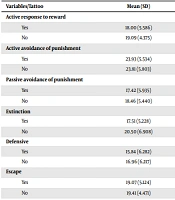
As the results show, the active avoidance of punishment had the highest mean, and defensive had the lowest mean among the variables in the two groups.
According to Table 1, tattooed and non-tattooed participants had significant differences in extinction and total scores of avoidance. No significant difference was seen between the two groups in other variables.
Table 1.
Results of Behavioral Cerebral Systems between Tattooed and Non-Tattooed Substance Abusers
| Variables/Tattoo | Mean (SD) | t | P |
|---|---|---|---|
| Active response to reward | 0.218 | ||
| Yes | 18.00 (5.586) | -1.237 | |
| No | 19.09 (4.375) | -1.235 | |
| Active avoidance of punishment | 0.903 | ||
| Yes | 23.93 (5.534) | 0.122 | |
| No | 23.81 (5.803) | 0.122 | |
| Passive avoidance of punishment | 0.302 | ||
| Yes | 17.42 (5.935) | -1.037 | |
| No | 18.46 (5.440) | -1.037 | |
| Extinction | 0.006 a | ||
| Yes | 17.51 (5.228) | -2.771 | |
| No | 20.50 (6.908) | -2.777 | |
| Defensive | 0.308 | ||
| Yes | 15.84 (6.282) | -1.023 | |
| No | 16.96 (6.217) | -1.023 | |
| Escape | 0.691 | ||
| Yes | 19.07 (5.124) | -0.398 | |
| No | 19.41 (4.471) | -0.398 | |
| Total of encounter | 0.333 | ||
| Yes | 41.93 (5.459) | -0.972 | |
| No | 42.90 (5.867) | -0.972 | |
| Total of avoidance | 0.014 a | ||
| Yes | 34.93 (8.741) | -2.501 | |
| No | 38.96 (9.544) | -2.503 | |
| Total of fight | 0.376 | ||
| Yes | 34.92 (10.044) | -0.889 | |
| No | 36.38 (8.596) | -0.888 |
a P is significant.
5. Discussion
The present study was conducted to compare BAS and BIS between tattooed and non-tattooed substance-dependent people. The findings demonstrated that BIS exhibited lower levels of function in substance-dependent people with tattoos than in those without tattoos; more clearly, BIS activity was lower in substance-dependent people with tattoos than in those without tattoos. This finding represents that lower levels of BIS function, and subsequently, higher impulsivity can lead substance-dependent people to do high-risk behaviors such as tattooing.
This finding is consistent with a study by Julant et al. that highlighted the effects of inactivity and low BIS activity on the tendency towards tattoos in substance-dependent people (13). Besides, such evidence is in agreement with the findings by LIewellyn on BIS dysfunction in amphetamine and methamphetamine users that get tattoos (14). It is also in line with the study by Christensen and Moronguilo that reported the activity of BIS to be two times higher in college students who do not commit high-risk behaviors than in those who do high-risk behaviors (15).
This argument can be explained with regards to the biopsychological backgrounds that influence risk-seeking behaviors such as tattooing. In biological models, it is assumed that neuro-biological abnormalities such as amygdala dysfunction and BIS dysfunction lead to the formation of certain cognitive-emotional deficits including poor problem-solving skills and emotional excitability, as well as the development of specific personality traits such as show-off related impulsive behaviors (16, 17).
Subsequently, such behaviors disrupt normal sociability and lead to socially unacceptable behaviors in people; therefore, they are less likely to do socially acceptable behaviors to obtain their desires. In other words, people are brought up in a way that they use risky behaviors such as tattooing as a tool to attract others’ attention (18).
Moreover, low activity of BIS declines inhibitions set by social limitations, rules, and requirements, which are a reason for people's tendency toward unacceptable behaviors such as tattooing. Low activity of BIS reflects an inherited baseline orientation or activation of response to tendency toward novelty, reward signs, active avoidance of conditionalized signs of punishment, and escape from unconditional punishment. In addition, low BIS activity is mainly exhibited by further exploratory activity in response to novelty, impulsivity, being indulged in the tendency toward reward signs, and active avoidance of failure.
This characteristic represents an inherited orientation toward continuing the behavior in response to the signs of social reward, emotionalism, social sensitivity, attachment, and dependence on others’ approval (19). A short hesitation about these characteristics represents their association with the tendency toward getting tattoos. This argument has been confirmed by previous studies (20).
It seems that low BIS activity, as Baskin-Sommers and Sommers stipulated, increases risk-taking to obtain social approval in people such that they turn their bodies into an exciting painting on the one hand, and causes them to greatly underestimate the risks and consequences due to tendency to such behaviors on the other hand. For example, despite being involved in high-risk behaviors such as tattooing, people with tattoos underestimate the risks and consequences of tattooing and assume themselves to be immune from such serious hazards via insensible thoughts such as “tattoos cause no damage to me” (21).
The effects of the BIS on the ability of emotional processing can be used to explain this finding. People with normal (moderately active) BIS report to have lower levels of negative emotions and establish strong relationships with others to whom they refer to receive support in emotional distress; therefore, they are less likely to do risky behaviors to attract others’ attention. Approaches to regulating emotions and relationship with others depend on the sensitivity and response of the BIS (22).
Evidence indicates that people with different levels of BIS activity exhibit different sensitivity and bias toward receiving external signs, including exciting and pleasurable stimuli (23).
The difference in sensitivity and bias plays an important role in emotional regulation. People with normal BIS exhibit optimal and coherent response to exciting environmental stimuli that they experience, and learn that balanced expression of emotions and socially acceptable behavioral responses can lead to positive outcomes. In contrast, people with lowly active BIS respond to exciting environmental stimuli extremely because of the poor capability of emotional processing and fail to control their responses.
5.1. Conclusions
While BAS is associated with positive emotions, BIS is associated with negative emotions. The tattoo seems to be a sign of special personality characteristics and can be used as a way to extinction the emotions and avoiding to deal with pejorative emotions. Higher impulsivity can lead substance-dependent people to do high-risk behaviors such as tattooing.