


1. Background
Gender recognition is an important issue in forensics and anthropology. Gender differences in the bony pelvis and skull are well defined. After these two bones, it is the mandibular bone in humans that helps us identify age, sex, and race (1). The mandibular bone, like other bones in the body, is affected by age, metabolic activity, and hormonal changes (2). The mandibular angle is actually the angle between the posterior border of the Ramos mandible and the lower border of the mandibular bone (3). The mandibular bone is the largest and strongest bone in the face with a horizontally curved, convex forward structure with two broad rami, which climbs upwards at the end of the structure. The coronoid and condyloid appendages of the mandibular bone are considered suitable for study, as this bone is the most durable facial skeleton and retains its shape better than do other bones. Differences in the mandible between different sexes may be due to relative differences in the development of the musculoskeletal system, especially the masticatory muscles attached to the mandible (4, 5).
Radiographs are a good tool for identification in forensic medicine. The accuracy of measurements in radiography is based on the quality of radiography. This device provides the ability to view the entire structure of the mandible (6). Considering what was said about the importance of the mandibular bone in sex determination, this study was performed to investigate sex determination using mandibular angle measurement in the graphics of Iranian adults referred to the 600 Army Dental Center in 2016.
2. Methods
In a cross-sectional study, 73 men and 76 women aged over 18 years were enrolled. Patients were excluded from the study if they did not have an identity document, or had trauma to the mandible, congenital malformations, bone disease, or a history of maxillofacial surgery. Also, if the stereotype lacked the desired quality for evaluation for any reason, it was excluded from this study. Pack software was used to measure the mandibular angles (the angle between the intersection of the posterior side of the ascending horn and the lower side of the mandible) in all Panorex graphs on the right (Figure 1). Men and women were divided into three age groups: 18 - 34, 35 - 49, and ≤ 50 years. The amount of radiation was 60 - 63 kV in women and 66 - 70 kV in men, which was irradiated for 18 seconds, with maximum radiation of 80 kV.
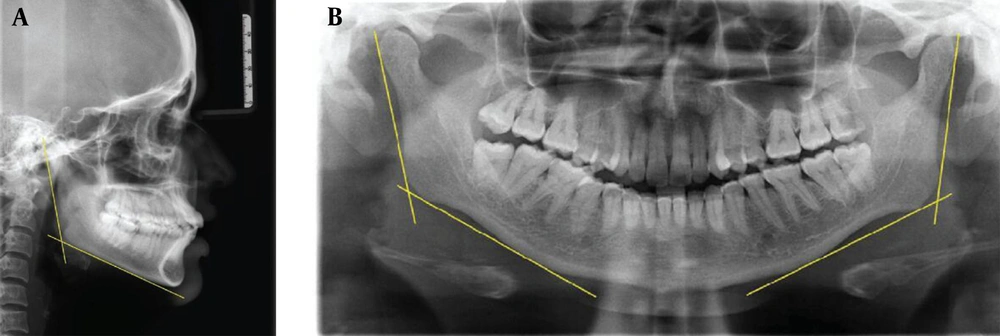
Figure 1.
Mandibular angles in (A) cephalogram and (B) panorex graphics.
The data were analyzed by ROC, Two-way ANOVA, and Bonferroni post hoc test using SPSS 22 software. The statistical significance level in the present study was considered less than 0.05.
The present study with the ethics code of IR.AJAUMS.REC.1399.223 was approved by the Ethics Committee of the Army University of Medical Sciences.
3. Results
The mean mandibular angle was significantly higher in women than in men (Table 1). However, there was no significant difference in the mean mandibular angle between age groups. Mandibular angle had a significant cutoff point for sex differentiation (Table 2).
Table 1.Mandibular Angle in Males and Females in Three Age Groups a
| 18 - 34, y | 35 - 49, y | Above 50, y | All Ages | P Value b | |
|---|---|---|---|---|---|
| Male | 121.8 ± 0.6 | 122.4 ± 0.9 | 123.4 ± 0.6 | 122.2 ± 0.5 | 0.498 |
| Female | 124.3 ± 0.5 | 124.6 ± 0.7 | 126.3 ± 0.8 | 124.7 ± 0.4 | 0.122 |
| P value | P < 0.05 | P < 0.05 | P < 0.05 | P < 0.05 |
aData are expressed as Mean ± SEM and analyzed by Two-Way ANOVA and Bonferroni post hoc test.
bP < 0.05 was considered significant.
Table 2.Cutoff Point of Mandibular Angle and Mandibular Foramen Diameter (Three Directions) in Males and Females
| Age Group | Cutoff Point (Degree) | AUC | P Value | Sensitivity (%) | Specificity (%) |
|---|---|---|---|---|---|
| Mandibular angle | 123.1 | 0.758 | 0.000 | 74 | 66 |
4. Discussion
Gender determination is one of the most important pieces of information that can be obtained from bones (7). It has been demonstrated that humans differ from each other in size and proportion and that these variances can affect the metric assessment of sex. In the present study, the mandibular angle was significantly higher in women. It is in agreement with the other studies (8-11). However, some reports contradict our results (12, 13). This difference may be because they performed their study on completely toothless or toothless elderly patients in the posterior region. The mandibular angle increased non-significantly with age, which is in agreement with other reports (14). This result may be due to that muscle function preserves the bone at the point where the muscle joins the bone. Therefore, the connection of the internal pterygoid muscle and the master leads to the preservation of the gonial angle region. With age, the diet becomes softer, and the chewing force decreases; thus, the size of the gonial angle increases as getting older and bone resorption in the area. The mandibular angle was much higher in the present study than in the study by Akhlaghi et al. (15), which examined the mandibular angle in 12 to 19-year-old Iranian population, and this indicates an increase in the mandibular angle with age. Our measurements in this study confirm this subject.
In the present study, unlike most studies in Iran that examined the mandibular bone in corpses, the mandibular bone of living individuals was examined. It should be noted that in the present study, in order to investigate the characteristics of the mandibular bone, an all-digital device and pack software were used, which are the other distinguishing features of the present study compared to other studies conducted in Iran. It is suggested that a long-term study be performed on a larger statistical population. Factors such as tooth or tooth loss, malocclusions, and chewing patterns should also be considered as variables, as these can also affect outcomes.
4.1. Conclusions
It may be concluded that the radiomorphometric index measured in this study, i.e., the mandibular angle, may predict gender, but this is not the case for age and cannot be used as an accurate and practical tool in estimating the age of individuals.
