
1. Background
The coronavirus disease 2019 (COVID-19) has recently become a health problem in the world, leading to physical, psychological, and social issues (1-3). Physical activity has played a critical role in decreasing physical, mental, and social issues during this period. For example, a better quality of life has been reported in active individuals versus inactive individuals during the COVID-19 pandemic (1). In addition, long-term inactivity harms the health-related quality of life and causes more stress during this period (4). Adolescence is a transitional period between childhood and adulthood, including rapid and surprising physical changes. The body requires to move to adapt to these changes (5). Children and adolescents are the future youth of all nations. More than 2.3 billion people of the world population are under 24 years old (about 42% of children from birth to 14 years and 26% of those aged 15 - 24 years old) (5). Also, adolescence is a critical stage for increasing the proper habits and, thus, a healthy lifestyle (6).
Sports and physical activities should be started during this period of life to become a habit. Because these activities can create a positive attitude, this habit can last a lifetime (5). Physical activity is a proper tool to improve adolescents’ satisfaction and quality of life (6). Life quality is a multi-dimensional concept that refers to physical, mental, and social health (7). Studies have indicated that an active lifestyle is associated with health and better life quality, and in contrast, a sedentary lifestyle is associated with lower life quality among adolescents (7). Studies have also indicated that subjective well-being is directly related to the quality of life. In a study, pleasure and satisfaction were reported as the causes of 81% of the changes in life quality. In addition, the quality of life for adolescents is related to solving life issues.
Health has a strong relationship with quality of life. The individuals feel comfortable and satisfied with their health, but health is not only physical but also mental and social. The World Health Organization has recommended 30 minutes of moderate physical activity per day for a healthy life (5). Health has an immediate effect on the quality of life of people in physical, mental, and social dimensions (8). In addition, studies have reported the role of health in the satisfaction of adolescents, especially some studies that have compared girl and boy adolescents, and the level of life satisfaction of girls was lower than boys, which was related to less activity in girls than boys probably (8).
Therefore, paying attention to this issue can increase sports and physical activity in adolescent girls and boys due to its effect on life satisfaction. Also, considering the coronavirus epidemic and its destructive impacts on physical, mental, and social health and reduced quality of life, there are few studies about the effect of physical activity on the health-related life quality of adolescents.
2. Objectives
The current study aimed to evaluate the health dimension of life quality in active and inactive adolescents during the COVID-19 pandemic.
3. Methods
3.1. Population and Statistical Sample
The present study population consisted of all high school students in Shiraz schools. According to Morgan’s table, 350 (175 active and 175 inactive students) students participated in this study as volunteers. According to previous studies, the criterion of being active was having at least three one-hour sessions of physical activity during the week.
3.2. Method of Collecting Information
This study used a 12-question Short-form Quality of Life Questionnaire (SF-12) to collect information.
3.3. Quality of Life Questionnaire
To evaluate the quality of life, the SF-12, developed by the World Health Organization in 1996, was used. This 12-question questionnaire is a shortened form of the 36-question Quality of Life Questionnaire, which includes two physical and mental parts. It has eight subscales. A higher score indicates a higher quality of life, so that a score of 37 - 48 is in a good class, 25 - 36 in the middle class, and 12 - 24 in the poor class. Also, by answering different questions, the subscales are calculated as follows: the overall perception of one’s health (question 1), physical function (questions 2 and 3), physical health (questions 4 and 5), emotional problems (questions 6 and 7), physical pain (question 8), social function (question 9), vitality and vital energy (question 11), and mental health (questions 10 and 12).
3.4. Statistical Analysis
To evaluate the normality of the distribution of findings, we used of Kolmogorov-Smirnov test. Also, an independent t-test was used to evaluate the differences in research findings. A significance level of 0.05 was considered using SPSS 18.
4. Results
The level of quality of life, general mental health, and general physical health were higher in active students than inactive students (Table 1).
Table 1.
Health-related Quality of Life in the Active and Inactive Adolescents a
| Variables | Active Group | Inactive Group | P-Value |
|---|---|---|---|
| Mental component summary | 21.52 ± 0.37 | 20.36 ± 0.75 | 0.001 b |
| Social function | 4.44 ± 0.05 | 4.05 ± 0.14 | 0.001 b |
| Vitality | 4.69 ± 0.10 | 4.21 ± 0.28 | 0.001 b |
| Mental health | 9.36 ± 0.20 | 9.30 ± 0.22 | 0.030 b |
| Emotional problems | 2.97 ± 0.01 | 2.83 ± 0.12 | 0.001 b |
| Physical component summary | 15.65 ± 0.58 | 14.62 ± 0.19 | 0.001 b |
| Body pain | 4.85 ± 0.12 | 4.56 ± 0.14 | 0.019 b |
| Understanding of your life | 3.41 ± 1.02 | 3.22 ± 1.14 | 0.881 |
| Physical function | 4.63 ± 0.15 | 4.53 ± 0.08 | 0.001 b |
| Physical health | 2.73 ± 0.30 | 2.30 ± 0.10 | 0.001 b |
| Health-related quality of life | 37.18 ± 0.21 | 34.98 ± 0.54 | 0.001 b |
a Data are presented as mean ± standard error of the mean.
b P ≤ 0.05
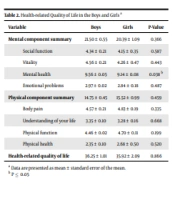
There was no significant difference in the level of quality of life, general mental health, and general physical health between boys and girls (Table 2).
Table 2.
Health-related Quality of Life in the Boys and Girls a
| Variables | Boys | Girls | P-Value |
|---|---|---|---|
| Mental component summary | 21.50 ± 0.55 | 20.39 ± 1.09 | 0.366 |
| Social function | 4.34 ± 0.21 | 4.15 ± 0.35 | 0.587 |
| Vitality | 4.56 ± 0.21 | 4.26 ± 0.47 | 0.443 |
| Mental health | 9.56 ± 0.05 | 9.14 ± 0.08 | 0.038 b |
| Emotional problems | 2.97 ± 0.02 | 2.84 ± 0.18 | 0.487 |
| Physical component summary | 14.75 ± 0.45 | 15.52 ± 0.99 | 0.459 |
| Body pain | 4.57 ± 0.21 | 4.83 ± 0.19 | 0.335 |
| Understanding of your life | 3.35 ± 0.10 | 3.28 ± 0.16 | 0.668 |
| Physical function | 4.46 ± 0.02 | 4.70 ± 0.11 | 0.199 |
| Physical health | 2.35 ± 0.10 | 2.68 ± 0.50 | 0.520 |
| Health-related quality of life | 36.25 ± 1.01 | 35.92 ± 2.09 | 0.866 |
a Data are presented as mean ± standard error of the mean.
b P ≤ 0.05
5. Discussion
We studied the health-related quality of life in active and inactive adolescents during the COVID-19 pandemic. In general, the results showed that quality of life was higher in active students than in inactive students, and also, quality of life, general mental health, and general physical health in boy students were higher than in girl students. Our research results showed that the health-related quality of life score in active students was higher than in inactive adolescents. In addition, there was a significant difference in the overall mental and physical health scores and in all the sub-comparisons of these two variables between active and non-active adolescents. These results are in line with the findings of Sadeghipour et al. reporting that active students had a higher quality of life during the quarantine period caused by the COVID-19 pandemic (1). During the epidemic of viral diseases, such as COVID-19, students have anxiety due to mental pressure and concerns about their health, and fear of failure in their educational process, and this issue can affect their quality of life. Shakiba et al. reported that non-athletic students of dentistry had a low quality of life (9). In general, regardless of epidemics, such as COVID-19, the quality of life of athletes is higher compared to non-athletes and they have a better mental and emotional state (10), which is consistent with our research, in which active students had a better condition in terms of mental and physical quality of life. Wingerson et al. reported that athlete students’ anxiety levels increased during the COVID-19 pandemic compared to before, which caused a variation in athletes’ quality of life (11). Parsak and Sarac observed no significant difference in the quality of life of athletes and non-athletes; however, athletes were infected with the disease of COVID-19 to a lesser extent (12), and this issue can raise the concerns about athletes being excluded due to contacting the disease during the epidemic. Inactive people who have a low level of physical activity mainly have musculoskeletal disorders, which lead to a decrease in physical, mental, and social functions, a decrease in general health, and, ultimately, a decrease in the quality of life (13). This issue shows the importance of exercise and physical activity in the development of the quality of life at all times, especially during epidemics when the level of physical activity is unintentionally reduced.
The comparison of the quality of life in active and inactive adolescents in each of the gender groups of male and female showed that there was no significant difference between the active and inactive groups of male adolescent students, but in the group of girls, the results showed that female athlete students had a higher quality of life. In the study by Sadeghipour et al., active male students had a higher quality of life, which was attributed to girls’ greater concern about being overweight during the COVID-19 quarantine (1). McGuine et al. reported that female athletes had moderate to severe symptoms of anxiety compared to male athletes during the COVID-19 restrictions (14). Although it has been shown that girls have more concerns about their physical activity levels (15), it seems that the female adolescent athletes in the present study were able to overcome this concern well. Although the level of worry and anxiety of the research samples was not investigated in the present study, female athletes may have less anxiety due to their physical activity levels, which has increased their quality of life compared to inactive girls. Physical activity can reduce anxiety levels and increase the quality of life (16). On the other hand, during the COVID-19 pandemic, athletes have experienced more disturbances in their eating habits (17). Because female athletes are usually more sensitive to this issue, perhaps this is one of the reasons why female adolescent athletes have a better quality of life. Also, healthy food patterns have a significant relationship with athletes’ positive state of attitude and mental health (18).
In total, the results of this research showed that during the epidemic of COVID-19, active adolescent students had a higher quality of life, and in the group of boys, there was no significant difference between the quality of life of active and inactive students, but in the girls’ group, active students had a higher quality of life. The small number of samples and the lack of evaluation of the psychosocial variables of the research samples can be considered as one of the limitations of the research. However, it seems that athlete students have a higher quality of life, which can contribute to the importance of exercise and physical activity during epidemics in order to maintain the quality of life and, as a result, prevent the educational decline of students.