
1. Context
Different infections with viral agents appear clinically with coagulation disorders and hemorrhage. These factors could induce a range of mild skin hemorrhages to a disseminated coagulation state (1). For example, dengue, endemic in Asia and the Caribbean, can induce petechial and skin rashes in mild form; however, in severe patients, dengue could be associated with hemorrhagic shock syndromes (2). Hemorrhagic fevers with viral agents, such as Marburg virus, Ebola, Rift Valley fever, Crimean-Congo fever, and Lassa fever, induce hemorrhages with different severity degrees, and some cases might be associated with high mortality and morbidity (3). Some cases with parvovirus B19 and cytomegalovirus can induce clotting disorders, such as thrombosis (4). In addition, viral infections of the respiratory tract can enhance the deep venous thrombosis risk and probably pulmonary embolism (PE) (5, 6).
Compared to Middle East respiratory syndrome coronavirus and severe acute respiratory syndrome coronavirus 1, severe acute respiratory syndrome coronavirus 2 (SARS-CoV-2) has spread faster and influenced almost all continents unevenly (7). Approximately 5 - 10% of cases of coronavirus disease 2019 (COVID-19) are in severe condition and are admitted to the intensive care unit (ICU) for mechanical ventilation due to bacterial pneumonia (8). The SARS-CoV-2 pathophysiology goes far beyond just attack to lung tissue and is still being identified (9, 10).
Different agents induce the hypercoagulation condition in cases with severe SARS-CoV-2, including immobility and related circulatory stasis (common to intensive cases), acute inflammatory condition with acute phase reactant enhancement (e.g., C-reactive protein [CRP], and fibrinogen) and enhanced clotting agents, enhanced activity of von Willebrand factor (VWF), neutrophil extracellular traps enhancement, and neutrophilia (11). Some studies have observed that endothelial cell injury and enhanced blood viscosity in COVID-19 cases might lead to thrombogenesis (12, 13). Additionally, hypoxia can induce thrombosis by enhancing the viscosity of blood and the hypoxia-inducible transcription factor-dependent pathway. Stroke of the large vessel has been mentioned as a probable presentation of SARS-CoV-2 cases (14). All of Virchow’s triad elements, including stasis, endothelial dysfunction, and hypercoagulability state, can be observed in SARS-CoV-2 cases (4, 8, 15).
The present study, as a literature review, will evaluate the related data about thromboembolic events in cases with SARS-CoV-2. This study will focus on the thromboembolic conditions commonly observed in severe COVID-19 cases. It is mainly based on publications of isolated short series or clinical cases, with a retrospective information collection. The present review will evaluate related studies in this field and recently obtained data and information on thromboembolic events, disturbed hemostatic parameters, and thromboinflammatory conditions related to SARS-CoV-2 and will discuss the modalities for the management of this condition.
2. Evidence Acquisition
2.1. Study Setting
The present study was conducted at Arak University of Medical Science, Valiasr Hospital, Arak, Iran.
2.2. Study Design and Search Terms
This study, as a literature review, was conducted based on standard guidelines to evaluate related-to-title information about thrombotic or thromboembolic events in COVID-19. Keywords were combined and included as “thrombotic event”, “thromboembolic events”, “diagnosis”, “management”, “SARS-CoV-2”, “COVID-19”, and “literature review”.
2.3. Inclusion and Exclusion Criteria
Related and published studies about thrombotic or thromboembolic events in cases with SARS-CoV-2 and management methods were studied, and the related data were compared and summarized as a review article. In addition, review articles and case reports, papers with only abstracts, studies without full texts, articles without safety, book chapters, congress abstracts, review articles and studies without statistical aspects and irrelevant or inadequate information were excluded from the present study.
2.4. Assessment of Quality and Extraction of Data
In review and research studies, obtained information was included as abstracted independently. Moreover, information about the study sample size, study period, region, publication year, country, study name, and preventive methods of mortality was extracted. In addition, study quality was evaluated independently based on Joanna Briggs Institute’s critical appraisal checklist. This method includes nine items rated as either yes, no, not clear, or not applicable.
2.5. Databases
English databases, including the National Health Service, World Health Organization, PubMed, Google Scholar, Science Direct, and Scopus, were searched for this study.
3. Results
3.1. Mechanism of Coagulopathy in COVID-19
Cases of SARS-CoV-2 might have gentle low platelet, reduced prothrombin time to some extent, increased level of D-dimer, and enhanced fibrinogen, which are more frequently mentioned as increased disease severity. This COVID-19-associated coagulopathy (CAC) state was determined based on disseminated intravascular coagulation (DIC) and sepsis-initiated coagulopathy (SIC) (16). The SIC and DIC, which could occur in SARS-CoV-2, are uncommon when approved indicator standards are applied. Comparative discoveries of CAC are additionally accounted for in COVID-19 (16, 17). D-dimer marker, as a fibrin corruption index at fibrinolysis, is distinguishing for clotting of intravascular blood and could be brought up in infections and inflammation (18). An expansion in D-dimer could occur in SARS-CoV-2, and self-governing has a correlation with mortality. Increased D-dimer might be detected with SARS-CoV-2 lung disease and delivered based on the segregation of alveolar fibrin that is saved in acute respiratory distress syndrome (ARDS) (11). Extra coagulation markers and aggravation could be likewise unusual in SARS-CoV-2, such as VWF, ferritin, supplement, cytokines, and CRP (19, 20).
COVID-19 tilts the respiratory tract, obtaining cellular fraction using angiotensin-converting enzyme 2 (ACE2) receptor binding outside airway epithelial cells (11). Obsessive shifts in SARS-CoV-2, diffuse lesions of alveoli, type II pneumocytes initiation, fibrin affidavit, and arrangement of hyaline layer predictably change in ARDS cases (11, 21). Microvascular anomalies of the lung unmistakably occur in SARS-CoV-2, angiogenesis, microthrombi arrangement, and penetration of perivascular monocyte. The inflammation of cells in pulmonary endothelium includes the interruption of the membrane, articulation of receptor of endothelial ACE2, or backhanded impacts of host incendiary (17, 18).
Emboli occur in higher than 50% of SARS-CoV-2 postmortem evaluations. The receptor of ACE2 is totally communicated by different agents, and COVID-19 has been detected in the liver, kidneys, cerebrum, and heart, which might be thrombotic events out of the lungs (22). Pulmonary thrombosis of SARS-CoV-2 cases can lead to immunothrombosis or PEs; however, there is no current system for the symptomatic separation of patients (19, 22).
3.2. Hemostasis Changes in COVID-19 with Its Endothelial Dysfunction
The endothelium is a cellular layer fixing capacities of veins that incorporates giving a mechanical obstruction between the cellar membrane and the circling blood, controlling immunomodulation and tone of vessels (23). The brokenness of endothelium includes the enactment of the endothelium and reduces endothelium-subordinate vasodilation that leads to a proliferative state, procoagulant, and proinflammation (24). Clinical results of SARS-CoV-2 are more regrettable in cases with the disease that have a relationship with the brokenness of endothelium (e.g., primary hypertension, corpulence, and diabetes), and the brokenness of endothelium is proved in SARS-CoV-2 cases (25). The process of the brokenness of the endothelium might occur in direct COVID-19 infiltration of endothelium cells (14, 26, 27).
Limiting the spike protein of COVID-19 to the receptor of ACE2 is worked by serine protease TMPRSS2 provision, followed by viral replication and endocytosis (28). The damage to the endothelium and the induction of the delivery of viruses are insensitive reactions that can cause additional endothelial breakdown (29).
3.3. Mechanisms of Thrombosis and the Immune System in COVID-19
Invulnerable framework and hemostasis intricately have an association with two complementary frameworks that have prevented and protected the spread of invasive microorganisms. Physiological immunothrombosis might lead to dysregulated bringing (30). Thrombosis that might be related to the immune system has been proposed as a significant neurotic instrument in patients with COVID-19, whereby intrinsic safe cell actuation, unnecessary coagulation, and endothelial brokenness add to the noticed prothrombotic state (31). The relationship between the intrinsic insusceptible frameworks and hemostasis, especially macrophages, neutrophils, and monocytes, is the main index of thrombosis related to the immune system (32). Innate invulnerability activation might be motivated by the framework of coagulation. Active factor 10 and thrombin could activate insensitive cells and some receptors (33). Similarly, fibrin and fibrinogen have been shown to initiate neutrophil activation (34, 35).
3.4. Thrombotic Clinical Implications in COVID-19
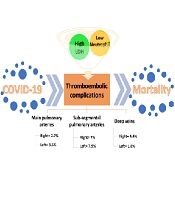
There are mounting and generous documents for a massive thrombosis danger in cases with SARS-CoV-2 (36). A study in Dutch clinics tracked down 31% of thromboembolic events in 184 SARS-CoV-2 ICU cases, despite thromboprophylaxis with low molecular weight heparin (37). Some related confusions were deep vein thrombosis, PE, dead myocardial tissue, fundamental blood vessel embolism, and ischemic stroke (38). A high level of PE severity accounts for 81% of the total attention (39). In SARS-CoV-2, venous thromboembolism (VTE) side effects are more common in ICU-admitted cases, with 59% incidence and 9.2% prevalence, and are related to a high mortality rate (40). The ICU cases with COVID-19 are related to greater VTE than non-SARS-CoV-2 ICU cases indicating that the basic etiology for VTE in SARS-CoV-2 is possibly higher than the idleness due to ICU alone treatment (41). The SARS-CoV-2 cases with VTE are more frequently observed and liable to show strange coagulation boundaries, such as activated partial thromboplastin time and D-dimer (13, 42).
4. Discussion
Thrombosis and COVID-19 have a similar pattern for total thrombotic side effects in COVID‐19 cases (43). The level of thrombotic risk was high in the first and second pandemics of COVID-19 (PE as the most common thrombotic side effect in the two pandemic waves); however, mortality was decreased by 47% in the second pandemic wave. Therefore, the side effects of thrombosis (especially in the lungs) remain a SAR-CoV-2 challenge (44, 45).
In previous studies, there has been an increased thromboembolic prevalence in COVID-19 cases that have been certified by evaluated studies. In a systematic review, the merged incidence from the 19 studies indicates that about 28% of SARS-CoV-2 cases led to thromboembolic events, which is a greater prevalent rather than in the general population, hospitalized non-ICU cases, and ICU patients. Two articles as cohort studies evaluated COVID-19 cases and observed that control cases have a lower level of VTE incidence in the control population, reported as 5% and 10%, respectively. Moreover, less than 28% were observed in COVID-19 cases in this study (46, 47).
In addition, another study by Menter et al. showed that the mean incidence (gender and age-adjusted) of VTE in a hospital was 960.5 per 10,000 evaluated cases. The incidence among non-hospitalized community residents was 7.1 per 10,000 cases (48). In addition to ICU-admitted cases, the VTE incidence at 28 days based on weekly intervals was 4.45%. A study by Tsakok et al. showed that 31 emboli patients were observed in COVID-19 cases despite therapy advances. In addition, they observed a decreased computed tomography pulmonary angiogram rate requests for the ICU cases in the second pandemic wave indicating a modification in practice (most SARS-CoV-2 cases were managed on respiratory high‐dependency units in the second wave) (45).
Some related studies mentioned that SARS-CoV-2 cases have a developing risk of different forms of pulmonary hypertension, such as chronic thromboembolic pulmonary hypertension (CTEPH), which is a known side effect of acute emboli. It was mentioned that CTEPH after SARS-CoV-2 was not observed in the systematic literature review due to the follow-up time. The absence of some to-date studies is not conclusive: In cases without SARS-CoV-2, the interval between subsequent CTEPH development and acute emboli might range from several months to years (22, 43). The incomplete resolution of thrombus has been observed in a group of pulmonary emboli and SARS-CoV-2 cases (44, 49, 50). Therefore, CTEPH could emerge after SARS-CoV-2-related acute pulmonary emboli. Similar to the aforementioned studies, a study from the United States observed a higher incidence of pulmonary hypertension in SARS-CoV-2 cases rather than in the general population (51). Therefore, enhanced CTEPH incidence could have been an important consequence of widespread SARS-CoV-2 conditions. The CTEPH incidence after SARS-CoV-2-related PE should be evaluated in long‐term studies (52).
Based on the present review study, thrombotic or thromboembolic events in COVID-19 should be considered a common condition, and this can lead to better management based on its early diagnosis.
4.1. Conclusions
The present study has reported further data about the influence of SARS-CoV-2 on thrombotic or thromboembolic events. Although most studies did not evaluate cases with a control group, an evaluation based on historical groups of cases in the general population, hospitalized cases, and ICU patients has shown a statistical difference in thromboembolism incidence in SARS-CoV-2 cases. Assailable cases, including elderly patients and cases with chronic comorbid disorders, have a higher hospitalization risk that makes them prone to a higher thromboembolism risk. The recent consensus among researchers supports using anticoagulation drugs in hospitalized SARS-CoV-2 cases with moderate to severe infection and critically ill patients. The results of the present study can be helpful to physicians who manage SARS-CoV-2 cases with a greater risk of thromboembolic events.
4.2. Limitations
The most important limitation of this study was the small number of studies in this field in the short time after the spread of SARS-CoV-2. Therefore, the current study investigated the studies for a longer time and conducted a review based on summarizing them.