
1. Background
Soldiers are a part of the main body of the armed forces in the Islamic Republic of Iran, and together with other members of the armed forces, they perform their duties and accept responsibility for establishing order and security (1). Keeping committed and expert human resources in military organizations and units is crucial. This issue is due to the importance of the inherent duties of military organizations. Any disruption in the commitment of the military forces poses a severe threat to the durability and credibility of a country (2). For this purpose, the presence of the country's youth in the period of military service is associated with opportunities and challenges, and one of the most important concerns of their families and commanders is to maintain the physical and mental health of soldiers during and after the end of military service (3). Studies have shown that the prevalence of suicidal ideation and attempts in the military was 11% (95% CI, 10% - 13%) and 11% (95% CI, 9% - 13%), respectively. The prevalence of suicide ideation and attempts in the drug-using military was 18% (95% CI, 7% - 33%) and 30% (95% CI, 23% - 36%), respectively (4).
People such as family members, close friends, colleagues, and others present in people's lives usually cannot provide professional and specialized aid to help people involved in suicidal thoughts and plans (5). Primary care professionals are often better positioned to maintain established relationships with patients, possessing a more comprehensive understanding of their health history. This pre-existing rapport can be crucial when patients undergo exacerbations of suicidal ideation (SI) or encounter stressors that could lead to suicidal behaviors, as they are more inclined to seek assistance from primary care professionals. Research indicates that a significant proportion of individuals (80% - 90%) who died by suicide increased their contact with primary care professionals in the year and months leading up to their suicide. Notably, 44% of those who died by suicide had contact with primary care professionals in the final month of their lives (6, 7). Many people engaged in suicidal thoughts may not want to discuss their condition, mental state, and negative thoughts and emotions. This issue is one of the main problems and challenges in identifying and referring suicidal people. Gatekeeper training is one of the most practical and professional suicide prevention strategies emphasizing training individuals to become qualified gatekeepers (8). Gatekeeper training relies on the Question, Persuade, Refer (QPR) method, initially established as a mental health intervention designed for individuals facing a suicidal emergency (9). Gatekeeper training provides trainees with the knowledge, aptitude, skills, and techniques to help them better recognize suicidal risk, identify individuals by symptoms, and intervene correctly and timely to provide help (10).
There is a lot of evidence that gatekeeper training can increase the perceived knowledge and coping skills of those under training in dealing with suicidal situations. Compared to people who received no activity, the people who received gatekeeper training have generally shown more efficiency and performance in recognizing suicidal warning signs and adopting more effective intervention strategies (11). Another study indicated that gatekeeper training improved the intervention skills, awareness, and self-confidence of the trained people in dealing with suicidal people and also strengthened their positive beliefs about the effectiveness of their suicide prevention strategies; however, while the conducted research indicated an advance in attitude and an increase in people's skills, abilities, and self-efficacy after receiving gatekeeper training, there was no standard or at least a defined scale of these competencies that is the framework for evaluating the performance of the gatekeeper training program (12). The findings from a study examining the attitudes of military personnel toward the causes of soldiers' suicides indicated that intra-organizational factors, including inappropriate and provocative behavior by commanders, discriminatory application of laws, and neglect of soldiers and their needs, can significantly impact this issue. Consequently, it highlights the importance of training commanders in effective subordinate management and fostering awareness of suicide prevention (13).
In this study, we developed a gatekeeper-based suicide prevention training package to improve attitudes and enhance knowledge about suicide in IR army commanders who are in daily direct contact with their duty-staff personnel under command. In the end, by reviewing the literature and the background of studies related to high-risk behaviors, especially suicide in duty-staff personnel of the IR army and the methods of suicide prevention in the army forces, a qualitative and comprehensive research gap was visible in line with the fundamental development of a suicide prevention training package based on the gatekeeper model in Iran.
2. Objectives
Given the vital importance of this matter on the well-being of soldiers and the lack of studies in this regard on the Iran army, this study aimed to evaluate the impact of a gatekeeper suicide prevention training package on improving the attitude and enhancing the knowledge of army commanders in the field of suicide prevention.
3. Methods
A Delphi method was used to design and develop the gatekeeper training package. This research was conducted with a pretest and posttest based on a quasi-experimental study. In this study, the statistical population in the first stage (the development of the gatekeeper-based suicide prevention training package) consisted of psychologists and psychiatrists who specialized in suicide prevention. In the second stage (the effectiveness analysis of the gatekeeper training package), the population consisted of 40 commanders and IR army rank officers of Tehran in 2023. In this study, sampling was conducted in 2 stages. For the Delphi section of the elite, 20 participants were selected based on purposeful sampling. In the intervention section, 40 commanders were randomly assigned to experimental (20 participants) and control (20 participants) groups based on purposeful sampling. In this study, the following criteria were considered: (1) Consent to participate; (2) living in Tehran; (3) having daily direct contact with the army’s duty-staff personnel under their command; (4) having at least a diploma educational degree for commanders. In addition, the exclusion criteria included: (1) Failure to attend the training session; (2) the lack of cooperation with the researcher in the process of the training intervention and the lack of consent to participate; (3) the failure to follow training intervention rules.
All commanders were assured that their participation in the research was entirely voluntary, and they were also informed that all their information was confidential and would be published anonymously.
The researcher conducted 7 topics of gatekeeper-based suicide prevention training package (risk factors for suicide in army "intra-organizational factors - extra-organizational factors," most common methods of suicide in army, signs and symptoms of suicide in army personnel, essential actions of gatekeepers in army, destructive actions of gatekeepers in army, referral centers, myths and misconceptions about suicide in army) for the experimental group in a 1- to 3-h single session, while the control group underwent no intervention. The international valid attitude toward suicide (ATTS) questionnaire by Renberg and Jacobsson (1996) was used to evaluate the effectiveness of the gatekeeper training package on commanders and collect data in this study. Survey items of the questionnaire included basic demographic profiles, such as age, education level, marital status, and duration of service in the IR military.
This study used the 31-question form of Arnotovaska and Grad scale (14). This scale has 5 components: Facilitation, preventability, incomprehensibility, avoidance of talking, unpredictability, loneliness, and crying for help. The reliability of this scale, using Cronbach's alpha, was α = 0.76 in Renberg and Jacobsen's study, and using exploratory factor analysis, they stated that the questions of this scale generally justify 60% of the total variance (15). The ATTS questionnaire was administered to both groups in the pretest and posttest. The analysis of the research data was carried out using the Mann-Whitney U test in SPSS version 26. All the results obtained from this research were realized under the official permission of AJA University of Medical Sciences.
4. Results
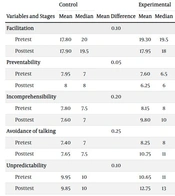
To assess the effectiveness of the suicide prevention training package based on the gatekeeper model on commanders' awareness of preventing suicide among duty-staff employees of the Islamic Republic of Iran Army, the Mann-Whitney-U test was employed. The evaluation of the gatekeeper suicide prevention package used several scales, including facilitation, preventability, incomprehensibility, avoidance of talking, unpredictability, and loneliness and cry for help in the ATTS questionnaire. Table 1 displays the obtained results.
Table 1.
The Statistical Description of Attitude Toward Suicide Scores for 2 Measurement Stages, Separately for Both the Experimental and Control Groups, With the Results of the Mann-Whitney-U Test
| Variables and Stages | Control | Mean Difference | Experimental | Mean Difference | Mann-Whitney U (Z Value) | P-Value | ||
|---|---|---|---|---|---|---|---|---|
| Mean | Median | Mean | Median | |||||
| Facilitation | 0.10 | 1.35 | 2.793 a | 0.006 | ||||
| Pretest | 17.80 | 20 | 19.30 | 19.5 | ||||
| Posttest | 17.90 | 19.5 | 17.95 | 18 | ||||
| Preventability | 0.05 | 1.35 | 2.388 b | 0.024 | ||||
| Pretest | 7.95 | 7 | 7.60 | 6.5 | ||||
| Posttest | 8 | 8 | 6.25 | 6 | ||||
| Incomprehensibility | 0.20 | 1.65 | 2.991 a | 0.003 | ||||
| Pretest | 7.80 | 7.5 | 8.15 | 8 | ||||
| Posttest | 7.60 | 7 | 9.80 | 10 | ||||
| Avoidance of talking | 0.25 | 2.50 | 4.552 a | 0.001 | ||||
| Pretest | 7.40 | 7 | 8.25 | 8 | ||||
| Posttest | 7.65 | 7.5 | 10.75 | 11 | ||||
| Unpredictability | 0.10 | 2.10 | 3.644 a | 0.001 | ||||
| Pretest | 9.95 | 10 | 10.65 | 11 | ||||
| Posttest | 9.85 | 10 | 12.75 | 13 | ||||
| Loneliness and crying for help | 0.15 | 1.55 | 4.094 a | 0.001 | ||||
| Pretest | 6.30 | 6.5 | 7.10 | 7 | ||||
| Posttest | 6.15 | 6.5 | 5.55 | 6 | ||||
a Significant at the 0.01 level.
b Significant at the 0.05 level.
Table 1 shows a statistical description of ATTS prevention scores, presenting mean and median scores individually for both the experimental and control groups across 2 measurement stages (pretest and posttest). The results of the Mann-Whitney U test to compare the scores of the 2 groups are also presented in Table 1. Based on the results obtained, all the statistical measures associated with data derived from the components of facilitation, preventability, incomprehensibility, avoidance of talking, unpredictability, loneliness, and cry for help achieved statistical significance at the alpha level of 0.05 (P < 0.05). Significant points in the table are denoted with an asterisk (*) marker (significant at the 0.05 level* and significant at the 0.01 level**). Consequently, it is concluded that the suicide prevention training package, grounded in the gatekeeper model, has proven effective in enhancing commanders' awareness concerning suicide prevention among duty-staff employees of the Islamic Republic of Iran Army.
5. Discussion
This study aimed to develop a gatekeeper-based suicide prevention training package and evaluate its impact on improving ATTS and enhancing knowledge about suicide prevention in IR army commanders. In the present study, it was found that the gatekeeper-based suicide prevention training package was effective in enhancing knowledge and improving ATTS in army commanders who are in daily direct contact with duty-staff personnel. The present study's findings are consistent with prior studies examining the influence of the gatekeeper-based suicide prevention training package. Consistent with the results of the present study, Burnette et al. indicated that gatekeeper training was able to convey and prepare the army's personnel and commanders for a more practical intervention to persuade and refer the personnel at risk of suicide, correct myths and false beliefs about suicide, enhance knowledge about suicide prevention and eliminating the willingness to intervene (11).
Consistent with the findings of the present study, the reports presented in the study by Stone et al. showed that identifying people at risk of suicide in the military, continuously providing conditions for their treatment and referral, and supporting these people can have a positive effect on suicide prevention and related risk factors in the military. In other words, gatekeeper training can provide a platform for trainees (even in stressful environments such as military barracks) to intervene in the field of identification, persuasion, and referral of personnel at risk of suicide with more competence in a principled and regular way (16). According to the findings of the study conducted by Hawgood et al., individuals who underwent gatekeeper training demonstrated notable enhancements in their observational and perceptive abilities, as well as their applied knowledge. Additionally, they exhibited more positive attitudes and a decreased reluctance to intervene when encountering individuals at risk of suicide. This program was specifically targeted at gatekeepers who had not received prior training; however, participants in this study who had a prior background in suicide prevention skills also experienced positive and significant gains and results in most of the measurement scales of this study (17).
A significant finding from another study underscores the effectiveness of semi-experimental research and workshops in the areas of suicide prevention and life skills. This research highlights the significant impact of educational workshops on improving the mental well-being of military personnel. Additionally, in-depth interviews and group therapies revealed that relationships and social support within military settings, both vertically and horizontally, exert a significant impact on the mental well-being of soldiers (18). Consistent with the findings of the present study, Isaac et al. indicated that the training of gatekeepers in many populations, including military personnel, school employees, medical personnel, and local people, showed that this type of training had a positive and significant impact on the knowledge, shaping of abilities, and reshaping and optimizing the attitudes and views of trainees about suicide prevention. Subsequent investigations into gatekeeper training, conducted on a more extensive scale involving military personnel and regional physicians, showed encouraging findings, demonstrating significant reductions in suicidal ideation, self-harm behaviors, and fatalities (19). One of the main limitations of this study is the lack of research literature related to the performance of gatekeepers in Iran and the development of a comprehensive suicide prevention package based on this model and its evaluation. In this way, the researcher, relying on the Delphi method and obtaining the views of army elites in the field of suicide prevention, designed the gatekeeper training package. For this purpose, conducting more research and studies in this field is suggested.
5.1. Conclusions
The suicide prevention training package, grounded in the gatekeeper model, can enhance the self-efficacy of army commanders in intervention, improve their knowledge and skills in suicide prevention, rectify misconceptions about suicide, eliminate the stigma associated with suicide, and equip them to effectively assist the individuals at risk of suicide. Also, the findings of this study can be used in formulating suicide prevention programs for military training centers, inspection units, counseling centers of military barracks, mental health units, and training and educational units of barracks.