
1. Background
Infection with intestinal parasites in human communities is one of the main health problems in most countries across the globe (1). Children are the most vulnerable among parasitic patients. Parasitic infections play a crucial role in increasing malnutrition by compromising the immune system and altering the macro and micronutrient balance of the body (2). During childhood, a lack of essential vitamins and minerals can directly affect growth and development, morbidity, and the chances of survival of a child (3). Infections caused by worms (such as Ascaris lumbricoides, hookworms, Trichuris trichiura, and Hymenolepis nana) and protozoa parasites (including Entamoeba histolytica and Giardia lamblia) are directly related to poverty, polluted water, inadequate medical care, and poor health (4, 5). Studies have shown that intestinal parasitic infections occur in 28 to 39.1% of school-age children in some developing countries (6-8). It has also been reported that the prevalence of intestinal parasitic infections in Iran ranges from 11.93 to 33.3% (9-11).
2. Objectives
The present study aimed to assess the correlation between intestinal parasitic infections and the nutritional status of primary school students in two residential settlements in Tehran.
3. Methods
3.1. Study Design
This cross-sectional descriptive-analytical study used an available sampling method to assess 250 primary school students from 2 residential settlements in Tehran. Inclusion criteria included students who had experienced symptoms such as abdominal pain, bloating, bloody diarrhea, and bruxism and subsequently received anti-parasitic medicine during the previous year. Exclusion criteria included individuals who did not exhibit severe symptoms or had not taken medication.
3.2. Parasitology Examination
All samples were initially examined for color, consistency, and the presence or absence of blood, tapeworms, etc. Subsequently, a portion of each sample was cultured in an agar nutrient medium. Diarrhea samples underwent testing via direct wet smear using physiology serum and Lugol, as well as formalin ethyl acetate methods. Suspicious samples of intestinal flagella for both tested methods were permanently stained by the trichrome method. Also, samples suspected of Cryptosporidium by the Lugol staining method were painted with modified Kinyoun's acid-fast stain. After 25 h of culture, the presence or absence of traces in the medium was detected through stereomicroscopy for 1 week every 22 h. Trace mediums were washed with normal saline to investigate the existence of larvae and their type based on morphology and detection key. Samples positive for intestinal pathogens were reevaluated, and formalin ether concentration (sedimentary method) was used for all samples in addition to the direct test method. Initially, a portion of the stool was dissolved in 10 mL of 10% formalin, and then 3 mL of ether was added to a 7-mL-filtered suspension, after which the mixture was vigorously shaken and centrifuged for 2 min at 2000 - 2500 rpm. After centrifugation, 4 layers were formed. The top 3 layers were discarded, and Lugol was added to the sediment in the pipe for examination under the microscope.
3.3. Nutrition Test
To investigate nutritional status the Mini Nutritional Assessment (MNA) questionnaire was used. The MNA questionnaire includes various sections about anthropometric measurements such as body mass index, average arm circumference, leg muscle circumference, weight, height, and weight loss. Additionally, it covers general specifications (such as lifestyle, depression symptoms, mental health issues, and mobility), nutritional specifications (including eating independence and intake of meals, food, and fluids), and a documentary evaluation on self-understanding of health and nutrition. The answers to each question are awarded points. The total scores are then classified as follows: A score below 17 indicates malnutrition, a score from 17 to 23.5 implies potential malnutrition and a score from 24 to 30 signifies a normal diet.
3.4. Body Status
Furthermore, self-reported daily activities were used to assess functional status. Participant weight and height were measured using a 3-lever scale with minimal clothing and without shoes (accurate to 0.1 kg) and a tape measure (accurate to 0.5 cm without shoes). Once participants were selected, a questionnaire was administered via interviews to collect data on parasitic infections and their frequency, which was then analyzed according to the research objectives.
3.5. Statistical Analysis
The data were analyzed using the χ2 test, and the analysis was performed using SPSS version 23. A significance level of 0.05 was applied.
3.6. Ethical Aspects
The Ethics Committee of the Army University of Medical Sciences approved this study (code: IR.AJAUMS.REC.1399.050). Written consent was obtained from the families of the students before sampling.
4. Results
The study involved 250 students with a mean age of 10.17 ± 1.65, ranging from 7 to 14 years.
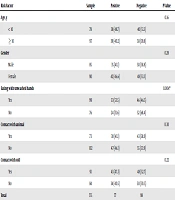
Out of the surveyed students, 45 (18%) were infected with parasitic infections (23, 10, 5, 3, 2, and 2 were infected with G. lamblia, E. coli, hookworms, Endolimax nana, H. nana, and A. lumbricoides, respectively). There was no significant difference in the frequency of infection between girls (n = 27) and boys (n = 18; P = 0.675).
Of the surveyed students, 18 individuals (7.2%) were found to be malnourished, 212 individuals (84.8%) were exposed to malnutrition, and 20 individuals (8%) had normal nutrition levels. The results showed a significant association between nutritional status and parasitic infection (P < 0.001). Ten (55.6%) cases (out of 18) of malnourishment, 32 (15.1%) cases (out of 212) of malnutrition, and 3 (15.0%) cases (out of 20) of normal nutrition had parasitic infections.
The association between parasitic infection and mother's and father's education was significant (P < 0.001); 82.2%, 6.7%, 6.7%, 4.4%, and 0% of cases with parasitic infection had mothers with an under diploma, diploma, associate, bachelor, and master education, respectively. The distribution of fathers' education levels among the cases with parasitic infection is as follows: 0% had fathers with under diploma education, 0% had fathers with a diploma, 26.7% had fathers with an associate degree, 73.3% had fathers with a bachelor's degree, and 0% had fathers with a master's degree.
5. Discussion
The World Health Organization (WHO) estimates that a quarter of the world's population has 1 to 4 intestinal parasites (12). Currently, there is no national program in Iran to control intestinal parasitic infections (13), and the prevalence of parasitic infections varies among different populations. Therefore, to develop an effective strategy to control parasitic infections, it is necessary to assess the prevalence of these types of infections periodically (11).
The parasitic infection rate of the students in this study was 18%, while a study conducted in the Ethiopian capital reported a higher rate of 29%. Entamoeba histolytica and E. dispar were the most common parasites found in that study (14), while this study did not discover any of these parasites in the samples. In Hernandez et al.'s study (15), all Colombian children examined had intestinal parasitic infections, a much higher rate than found in our study. The prevalence of parasitic contamination in different parts of Iran emphasizes its significance as a major health concern throughout the country. Approximately 25.1% of primary school students in Bushehr were found to be infected with at least 1 type of intestinal parasite, with 5.9% of them being infected with multiple species. The highest prevalence was observed among children in education levels 4 and 5 (16). Similarly, among children aged 7 - 13 years in Ardabil, the prevalence rate stands at 27.7% (17). According to studies conducted in Iran, the rate of parasitic infection in primary school students in Urmia was 42.5%, and the most common parasite was Giardia, with a frequency of 20.5% (18). Research shows that in South Khorasan Province, the rate of intestinal parasitic infection among primary school students was about 47.7%, of which almost 33.4% were pathogen parasites (19). These studies demonstrate that various types of parasites are present. In addition, although non-pathogenic parasites are not harmful to human health, they can be considered a health indicator in the region because their presence indicates the lack of hygiene in these families. In the current study, 7.2% of the children were malnourished. This prevalence was lower than the rate reported in previous studies (20), as well as the rates observed in Chinese (21) and Egyptian children (22). Malnutrition and parasitic infection in the present study had a significant correlation that is similar to the results obtained in other studies (23, 24). As in a cross-sectional study by Haratipour et al. (25), all preschool children of Shahrood City (1850 cases) were selected by a simple census, and after the investigation, the prevalence of parasitic infection in boys (51.1%) was significantly higher than in girls (42.3%). Also, a significant relationship was observed between malnutrition (height for age) and parasitic infections (P < 0.05). Madadi et al. (26) observed that children with Cryptosporidium infection had more malnutrition compared to those who were negative for Cryptosporidium, but this important finding was not statistically significant. In a study in Argentina, 60 children were examined using anthropometric and parasitological analyses, and 28.3% of them had malnutrition. Among malnourished children, 88.2% had parasitic infection by at least 1 potentially pathogenic species. Malnourished children had a higher prevalence of most parasite species compared to well-nourished children, but there was no significant relationship between them (27). In addition, the study examined the relationship between the frequency of parasitic infections and the level of education of parents. The results revealed that the relationship between parasitic infection and mother's education was significant, with 82.2% of infected individuals having mothers with high school education; also, the relationship between parasitic infection and father's education was found to be significant. Davami et al. (28) conducted a study that revealed a correlation between lower maternal education, lower family income, and larger households with an increased incidence of intestinal parasitic infections in children. Moreover, students with employed mothers exhibited the lowest infection rates. In other studies, the lack of proper environmental health and the unsustainable employment of parents have been introduced as the most important factors in the prevalence of parasitic infection and malnutrition in children (29).
Based on the results of the current study and considering the pathogenic role of parasites in humans, as well as the physical, psychological, economic, and social losses caused by them, it is imperative to conduct further research on the prevalence of parasitic infections in various regions and societies, as well as to implement programs to improve the nutrition and health status of students in those schools.
5.1. Conclusions
It seems that parasitic infections are associated with students’ nutritional status and their parent education.