1. Background
Hemophilia is a serious disease whose unpredictability causes complications, such as bleeding, internal joint bleeding, and intracranial bleeding (1). In patients with hemophilia, in addition to medical issues, such as bleeding (2), the risks of incorrect treatment and misdiagnosis (3) can affect all aspects of a person and his/her family's life. According to the nature of the disease, spontaneous repeated bleeding, which sometimes occurs with the slightest stroke, can drastically affect the body and soul of the patient. Additionally, the treatment and its huge costs, the issue of health safety of blood products, and above all, the coagulation factors, which seriously expose patients and their families to various viral diseases, can be taken as other effects (4). There will be some other sorts of problems, such as academic breaks, negative mental image (5), socioeconomic burden (6), social or behavioral problems (7), and employment difficulties (8).
Following the treatment in chronic patients, especially the hemophilia ones, a controversial issue has been considered. Non-adherence to treatment is always considered an important and multidimensional problem in the field of health. Weak cooperation in treatment is a warning sign for both patients and healthcare providers due to weak social support. From a clinical point of view, non-adherence to the treatment causes a decrease in the beneficial effects of the treatment and an increase in signs and symptoms, complications, the rate of hospitalization, and even death (9).
Available evidence suggests that hemophiliac adults face many challenges related to their disease, including difficulty controlling bleeding periods (10), joint destruction (11), arthritic ache (12), physical disability, emotional turmoil (13), social problems, financial problems (14), and treatment-related problems (15), all of which also affect their family relationships. Hemophilia affects patients physically, socially, and psychologically. Traumatic experiences, chronic stress, and other illnesses can lead to psychopathy and mental disorders; however, many individuals with hemophilia have a very positive outlook (1). Research has shown that adherence to treatment decreases in late childhood and adolescence in chronic patients with other chronic diseases. The same tendency was observed in hemophilia, where adherence to preventive measures has been shown to decline sharply in early adolescence when self-prescription usually begins (16).
Due to the complexity of health and treatment issues in the contemporary world, responsibility and participation in self-care and treatment is not only the awareness of the nature of the disease; it is also necessary to create motivation and positive attitudes with social support for hemophilia patients (17).
Social support has been defined as the care, affection, respect, consolation, and help that other individuals or groups devote to an individual. This support might be provided by various sources, such as spouse, fiancé, family, relatives, friends, colleagues, doctors, or other social organizations (18). The importance of social support in the management of chronic diseases has been proven for a long time. The perceived social support has diverse effects on the physical and psychological conditions, such as satisfaction and various aspects of individuals’ quality of life (19, 20), and it is considered a determining and modifying factor in dealing with and adapting to stressful life conditions (21). Social support is known as an important factor in social psychology and in facilitating health behaviors (22).
Social support is strongly attached to the feeling of acceptance by others (emotional dimension) (23). Researchers have shown that low social support from friends and others can affect health status in a negative way (24). On the other hand, the high level of social support is considerably related to the improvement of physical and mental levels and has protective effects on physical health (25, 26). The evidence shows that mortality is reduced strongly in individuals who receive more social support (27). Rader also believes that social support will highly affect the quality of life by increasing personal competence, perceived control, sense of stability, and recognition of life values (28).
Ratajova et al. found that social support can be considered an important factor in confronting hemophilia. They also stated that social support includes a network of support from friends, family, and healthcare specialists (1). Therefore, considering the prevalence of hemophilia and the importance of social support concerning this chronic disease, the present study was conducted with the aim of investigating the level of social support and its relationship with the clinical and demographic characteristics of patients going to the hemophilia center.
2. Methods
This cross-sectional study was conducted on patients going to the hemophilia center in Sanandaj, Iran, in 1402. The statistical population of patients going to Sanandaj Hemophilia Center included 163 individuals. Based on the sample entry criterion, which was from 18 years and above, the volume of the sample was equal to 120 samples. Sampling continued until data saturation. The inclusion criteria included those having hemophilia type A or B with a doctor's approval, age over 18 years, and willingness to participate in the study. The exclusion criteria, on the other hand, included having a family member working as medical-treatment staff (even if they do not live together) and incomplete questionnaires.
After having obtained the code of ethics from the Ethics Committee of the Kurdistan University of Medical Sciences (IR.MUK.REC.1401.339), the questionnaire was distributed twice a week during the activity hours of the Hemophilia Center in Sanandaj Hemophilia Center. Based on the inclusion criteria, the researcher invited the hemophilia patients to participate in the research. First, the purpose of the study was explained to all, and then informed consent was obtained from them. The Social Support Questionnaire was distributed in person at the Hemophilia Center in Sanandaj. In the case of illiterate patients, the questionnaire was filled out by the researcher. The obtained information was kept confidential, and the information was strictly used in line with the goals of this study.
When the samples entered the study, demographic and clinical characteristics, including gender, age, type of hemophilia, age of diagnosis, referral numbers per month, patient's education, family income, type of drug used, insurance status and type of insurance, coverage status of special organs, the employment status, and place of residence, were recorded in the information registration form. To qualify the questions in terms of edition and science, the questions were given to 10 experts, and their opinions were applied. The Social Support Questionnaire (SSA3) prepared by Vaux et al. in 1986, including three dimensions of family, friends, and others, was used in this study. The aforementioned questionnaire has 23 items which include three subscales: Family support (questions 2, 4, 7, 9, 11, 13, 18, and 22), support from friends (questions 1, 6, 10, 15, 16, 19, and 23) and the support of others (3, 8, 5, 12, 14, 17, 20, and 21). Scoring will be done using a 5-degree Likert scale (very high = 5, high = 4, moderate = 3, low = 2 and very low = 1). The scoring of questions 3, 10, 13, 21, and 22 was done in reverse. The reliability of the questionnaire was 0.93 based on the Pearson test.
For qualitative variables, the frequency distribution table was calculated concerning qualitative variables. Mean and standard deviation were calculated concerning quantitative variables. In the analytical part of the study, independent t-student statistical analysis was used to answer the tests and test hypotheses. A one-way analysis of variance was performed to compare the average dimensions of social support for hemophilia patients according to individual characteristics and socioeconomic variables. A significance level of less than 5% was considered. STATA software (version 12) was used for statistical analysis.
3. Results
The research results showed that 93 subjects participated in this study, including 77.5% male and 22.5% female. The main part of the population belonged to the age range of 18-28 years, 26.7% belonged to the range of 29-39, and 8.3% belonged to over 50 years. In this study, 55.8% of patients suffered hemophilia type A, and the remaining (44.2%) tolerated hemophilia type B. The age diagnosis of 30.8% of the samples were diagnosed when they were less than 1 year old, And 30.7% were between one and two years old and only 5% were between 12 and 20 years old. In this study, 67 patients (55.8%) visited twice a month; nevertheless, 29.2% visited the center once a month. Moreover, 59 patients (49.2%) had a diploma and sub-diploma, 40% had an upper diploma degree, and only 1 patient had a postgraduate degree and higher. The monthly income of 70.9% of patients' families was less than 5 million tomans. The 8 million tomans monthly income belonged only to 3.3% of families. Factor 8 antihemophilic was used by 53 subjects (44.2%), Novasone was used by 25% of the patients, and desmopressin was used by 17.5% of the patients. Additionally, 67 patients (55.8%) were under social security insurance, 31.6% had health insurance, and 13 subjects (10.8) had no insurance coverage. None of the patients was covered by a special organization, such as the Social Welfare Bureau and Aid Committee. The majority of patients (49.2%) were self-employed, 25% were unemployed, and 5% were employees. Additionally, 94 (78.3) of the investigated subjects lived in the city, and the remaining 21.7% lived in rural areas.
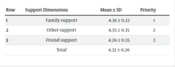
The three dimensions of social support, namely family support, support from others, and support from friends, were examined in dimensions. Family support, with an average of 4.36, has the highest value, compared to other dimensions. The average value of total social support was equal to 4.32 (Table 1).
Table 1.
Average and Prioritization of Social Support Dimensions of Studied Hemophilia Patients
| Row | Support Dimensions | Mean ± SD | Priority |
|---|---|---|---|
| 1 | Family support | 4.36 ± 0.33 | 1 |
| 2 | Other support | 4.35 ± 0.35 | 2 |
| 3 | Friend support | 4.26 ± 0.35 | 3 |
| Total | 4.32 ± 0.26 |
According to the results of the independent student t-test in social support dimensions, there was no statistically significant difference in terms of gender, type of hemophilia, and place of residence (P > 0.05) (Table 2). The results of the analysis of variance (ANOVA) test showed that there was no statistically significant difference concerning the patient’s occupation, diagnosis duration, and patient’s age in social support dimensions (P > 0.05) (Table 3). As the ANOVA test result showed, there was no statistically significant difference in accordance with the level of education and patient’s physician appointment (Table 4) (P > 0.05). However, in terms of monthly family income, in the dimensions of family support, support of others, and total social support, a statistically significant difference was observed in such a way that the increase in monthly family income made social support increase drastically (P < 0.05) (Table 4). Based on the results of the ANOVA test, no statistically significant difference was noticed in the dimensions of social support according to the type of drug used (P > 0.05) (Table 5).
Table 2.
Comparison of Average Dimensions of Social Support of Hemophilia Patients Studied Based on Gender, Place of Residence, and Type of Hemophilia
| Dimensions | Mean ± Standard Deviation of Social Support Score Based on Gender | t | P-Value | |
|---|---|---|---|---|
| Male | Female | |||
| Family support | 4.35 ± 0.33 | 3.35 ± 0.34 | -0.023 | 0.982 |
| Friend support | 4.23 ± 0.36 | 4.33 ± 0.29 | 1.343 | 0.182 |
| Other support | 4.36 ± 0.36 | 4.29 ± 0.40 | -1.009009/.1- | 0.315 |
| Total social support | 4.32 ± 0.27 | 4.32 ± 0.21 | 0.061 | 0.952 |
| Dimensions | Mean ± Standard Deviation of Social Support Score Based on Residence | t | P-Value | |
| Urban | Rural | |||
| Family support | 4.37 ± 0.34 | 4.31 ± 0.32 | 0.791 | 0.431 |
| Friend support | 4.24 ± 0.30 | 4.30 ± 0.49 | -0.787 | 0.433 |
| Other support | 4.36 ± 0.35 | 4.28 ± 0.35 | 1.041 | 0.300 |
| Total social support | 4.32 ± 0.25 | 4.30 ± 0.29 | 0.523 | 0.602 |
| Dimensions | Mean ± Standard Deviation of Social Support Score Based on the Type of Hemophilia | t | P-Value | |
| Type A | Type B | |||
| Family support | 4.33 ± 0.32 | 4.38 ± 0.34 | -0.853 | 0.396 |
| Friend support | 4.25 ± 0.38 | 4.26 ± 0.30 | -0.036 | 0.971 |
| Other support | 4.37 ± 0.35 | 4.32 ± 0.36 | 0.660 | 0.511 |
| Total social support | 4.32 ± 0.26 | 4.33 ± 0.25 | -0.083 | 0.934 |
Table 3.
Comparison of the Average Dimensions of Social Support of the Studied Hemophilia Patients According to Age of Patients, Duration of Disease Diagnosis, and Occupations of Patients
| Dimensions | Mean ± Standard Deviation of Social Support Score Based on the Age of Patients | F | P-Value | ||||
|---|---|---|---|---|---|---|---|
| 18-28 | 29-39 | 40-50 | 51-61 | 62-above | |||
| Family support | 4.33 ± 0.35 | 4.35 ± 0.28 | 4.36 ± 0.34 | 4.47 ± 0.32 | 3.87 ± 0.00 | .0.865 | 0.487 |
| Friend support | 4.29 ± 0.40 | 4.26 ± 0.31 | 4.24 ± 0.30 | 4.16 ± 0.30 | 4 ± 0.00 | 0.409 | 0.802 |
| Other support | 4.37 ± 0.35 | 4.28 ± 0.38 | 4.38 ± 0.33 | 4.37 ± 0.33 | 4.12 ± 0.00 | 0.510 | 0.729 |
| Total social support | 4.33 ± 0.27 | 4.30 ± 0.22 | 4.33 ± 0.26 | 4.34 ± 0.28 | 4.32 ± 0.00 | 0.483 | 0.748 |
| Dimensions | Mean ± Standard Deviation of Social Support Score Based on Disease Diagnosis Duration | F | P-Value | ||||
| Less than 1 | 1-2 | 2-6 | 6-12 | 12-20 | |||
| Family support | 4.38 ± 0.32 | 4.29 ± 0.37 | 4.34 ± 0.32 | 4.43 ± 0.26 | 4.54 ± 0.15 | 1.033 | 0.393 |
| Friend support | 4.29 ± 0.38 | 4.22 ± 0.31 | 4.24 ± 0.36 | 4.20 ± 0.34 | 4.38 ± 0.36 | 0.434 | 0.784 |
| Other support | 4.32 ± 0.33 | 4.32 ± 0.37 | 4.33 ± 0.38 | 4.59 ± 0.26 | 4.46 ± 0.13 | 1.108 | 0.356 |
| Total social support | 4.33 ± 0.23 | 4.28 ± 0.29 | 4.31 ± 0.26 | 4.42 ± 0.24 | 4.46 ± 0.13 | 1.020 | 0.400 |
| Dimensions | Mean ± Standard Deviation of Social Support Score Based on the Job of Patients | F | P-Value | ||||
| Unemployed | Staff | Student | Personal Job | Household | |||
| Family support | 4.27 ± 0.38 | 4.42 ± 0.38 | 4.36 ± 0.30 | 4.38 ± 0.32 | 4.35 ± 0.33 | 0.578 | 0.679 |
| Friend support | 4.22 ± 0.44 | 4.38 ± 0.19 | 4.44 ± 0.377 | 4.21 ± 0.30 | 4.32 ± 0.30 | 1.334 | 0.261 |
| Other support | 4.14 ± 0.40 | 4.56 ± 0.19 | 4.46 ± 0.27 | 4.42 ± 0.30 | 4.33 ± 0.36 | 4.632 | 0.002 |
| Total social support | 4.21 ± 0.32 | 4.46 ± 0.22 | 4.42 ± 0.24 | 4.34 ± 0.23 | 4.35 ± 0.17 | 2.351 | 0.058 |
Table 4.
Comparison of Average Social Support of Studied Hemophilia Patients According to Number of Physician’s Appointments, Education Level of Patients, and Monthly Income of the Family
| Dimensions | Mean ± Standard Deviation of Social Support Score Based on Patient’s Physician Appointment | F | P-Value | |||
|---|---|---|---|---|---|---|
| 1 | 2 | 3 | 4 | |||
| Family support | 4.32 ± 0.30 | 4.39 ± 0.35 | 4.29 ± 0.30 | 4.37 ± 0.00 | 0.555 | 0.646 |
| Friend support | 4.23 ± 0.34 | 4.29 ± 0.33 | 4.18 ± 0.44 | 4 ± 0.00 | 0.791 | 0.501 |
| Other support | 4.34 ± 0.36 | 4.37 ± 0.33 | 4.28 ± 0.40 | 3.87 ± 0.00 | 0.965 | 0.412 |
| Total social support | 4.30 ± 0.28 | 4.35 ± 0.22 | 4.25 ± 0.33 | 4.09 ± 0.00 | 1.154 | 0.330 |
| Dimensions | Mean ± Standard Deviation of Social Support Score Based on Education of Patients | F | P-Value | |||
| Diploma and Lower | Upper Diploma | BA | Over BA | |||
| Family support | 4.36 ± 0.32 | 4.32 ± 0.33 | 4.44 ± 0.38 | 4 ± 0.00 | 0.772 | 0.512 |
| Friend support | 4.24 ± 0.37 | 4.27 ± 0.33 | 4.25 ± 0.27 | 4.42 ± 0.00 | 0.153 | 0.928 |
| Other support | 4.34 ± 0.38 | 4.34 ± 0.33 | 4.40 ± 0.28 | 4.12 ± 0.00 | 0.213 | 0.888 |
| Total social support | 4.32 ± 0.27 | 4.31 ± 0.25 | 4.37 ± 0.20 | 4.17 ± 0.00 | 0.239 | 0.869 |
| Dimensions | Mean ± Standard Deviation of Social Support Score Based on Family Monthly Income | F | P-Value | |||
| Less than 3 | 3-5 | 5-8 | Over 8 | |||
| Family support | 4.27 ± 0.36 | 4.31 ± 0.30 | 4.34 ± 0.37 | 4.52 ± 0.26 | 4.196 | 0.007 |
| Friend support | 4.24 ± 0.377 | 4.23 ± 0.38 | 4.32 ± 0.07 | 4.30 ± 0.29 | 0.360 | 0.782 |
| Other support | 4.27 ± 0.32 | 4.27 ± 0.42 | 4.59 ± 0.12 | 4.53 ± 0.23 | 5.371 | 0.002 |
| Total social support | 4.26 ± 0.26 | 4.27 ± 0.27 | 4.42 ± 0.10 | 4.46 ± 0.19 | 4.960 | 0.003 |
Table 5.
Comparison of Average Social Support of Studied Hemophilia Patients Based on the Type of Drug Used
| Dimensions/Type of Drug | Mean ± Standard Deviation of Social Support Score Based on Type of Drug Used | F | P-Value | |||||
|---|---|---|---|---|---|---|---|---|
| Anti-hemophilic | Desmopressin | Beogeneric | Novasone | Des+Novasone | Anti+Desmo | |||
| Family support | 4.14 ± 0.29 | 4.06 ± 0.26 | 4.00 ± 0.00 | 4.22 ± 0.32 | 4.23 ± 0.34 | 4.15 ± 0.35 | 0.507 | 0.770 |
| Friend support | 4.04 ± 0.35 | 3.92 ± 0.30 | 4.28 ± 0.00 | 4.13 ± 0.32 | 4. 05 ± 0.36 | 3.96 ± 0.49 | 0.575 | 0.719 |
| Other support | 4.57 ± 0.46 | 4.78 ± 0.10 | 4.85 ± 0.00 | 4.65 ± 0.33 | 4.50 ± 0.43 | 4.52 ± 0.46 | 0.546 | 0.741 |
| Total social support | 4.06 ± 0.27 | 4.06 ± 0.03 | 4.17 ± 0.00 | 4.1 ± 0.22 | 4.07 ± 0.27 | 4.03 ± 0.29 | 0.548 | 0.740 |
4. Discussion
According to the results of the present study, 77.5% of the studied patients were male. Hemophilia is a hereditary bleeding disorder that occurs mostly in men (29). Most of the study subjects were within the age range of 18-28 years, and 55.8% of the patients had hemophilia type A. In a study by Plug et al., most of the participants (85%) had hemophilia type A (30). In the UK, it has been estimated that 5 900 individuals have hemophilia type A and 1 200 individuals suffer from hemophilia B (29). In another study conducted in Tehran and Karaj, Iran, 80% of the patients had hemophilia type A (31). In a study by Chiu et al., 82% of the studied population was suffering from hemophilia A (32). In the present study, 49.2% of the participants had a diploma and sub-diploma education, and 1 case had postgraduate education and higher. The findings of previous studies indicated that patients with hemophilia have a higher level of education (30, 33).
The monthly income of 70.9% of patients’ families was less than 5 million Tomans, and only in 3.3% of the families, it was higher than 8 million Tomans. In a study conducted in Canada, more than half of the hemophilia patients participating in the study had a high household income, and 35% of the patients had an average household income (32), which is very close to the present study’s results. None of the patients was covered by a special organization, such as a relief or welfare committee, and 10.8% were without insurance coverage.
In the current study, the average social support of the studied patients was equal to 4.32 out of a maximum of 5, which means that the social support of the studied patients was almost at a high level. The results of a study conducted in Canada showed that participants with hemophilia have high average social support scores (32), which is consistent with the findings of the present study. In another study conducted in the Czech Republic, hemophilia patients are involved actively in helping others and providing social support in addition to receiving help and support. Compared to the illness or problems of others, their health problems might not seem so serious; accordingly, it can help them to deal with their illness (1). In a 2020 study by Ratajova et al., it was also shown that individuals with hemophilia not only want to receive support but also try to provide support to others (1). The findings of studies by Anari et al. (34) and Geckova et al. (35) indicated a high level of social support for patients, which confirms the present study’s findings; however, Yan and Sellick (36) showed an average level of social support. Different results of the studies can be due to the different societies and samples studied, in addition to the different understandings of social support and the views of different societies regarding hemophilia patients.
The results indicated more family support from the patients' point of view, which is by itself an important point and a valuable issue. By increasing friends’ and others’ support, along with the improvement of family support, there can be much better conditions for the improvement and promotion of each patient's physical and psychological health.
The demographic variables and their relationship with the social support components of the patients showed that by increasing monthly family income, social support increased significantly. No statistically significant difference was observed in social support in terms of the age of patients, age of diagnosis, level of patients' education, and number of patients' visits per month. Employed patients had the highest support from others; however, unemployed patients had the least support from others.
In a study by Jafari et al. in 2021, the variables of income, gender, and employment had a significant effect on the social support scores of ischemic heart patients. Jafari et al. (37) observed a significant relationship and direct correlation between family income and social support of patients with chronic disease, which is consistent with the results of the present study. In studies by Ghodusi et al. (38) and Yan and Sellick (36), family income had a significant relationship with social support, which is consistent with the results of the present study. Due to economic and cultural factors and different structures among families, compatibility and help-seeking behaviors are also different among them. For example, poor families have a small and limited non-family social network. The costs of mutual support in poor families can affect the support they receive (39).
Gender did not show a statistically significant relationship with social support in the present study; however, a significant relationship was reported in studies by Tol et al. (40) and Yan and Sellick (36). This study showed no significant relationship between the age of disease diagnosis and social support. Researchers point out that the level of adaptation of a person to a chronic disease increases over time (41). According to the low income of the patients and this factor and variable effects on social support based on the results of the research, it is necessary to provide and allocate financial support to these patients. None of those patients has been supported by special organizations, such as the welfare organization. Such organizations' support will provide the patients with suitable conditions. Unemployed patients had the lowest level of support from others, and by giving special attention to these patients and holding skill courses and financial support to create employment, their improvement will be made just similar to the employees. Additionally, due to frequent absences from school, limited ability to participate in sports activities, the need for constant availability of drugs, and intravenous use of drugs, individuals with hemophilia in society need special attention and a wide range of social support.
Family, friends, teachers, doctors, nurses, psychologists, and other individuals have an effective role in expanding the social support network for those with hemophilia. For example, families provide emotional stability to individuals with hemophilia and help and support them when health complications arise from the disease. Families also provide a sense of satisfaction in life for patients with hemophilia. Psychologists play a key role in providing information and psychological support during the treatment period, especially concerning necessary operations due to hemophilia complications. Teachers can facilitate the merging process of children and adults with hemophilia and encourage them to do sports and social activities. Doctors and nurses should communicate with hemophilia patients and support them. Individuals with hemophilia should be able to express their opinions and concerns and share their feelings.
4.1. Conclusions
According to the results of the present study, the average social support of hemophilia patients was adequate, and the most important social support was family support. According to the results of this study, if the social support of hemophilia patients is increased through creating employment, increasing income, access to urban medical facilities and services, material and spiritual coverage of organizations, and community support, it can be expected to improve the health level of patients with hemophilia.