
1. Background
The educational strategies for medical sciences, including nursing, currently require profound transformation to optimize clinical competence by developing novel teaching methods and enhancing student-centered learning, which are effective in fostering self-efficacy among graduates and promoting creative thinking (1). One of the primary missions of nursing education is to train competent individuals with sufficient knowledge and skills to maintain and improve public health (2).
Recently, much attention has been given to educational systems based on active and comprehensive learning approaches to enhance problem-solving skills, creativity, and initiative among students (3). Given the impact of the coronavirus disease 2019 (COVID-19) pandemic on education (4), there has been a growing trend towards electronic learning (e-learning) (5).
The significant advancements in information and communication technologies have brought about substantial changes in educational models in today’s world. Students have embraced the use of technology in the teaching process. In higher education, students are interested in establishing communication, interactions, and engagement rather than being passive recipients of information. They prefer learning about various topics in different educational environments (6), such as collaborative learning settings with student-centered activities (7).
The flipped classroom (FC) approach, advocated as one of the effective blended learning strategies implemented during the COVID-19 pandemic (8), has been at the forefront of educational changes aimed at creating student-centered learning environments. In this approach, e-learning (both online and offline) can be effectively blended with traditional methods and utilized inside or outside the classrooms (7). This way, the traditional structure of the learning process is reversed, where activities typically done in classrooms are completed at home or outside, and learning processes usually done at home are moved to classrooms (9).
Lecturers provide teaching materials to students before they attend the classroom, allowing them to learn the educational content individually or in groups. These activities replace traditional classroom teaching and are referred to as FC (2). In this instructional strategy, the lecturer is not merely an information transmitter but a facilitator or guide, providing personal feedback to students and playing a more supportive role in the education process. Since FC places emphasis on the application of learned concepts and innovative activities, learners develop a deeper understanding of the teaching materials (1).
In the FC approach, students take on an active role in the learning process, fostering deeper learning and motivation. They are guided to self-study, self-direct, and apply knowledge independently (10). This approach aims to restructure classrooms for enhanced learning, promoting student-centered and collaborative learning through teamwork, often resulting in favorable outcomes (11). Flipped classroom transforms a passive classroom into an active workshop, where students freely express their opinions on teaching materials, assess their learning, and engage with peers through practical group activities (12).
A review of previous research across different countries highlights the positive impact of FC on e-learning during the COVID-19 pandemic (13-15). Numerous studies have demonstrated the effectiveness of FC compared to traditional teaching methods across various curriculum contents (16-18). For instance, Hu et al., in a meta-analysis, found that students in FC classrooms achieved higher scores in theoretical knowledge and skills compared to those in lecture-based classrooms (19). Similarly, Hsiao et al. reported that FC students exhibited deeper learning, higher satisfaction levels, and better outcomes (20).
However, some studies present contradictory findings to the current study. For example, Missildine et al. showed that while the mean scores of students in the FC group were higher compared to two other groups—those learning through traditional lectures and traditional lectures supplemented with videos—nursing students trained via FC expressed lower satisfaction levels compared to those using the other two methods (18).
Overall, practical and theoretical education through innovative training and teaching methods is crucial for preparing students to enter professional roles. Various teaching methods are employed in nursing education courses. Given that one of the researchers in this study had been a lecturer of the epidemiology course for undergraduate nursing students for several consecutive semesters, the following research question was addressed:
- Does FC result in improved learning outcomes and higher levels of satisfaction among nursing students?
2. Objectives
In light of this, the present study aimed to design and implement the FC approach in the epidemiology course and assess the level of satisfaction with this instructional strategy among nursing students.
3. Methods
This descriptive-analytical study, employing a cross-sectional research design, was conducted in 2022 at a nursing school in Tehran, Iran. A total of 109 nursing students enrolled in the second semester of an undergraduate program were recruited using convenience sampling. The inclusion criteria encompassed students enrolled in the epidemiology course during the second semester of 2021 - 2022 and the first semester of 2022 - 2023, possessing computer access, and demonstrating willingness to participate. Conversely, exclusion criteria included missing more than one session of the FC and showing reluctance to continue cooperation. No research unit missed more than one session, thus no exclusions were made. The FC approach was implemented over eight weeks, with each session lasting two hours, taught by one of the researchers acting as a lecturer. The learning principles developed by Kim et al. for FC (21) were applied as follows:
(1) Allowing students to acquire background information prior to classroom activities
(2) Encouraging student engagement in online education and preparation before attending face-to-face classrooms
(3) Implementing systematic methods of evaluation
(4) Establishing connections between activities inside and outside of classrooms
(5) Providing well-organized and clear guidance
(6) Allocating sufficient time for assignments
(7) Assisting students in forming and maintaining a learning community
(8) Providing immediate feedback on individual or group activities
(9) Utilizing familiar technologies easily accessible to students
To commence the FC approach, the lecturer prepared teaching materials for each session in multimedia format, which were then uploaded to the offline NAVID Virtual Education System to facilitate student access. Additionally, an online group comprising lecturers and students was established on a social networking app to facilitate questions and answers. After reviewing the lesson plan, students could access educational materials and required pages in the reference book to read before each classroom session.
Subsequently, students attended face-to-face classrooms adequately prepared and informed. During class, students were presented with a series of questions related to the teaching materials and asked to answer them in groups of 3 - 4, followed by 15 minutes of discussion. Afterwards, they presented their answers and provided further explanation. The groups then collectively discussed their answers, with the lecturer acting as a facilitator or guide, providing brief explanations to resolve any doubts among students. This process was repeated for all content related to each session.
Upon the completion of eight sessions and at the end of the academic semester, the Questionnaire for Satisfaction with Flipped Classroom (QSFC), developed by Ahadiat, was employed to assess the students' satisfaction levels (22). This questionnaire consisted of 15 items rated on a five-point Likert-type scale, ranging from completely agree (scored 5) to completely disagree (scored 1), resulting in a range of 15 - 75. Scores 15 - 35 indicated a low level of satisfaction, while 35 - 55 and 55 - 75 represented moderate and high levels of satisfaction, respectively. The validity and reliability of the QSFC had previously been confirmed (22). In this study, the content validity of the questionnaire was further confirmed by the opinions of 10 nursing professors. Additionally, Cronbach’s alpha coefficient was calculated to measure the reliability of the entire questionnaire, yielding a value of 0.951.
Data analysis was conducted using IBM SPSS Statistics 14.0. Normality of the data was assessed using the Kolmogorov-Smirnov test. Descriptive statistics, including mean and standard deviation, were used, along with inferential statistics such as the Spearman correlation coefficient, independent-samples t-test, and chi-square test. The significance level was set at P < 0.05.
4. Results
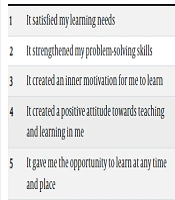
The mean age of the students was 20.61 ± 1.061, ranging from 19 to 24, with approximately 60% of the participants being male. All students were enrolled in the second academic semester. The majority of students expressed moderate (48.6%) to high (47.7%) levels of satisfaction with the FC approach. Only 3.7% of the students reported a low level of satisfaction. Among male students, 67.3% were highly satisfied with FC, while 46% of female students expressed moderate satisfaction. The overall mean satisfaction score with FC was 55.36 ± 12.54, indicating a moderate level of satisfaction. The analysis revealed no significant relationship between total satisfaction score and age among students (P = 0.086). However, the moderate level of satisfaction among male students was higher than that among females (P = 0.017). Table 1 presents the mean ± SD, mode, and median of each QSFC item, while Table 2 reports the results regarding the level of satisfaction among students.
Table 1.
Mean, Standard Deviation, Median, and Mode of Responses to the Questionnaire for Satisfaction with Flipped Classroom items, Ranging from Completely Agree (Score 5) to Completely Disagree (Score 1)
| Row | Item | Mean | Standard Deviation | Median | Mode |
|---|---|---|---|---|---|
| 1 | It satisfied my learning needs | 3.72 | 1.03 | 4.00 | 4 |
| 2 | It strengthened my problem-solving skills | 3.52 | 1.11 | 4.00 | 3 |
| 3 | It created an inner motivation for me to learn | 3.52 | 1.17 | 4.00 | 3 |
| 4 | It created a positive attitude towards teaching and learning in me | 3.53 | 1.13 | 4.00 | 4 |
| 5 | It gave me the opportunity to learn at any time and place | 3.32 | 1.12 | 3.00 | 3 |
| 6 | It made me interested in deep learning | 3.31 | 1.12 | 3.00 | 3 |
| 7 | It created the ability to manage learning in me | 3.50 | 1.15 | 4.00 | 3 |
| 8 | It made me feel responsible for learning | 3.74 | 1.04 | 4.00 | 4 |
| 9 | It gave me the opportunity to interact and discuss with my classmates | 3.90 | 1.06 | 4.00 | 4 |
| 10 | It created the opportunity to interact and discuss with the professor | 3.86 | 1.08 | 4.00 | 5 |
| 11 | It created the opportunity to express oneself in class | 4.03 | 1.00 | 4.00 | 5 |
| 12 | It created the opportunity for group work in class | 3.98 | 1.04 | 4.00 | 4 |
| 13 | Create continuous access to course content | 3.78 | 0.95 | 4.00 | 4 |
| 14 | It created the opportunity for active participation in learning | 3.97 | 1.04 | 4.00 | 5 |
| 15 | It had a positive effect on my grades | 3.66 | 1.17 | 4.00 | 5 |
Table 2.
Nursing Students’ Satisfaction with Flipped Classroom
| Variables | Satisfaction Rate | Frequency | Values a |
|---|---|---|---|
| Gender | Female | Low | 1 (25) |
| Moderate | 23 (46) | ||
| High | 17 (32.7) | ||
| Total | 41 (38.7) | ||
| Male | Low | 3 (75) | |
| Moderate | 27 (54) | ||
| High | 35 (67.3) | ||
| Total | 65 (61.3) | ||
| Age | 19 | Low | 1 (25) |
| Moderate | 5 (9.8) | ||
| High | 8 (15.4) | ||
| Total | 14 (13.1) | ||
| 20 | Low | 0 (0) | |
| Moderate | 18 (35.3) | ||
| High | 19 (36.5) | ||
| Total | 37 (34.6) | ||
| 21 | Low | 2 (50) | |
| Moderate | 16 (31.4) | ||
| High | 19 (36.5) | ||
| Total | 37 (34.6) | ||
| 22 | Low | 1 (25) | |
| Moderate | 10 (19.6) | ||
| High | 5 (9.6) | ||
| Total | 16 (15) | ||
| 23 | Low | 0 (0) | |
| Moderate | 1 (2) | ||
| High | 1 (1.9) | ||
| Total | 2 (1.9) | ||
| 24 | Low | 0 (0) | |
| Moderate | 1 (2) | ||
| High | 0 (0) | ||
| Total | 1 (0.9) |
a Values are expressed as No. (%).
5. Discussion
The prolonged COVID-19 pandemic has compelled numerous universities worldwide, including those in Iran, to adopt instructional strategies such as transitioning from face-to-face education to e-learning to sustain their operations (23). The aim of the present study was to assess the level of satisfaction with FC in the epidemiology course among nursing students at a school of nursing.
The study findings revealed that the majority of students expressed moderate to high levels of satisfaction with FC. Additionally, students achieved moderate-to-high scores on most QSFC items. Similar to our findings, Martínez reported high student satisfaction with the FC experience, noting improvements in the learning process and academic performance compared to traditional lectures (24).
Ernesto found that higher education students viewed FC as a positive learning approach (25). In another study, Goke examined the advantages and disadvantages of FC from the perspectives of students and lecturers, highlighting enhanced learning performance and insufficient preparation before class as the most commonly reported outcomes, respectively (26).
Awidi and Paynter also found that undergraduate students expressed high levels of satisfaction with certain aspects of the FC approach during a biology course. They noted correlations between elements of the learning design model and students' self-confidence, motivation, and participation, suggesting that adjusting FC components, such as pre-planned lectures and the structure of in-class activities, could enhance the overall learning experience (27).
According to Ismaili et al., FC as a learning process encompasses twelve dimensions, including learning motivation, individual factors, organizational culture, and structural factors. They proposed solutions such as obtaining approval for FC as an independent approach from top management, providing and improving high-quality infrastructure and facilities for online education, and enhancing management capabilities through competent lecturers familiar with FC to effectively implement this instructional strategy among students (28).
Toofaninejad et al. further observed that FC positively influenced various aspects of higher education, including learning, cognitive load, involvement, accuracy, motivation, attitude, satisfaction with a course, and self-efficacy. However, significant challenges faced by FC included a lack of knowledge and improper adaptation to this teaching method, increased lecturer workload, and issues with video-based learning (7).
Dadgari et al. suggested that FC could enhance students' readiness for self-directed learning, indicating its potential when combined with traditional teaching methods (2). Javadi et al. similarly found that FC could be more effective than lectures in increasing students' academic enthusiasm. Activities in FC focused on active engagement with teaching materials and learning tasks, directing students' thoughts and actions effectively to enhance their academic motivation and enthusiasm, ultimately promoting learning (29).
Golzari and Attaran proposed that FC-based education facilitated teaching educational content outside classrooms. Classroom activities such as assignments, repetition, practice, questioning, answering, and discussions on various topics replaced traditional lectures, fostering classroom dynamics, higher motivation, and deeper learning (30).
Jafaraghaie et al.'s examination of nursing students' views and experiences with the FC model revealed positive outcomes. Most students preferred FC over traditional methods, which often relied heavily on lectures (1). Tang et al. however, found that while FC could enhance learning, attention, and evaluation in educational courses, students generally expressed dissatisfaction with e-learning, particularly with modes of communication and question-and-answer sessions. Despite this, the FC approach was seen as beneficial in preparing nursing students for their professional roles. It's worth noting that satisfaction alone may not accurately measure students' learning outcomes (31).
Among the significant limitations of the present study was the absence of any student withdrawals due to the requirements to take and pass the epidemiology course. Additionally, a briefing session was conducted at the onset of the study to elucidate the research objectives and procedures.
5.1. Conclusions
Based on previous research and the study results, FC can be considered an effective teaching method for enhancing learning and increasing satisfaction among students in various fields, especially in critical situations. However, the successful implementation of FC depends on self-motivated, responsible, and committed students. It's essential for lecturers to recognize that effective learning requires enthusiastic student involvement before and during FC activities. Therefore, further studies utilizing two groups (intervention and control) and exploring other BL-based strategies in different academic courses are recommended.