
1. Background
Spinal cord injury is a devastating condition that, depending on its severity and extent, can dramatically alter an individual's health and lifestyle (1). It is considered one of the most challenging types of physical disability, with sensory and motor dysfunction impairing the ability to perform even the simplest daily tasks, rendering individuals dependent and experiencing various functional limitations (2). In general, spinal cord injuries, which involve severe damage to the spinal cord caused by accidents, diseases, or surgeries, can have profound and multifaceted impacts on patients' lives. These disabilities may result in motor impairments, sensory changes, and problems with urinary and sexual function (3). Moreover, many individuals with spinal cord injuries experience psychological difficulties such as anxiety and depression, which can exacerbate physical disabilities and reduce quality of life (4).
Spinal cord injuries, frequently arising from traumatic or non-traumatic etiologies affecting the spinal cord, present substantial challenges to healthcare systems (5). Individuals with spinal cord injuries manifest a spectrum of disabilities that affect diverse aspects of their lives. Motor impairments, sensory alterations, and urinary dysfunction are common sequelae of these injuries (6). Subsequent to a spinal cord injury, individuals typically experience profound life adjustments, necessitating sustained time and interpersonal support to facilitate adaptation and modification of daily activities. Concomitantly, many individuals with spinal cord injuries encounter a range of psychological adversities, including disturbances in self-concept, feelings of social isolation, depressive symptoms, and anxiety (7).
Spinal cord injury can significantly impair sexual function, resulting in diminished sexual performance and satisfaction (7). Individuals with spinal cord injuries frequently experience feelings of hopelessness and reduced satisfaction in their sexual relationships, primarily due to physical limitations and anxieties surrounding sexual function (8). It is, however, crucial to acknowledge that a spinal cord injury does not invariably extinguish sexual desire or drive. With sufficient time, individuals can adapt to their altered circumstances and re-establish their sexual urges (9).
Erection, ejaculation, and orgasm constitute distinct physiological processes. In men with spinal cord injuries, one or more of these functions may be compromised, contingent upon the severity of the injury. While 10 - 20% of men with spinal cord injuries may achieve ejaculation through sexual intercourse, only half to two-thirds report experiencing orgasm. Even when ejaculation is preserved, the quality of the orgasmic experience may be altered (10). Women with spinal cord injuries also experience significant sexual dysfunction (11), commonly encountering difficulties in achieving sexual satisfaction and altered sensory experiences during orgasm (12).
Within the context of spinal cord injury, hope assumes a pivotal role as a salient psychological construct. Hope empowers individuals with spinal cord injuries to cultivate the motivation and capacity to pursue an enhanced quality of life in the face of adversity (13). Functioning as a critical psychological determinant, hope facilitates the redirection of focus from perceived limitations to the identification of opportunities and solutions aimed at improving both overall quality of life and sexual function. Furthermore, hope serves to orient individuals with spinal cord injuries toward positive goals and equips them with the resilience to navigate challenges and hardships (14).
Considering the elevated prevalence of psychological disorders among individuals with spinal cord injuries, group therapy presents a valuable modality for addressing their unique challenges. Logotherapy, a therapeutic approach focused on facilitating the discovery of meaning and purpose, offers particular advantages for individuals with spinal cord injuries who confront substantial life adversities. By cultivating a sense of meaning, logotherapy can augment patients' capacity to manage difficulties and enhance their overall quality of life and sexual satisfaction (15). Logotherapy has been shown to enhance hope and quality of life in patients with colorectal cancer (16), improve hope and psychological well-being in patients with COVID-19 (17), and enhance sexual function and marital satisfaction in individuals with multiple sclerosis (18). Additionally, logotherapy has been linked to improvements in marital satisfaction, psychological well-being, couple interactions, sexual function, and reduced anxiety (19, 20).
While logotherapy has demonstrated efficacy in enhancing sexual function and overall well-being (18), its application to individuals with spinal cord injuries presents a unique and clinically relevant context. The novelty of this research lies in its specific focus on evaluating the effectiveness of logotherapy in addressing the intertwined challenges of marital sexual dysfunction and diminished hope, which are particularly prevalent and impactful in the spinal cord injuries population. Individuals with spinal cord injuries face distinct physiological and psychological adjustments that significantly affect their sexual function and perceived quality of life (21). This study, therefore, aims to develop and assess a therapeutic intervention tailored to the specific needs and challenges of individuals with spinal cord injuries, empowering them to better cope with the complexities of daily life and to improve their marital and sexual experiences. Unlike broader applications of logotherapy, this research directly investigates its impact on the specific psychological and relational sequelae of spinal cord injuries, thereby contributing novel insights into the therapeutic management of this vulnerable population.
2. Objectives
This study was conducted to determine the effectiveness of logotherapy on marital sexual function and hope in individuals with spinal cord injuries.
3. Methods
This investigation employed a quasi-experimental pre-test-post-test control group design. The study population encompassed all male and female individuals with spinal cord injuries residing in Ahvaz, Iran, in 2023. A convenience sample of 30 participants (15 per group) was selected from patients referred to the Orkideh Rehabilitation Center in Ahvaz, adhering to specific inclusion criteria. Participants were included if they provided informed consent, possessed adequate literacy, scored below the mean on the Marital Sexual Function Scale and Miller Hope Scale, and were not concurrently medicated for other disorders. Exclusion criteria included dissatisfaction with study participation and missing more than two treatment sessions.
Following pre-testing, the experimental group received the intervention, while the control group was placed on a waitlist. A post-test was administered to both groups upon intervention completion. To uphold ethical principles, the control group received a condensed version of the intervention at the end of the study.
3.1. Measures
3.1.1. Marital Sexual Function Scale
The Marital Sexual Function Scale was developed by Farajnia et al. (22). This scale consists of 60 items categorized into seven dimensions: Sexual involvement, sexual expression, sexual arousal and sensation, sexual desire, sexual fulfillment, sexual attitude, and sexual awareness. The scale uses a Likert-type response format, with responses ranging from 1 (strongly disagree) to 5 (strongly agree). The total score for each participant ranges from 60 to 300. Farajnia et al. (22) reported a Cronbach's alpha of 0.95 for the scale's reliability. In the present study, Cronbach's alpha was calculated to assess the reliability of the scale, yielding a value of 0.88.
3.1.2. Miller Hope Scale
The Miller Hope Scale is a diagnostic tool assessing eight dimensions of hope and distress, based on observable behaviors in hopeful and hopeless individuals. Scores range from 40 (despair) to 200 (maximum hopefulness). Miller posited that hope is linked to psychological well-being and a clear life perspective (23). Abdi and Asadi (24) reported a Cronbach's alpha of 0.86 for the scale's reliability. In this study, the scale demonstrated a Cronbach's alpha of 0.89.
3.1.3. Intervention
Group logotherapy sessions, based on the group logotherapy techniques outlined by Schulenberg et al. (25), were conducted weekly for eight 90-minute sessions with the experimental group. A summary of the logotherapy sessions is presented in Table 1.
Table 1.
A summary of the Logotherapy Sessions
| Sessions and Topic | Session Description |
|---|---|
| 1. Introduction and group member acquaintance | Introduction of group members and group leader for acquaintance, explanation of group goals and rules by the group leader, brief explanation of logotherapy |
| 2. Working towards recognizing personal meaning, values, and attitudes | Preparing the group to start working by discussing meaning and values, implementing an attitude change technique with the cooperation of group members, assigning homework for the attitude change technique |
| 3. Working towards accepting responsibility | Reviewing the previous session's homework, discussing and providing feedback on the assigned homework, discussing the responsibility of individual choices, assigning homework to prepare a checklist of individual choices |
| 4. Working towards awareness of personal values | Starting the session by reviewing the previous session's homework, implementing the awareness of values technique with the participation of group members, assigning homework for the awareness of values technique |
| 5. Identifying personal values | Reviewing the assigned homework from the previous session and providing feedback, continuing the awareness of values technique, completing the personal values checklist as homework |
| 6. Continued identification of personal values | Reviewing the assigned homework from the previous session and providing feedback, completing the personal values checklist as homework |
| 7. Identifying the role of values in life | Reviewing the assigned homework from the previous session and providing feedback, implementing the "film" exercise with the participation of members, completing the personal values checklist as homework |
| 8. Summarizing and concluding the sessions | Reviewing the assigned homework from the previous session and providing feedback, reviewing the completed personal values checklist for each individual and discussing the meaning of life for each person, providing a summary of the sessions and concluding the group work, receiving feedback from group members on the group's performance, re-administering the questionnaires as a post-test, and ending the group work |
3.2. Statistical Analyses
Data analysis was conducted using nonparametric statistical methods due to the distribution of the data. Changes in scores from pre-test to post-test for marital sexual function and hope were calculated for each participant. Data are presented as medians and interquartile ranges (IQR). The Kolmogorov-Smirnov test was initially used to assess the normality of data distribution. Although the results indicated approximate normality, a nonparametric approach was chosen. The Mann-Whitney U test was used to compare the distributions of change scores between the logotherapy and control groups for both marital sexual function and hope. Statistical significance was set at P < 0.05.
4. Results
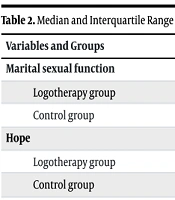
In terms of age distribution, 19 participants (63.3%) were male patients with a mean age of 37.54 ± 4.02, and 11 participants (36.7%) were female patients with a mean age of 32.70 ± 3.61. The median and IQR values for the changes in marital sexual function and hope are presented in Table 2. For the logotherapy group, the median change in marital sexual function was 56.75 (IQR = 31.93), while the control group exhibited a median change of -3.46 (IQR = 20.45). For hope, the logotherapy group showed a median change of 53.26 (IQR = 28.73), compared to -2.54 (IQR = 13.58) for the control group. These results highlight marked improvements in both variables for the logotherapy group, in contrast to negligible or negative changes in the control group (Table 2).
Table 2.
Median and Interquartile Range of Changes in Marital Sexual Function and Hope Scores
| Variables and Groups | Median Change (IQR) |
|---|---|
| Marital sexual function | |
| Logotherapy group | 56.75 (31.93) |
| Control group | -3.46 (20.45) |
| Hope | |
| Logotherapy group | 53.26 (28.73) |
| Control group | -2.54 (13.58) |
Prior to conducting the Mann-Whitney U test, the Kolmogorov-Smirnov normality test results were reviewed to assess the data’s distribution. Although normality was approximated (P > 0.05 for all variables), a nonparametric analysis was performed as specified. The Mann-Whitney U test was used to determine whether the distributions of change scores differed significantly between the logotherapy and control groups. The Mann-Whitney U test results indicated significant differences between the groups for both variables. For marital sexual function, the logotherapy group exhibited a significantly greater increase in scores compared to the control group (U = 3, P < 0.001). Similarly, for hope, the logotherapy group demonstrated a significantly greater improvement compared to the control group (U = 2, P < 0.001). These low U values reflect the substantial separation between the groups’ change scores, with the logotherapy group consistently outperforming the control group. Based on the pronounced differences in median change scores and the Mann-Whitney U test outcomes, it can be concluded that logotherapy was effective in improving both marital sexual function and hope in patients with spinal cord injuries.
5. Discussion
The present study aimed to determine the effectiveness of logotherapy on marital sexual function and hope in individuals with spinal cord injuries. The primary finding indicated that logotherapy was effective in improving marital sexual function. This finding is consistent with the results of the study conducted by Haghjou and Javanbakht (18). This finding can be elucidated by positing that logotherapy, through its emphasis on the discovery of meaning and purpose, significantly contributes to the enhancement of sexual function and the quality of intimate relationships in individuals with spinal cord injuries.
Individuals with spinal cord injuries frequently encounter a multitude of physical and psychological challenges pertaining to sexual function and associated emotional states. These challenges can precipitate diminished self-esteem, reduced sexual satisfaction, and feelings of hopelessness regarding the formation of intimate relationships (4). Logotherapy, by affording patients the opportunity to reassess life values and formulate novel personal objectives, facilitates a shift in focus from physical limitations to the deeper existential meaning of life and interpersonal connections (16).
Logotherapy exerts a sustained and positive influence on the quality of intimate relationships and sexual function. A key mechanism underlying the effectiveness of logotherapy in enhancing sexual function is the promotion of self-acceptance and a fortified sense of self-worth. By guiding patients in the discovery of meaning in life, this therapeutic approach facilitates the acceptance of their bodies and physical conditions in a non-judgmental manner (19). This acceptance contributes to a reduction in anxiety and stress associated with sexual function and the apprehension of external judgment, consequently fostering increased self-confidence and sexual satisfaction. A reduction in negative cognitions and an enhanced attitude towards the body and physical limitations facilitate increased engagement in intimate situations and promote the experience of emotional and sexual gratification.
Furthermore, logotherapy contributes to the sustained improvement of sexual function by facilitating the reconstruction of meaning within intimate and sexual relationships. This therapeutic approach, through the cultivation of a sense of belonging and a deeper connection with a romantic partner, enables patients to establish higher-quality emotional relationships (18).
The research findings also demonstrated that logotherapy was effective in improving hope in patients with spinal cord injuries at the post-test stage. This finding is consistent with the results of studies conducted by Peyman (16) and Zolfali Pormalek et al. (17). This finding can be explained by the proposition that logotherapy, as a therapeutic modality, facilitates patients' pursuit of meaning and purpose in life amidst such challenges. Logotherapy underscores the pursuit of meaning in life and facilitates patients' ability to comprehend challenging experiences and life adversities. This approach equips patients with strategies to navigate issues such as illness and disability with a more constructive perspective, thereby enhancing their overall quality of life (25).
Logotherapy aids individuals in identifying their core values and life objectives, leading to increased life satisfaction. Hope assumes a critical role in this process, referring to an individual's capacity to envision a positive future and actively work towards achieving their aspirations. Individuals with spinal cord injuries who have higher levels of hope typically demonstrate a greater willingness to seek effective solutions to their problems and improve their quality of life (17). This hope can serve as a motivation to strive for improved health and quality of life.
The relationship between logotherapy and hope can significantly improve quality of life. The attainment of heightened meaning in life among patients correlates with an augmented sense of hope. Conversely, individuals exhibiting elevated levels of hope are more inclined to pursue and discover meaning, resulting in enhanced life satisfaction. This reciprocal relationship fosters a positive feedback loop wherein logotherapy and hope mutually reinforce each other (16).
Individuals with spinal cord injuries participating in logotherapy can achieve more favorable outcomes by refining their capacity to pursue meaning and purpose. These outcomes encompass improved positive affect, enhanced stress management skills, and strengthened social connections. Furthermore, elevated hope levels can promote engagement in health-enhancing behaviors, which subsequently contribute to an improved overall quality of life.
Individuals with spinal cord injuries frequently encounter a multitude of physical and psychological challenges that directly affect their sexual function (21). These challenges manifest as decreased libido, difficulties in engaging in sexual relationships, and the development of negative self-perceptions and adverse feelings towards their sexual partners. Logotherapy, as a therapeutic modality, assists patients in navigating the experiences and challenges associated with their disabilities, thereby facilitating a focus on positive emotions and the pursuit of existential meaning (26). This meaning-finding process can contribute to enhanced self-confidence, improved hope, and more fulfilling interpersonal and sexual relationships. Furthermore, logotherapy equips patients with the skills to transform negative experiences into opportunities for personal growth and development, which specifically contributes to improved hope and sexual function.
This research was subject to several limitations. One such limitation was the absence of a follow-up period. Additionally, the restriction of the sample to spinal cord injury patients in Ahvaz may limit the generalizability of the findings to other populations. Notably, the post-test treatment protocol did not include the partners of the individuals with spinal cord injuries to directly examine the effectiveness of logotherapy on the dyadic relationship. While incorporating partner involvement could have provided valuable insights into the interpersonal dynamics and the impact of logotherapy on the couple's interaction, we prioritized a focused, manageable, and ethically sound study design that primarily assessed the individual's response to logotherapy. The primary aim of the study was to evaluate the direct impact of logotherapy on the individual's psychological state (hope) and personal sexual function. Therefore, the focus was intentionally placed on the individual's experience and changes, rather than the dyadic interaction. Future research should consider incorporating partner involvement to further explore the broader relational effects of logotherapy in this population.
5.1. Conclusions
The present study's findings offer robust evidence supporting the beneficial influence of logotherapy on critical facets of well-being. Specifically, the results revealed a statistically significant improvement in both marital sexual function and hope levels among participants receiving logotherapy. This suggests that logotherapy represents a potentially efficacious intervention for individuals with spinal cord injuries, addressing not only the physical limitations but also the associated psychological and emotional challenges. While this study contributes valuable insights, further research is necessary to investigate the long-term effects of logotherapy in this population. Moreover, exploring the specific mechanisms through which logotherapy exerts its therapeutic effects would enhance our comprehension of this intervention.