
1. Background
Higher education in the medical sciences, particularly in clinical disciplines, is fundamentally based on practical and experiential training. In this context, clinical faculty members serve as a vital link between academic environments and clinical settings and play a central role in enhancing students’ scientific knowledge and skills. Clinical education provides an effective platform for translating theoretical knowledge into clinical competence; without specialized, committed, and motivated instructors, this process faces substantial challenges (1). Given the structural differences between educational and health care systems, expectations of clinical faculty members have expanded across teaching, research, and clinical practice. However, the lack of clear frameworks for recruitment, promotion, and performance evaluation has created ambiguous and sometimes conflicting conditions for these individuals (2).
Within this framework, clinical faculty members play a vital and irreplaceable role in bridging theoretical knowledge and practical skills, serving as a crucial link between academic institutions and health care environments. However, this group faces multiple organizational, structural, and individual challenges that can adversely affect the quality of clinical education (3, 4).
These individuals are responsible not only for conveying theoretical concepts but also for teaching clinical skills to students in real health care settings and preparing them to play an effective role in the health care system. Clinical education is a valuable platform for integrating knowledge and practice, and its effective implementation is not possible without skilled, committed, and motivated clinical educators (5). At the same time, given the structural and functional differences between educational and health care systems, expectations of clinical faculty members have increased substantially across educational, research, and clinical domains. However, the absence of clear and coherent frameworks for recruitment, promotion, and performance evaluation has created ambiguous and sometimes contradictory conditions for this group (6).
In many educational and health care centers, clinical faculty members lack a defined organizational position in hospital settings and, therefore, do not receive the necessary administrative and professional support. This situation exposes them to multiple pressures. With the rapid advancement of medical sciences and the increasing complexity of health care processes, the role of nursing, as one of the fundamental pillars of the health care system, has become more significant than ever (7).
In this context, clinical nursing faculty members, who are responsible for educating and training the next generation of nurses, play a pivotal role in improving the quality of health care services. Serving as a bridge between academic theoretical knowledge and practical clinical settings, they work in a challenging environment that demands professional competence, adaptability, and a strong sense of commitment (8).
Clinical environmental conditions also contribute to the difficulty of this group’s responsibilities. High patient volume, shortages of human resources, limited equipment and facilities, and the constant need to remain aligned with scientific and technological advances place considerable pressure on clinical faculty members (9). In a study by Salem et al., problems in clinical nursing education, including inadequate clinical environments (51.1%), lack of necessary equipment and supplies (45.0%), and overcrowding (46.7%), created significant challenges for nursing instructors in providing high-quality education (10, 11).
The simultaneous responsibilities of teaching, research, and clinical practice also lead to role conflict and difficulty in focusing on improving educational quality. This inherent conflict negatively affects job satisfaction and may reduce the effectiveness of clinical education, thereby affecting the quality of student learning (11).
In addition, inadequate organizational support, insufficient opportunities for professional development and academic advancement, and psychological pressures resulting from constant exposure to patients in critical conditions further complicate the working conditions of clinical faculty members (12). These factors can lead to decreased job motivation, professional burnout, and even the departure of skilled personnel from education, which could have negative short- and long-term consequences for the country’s health care system (13).
In addition to structural and environmental challenges, rapid changes in educational programs, the emergence of new educational and clinical standards, rising student expectations, and pressures associated with research performance indicators have further increased the complexity of the situation for clinical faculty members.
Although policies have been developed to establish clinical faculty positions, structural, cultural, and administrative challenges have continued to hinder the achievement of these policy objectives (14, 15). These issues include the absence of coherent executive regulations, lack of appropriate infrastructure, and interprofessional conflicts (16). Furthermore, due to limited awareness of regulations or inconsistencies between university and hospital systems, many faculty members are unable to fulfill their roles effectively.
Under these circumstances, developing a comprehensive and precise understanding of the challenges and obstacles faced by this group and proposing practical and effective solutions are essential for improving the quality of the nursing education system and safeguarding public health (17). Systematic, evidence-based research can provide an appropriate foundation for policy reform and improving the conditions of clinical faculty members by identifying the root causes of problems and proposing practical solutions.
2. Objectives
Given the critical role of clinical faculty members in improving the quality of clinical education and the lack of in-depth qualitative studies addressing their actual challenges, this study aimed to explore the lived experiences of clinical nursing faculty members, identify existing challenges, and propose potential solutions for improvement. By analyzing empirical data obtained through interviews with clinical faculty members, this research sought to provide a deep, multidimensional understanding of their real-life conditions.
3. Methods
3.1. Study Design
This qualitative study used a conventional content analysis approach to describe the challenges faced by clinical nursing faculty members. Conventional content analysis is a qualitative method used to interpret the meaning of textual content through a systematic process of coding, categorizing, and interpreting data.
3.2. Participants
The study population consisted of clinical faculty members from a selected nursing school in Tehran. Using purposive sampling, eight clinical faculty members with at least 2 years of clinical experience who were willing to participate were selected. Maximum diversity was sought in terms of gender, educational degree, academic rank, and work experience.
3.3. Data Collection
Data were collected through in-depth, semi-structured interviews. Initial questions included items such as "Since when have you been a clinical faculty member?" and "What challenges have you experienced so far?" Interviews were conducted in a quiet environment based on the participants' preferences and were audio-recorded after written informed consent was obtained. Each interview lasted approximately 45 to 60 minutes.
3.4. Trustworthiness
To ensure the credibility and accuracy of the data, Guba and Lincoln's four criteria were applied. For credibility, member checking was conducted through a two-step process. First, the research team, consisting of multiple researchers, thoroughly reviewed the full interview transcripts, initial codes, and derived categories to ensure consistency and alignment with the data. Second, each participant received a summary of their interview transcript and the preliminary themes, which they reviewed to confirm the accuracy of interpretations and the relevance of the identified themes. For example, one participant confirmed the code "Bridging the gap between education and clinical practice" within the "Responsive Workforce" category, stating, "The most important advantage is that it can reduce the gap between education and clinical practice, as it is permanently based there and can fully orient students" (Pos. 30). This dual review process ensured that the findings were firmly grounded in participants' perspectives. For transferability, a detailed description of the research context, participant characteristics (Table 1), and the purposive sampling strategy was provided to enable readers to assess the applicability of the findings to other settings. Dependability was achieved through meticulous documentation of the data analysis process, including coding and categorization, which was independently reviewed by two researchers to verify consistency. Confirmability was ensured by maintaining an audit trail of raw data, codes, and category development, which was evaluated by a third researcher to confirm that interpretations were data-driven.
Table 1.
Demographic Characteristics of the Participants
| No. | Gender | Age (y) | Academic Degree | Faculty Rank | Academic Experience (y) | Clinical Specialty Area |
|---|---|---|---|---|---|---|
| 1 | Female | 40 | Master's degree | Instructor | 4 | Military nursing care |
| 2 | Female | 38 | Master's degree | Instructor | 3 | Neonatal intensive nursing care |
| 3 | Male | 36 | Master's degree | Instructor | 2 | Home care/intensive nursing care |
| 4 | Female | 39 | PhD | Assistant Professor | 6 | Pediatric nursing care |
| 5 | Female | 42 | Master's degree | Instructor | 6 | Military nursing care |
| 6 | Female | 44 | PhD | Assistant Professor | 6 | Pediatric nursing care |
| 7 | Female | 39 | PhD | Assistant Professor | 6 | Neonatal intensive nursing care |
| 8 | Female | 65 | PhD | Assistant Professor | 30 | Expert of the Special Audit Board of the Ministry of Health and Medical Education |
3.5. Researcher Reflexivity
Reflexivity is a critical component of qualitative research because it acknowledges and addresses the influence of researchers' backgrounds on the study process. As faculty members in a clinical academic setting, the researchers shared an insider perspective with the participants, who were also clinical faculty members. This insider status facilitated rapport building and a deep understanding of the context, but it also posed a risk of bias in data collection and interpretation because the researchers' own experiences could shape their assumptions. To mitigate these potential biases, several strategies were used. First, peer debriefing sessions were held with colleagues outside the research team to challenge interpretations and enhance objectivity. Second, a reflexive journal was maintained throughout the study to document assumptions, decisions, and reflections and was regularly reviewed to minimize subjective influence. Third, an external researcher unaffiliated with the clinical academic setting reviewed the coding and categorization process to provide an outsider perspective and enhance confirmability. These measures ensured that the findings were grounded in the data rather than the researchers' preconceptions and thereby strengthened the rigor of the study.
3.6. Data Analysis
Data analysis was conducted concurrently with data collection using the conventional content analysis method and the stages proposed by Graneheim and Lundman. The analysis process included verbatim transcription of the interviews, repeated reading of the texts to gain a comprehensive understanding of the content, extraction of meaning units, condensation of meaning units and assignment of initial codes, grouping of codes based on similarities and differences, and development of subcategories and main categories. Initial coding was performed independently by two researchers, and disagreements were resolved through discussion and consensus.
To ensure transparency in the data analysis process, Table 2 illustrates the progression from raw data to main categories for the "Responsive Workforce" category. Table 2 provides a detailed textual example of the steps from raw data to main categories based on Graneheim and Lundman's conventional content analysis approach. This addition clarifies the analytical rigor and enhances the transparency of the study.
Table 2.
Example of the Data Analysis Process for the "Responsive Workforce" Category
| Stages | Description | Example |
|---|---|---|
| Raw data (interview transcript) | Verbatim text from participant interviews. | "Alongside the educational supervisor, they can address the educational issues of staff, provide in-service training, and even take on the role of the supervisor themselves." (Pos. 30) |
| Meaning unit | Segment of text with a specific meaning. | "Alongside the educational supervisor, they can address the educational issues of staff, provide in-service training, and even take on the role of the supervisor themselves." |
| Condensed meaning unit | Summarized meaning unit retaining core content. | "Addressing staff educational issues and providing in-service training" |
| Code | Initial label assigned to the condensed meaning unit. | "Support for in-service training" |
| Subcategory | Grouping of similar codes. | "Enhancing Education and Research" |
| Main category | Overarching theme derived from subcategories. | "Responsive Workforce" |
In total, 146 initial codes were identified and organized into 13 subcategories and 4 main categories. Code repetition was observed from the fifth interview, and no new codes emerged in the sixth interview, confirming saturation.
3.7. Ethical Considerations
The study was initiated after ethical approval was obtained from the Ethics Committee of Baqiyatallah University of Medical Sciences. Before each interview, the study objectives were explained to participants, and written informed consent was obtained. Participants were assured of the confidentiality of their data and of their right to withdraw from the study at any stage. All data were securely stored and coded for analysis.
By adhering to rigorous qualitative research principles, this methodology enabled the collection of rich, meaningful data regarding the lived experiences of clinical faculty members, forming the basis for scientifically explaining their challenges in the subsequent sections of the study.
4. Results
4.1. Participant Characteristics
In this study, analysis of data obtained from eight semi-structured interviews with clinical nursing faculty members led to the emergence of four main categories and thirteen subcategories. The average interview duration was 50 minutes. From the fifth interview onward, code repetition was observed, and by the sixth interview, no new codes were identified, indicating that theoretical saturation had been reached. The demographic characteristics of the participants are presented in Table 1.
4.2. Themes and Subthemes
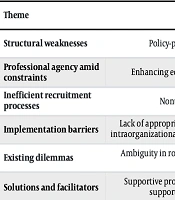
Following analysis of the interviews, a conceptual structure was developed that encompassed multiple dimensions of the challenges experienced by clinical faculty members. These categories were derived using a conventional content analysis approach, in which meaning units were coded and aggregated into themes based on conceptual similarity. The main categories and their respective subcategories are presented in Table 3.
Table 3.
Themes and Subthemes of Challenges Faced by Clinical Nursing Faculty
| Theme | Subthemes | Example Codes (Pos.) | Supporting Quote |
|---|---|---|---|
| Structural weaknesses | Policy-practice gap, research bias, bureaucratic inertia | Pos. 42 | "Research credits can replace teaching credits. we cannot intervene." (Pos. 42) |
| Professional agency amid constraints | Enhancing education and research, addressing clinical concerns | Pos. 12, 30 | "Faculty can help resolve educational issues, provide in-service training." (Pos. 30) |
| Inefficient recruitment processes | Nontransparent practices, dual-authority issues | Pos. 14, 32 | "They announce a call. but appoint their own internal staff." (Pos. 32) |
| Implementation barriers | Lack of appropriate infrastructure, poor interprofessional interactions, intraorganizational issues, extraorganizational issues, individual challenges | Pos. 12, 22, 28 - 29, 56, 63, 66 | "They just don't accept that a nursing PhD might know more." (Pos. 28 - 29) |
| Existing dilemmas | Ambiguity in roles and responsibilities, legal and employment-related challenges, neglected regulations | Pos. 42, 56 | "I can't really recall exactly what the bylaw said!" (Pos. 56) |
| Solutions and facilitators | Supportive provisions, constructive collaboration, legal recognition, supportive environment, infrastructure development | Pos. 20, 24 - 25, 32, 66 | "Hospitals should allocate rooms. and equip them with their own budgets." (Pos. 66) |
Analysis of eight semi-structured interviews with clinical nursing faculty members (average duration, 50 minutes) identified six main themes through conventional content analysis based on Graneheim and Lundman's approach. Code repetition was observed from the fifth interview onward, and no new codes emerged in the sixth interview, confirming theoretical saturation. The themes, detailed in Table 3, are described below.
4.2.1. Structural Weaknesses
This theme highlights notable weaknesses and inconsistencies in regulations governing clinical faculty members. Subthemes included the policy-practice gap, research bias, and bureaucratic inertia. One participant remarked:
"Research credits can replace teaching credits. Let me say, you and I may agree that these policies are flawed, but since this is a national-level system, we cannot intervene. And because those who draft these regulations are senior academics themselves, they say, 'Well, if clinical faculty don't want to apply them, there's no reason to enforce them.'" (Pos. 42)
This reflects systemic neglect of clinical roles, whereby research achievements may substitute for teaching contributions, contradicting the rationale for the presence of clinical faculty. The participant further noted:
"Those who want to change their employment status through research need final approval from the central promotion committee. This committee has its own internal regulations. For instance, to be promoted from assistant professor to associate professor, the candidate must have at least five English-language articles, three of which must be as first or corresponding author, published in Type 1 indexed journals like PubMed or Medline, and an h-index above 3. Otherwise, the committee will reject the file as unqualified." (Pos. 42)
These strict requirements create bureaucratic obstacles, diminishing motivation and diverting energy from professional development to administrative hurdles.
4.2.2. Professional Agency Amid Constraints
This theme, encompassing the subthemes of enhancing education and research and addressing clinical concerns, highlights faculty resilience in contributing to education and clinical care despite challenges. One participant stated:
"When someone with such a background enters the clinical setting, particularly with an educational mission, they can simultaneously contribute to the clinical environment by preventing incorrect practices. Even if they cannot completely stop them, they can instill a thought process that may later lead to correction by others." (Pos. 12)
Faculty members act as intellectual mentors, guiding clinical teams toward improved practices. Another participant added:
"Alongside educational supervisors, faculty can help resolve the educational issues of staff, provide in-service training, and even take on the role of the supervisor themselves. In my opinion, a faculty member in the clinical setting can be more effective practically and in terms of specialization." (Pos. 30)
These efforts demonstrate faculty members' capacity to bridge education-practice gaps through informal mentoring and tailored in-service training.
4.2.3. Inefficient Recruitment Processes
This theme includes the subthemes of problems in the recruitment process and nonimplementation of higher-level policies. One participant noted:
"There was a debate, and it caused some challenges. I heard that they issue fake job calls. They announce a call for clinical faculty, but in reality, they appoint their own internal staff. Why do they do this?" (Pos. 32)
This highlights a lack of transparency, whereby formalistic job calls favor preselected candidates, erode trust, and discourage talent. Another participant explained:
"The faculty member is supposed to be stationed in the clinical setting. But as I mentioned, our hospital cannot independently recruit faculty, so appointments must come from the nursing school. This creates a dual-authority issue: faculty are expected to work in the hospital, but their contract and supervision come from the university. They have teaching duties in the hospital, but since their supervisor is in the faculty, they do not take orders from the hospital. This creates a problem." (Pos. 14)
This dual-authority issue reflects a policy-practice gap, creating role ambiguity and disrupting the delivery of clinical education.
4.2.4. Implementation Barriers
This theme encompasses the subthemes of lack of appropriate infrastructure, poor interprofessional interactions, intraorganizational issues, extraorganizational issues, and individual-level challenges. One participant stated:
"But since the faculty lacks the necessary capacities and infrastructure, it cannot fully implement the bylaw, and our clinical faculty members effectively function as educational instructors." (Pos. 12)
Another participant noted medical dominance:
"In societies like ours, it's all about medical dominance. They just don't accept that a nursing PhD might know more than them or even have the right to offer a correction." (Pos. 28 - 29)
Intraorganizational issues were also highlighted:
"There are no clinical expectations in this role; my current position is entirely educational. Before becoming a faculty member, I was actually more involved in clinical practice." (Pos. 63)
Extraorganizational issues included the following statement:
"There is no separate bylaw for clinical faculty; they are evaluated just like instructors." (Pos. 22)
Individual challenges were also noted:
"I think they're supposed to be stationed in the clinical setting. I can't really recall exactly what the bylaw said!" (Pos. 56)
These barriers, driven by resource shortages and hierarchical conflicts, hinder effective policy implementation and bedside teaching.
4.2.5. Existing Dilemmas
This theme includes the subthemes of ambiguity in roles and responsibilities, legal and employment-related challenges, and neglected regulatory clauses. One participant highlighted role ambiguity:
"I think they're supposed to be stationed in the clinical setting. I can't really recall exactly what the bylaw said!" (Pos. 56)
Legal and employment challenges were also noted:
"To be promoted. [faculty members] must have at least five English-language articles. otherwise [they are] rejected." (Pos. 42)
Neglected regulatory clauses, derived from participant narratives, reflected ignored policies and limited faculty consultation, eroding motivation and consistency.
4.2.6. Solutions and Facilitators
This theme encompasses the subthemes of supportive provisions, constructive collaboration, legal backing, supportive environment, and infrastructure development. Participants proposed the following:
"They count clinical supervision and internships. and up to 50% through joint research, with department head approval." (Pos. 24 - 25)
"The presence of clinical faculty will only be felt if there's mutual support. People need to stop pursuing only personal gain and work toward positive change." (Pos. 32)
"This issue needs to be raised and approved in hospital meetings so the required supports for that individual can be provided." (Pos. 20)
"If hospital management understands what a clinical faculty member actually does, it would stop others from taking advantage of that individual." (Pos. 32)
"Hospitals should allocate rooms. and equip them with their own budgets; only then can we effectively deploy clinical faculty." (Pos. 66)
These solutions advocate adaptive reforms to align policies with clinical realities and enhance the quality of education and care.
5. Discussion
This qualitative study uncovered the complex challenges faced by clinical nursing faculty members in Iran, highlighting a persistent disconnect between policy intentions and practical realities. Drawing on Institutional Theory, the findings illustrate how organizations such as universities and hospitals conform to external pressures through formalized structures that often function as myths, leading to decoupling between policies and implementation (18, 19). This perspective explains systemic inertia and strengthens the analysis by clarifying why barriers persist despite reform efforts.
Structural weaknesses in regulations reveal a bias toward research metrics that marginalizes clinical roles and fosters demotivation. Interpreted through Institutional Theory, this decoupling arises from isomorphic pressures in which policies mimic academic norms without adapting to clinical contexts (20). Notably, participants advocated for reforms amid bureaucracy, such as stringent promotion requirements (Pos. 42), indicating latent agency. These findings suggest that unaddressed gaps erode the quality of student education and compromise patient care.
The responsive workforce category, reframed as professional agency amid structural constraints, underscores the resilience of clinical nursing faculty members in navigating systemic challenges. Role Theory highlights how faculty members manage ambiguity and conflict arising from multifaceted expectations, such as balancing teaching, research, and clinical duties (21). Faculty members use strategies such as informal mentoring, self-advocacy for educational reforms, and networking with colleagues to share resources, thereby fostering resilience that enhances students' critical thinking and clinical preparedness. For instance, informal mentoring mitigates medical dominance by enabling faculty members to guide students outside formal rounds, while self-advocacy counters bureaucratic constraints. However, sustained agency carries a risk of burnout, as faculty members overextend themselves to compensate for resource shortages (22, 23). Complex Adaptive Systems (CAS) theory frames these strategies as adaptive responses within the dynamic university-hospital interface, where nonlinear interactions exacerbate challenges (24, 25). Reforms such as structured mentoring or interprofessional training could harness this agency to improve student competency and patient care quality.
Inefficient recruitment processes perpetuate inequities through nontransparent practices (Pos. 32), reflecting institutional isomorphism that prioritizes internal norms over expertise (19). Role Theory explains dual-authority conflicts (Pos. 14) as sources of strain (21), deterring talent and affecting the quality of teaching. Notably, ideological clearances overshadow clinical skills, widening gaps that hinder student preparation and patient safety (2).
Implementation barriers, including infrastructure shortfalls and conflicts (Pos. 66), manifest in daily hierarchies in which medical dominance undermines teaching (Pos. 28 - 29). CAS theory views this as an emergent dysfunction of interdependent elements (26, 27). Policies fail because of normative pressures without adaptive mechanisms (18), echoing findings from Rezaei Yazdeli et al. (28). Existing dilemmas such as role ambiguity (Pos. 56) amplify strain, according to Role Theory (21). Coping relies on intrinsic factors, but systemic neglect risks declines in education and care. Solutions and facilitators support adaptive reforms, such as legal support.
Implementation barriers, including infrastructure shortfalls and interprofessional conflicts, significantly impede clinical nursing faculty members' ability to teach skills at the bedside. CAS theory frames these barriers as emergent dysfunctions of interdependent elements in the university-hospital interface, where high patient care demands disrupt educational responsibilities (26, 27). For instance, faculty members reported that heavy patient loads limited time for bedside teaching and hindered skill transfer to students (29). As various studies have reported conflicts between physicians and nurses, in some cases, such conflicts also exist between physicians and clinical nursing educators, and educators are ignored by physicians at the patient's bedside (30). Role Theory explains this as role conflict, in which faculty members' dual responsibilities as educators and clinicians create strain (21). These barriers, compounded by normative pressures without adaptive mechanisms (18), impair student clinical competency and ultimately affect patient safety.
The persistent policy-practice gap in clinical nursing education stems from systemic and contextual barriers that hinder effective implementation. Institutional Theory highlights how universities and hospitals adopt formalized policies to gain legitimacy, yet these policies often remain symbolic because of decoupling, whereby practical execution lags behind intentions (18, 19). For instance, stringent promotion requirements prioritize research over clinical expertise, misaligning with faculty needs and creating bureaucratic inertia (20). Resource shortages, such as inadequate clinical facilities, exacerbate implementation failures because policies lack the infrastructure needed to support bedside teaching. CAS theory frames these issues as emergent dysfunctions arising from misaligned university-hospital interactions, where competing priorities disrupt policy execution (26). Resistance to change, rooted in entrenched medical hierarchies, further impedes reforms (31). These findings underscore the need for adaptive mechanisms to align policies with clinical realities.
The identified challenges, including structural weaknesses, inefficient recruitment, implementation barriers, and role ambiguity, directly undermine the quality of nursing student education and, consequently, patient care. Role Theory highlights how ambiguous expectations create strain, reducing faculty members' ability to provide consistent bedside teaching and mentorship, which impairs students' acquisition of clinical skills (21). Inefficient recruitment introduces underqualified faculty, further compromising educational quality. CAS theory frames these challenges as emergent dysfunctions in the university-hospital interface, where uncoordinated interactions amplify gaps in student training (26). Consequently, inadequately trained students contribute to compromised patient safety, as reduced clinical competency correlates with increased practice errors (32). These findings underscore the urgent need for systemic reforms to enhance educational and care outcomes.
5.1. Implications and Recommendations
This study can assist policymakers at the Ministry of Health and Medical Education in revising recruitment and promotion guidelines for clinical faculty members. Furthermore, hospital and nursing school administrators can use these findings to improve interdisciplinary interactions and enhance the integration of faculty members into clinical settings. Future studies are recommended to conduct comparative analyses of clinical faculty challenges in different countries to develop more effective implementation strategies.
5.2. Study Limitations
This research had several limitations, including a limited number of participants due to its qualitative nature and the inability to explore all aspects of implementation and policy-making because of the complexity of the subject. Nevertheless, the findings provide valuable insights into the challenges and opportunities faced by clinical nursing faculty members and may contribute to enhancing their role and position.
5.3. Conclusions
Clinical nursing faculty members face multilayered challenges arising from structural weaknesses, inefficient recruitment processes, implementation barriers, and role ambiguity. Addressing these challenges requires clear supportive policies, stronger collaboration between universities and hospitals, transparent recruitment and promotion processes, and infrastructure that enables clinical faculty members to fulfill their educational and clinical roles. Such reforms can strengthen clinical nursing education and improve the quality of patient care.