1. Background
Rapidly spreading the COVID-19 disease creates a public health emergency, and unprecedented health needs worldwide have been demanded (1, 2). Nurses play a critical role on the front line of healthcare organizations in response to these unique health needs (3, 4). As a result, they experience extreme pressure worldwide (3). As a result of insufficient preparedness and affecting a large percentage of staff, nursing staff shortages have worsened (5, 6). For this reason, internship nursing students are employed as auxiliary nurses (3), and a significant number of nursing students also volunteered to provide healthcare services during the COVID-19 pandemic for social, professional, and moral reasons (5).
In addition to the risk to health, nursing students experience a higher rate of other occupational hazards and psychological stress during the internship (3) than experienced nurses due to insufficient clinical training, lack of clinical experience, and weak safety awareness (2). During outbreaks of the severe acute respiratory syndrome (SARS) in Hong Kong and South Korea, nursing students perceived they were exposed to a higher risk of infection. Therefore, they have little intention of providing nursing care for patients affected by this newly emerged disease (7, 8). In addition, in similar crises, such as the Middle East respiratory syndrome (MERS) epidemic in Saudi Arabia, healthcare students were reluctant to work in facilities because of insufficient infection control (9).
As internship nursing students could play an auxiliary role in surging human resources in such public health emergencies, understanding the influences of the COVID-19 pandemic on nursing student behavior is crucially essential (10). Lovric et al. assessed nursing students’ perception of Croatia during the COVID-19 pandemic. The researchers pointed out that the nursing students feared infection and worried about their family’s health (1). Roca et al. revealed that nursing students were uncertain about their tasks and legal support. The students also stated that the situation was very dynamic and complex (3).
Moreover, the students needed to prepare for such cases, faced professional challenges, and expressed needed new knowledge (3). Thus, examining their experiences is essential to plan for students’ protection and support (1). This assessment of the experiences should focus on studying, describing contextual elements, and reflecting on socio-cultural and personal aspects.
2. Objectives
This study aimed to describe the experience of the final year of nursing students who spent their internship as assistant nursing staff in one of Iran’s provinces.
3. Methods
3.1. Study Design
The study was performed based on the conventional qualitative content analysis method. Qualitative research aims to explore and understand the inner world of people. Researchers understand the meaning of phenomena in detail by entering into the world of individuals’ experiences (11). Therefore, the study was conducted following the consolidated criteria for reporting qualitative research (12).
3.2. Setting and Participants
The internship students were selected purposively in different departments of Kermanshah University of Medical Sciences (KUMS), Iran. In this study, the interviews continued to reach saturation, which was achieved by interviewing 11 nursing students. However, two additional interviews were conducted to ensure no new concepts were developed. The inclusion criteria included internship nursing students (semesters 7 and 8) who have completed at least one of their internship courses in one of the hospital wards affiliated with KUMS. Additionally, they should have sufficient research experience and be able to transfer their knowledge. The demographic characteristics of the participant are depicted in Box 1.
Box 1.
The Sample Questions
| Questions |
|---|
| Are your clinical training and clinical learning changed significantly in COVID-19 era? |
| Are there any different subjects in your clinical learning? |
| Has your desire for an internship changed? |
| Do you feel valued as a nurse staff member these days? |
| What is your overall sense? |
3.3. Data Collection
A semi-structured interview (face-to-face) was used to gather study data. The interviews were conducted from the 2nd of August to the 29th of September 2022. The participants were asked to share their experiences regarding these questions "Are your clinical training and clinical learning changed significantly in the COVID-19 era?" and "As an internship nursing student, what challenges did you face in a clinical environment during the COVID-19 era?" Furthermore, the interviewer asked exploratory questions like “could you explain more? Why? And how?” Tried to clarify and enhance the depth of understanding of the participants’ expressions or statements. All of the interviews were carried out by the first author (Kh.M). The interviewer is an assistant nursing professor with experience in qualitative interviews. The interviews were conducted in educational hospitals affiliated with KUMS, where participants passed their internship courses. All the interviews were performed in a class at the date and time the participants offered the interviews.
The sampling process aimed to select different gender (male: Seven, female: Six), ages (22 - 29), and several teaching hospitals affiliated with Kermanshah University of Medical Science in Iran to provide rich, comprehensive, and in-depth information to gain maximum possible variation in sampling.
The interviews lasted about 25 to 40 minutes by social distance measures. All the selected students agreed to participate in the study. Before starting the discussion, the purpose of the study was explained to the participants. After expressing students’ verbal constants, all interviews were recorded.
3.4. Data Analysis
The recorded conversation was written verbatim after each interview. The scripts were analyzed using the content analysis method introduced by Graneheim et al. (11). The following steps were applied by two research team members (Kh.M and V.Gh) independently to create code, subcategories, and main categories. Firstly, interview texts were read carefully, and critical information was highlighted. Secondly, highlighted essential information was condensed and abstracted to create codes. Thirdly, the regulations were grouped by meaning similarity. Fourthly, subcategories and categories were created by constant comparison. Finally, the emerging codes, subcategories, and classes were compared after completing the individual data analysis, and a common consensus was reached. In the last step, finalized categories and subcategories were developed.
3.5. Rigor and Quality Criteria
Credibility, confirmability, dependability, and transferability are introduced as criteria for the rigor and validity of qualitative data analysis. Long-lasting involvement of the research team with students and careful reading of the interview transcribes were approved credibility criteria of the results. Confirmability and dependability criteria were approved by checking the data analysis process and the results with all research team members and using external auditing to ensure the accuracy of the data analysis and the created codes, subcategories, and categories. Lastly, The COREQ checklist was used to explain the study context, sampling methods, participants, and data analysis process (12).
3.6. Ethical Considerations
The institutional review board of KUMS (IR.KUMS.REC.1400.822) approved the study protocol and supervised the whole research process. Participants were informed about the aim of the study and signed a written constant form before the interview started. Subsequently, all personnel information except age and gender was anonymized by specifying a numerical code (P1, P2...) to each participant during the transcription process to ensure the confidentiality principles of participants. Furthermore, all the data gathered in the research process were preserved in a password-protected folder, and only the research team had permission to access the data.
4. Results
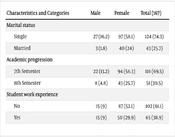
The mean age of participants was 24.46 years, and three of four were single. The participants’ characteristics are presented in Table 1.
Table 1.
The Demographic Characteristics of the Participants
| Participants Number | Age | Sex | Marital Status | Course Year |
|---|---|---|---|---|
| 1 | 23 | Male | Single | Four years |
| 2 | 26 | Female | Married | Four years |
| 3 | 22 | Male | Single | Four years |
| 4 | 24 | Male | Single | Four years |
| 5 | 23 | Male | Single | Four years |
| 6 | 22 | Female | Single | Four years |
| 7 | 25 | Male | Single | Four years |
| 8 | 27 | Female | Married | Four years |
| 9 | 23 | Female | Single | Four years |
| 10 | 25 | Male | Single | Four years |
| 11 | 23 | Female | Single | Four years |
| 12 | 29 | Female | Married | Four years |
| 13 | 26 | Male | Single | Four years |
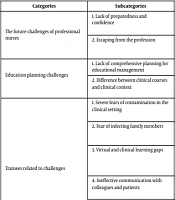
The data were classified into three categories and ten subcategories. Table 2 presents the results of the data analysis.
Table 2.
The Emerged Categories and Subcategories from the Data
| Main Categories | Categories | Subcategories | Open Codes |
|---|---|---|---|
| Clinical education insufficiency | The future challenges of professional nurses | 1. Lack of preparedness and confidence | Inability to do independent work; feeling the need to re-educate; Not being prepared |
| 2. Escaping from the profession | Hesitation to continue the profession; No competence; Attitude to have to change the job of nursing | ||
| Education planning challenges | 1. Lack of comprehensive planning for educational management | The managerially of the managers; Irregularity in the Caramese program | |
| 2. Difference between clinical courses and clinical context | Interference in the courses provided in the bed; Passing Caramers in the relevant sections | ||
| Trainees related to challenges | 1. Severe fears of contamination in the clinical setting | Distance from patients; Fears of being infected; Failing to do therapeutic processes | |
| 2. Fear of infecting family members | Limit contact with family members; Worrying about the transmission of the disease to the parents. | ||
| 3. Virtual and clinical learning gaps | Reducing motivation to study; Shortening of the periodic period; The knowledgeable knowledge because of being virtual | ||
| 4. Ineffective communication with colleagues and patients | Poor relationship with patients; Poor connection with nurses; Losing educational opportunities | ||
| 5. Clinical evaluation challenges | Defects in student clinical assessment; Different courses with clinical sections | ||
| 6. Feeling stigma | Distance of friends from us; the gap between the people of society from us; See us as a virus. |
4.1. The Future Challenges of Professional Nurses
4.1.1. Lack of Preparedness and Confidence
A lack of confidence in their preparedness to work as nurses after graduation was one of the students’ most significant challenges. Students who have better experience in an educational setting will be successful nurses in the future. Most of the participants felt that they did not get the required competencies and skills for doing their roles as a nurse in the future. “I thought I was not qualified to work as a nurse after graduation. He said, in my opinion, most of the required skills were not taught to us during the internship, especially in intensive care units” (participant #11). Another participant said, “right now, it can be said that almost all nursing students are not ready to enter the clinic as independent nurses. They seem to have to begin their training again by working in hospital wards” (participant #4).
4.1.2. Escaping from the Profession
The most striking result of the interviews is that a significant percentage of nursing students are considering escaping from nursing because nursing is a highly challenging profession. Most study participants believed they had a negative and lasting attitude about their work. The nursing profession could suffer significantly if these attitudes and feelings do not change.
One participant said, “before the COVID-19 outbreak, I was interested in nursing, but right now, I am not sure that I could tolerate such a challenging and demanding career as my future career” (participant #7). Another student expressed, “My experience in caring for COVID-19 patients learn to my profession risks. Right now, I am completely regretful about being a nurse, and I am thinking about changing my profession” (participant #13).
4.2. Education Planning Challenges
The other issues that emerged from the data analysis were challenges raised after declaring the pandemic in educational systems. The participants stated no planning for such a situation and transition to virtual education.
4.2.1. Lack of Comprehensive Planning for Managing Educational Activities
Most subjects agreed that crisis management was required in all aspects and tasks following the spread of the COVID-19 virus in the community, especially in university education. The participants believed that the educational managers and other related persons should immediately develop new practical initiatives to prevent a decline in the quality of education. Participants agreed that although some things were accomplished, an overall plan for continuing the educational activities needed to be revised. The following quote demonstrates, “The managers must rapidly evaluate the situation, develop a transparent and well-organized program, and then share it with the professors and students. But we have not seen any defined plan; therefore, sometimes, the length of our internship becomes shorter or completely canceled. So there were not enough time and opportunities to observe and practice the required skills” (participant #3).
4.2.2. Difference Between Clinical Courses and Clinical Context
Based on several participants’ narrations, there were differences between our clinical course and the departments where they had taken some courses. Some participants expressed that these internships were incompatible with our professional needs. The following comments highlight this” we did not send of infectious disease department, or some of our internships were performed in an unrelated department to the courses. This led us not to see related cases, and so we did not learn about that course” (participant #5). Or another participant said, “our internship in dermatology and burn was changed with an emergency department” (participant #8).
4.3. Trainees Related to Challenges
Trainees faced challenges were the other issues that emerged from data analysis. This theme included six subcategories. In the following, each of these subcategories has been explained.
4.3.1. Severe Fears of Contamination in the Clinical Setting
Infecting with COVID-19 was nearly all students’ first and main concern when they attended wards for their internship. This subject occupied their minds, leading to the loss of many educational opportunities in clinical settings. Therefore, most students tried to get away from the patients’ and did not do any clinical procedures. This is evident in the following expression” Due to the high rate of transmission and mortality of COVID-19 disease, I tried not to do any clinical work, I did not go to see any procedures, and I kept my distance from the patients” (participant #13).
Another participant said, “generally speaking, hospitals were scary for us because we thought it was possible to be infected with COVID-19. Moreover, we went into some wards where suspected COVID-19 patients were admitted. This caused us to escape from doing clinical procedures” (participant #9).
4.3.2. Fear of Infecting Family Members
Nearly half of the interns expressed that fear of infecting family members was another main barrier to learning in the clinical context during the COVID-19 pandemic. They stated that transmitting the infection to other family members, especially parents, was a significant concern for them during the clinical courses. The participants declared that to limit our contact with patients, we asked questions about topics we could not understand via virtual education. One participant said, “As I left with my family, I was apprehensive about my mother and father. Therefore, I did not do anything during my internship, and I repeatedly asked questions about the diseases and the drugs” (participant #1).
Most of the internships that lived with their family members seemed worried about their parent’s health status. Hence, they limit their clinical activities during training unless their instructors force them to do a clinical procedure.
4.3.3. Virtual and Clinical Learning Gaps
The narrations of most students indicate that virtual education resulted in low motivation to study, and they need more readiness for the clinical setting. The participants believed that virtual education severely decreases the quality of education. This issue was pointed out in the following comment “because of virtual education, our motivation for studying remarkably decreased. So we did not learn anything from our theoretical courses. In some cases, our instructor must spend a long time for taught to us the primary subjects. From the other side, the length of our clinical courses become shorter” (participant #10).
Because of the COVID-19 pandemic, we limited clinical procedures, and the instructors had little force on functional performance. Therefore, clinical training quality severely deteriorated, and theoretical courses declined (participant #6).
4.3.4. Ineffective Communication with Colleagues and Patients
As everyone wore masks, most students found communicating clearly with staff and patients challenging. Consequently, this interruption in communication prevented students from talking with patients or asking the nursing staff. This factor indeed decreases the opportunities for training. This is noticed in the following narration” due to having the mask, we are unable to communicate much obviously, and take a history from the patients, then we only read something from the patients’ documents” (participant #2).
The other participants said, “Due to constant wearing the masks and goggles and working in the stressful environment of hospitals and high workload during the COVID-19, most of the nursing staff were tired and impatient, so they rarely communicated with us, or we were unable to ask them. As a result, we could not learn from them” (participant #1).
4.3.5. Clinical Evaluation Challenges
According to the expression of the participants, clinical evaluations in the COVID-19 era were not valid. There were differences between the objectives defined in the course plans and those described in the department where we did our internships due to limitations in clinical fields. Therefore, they concluded that this factor could impair our clinical evaluation.
One of the student narrations is “regarding our clinical evaluation, the wards which we went was different from the objects and the discussions that the professor proposed to be done in the bedside or the length our clinical courses become shorter, so we did not achieve to the required competencies. Then, I thought our grades were not valid, and this subject affected my classmate psychologically” (participant #12).
4.3.6. Feeling Stigma
Several interviewees felt that some people considered them a threat to their health. Consequently, this factor reduced our friends and family members' interactions with us.
This is indicated in the following comments: “Most of our friends and relatives did not communicate with us. They were afraid of us and thought that we were carriers of the virus and infecting them, which made us uncomfortable (participant #3).
Another informant echoed this view “The agency drivers no longer wanted to take us from the dormitory to the hospital. They considered us a mobile virus” (participant #5).
What emerges from the results reported here is that the outbreak of the COVID-19 virus severely influenced the clinical training of nursing internship students. Moreover, the pandemic has had a significant effect on the personal and professional life of nursing students.
5. Discussion
Clinical training is usually confronted by challenges such as theory and practice gaps (13, 14) and issues related to students’ communication with patients, their families, and health personnel (15). Applying the appropriate training method is one of the main influencing factors in the success of clinical training, which should be compatible with the existing conditions. It is valuable and effective for all students (16). After the declaration of COVID-19 spread in Iran, like in other countries, all aspects of social life, including education and academic education, were affected (17-20). Therefore, medical science universities were forced to suspend their face-to-face education and clinical training temporarily. Therefore, educational administrators and planners should implement alternative methods for restarting their institution’s activities (21). Virtual education provides good opportunities for continuing education due to its capabilities (using this method of education anywhere and anytime) and maintaining the safety of students and professors (22). However, the research findings regarding quality and other issues related to virtual education led to many concerns among students and the persons who are responsible for clinical training (22, 23).
Lack of preparedness and confidence for working as a nurse is one of the issues that emerged from the data analysis. This issue indicated that the internship nursing students do not consider themselves competent to work as a nurse. This finding is in line with Michel et al. findings that nursing students did not consider themselves qualified enough to care for a patient (24). A possible explanation for this finding could be the need for more opportunities to practice most clinical procedures or the shortening of clinical training time because of the COVID-19 pandemic.
Further analysis indicated significant drawbacks in planning for education during the COVID-19 pandemic period. This finding showed no comprehensive planning for continuing education in the COVID-19 pandemic era and differences between clinical courses and clinical context of training for nursing students. This finding was also reported by Huang et al. (25).
This result is consistent with Huang et al., who showed that different learning contexts could lead to diverse outcomes (25). Carpenter noted that social justice in clinical training is deeply related to its values (26). Therefore, it is expected that educational managers proactively plan for such unexpected situations to continue clinical training during a long-term disaster. This approach could stabilize educational programs, and students also observe justice in the field.
One expected finding was the extent to which students were personally confronted with some challenges. There is severe panic among students about getting contaminated in hospital wards. Due to the high risk of COVID-19 transmission, the safety of people in contact with COVID-19 patients is severely in danger. Thus, trainers were worried about themselves and their family members (27, 28). A possible explanation for this might be conflicting information regarding the transmission routes of COVID-19 on social media. However, healthcare workers (HCWs) and trainers felt that their presence in the hospital threatens the health of themselves and their family members. This finding was also confirmed by other investigations (27-31). Providing personal protective equipment and support for family members of HCWs or everyone who works in a disaster is necessary to enhance the feeling of duty of care in such situations. Trainers’ motivation to present in a clinical setting can remarkably decline without paying attention to this subject.
The following issues emerged from the data were virtual and clinical learning gaps. Devi et al. pointed out that trainers faced problems such as disturbed social interactions, unfamiliar clinical environments, and instructors due to the spreading of virtual education during the COVID-19 pandemic. In other words, clinical learning was shifted from a physical and actual situation to a virtual environment. Thus, they should have included humanistic interactions and the development of clinical skills achieved in direct nursing care. As a result, this issue can interfere with learning from the cases and developing professional identity (23).
Moore and Montejo, showed that applying clinical training with case-based methods in a virtual setting can facilitate using theoretical knowledge in clinical settings. According to Moore and Montejo, well-designed virtual cases can effectively supplement nursing students’ clinical learning without a clinical experiment. The investigators also reported that this method could substitute for clinical education and decrease the gaps between theory and practice (32). However, clinical training in the post-COVID-19 era cannot return to clinical training before the COVID-19 pandemic. Therefore, it must use the opportunities and experiences created by virtual education during the COVID-19 pandemic. Further research should be undertaken to investigate how to avoid the challenges raised in virtual training during the period of clinical training (33, 34).
Clinical training evaluation was another challenge that nursing internships pointed to, which is a familiar challenge in the COVID-19 pandemic. Clinical training has been controversial for years (35, 36). This issue is crucial because repeatedly expressed by nursing internship students. Yekefallah et al. also confirmed this issue in evaluating medical students during the COVID-19 era (37). However, more research on this critical topic needs to be undertaken.
5.1. Limitations
As a result of the new pandemic, limited research has been conducted on the subject. Hence, the consequences of the current study cannot be compared with those of other papers. Another limitation is that the particular setting of the research and the qualitative method smeared do not permit generalizations. Still, the results can make an exciting contribution to understanding similar experiences (transferability). The analysis was presented in teams, and we discussed how to corroborate our descriptions inter-subjectively.
5.2. Conclusions
This study set out to understand the views and experiences of internship nursing students about clinical training during the COVID-19 pandemic. Although many attempts were performed to continue the clinical activity of nursing students in this period, nursing students experienced several challenges, such as (the future challenges of professional nurses, education planning challenges, and trainee-related challenges) officially, personally, and professionally during their clinical courses. Therefore, nursing faculties should proactively plan for confronting these supposed challenges. Furthermore, further studies on the clinical training challenges and initiatives implemented to solve these issues are recommended.