
1. Context
In the contemporary communication environment, social networks have become a transformative influence in higher education. These platforms are integral to students’ lives and shape their academic, cultural, and social interactions. The use of social networks in higher education increased substantially after the COVID-19 pandemic (1-3). Social media comprises online platforms that facilitate communication, information sharing, and interaction among users (4-6). In academic settings, platforms such as Facebook, Instagram, Twitter, and LinkedIn are increasingly used. Recent evidence indicates that most students use at least one social platform daily and that a substantial proportion of these interactions relates to academic activities (7, 8).
Student engagement is multidimensional. Academic engagement includes participation in classroom interactions, involvement in group research activities, and the use of digital educational resources. Students use Telegram groups to exchange academic materials and course-related content (9). Sociocultural engagement includes participation in student associations, attendance at university events, and cross-cultural interactions. Students commonly receive information about university events through Instagram (10-12). Civic engagement includes voluntary activities, social campaigns, and public-benefit programs. Social media has been associated with increased participation in civic activities (13, 14).
The influence of social networks on engagement in academic environments, particularly across educational, cultural, and social domains, has not been comprehensively synthesized. Some studies describe social networks as powerful tools for improving student interactions (15-17), whereas others report adverse effects, including reduced physical presence and impaired academic concentration (18-20). These conflicting findings, the lack of a unified perspective, and limited attention to the moderating role of university policies indicate the need for a comprehensive review.
This review aimed to provide a holistic examination of the positive and negative effects of social networks on student engagement and to identify the factors that moderate these effects.
2. Evidence Acquisition
A narrative review provides a broad overview of key concepts, evidence sources, and research patterns in a complex field. It can clarify the extent, scope, and nature of existing research; summarize findings; identify knowledge gaps; and inform whether a systematic review is warranted. Unlike a systematic review, a narrative review does not formally assess the quality of the included studies. Given the scope of the topic, this approach was selected to examine both the positive and negative effects of social networks on student engagement. The review followed the framework proposed by Arksey and O'Malley (21) and comprised five stages.
2.1. Identifying the Research Question
The review question was: “What is known from the existing literature about the impact of social networks on student engagement in universities?” The term impact encompassed both positive and negative outcomes for student participation.
2.2. Identifying Relevant Studies
The authors searched scientific databases and manually identified texts, relevant reports, and reference lists of selected studies. Because of time constraints, only studies published from 2010 through 2025 were considered. Only English-language articles and reports were included because translation resources were unavailable. The search strategy was developed by reviewing publications on social networks and student engagement and identifying relevant keywords, synonyms, and variants. The search terms included “network,” “virtual networks,” “virtual,” “Telegram,” “Instagram,” “Twitter,” “Facebook,” “WhatsApp,” and “YouTube,” combined with “students,” “university,” or “higher education,” and with “engagement,” “activity,” “involvement,” or “collaboration.”
2.3. Selecting Appropriate Studies
Two reviewers screened English-language publications addressing the influence of social networks on student engagement. Screening was conducted by title, abstract, and full text. Duplicate and irrelevant records were removed. When relevance could not be determined from the abstract, the full text was assessed. Disagreements were resolved through discussion or consultation with a third reviewer. EndNote X5 was used to organize records, screen titles and abstracts, and identify duplicates.
2.3.1. Inclusion and Exclusion Criteria
Eligible publications were original studies related to social networks and student engagement, available in full text, and published in English. Publications on unrelated topics, review articles, letters to the editor, and studies with very small samples were excluded.
2.4. Data Charting
Two independent reviewers used a standardized data-extraction form developed in Excel 2016. Disagreements were discussed with a third reviewer until consensus was reached. Extracted variables included the authors, publication year, study objective, and type of effect.
2.5. Summarization and Reporting
The evidence was organized thematically to integrate findings across the included literature. The objective was to provide a comprehensive account of the evidence rather than to assess study quality or determine the generalizability of individual studies. Two researchers independently coded the data through familiarization with the article texts; identification and extraction of key themes; categorization of articles under the themes; examination of each study’s findings; and verification of the extracted content within each domain. The resulting themes are presented in Table 1-3.
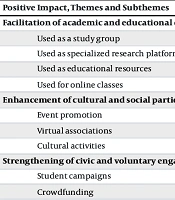
Table 1.
Positive Effects of Social Networks on Student Engagement
| Positive Impact, Themes and Subthemes | Statement |
|---|---|
| Facilitation of academic and educational communication | |
| Used as a study group | Students use Telegram or WhatsApp groups for class discussions and resource sharing. |
| Used as specialized research platforms | Platforms such as ResearchGate and LinkedIn have increased participation in academic research. |
| Used as educational resources | Students use YouTube channels to understand complex course concepts. |
| Used for online classes | The use of Zoom and Microsoft Teams has improved student interaction. |
| Enhancement of cultural and social participation | |
| Event promotion | Students first learn about university events through Instagram or Twitter. |
| Virtual associations | The formation of Facebook groups has increased membership in academic associations. |
| Cultural activities | Social networks facilitate interaction among international students. |
| Strengthening of civic and voluntary engagement | |
| Student campaigns | Environmental initiatives on Twitter have increased participation rates. |
| Crowdfunding | The use of GoFundMe in student projects has been successful. |
3. Results
The review identified both positive and negative effects of social networks on student engagement. Positive effects included the facilitation of academic and educational communication, enhanced cultural and social participation, and stronger civic and voluntary engagement (Table 1).
Negative effects included reduced academic concentration and attendance, social media addiction, lower grade point averages, reduced physical participation, social isolation, misinformation, distrust, depression, and social comparison (Table 2).
Table 2.
Negative Effects of Social Networks on Student Engagement
| Negative Impact, Themes and Subthemes | Statement |
|---|---|
| Academic and educational dimension | |
| Reduced concentration | Constantly checking social media during study time reduces students' productivity. |
| Decreased attendance or participation | Attendance at university libraries has decreased because of access to digital resources. |
| Social media addiction | Instagram use has reduced students' study time. |
| Grade point average decline | The use of various social networks has led to lower examination scores. |
| Cultural dimension | |
| Virtual interaction | Physical attendance at university events has decreased because of a preference for online interactions. |
| Increased isolation | Feelings of loneliness among students have increased despite virtual connections. |
| Civic and voluntary dimension | |
| Rumor dissemination | Misinformation on social networks has contributed to student tensions. |
| Distrust | The dissemination of false information has reduced trust in university institutions. |
| Depression and social comparison | Comparisons with influencers have reduced satisfaction with the university environment. |
Individual characteristics and university policies were identified as factors that may modify the relationship between social networks and student engagement (Table 3).
Table 3.
Factors Influencing the Relationship Between Social Networks and Student Engagement
| Factors Influencing and Themes | Statement |
|---|---|
| 1. Individual characteristics | |
| Introversion or extraversion | Extroverted students use social media more frequently for participation. |
| Gender | Women use social media more frequently than men to coordinate group activities. |
| 2. University policies | |
| Access restrictions | Universities that have restricted access to Facebook during class hours have reported improved physical attendance. |
| Encouragement of positive use | Offering academic credit for scientific activities on LinkedIn has been effective. |
4. Conclusions
4.1. Positive Effects on Academic and Educational Engagement
Social networks can facilitate academic and educational communication. Studies have emphasized the potential of social media to enhance learning and increase students’ interest and enthusiasm (17, 22, 23). Students report that social media enables rapid collaboration and interaction, facilitates the exchange of knowledge and skills with classmates, and provides opportunities for immediate feedback on academic and research activities. These platforms can therefore extend learning beyond the classroom and increase student participation and engagement (24-31).
4.2. Positive Effects on Cultural, Social, and Civic Engagement
Social networks can increase cultural and social participation by helping students learn about university programs, participate in activities, and engage in international interactions (32-35). They can also support civic and voluntary participation and student-led campaigns. This finding is consistent with studies emphasizing the role of digital media in social mobilization (36-39).
4.3. Negative Effects
Adverse academic and educational effects include reduced concentration and attendance, social media addiction, and lower grade point averages (40-44). Cultural effects include a preference for virtual interaction and increased social isolation (45, 46). In civic and voluntary domains, adverse effects include rumor dissemination, distrust, depression, and social comparison (47-50).
4.4. Moderating Factors
4.5. Limitations
This review used a defined set of specialized keywords. Although the authors searched multiple databases and used diverse relevant terms, some eligible studies may have been missed.
4.6. Implications and Final Conclusions
Social networks function as a double-edged sword in university settings. They can strengthen academic, cultural, and civic engagement while also threatening concentration, mental health, physical participation, and institutional trust. Their ultimate effects depend substantially on individual student characteristics and institutional policies. Extroverted students and women may use these platforms more positively, whereas targeted access restrictions and the encouragement of educational use may mitigate adverse effects.
Universities should adopt a proactive and balanced approach that leverages the positive potential of social networks while reducing misuse through media literacy education, ethical guidelines, and dedicated institutional platforms. Integrating social networks into broader university development strategies may help institutions maximize benefits while limiting harms.