
1. Background
In recent years, the use of academic social networks has increased significantly among researchers and students (1-4). Academic social networks are used to create collaborative groups, create and promote connections with friends and colleagues, create professional and career connections beyond the university and geographical boundaries (5).
In addition to the aforementioned advantages, academic social networks create scientific groups, joint research activities, and increase citations to researchers' articles (6). Another use of academic social networks is to develop interactions between academic researchers, especially when young researchers conduct research under the supervision of experienced researchers or when researchers share experiences, it becomes even more important (7).
In their study, Jeng et al. showed that users of joined academic social networks are more motivated to increase their professional knowledge and collaborate in writing research articles (8). Almousa also came to the conclusion that researchers use different academic social networks according to the nature of their research activities and their needs (9).
The development of academic social networks can pave the way for the achievement and establishment of a knowledge and research management system (10). Considering the development process of social networks in Iran, as well as the increased attention of the scientific community to this powerful means of interaction, assessing the needs of the intended users of these networks and the challenges and barriers to their development is an important issue (11).
Considering the development of different academic social networks and the unique features of each network, the present researchers compared 4 social networks widely used by Iranian researchers.
2. Objectives
The present findings can facilitate the choice of the right social network for researchers and can help create and implement social networks.
3. Methods
The present qualitative study was conducted in 2023 using a comparative approach. In a comparative study, to find the differences and similarities of 2 or more entities, they are juxtaposed and analyzed. A comparative study takes two steps to implement and get the results. In the first step, each entity is defined independently, and in the second step, the differences and similarities are compared, compiled and reconciled.
In the present study, the research population comprised of academic social networks selected as examples of popular social networks among researchers. To find these examples, the existing related literature was reviewed purposively. Finally, 4 popular academic social networks among Iranian researchers were found: Mendeley, ResearchGate, Academia, and LinkedIn (12).
The data collection instrument in this study was a checklist developed based on a review of literature. The instrument consisted of 8 dimensions and 70 items. These dimensions included communication channels (11 items), intelligence (9 items), search capability (10 items), privacy (7 items), communication management (11 items), customization facilities (7 items), navigation (7 items) and guidelines (8 items). The validity of this checklist was substantiated by a panel of 5 experts in health information management, medical informatics and medical librarianship.
To collect data, while examining the structure and performance of the websites of these social networks, the latest edition of guidelines and documents produced by the company owning the website were examined. The data analysis was done comparatively, and after entering the data in the checklist, the analysis was done descriptively and based on the consensus of three researchers. This study is part of a more comprehensive research project at Hormozgan University of Medical Sciences.
4. Results
In the present study, the usability of 4 popular academic social networks among Iranian researchers was compared in a comparative study from 8 dimensions.
4.1. Communication Channels
The communication channels reviewed by academic social networks were rated along eleven alternatives: Insert post, request an article, send and receive feedback, question and answer, manage posts, add comments, the number of times a post is read, the ability to hide and manage comments, the ability to approve content Likes by readers, the ability to chat with other users, the ability to respond to user comments. In all four academic social networks, it was possible to post comments, chat with other users and provide feedback. Concerning communication channels, the academic social networks ResearchGate, Mendeley, Academia and LinkedIn had, respectively, 11, 5, 4 and 9 alternatives.
4.2. Intelligence
In the present study, the intelligence of social networks was examined along nine alternatives: Automatically sending ads to the user's email, automatically displaying findings based on interest, the presence of a timer for automatic deletion of posts, warning about unseen (unread) items, sending content based on the researcher’s interests, possibility of saving search results, suggestion to follow researchers and research articles, suggesting content to the interest of researcher, introduction of researchers to similar areas of interests.
In all the academic social networks reviewed, it was possible to send the user's favorite content intelligently, and also in this dimension, ResearchGate was recognized as the smartest academic social network. Out of the 9 dimensions of usability related to intelligence, among the academic social networks ResearchGate, Mendeley, Academia, and LinkedIn had 8, 4, 6, and 6, respectively. In this study, the intelligence of social networks includes nine options (automatically sending advertisements to the user's email, automatically displaying findings based on interest, the existence of a timer for automatic deletion of posts, warning about unseen (unread) items, sending content to The basis of the researcher's interests was the possibility of storing search results, suggestions for following up researchers and research articles, suggested materials related to the researcher's interest, introduction of researchers with similar interests). In all the academic social networks reviewed, it was possible to send the user's favorite content intelligently, and also in this dimension, Research Gate was recognized as the smartest academic social network.
4.3. Search Capabilities
Search capabilities in the social network can be considered as one of the most important functions of social media. Search capabilities in these four academic social networks were rated along ten alternatives: Possibility of searching, possibility of advanced search, possibility of searching by title, author name, date, different parts of the article, search by user field, showing the number of results, searching users with similar interests. Out of ten features for searching, ResearchGate had 8, Mendeley 9, Academia 7, and LinkedIn 5 capabilities. Concerning search capabilities, Mendeley ranked first.
4.4. Privacy
Privacy in academic social networks was rated along 7 alternatives: Possibility of showing or hiding parts of the profile and posts, limiting the viewing of posts to a specific group of users, identifying the visitors of profile, making the profile public and semi-public, filtering unwanted information, limiting sending and receiving messages, or creating conditions for the user and validating profile information. ResearchGate and LinkedIn got the highest scores in this case among the investigated social networks. The ability to filter unwanted information, the ability to limit sending and receiving messages were among the alternatives that featured all four social networks investigated in this study. In terms of privacy, ResearchGate scored 6, Mendeley 4, Academia 3, and LinkedIn 6.
4.5. Communication Management (Followers and the Followed)
Creating a communication network in the social hobby network happens usually as interaction between followers and the followed.
This dimension was rated along eleven alternatives: Searching for people based on the link of other social networks, based on email, based on Google Plus, etc., inviting people to the social network, viewing items updated by followers, possibility of deleting a follower, viewing the list of followers and the followed, and viewing their profile, possibility of following other users, possibility of finding experts, giving warnings about what has been recently uploaded by followers on the site, and notification about new requests.
As the present findings showed, ResearchGate and LinkedIn enjoyed all alternatives in managing communication among researchers. In the dimension of communication management, ResearchGate scored 11, Mendeley 9, Academia 4, and LinkedIn 11.
4.6. Customization
The present study showed that ResearchGate and Mendeley provide users with the best alternatives for customization. It was also possible to customize notifications in all four social networks.
The 7 alternatives for customization were: Notifications customization according to user's personal settings, upgrading and customization of menus, customization of notifications, uploading resumes, updating items and favorites, creation of groups, downloading and uploading full texts of 7 articles. All four academic social networks scored 6 points concerning this dimension.
4.7. Navigation
Website navigation is a major feature that makes it user-friendly and easy to use. This feature in academic social networks was rated along seven alternatives: Direct link to the main page of the website on all pages, use of auxiliary links, clarity of browsing location with text and image, suitable title for each page, full insertion of page titling, easy navigation on the website, and insertion of the title of each part on top of each page. In this review, Academia and LinkedIn got all the expected scores, and ResearchGate, Mendeley got 6 points.
4.8. Guidelines
The presence of a guideline can encourage researchers to use academic social networks. To assess this dimension, 8 guidelines of websites were compared across four social networks.
This dimension was rated along several alternatives: Educational videos, guide messages, educational files, the possibility of questions and answers, online chat, possibility of emailing questions and suggestions, specialized discussion group for questions related to the website and possibility of sending feedback.
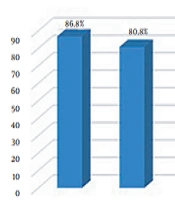
Concerning guidelines, ResearchGate scored 5, Mendeley 3, Academia 1 and Link Din 5 (Figure 1).
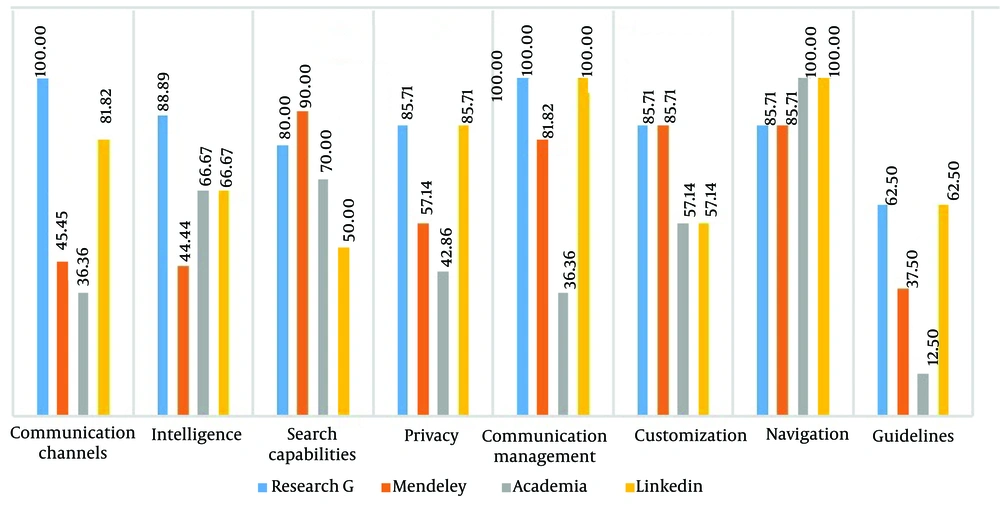
Figure 1.
The mean scores of academic social networks along different dimensions of usability. The mean score of communication channels was 65.91, intelligence 66.67, search capabilities 72.50, privacy 67.86, communication management 79.55, customization 71.43, navigation 92.86, and guidelines 43.75. Among social networks, ResearchGate was ranked first with a score of 87.14, followed by LinkedIn with a score of 75.71, Mendeley 65.71 and Academia 51.43.
5. Discussion
In the present study, four popular social networks among Iranian researchers were compared.
In this study, for the first time, academic social networks have been compared in a comparative way. The results of this study are very practical and can be used for social network designers. Considering that this study was conducted by non-English speakers, it can provide a clear perspective to managers and designers of social networks with a large audience.
In this research, eight dimensions of usability were analyzed in four academic social networks, ResearchGate, LinkedIn, Academia and Mendeley.
In the current research, Academia and Mendeley social networks got the lowest score in terms of communication channels. Social networks are valuable learning devices because they enable learners to create, publish and share their work. Social networks can facilitate learner interaction and collaboration (13). In this regard, Dehghani et al. also contended that communication channels of academic social networks are an important means of solving the researchers’ problems (14).
A major reason for using academic social networks is to establish a relationship with researchers and exchange opinions on scientific topics. The more powerful a social network with this regard, the more effective it will be. What should be noted in this context is the purpose of building a social network. It seems that though the two social networks Mendeley and Academia were developed to share information, they invested less in the communication channels.
In terms of intelligence, four social networks were examined. ResearchGate got the highest score and Mendeley the lowest. Kong found that the use of new technologies can play a role in attracting new users (15). Some other research on researcher needs also found that the intelligence of academic social networks can affect other network functions (16).
The intelligence of academic social networks makes it easy to work with that network and saves researcher’s time. Improving the intelligence of social networks will not only satisfy users, but also increase the popularity and entertainment aspects of network, which will cause researchers to spend more time.
As the present findings showed, Mendeley received the highest score in search capabilities. The other social networks that were examined received more than half of the score. In this regard, Selwyn admits that social networks can be useful and effective means of education and research if they can create suitable contexts to access uploaded scientific and research data (17). In this regard, Akwang considers the most important use of social networks to be search ability (18).
The main reason for researchers’ preference of academic social networks over common social networks is the existence of various scientific data and information confirmed in these networks. Therefore, as researchers view it, the existence of various search capabilities in academic social networks is crucial.
As the present findings showed, none of the social networks got a full score of privacy. Nowadays, with the advent of academic social networks, researchers all over the world have turned to these devices, which made them better capable of publishing and sharing their works of research (19). Therefore, social networks pay more attention to the privacy issue in view of new security issues such as creating fake user accounts, detecting theft and phishing (20). With an emphasis on the significance of security in social networks, Jain et al. divided the types of threats of social networks into 3 main categories: Conventional threats, modern threats and targeted threats (21).
Ensuring security and privacy can not only increase the number of social network users, but can also prevent these social networks from involvement in legal issues. In respecting people’s privacy, the network should not further complicate the issue. Similarly, it should not make it hard to access information.
As the present findings showed, customization in LinkedIn and Academia needed improvement. In agreement with this finding, Dehghani et al. also stated that a great solution for the popularity of social networks among users is the possibility of customization (22). In their study, Saberi et al. enlisted the most effective technical components of the efficiency of using social networks: Accessibility, ease of use, multimedia capability, structure, presentation of suitable content, freshness and being up-to-date, accuracy and precision, ability to understand content, appropriate graphic and visual structure, and subject coverage (23). Customization in social networks creates more user retention on the one hand, and on the other, it creates a competitive advantage for the academic social network.
5.1. Conclusions
Undoubtedly, academic social networks play an important role in the development of science and research and improving its quality. The facilities available in social networks not only create communication channels and guarantee the quality of research, but can also develop a potential capacity to pave the way for international research-oriented cooperation. As the present findings showed, ResearchGate social network got the highest scores. It can be concluded from the present findings that each academic social network is designed based on a primary goal; therefore, each academic social network is different in terms of facilities. The survey showed that all the investigated social networks scored higher than the average in all dimensions.
5.2. Suggestions
Designers of academic social networks should identify the main purpose of developing that social network before any design and programming. Then, the design of the social network requires comprehensive needs assessments, including interviews with users. With the emergence of technologies based on productive artificial intelligence, it is suggested to use these emerging technologies such as GPT Chat and Google Bard in academic social networks to increase the productivity of these networks.
Universities and research institutes should hold workshops to familiarize researchers with the usability of these social networks. Owners of social networks should update these websites based on users' needs and take measures for customization and ease of use.