
1. Background
Educational systems that prioritize student motivation and satisfaction are widely recognized as key determinants of success in higher education institutions (1). Upon entering university, students bring diverse experiences, needs, and expectations, and the extent to which institutions respond to these expectations plays a decisive role in shaping students’ academic attitudes and overall satisfaction (2, 3). As the primary recipients of educational services, students’ satisfaction is considered a valid indicator of both the effectiveness of the educational system and the quality of associated welfare-cultural facilities (4). Insufficient satisfaction may pose substantial challenges to achieving the core objectives of higher education, particularly the development of competent and committed human resources (5).
Monitoring student satisfaction enables universities to systematically review educational programs, align them with learners’ needs, and enhance organizational responsiveness. Student satisfaction has also been linked to institutional effectiveness and competitive advantage in higher education (6, 7). Conversely, dissatisfaction with the educational environment can disrupt learning, reduce academic engagement, and adversely affect students’ academic performance, personal development, and social growth (5).
Empirical evidence indicates that student satisfaction is influenced by interconnected factors, including student–faculty interactions, peer relationships, access to material and nonmaterial support, the quality of educational technologies, and students’ perceived self-efficacy (8, 9). National and international studies also suggest that organizational climate, participation, perceived autonomy, and interpersonal relationships play important roles in shaping satisfaction (3).
Findings across institutions remain inconsistent. Some studies have reported low satisfaction due to inadequate educational and support services (10-12), whereas others have reported moderate to high satisfaction (13, 14). These discrepancies highlight the influence of contextual and institutional factors and underscore the need for context-specific institutional evaluations.
Despite the growing body of research, many previous studies have focused narrowly on a single aspect of student services, such as classroom instruction (15), clinical training (16), or specific educational environments (10). Consequently, comprehensive studies that simultaneously assess educational services and welfare-cultural facilities remain limited. Addressing this gap is particularly important in specialized academic settings, in which institutional structures and student needs may differ substantially from those at general universities.
AJA University of Medical Sciences, a military medical university, plays a pivotal role in training health care professionals, particularly in paramedical disciplines. Given the direct association between educational quality and graduates’ future professional performance, evaluating students’ satisfaction with both educational services and welfare-cultural facilities is important. To date, no comprehensive assessment of these services has been conducted in the School of Paramedical Sciences at this university.
2. Objectives
This evaluation is particularly important at a military medical university, where students operate under unique regulations, hierarchical structures, and mission-oriented pressures that may influence their service expectations and satisfaction differently from those of students at civilian institutions (17, 18). Therefore, this study aimed to evaluate paramedical students’ satisfaction with educational services and welfare-cultural facilities at AJA University of Medical Sciences. The findings were expected to provide actionable evidence to inform institutional planning and targeted quality-improvement initiatives.
3. Methods
3.1. Study Design and Setting
This descriptive-analytical cross-sectional study was conducted at AJA University of Medical Sciences in Tehran, Iran. Data were collected from April 10 to 30, 2024, during the second academic semester of the 2024 academic year.
3.2. Study Population and Sampling Strategy
The study population included all undergraduate students at the associate and bachelor’s degree levels enrolled in the School of Paramedical Sciences across 6 fields: Laboratory Sciences, Anesthesia, Radiology, Operating Room Technology, Health Information Technology, and Emergency Medical Services. First-semester students were excluded to ensure that participants had sufficient exposure to the university environment and its services. The sampling frame was derived from the complete roster of eligible students (N = 250) obtained from the faculty’s educational affairs office. Because of the limited population size, a census approach was used. Inclusion criteria were 1) completion of at least 1 academic semester and 2) provision of voluntary informed consent. Exclusion criteria were withdrawal of consent or submission of an incomplete questionnaire.
3.3. Data Collection Procedure
After ethical approval was obtained from the Research Ethics Committee of AJA University of Medical Sciences and permission was obtained from the dean of the faculty, the research team administered the questionnaires during the first few minutes of classroom sessions. Before distributing the questionnaires, the researchers explained the study objectives, confidentiality protections, and the voluntary nature of participation. Of the 250 eligible students, 200 submitted complete questionnaires and were included in the statistical analysis, yielding a response rate of 80%. Figure 1 presents the participant selection and recruitment process.
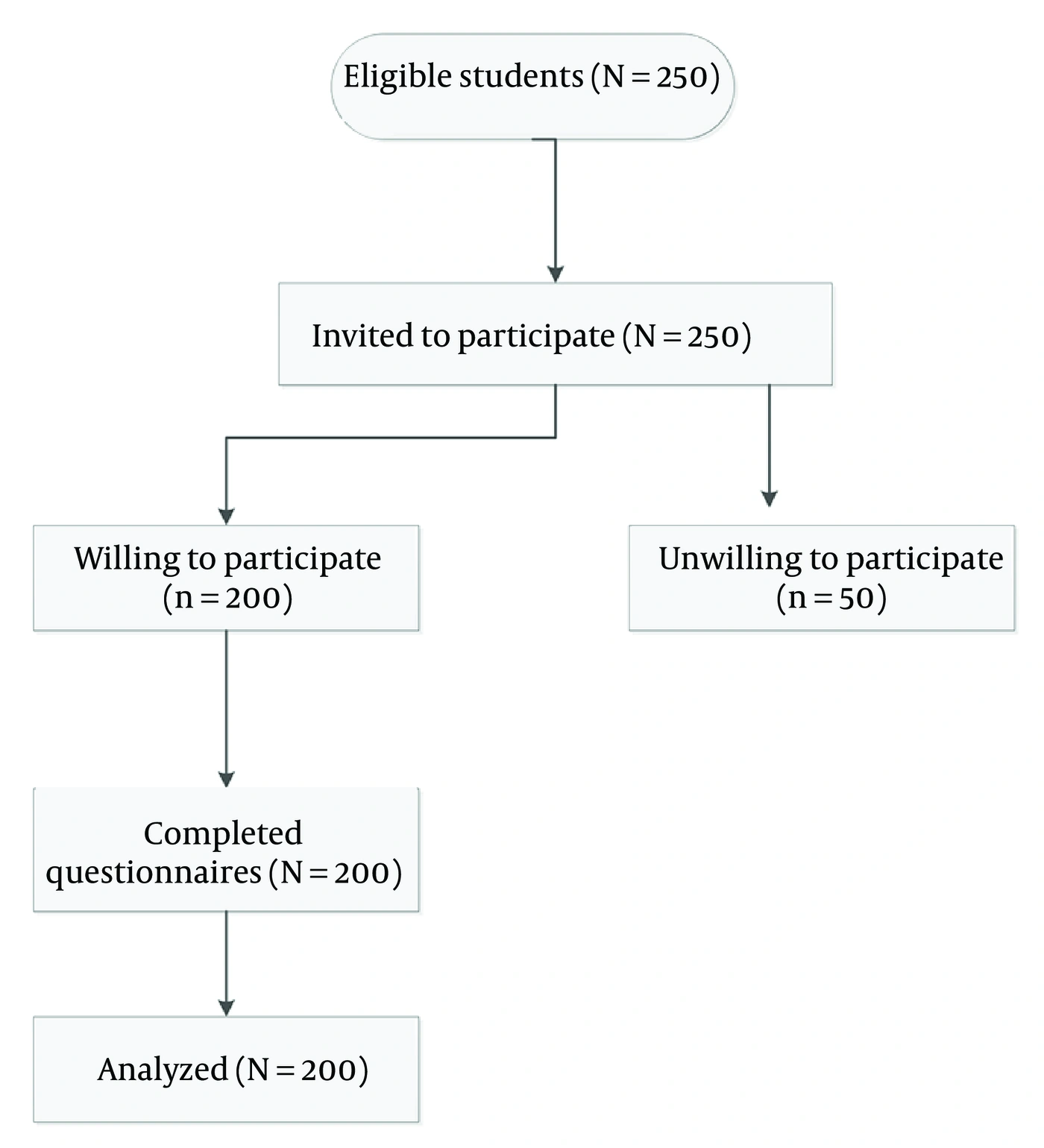
Figure 1.
Participant recruitment flow diagram
3.4. Instrument
A researcher-developed questionnaire was used to assess student satisfaction with educational services and welfare-cultural facilities. The instrument was developed based on the study objectives, a systematic literature review, and adaptations of 2 existing tools: the questionnaire developed by the Deputy for Education and Training of AJA and the Student Satisfaction Inventory. Items were tailored to the context of a military medical university and the paramedical student population. Of the initial 55 items, 41 remained after face and content validity evaluation. The final instrument was named the AJA Paramedical Student Satisfaction Inventory (APSSI).
The APSSI comprised 2 parts. Part 1 collected demographic information on age, gender, field of study, marital status, and place of birth. Part 2 contained 41 items across 6 predefined domains, each rated on a 5-point Likert scale ranging from 1 (strongly disagree) to 5 (strongly agree):
1) Academic Advisors: 4 items, including accessibility and quality of guidance
2) Faculty Members: 6 items, including teaching quality and communication
3) Educational Services: 7 items, including curriculum relevance and assessment methods
4) Auxiliary Educational Services: 10 items, including the library, laboratories, and information technology infrastructure
5) Welfare Facilities: 9 items, including dormitories, dining halls, and sports complexes
6) Cultural Facilities: 5 items, including student clubs and auditoriums
The complete English version of the APSSI is provided as Appendix 1 in Supplementary File 1.
3.5. Validity and Reliability
3.5.1. Validity
A panel of 10 specialists in health education and promotion, nursing education, and medical education assessed the instrument’s face and content validity. The preliminary draft was reviewed for clarity, relevance, and comprehensiveness. Based on expert feedback, several items were reworded or removed to improve face validity. Quantitative content validity was assessed using the content validity ratio (CVR) and content validity index (CVI) according to Lawshe’s method. The CVR was 0.97, indicating excellent essentiality, and the relevance-based CVI was 1.00, indicating complete agreement among experts regarding item relevance and clarity.
Exploratory or confirmatory factor analysis was not performed because of the exploratory, descriptive nature of the research and the relatively limited sample size for factor-analytic techniques (n = 200). The 6-domain structure was derived theoretically from the literature and expert consensus during the content-validity phase. Future research with larger samples should examine the factorial validity of the APSSI.
3.5.2. Reliability
Reliability was evaluated in a pilot study of 30 nonparamedical students from a similar academic setting. Internal consistency was assessed using standardized Cronbach α coefficients. The coefficient for the total scale was 0.97, indicating excellent reliability. As shown in Table 1, coefficients for the 6 domains ranged from 0.864 to 0.937.
Table 1.
Standardized Cronbach α Coefficients for the 6 Domains and Total AJA Paramedical Student Satisfaction Inventory
| Row | Domain | Number of items | Standardized Cronbach α |
|---|---|---|---|
| 1 | Academic Advisors | 4 | 0.928 |
| 2 | Faculty Members | 6 | 0.864 |
| 3 | Educational Services | 7 | 0.869 |
| 4 | Auxiliary Educational Services | 10 | 0.904 |
| 5 | Welfare Facilities | 9 | 0.937 |
| 6 | Cultural Facilities | 5 | 0.903 |
| 7 | Total | 41 | 0.970 |
3.6. Scoring and Data Transformation
Each domain’s raw score was calculated by summing its item scores. To facilitate consistent interpretation and comparison across domains with different numbers of items, raw scores were converted to a linear scale ranging from 0 to 100 using the following formula:
In this formula, n is the number of items in the domain, and ni is the score of each item in that domain. For a domain with k items, each scored from 1 to 5, the minimum possible score is k and the maximum is 5k. Thus, a score of 0 represents the lowest possible satisfaction, and a score of 100 represents the highest. The total satisfaction score was obtained by averaging the 6 transformed domain scores. For descriptive purposes, total scores were categorized as low (0 - 33.3), moderate (33.4 - 66.6), or high (66.7 - 100).
3.7. Statistical Analysis
Statistical analyses were performed using IBM SPSS Statistics, version 16.0. For normally distributed variables, descriptive results were expressed as mean ± SD; for variables with a nonnormal distribution, medians and interquartile ranges (IQRs) were reported. The Kolmogorov-Smirnov test was used to assess normality. Most variables significantly departed from a normal distribution (P < 0.05); therefore, inferential analyses used nonparametric methods. The Mann-Whitney U test was used to compare 2 independent groups, such as gender groups, and the Kruskal-Wallis H test was used for comparisons involving more than 2 groups, such as fields of study. When a Kruskal-Wallis test was significant, post hoc pairwise comparisons were conducted using the Dunn test with Bonferroni correction. Bonferroni-adjusted P values were reported for all pairwise comparisons.
For significant comparisons, the Mann-Whitney U and Kruskal-Wallis H statistics and their degrees of freedom, when applicable, were reported. Effect sizes were calculated using rank-biserial correlation for Mann-Whitney tests and epsilon squared (ε2) for Kruskal-Wallis tests, with values of 0.1, 0.3, and 0.5 interpreted as small, medium, and large effects, respectively. No additional adjustment was made for multiple demographic comparisons, such as comparisons across gender, field of study, and birthplace, because each demographic variable was tested independently. Bonferroni adjustment was applied only to post hoc pairwise comparisons following Kruskal-Wallis analyses. Statistical significance was set at P < 0.05. This study was reported in accordance with the Strengthening the Reporting of Observational Studies in Epidemiology guidelines for cross-sectional studies (19).
4. Results
4.1. Participant Characteristics
Of the 250 eligible students, 200 agreed to participate and submitted complete questionnaires for analysis. The participant recruitment and selection process is shown in Figure 1. Table 2 summarizes the participants’ demographic characteristics. The mean age was 21.57 years (SD, 1.57), and most participants (81.5%) were aged 20 - 23 years. Most participants were male (75%). The largest group studied Operating Room Technology (30%), followed by Laboratory Sciences (19%), Anesthesia (16.5%), Radiology (16.5%), Emergency Medical Services (11%), and Health Information Technology (7%). Most students were single (95.5%); 27.5% were born in Tehran, and 72.5% were born in other cities.
Table 2.
Sociodemographic and Educational Profile of the Study Sample (N = 200)
| Variables | No. (%) |
|---|---|
| Age | |
| < 20 | 13 (6.5) |
| 20 - 23 | 163 (81.5) |
| ≥ 24 | 24 (12.0) |
| Gender | |
| Male | 150 (75.0) |
| Female | 50 (25.0) |
| Field of study | |
| Laboratory Sciences | 38 (19.0) |
| Anesthesia | 33 (16.5) |
| Radiology | 33 (16.5) |
| Operating Room Technology | 60 (30.0) |
| Health Information Technology | 14 (7.0) |
| Emergency Medical Services | 22 (11.0) |
| Marital status | |
| Married | 9 (4.5) |
| Single | 191 (95.5) |
| Place of birth | |
| Tehran | 55 (27.5) |
| Other | 145 (72.5) |
4.2. Overall Satisfaction Across Domains
Student satisfaction scores across the 6 measured domains are presented in Table 3. The highest median satisfaction was observed for Academic Advisors (median, 75.00; IQR, 43.75), whereas the lowest was observed for Welfare Facilities (median, 38.89; IQR, 40.98). The IQRs indicated variability in responses, with the greatest dispersion in the Academic Advisors and Welfare Facilities subscales and the least dispersion in the Auxiliary Educational Services subscale. Collectively, these findings indicate higher and more consistent satisfaction with academic advising than with Welfare Facilities and Cultural Facilities.
Table 3.
Distribution of Satisfaction Scores by Service Domain a
| Satisfaction Domain | Median | Q1 | Q3 | IQR | Range (Minimum - Maximum) |
|---|---|---|---|---|---|
| Academic Advisors | 75.00 | 56.25 | 100.00 | 43.75 | 6.25 - 100 |
| Faculty Members | 62.50 | 45.83 | 82.29 | 36.46 | 12.50 - 100 |
| Educational Services | 62.50 | 50.00 | 85.71 | 35.71 | 10.71 - 100 |
| Auxiliary Educational Services | 56.25 | 42.50 | 75.00 | 32.50 | 2.50 - 100 |
| Welfare Facilities | 38.89 | 22.22 | 63.20 | 40.98 | 0 - 100 |
| Cultural Facilities | 50.00 | 35.00 | 75.00 | 40.00 | 0 - 100 |
| Total score | 57.31 | 44.81 | 76.98 | 32.17 | 14.57 - 100 |
a Satisfaction scores for each domain range from 0 to 100. Abbreviations: IQR, interquartile range; Q1, first quartile; Q3, third quartile.
4.3. Associations with Demographic Variables
Table 4 presents associations between satisfaction scores and demographic variables. Because the satisfaction scores were nonnormally distributed (Kolmogorov-Smirnov test, P < 0.05), medians and IQRs are reported. The table also provides test statistics (U for Mann-Whitney tests and H for Kruskal-Wallis tests) and effect sizes (r for 2-group comparisons and ε2 for multigroup comparisons).
Table 4.
Domain-Specific and Total Satisfaction Scores Stratified by Demographic Subgroup a
| Demographic variable | Academic Advisors | Faculty Members | Educational Services | Auxiliary Educational Services | Welfare Facilities | Cultural Facilities | Total score |
|---|---|---|---|---|---|---|---|
| Age group | |||||||
| < 20 | 100.0 (28.1) | 75.0 (31.3) | 67.9 (39.3) | 70.0 (46.3) | 50.0 (44.4) | 60.0 (52.5) | 74.7 (36.6) |
| 20 - 23 | 75.0 (43.8) | 62.5 (33.3) | 60.7 (35.7) | 57.5 (32.5) | 38.9 (41.7) | 50.0 (40.0) | 57.9 (30.4) |
| ≥ 24 | 78.1 (56.3) | 54.2 (33.3) | 60.7 (36.6) | 55.0 (29.4) | 34.7 (28.5) | 47.5 (38.8) | 49.8 (32.9) |
| Kruskal-Wallis H (df = 2) | 5.243 | 2.860 | 4.274 | 2.874 | 4.783 | 0.854 | 4.843 |
| P value | 0.073 | 0.239 | 0.118 | 0.238 | 0.092 | 0.653 | 0.089 |
| Gender | |||||||
| Male | 75.0 (50.0) | 60.4 (30.2) | 60.7 (28.6) | 55.0 (32.5) | 36.1 (33.3) | 50.0 (40.0) | 54.5 (29.6) |
| Female | 90.6 (43.8) | 72.9 (34.4) | 73.2 (36.6) | 67.5 (31.9) | 47.2 (35.4) | 55.0 (50.0) | 68.7 (32.1) |
| U (Mann-Whitney) | 3188.0 | 3357.0 | 3221.0 | 2914.0 | 3016.0 | 3178.0 | 3042.0 |
| P value | 0.106 | 0.276 | 0.135 | 0.018 b | 0.038 b | 0.106 | 0.046 b |
| Effect size (r) | 0.11 | 0.08 | 0.11 | 0.17 (small) | 0.15 (small) | 0.11 | 0.14 (small) |
| Field of study | |||||||
| Laboratory Sciences | 65.6 (45.3) | 66.7 (30.2) | 64.3 (25.9) | 61.3 (28.1) | 40.3 (47.9) | 52.5 (46.3) | 57.0 (34.3) |
| Anesthesia | 93.8 (40.6) | 62.5 (43.8) | 64.3 (46.4) | 55.0 (46.3) | 38.9 (40.3) | 60.0 (57.5) | 62.0 (38.3) |
| Radiology | 75.0 (50.0) | 66.7 (27.1) | 60.7 (42.9) | 57.5 (36.3) | 41.7 (23.6) | 50.0 (52.5) | 58.6 (35.5) |
| Operating Room Technology | 75.0 (50.0) | 54.2 (25.0) | 57.1 (31.3) | 52.5 (31.9) | 31.9 (35.4) | 47.5 (25.0) | 51.0 (26.5) |
| Health Information Technology | 78.1 (31.3) | 64.6 (24.0) | 60.7 (26.8) | 48.8 (35.0) | 33.3 (25.7) | 52.5 (37.5) | 57.8 (25.4) |
| Emergency Medical Services | 81.3 (37.5) | 70.8 (32.3) | 73.2 (41.1) | 63.8 (30.0) | 58.3 (37.5) | 62.5 (27.5) | 66.3 (27.4) |
| Kruskal-Wallis H | 5.845 | 15.755 | 5.165 | 7.761 | 15.350 | 5.199 | 7.925 |
| df | 5 | 5 | 5 | 5 | 5 | 5 | 5 |
| P value | 0.322 | 0.008 c | 0.396 | 0.170 | 0.009 c | 0.392 | 0.160 |
| Effect size (ε2) | – | 0.079 (medium) | – | – | 0.077 (medium) | – | – |
| Marital status | |||||||
| Married | 75.0 (46.9) | 54.2 (35.4) | 75.0 (21.4) | 62.5 (40.0) | 41.7 (41.7) | 50.0 (37.5) | 66.1 (35.1) |
| Single | 75.0 (43.75) | 62.5 (37.5) | 60.7 (35.7) | 55.0 (32.5) | 38.9 (41.7) | 50.0 (40.0) | 57.0 (32.5) |
| Mann-Whitney U | 788.0 | 813.0 | 574.0 | 732.5 | 856.5 | 770.0 | 785.0 |
| P value | 0.667 | 0.784 | 0.092 | 0.454 | 0.986 | 0.597 | 0.661 |
| Place of birth | |||||||
| Tehran | 81.3 (50.0) | 66.7 (37.5) | 64.3 (39.3) | 57.5 (37.5) | 44.4 (38.9) | 60.0 (50.0) | 59.5 (37.9) |
| Other | 75.0 (43.8) | 62.5 (33.3) | 60.7 (28.6) | 55.0 (29.4) | 36.1 (34.7) | 50.0 (40.0) | 56.6 (30.4) |
| U (Mann-Whitney) | 3874.0 | 3376.0 | 3425.0 | 3441.5 | 3163.5 | 3444.5 | 3408.0 |
| P value | 0.809 | 0.107 | 0.140 | 0.153 | 0.028 b | 0.155 | 0.129 |
| Effect size (r) | – | – | – | – | 0.16 (small) | – | – |
a Data are presented as median (IQR). Effect sizes are r for Mann-Whitney U tests and ε2 for Kruskal-Wallis tests.
b Significant differences are indicated by P < 0.05 after Bonferroni correction.
c Significant differences are indicated by P < 0.01 after Bonferroni correction.
4.3.1. Age
Although students younger than 20 years reported numerically higher mean satisfaction scores across all domains, the Kruskal-Wallis test showed no significant differences for any subscale or the total score (all P > 0.05; Table 4).
4.3.2. Gender
Total satisfaction differed significantly by gender (Mann-Whitney U = 3042.0, P = 0.046; r = 0.14, small), with female students reporting greater satisfaction than male students. This difference was particularly evident for Auxiliary Educational Services (U = 2914.0, P = 0.018; r = 0.17) and Welfare Facilities (U = 3016.0, P = 0.038; r = 0.15).
4.3.3. Place of Birth
Satisfaction with Welfare Facilities differed significantly by place of birth (Mann-Whitney U = 3163.5, P = 0.028; r = 0.16, small), with students born in Tehran reporting greater satisfaction than those born in other cities.
4.3.4. Academic Discipline
The Kruskal-Wallis test showed significant differences among fields of study for Faculty Members (H = 15.755, df = 5, P = 0.008; ε2 = 0.079, medium) and Welfare Facilities (H = 15.350, df = 5, P = 0.009; ε2 = 0.077, medium).
Post hoc pairwise comparisons using the Dunn test with Bonferroni correction showed that Emergency Medical Services students reported significantly greater satisfaction with Faculty Members than Operating Room Technology students (adjusted P = 0.015). Emergency Medical Services students also reported significantly greater satisfaction with Welfare Facilities than Operating Room Technology students (adjusted P = 0.019). No other pairwise comparison was significant after Bonferroni adjustment (all adjusted P > 0.05).
4.3.5. Marital Status
Marital status was not significantly associated with satisfaction in any domain (Table 4).
5. Discussion
This study examined paramedical students’ satisfaction with educational services and welfare-cultural facilities at AJA University of Medical Sciences. Overall satisfaction was moderate, with substantial variation across domains. Satisfaction was highest for Academic Advisors and lowest for Welfare Facilities. This pattern suggests that, although the university performs relatively well in academic guidance and core educational services, shortcomings in nonacademic domains, particularly welfare-cultural infrastructure, continue to adversely affect students’ overall educational experience.
The marked variability across domains underscores the multidimensional nature of student satisfaction, as documented in national and international literature (1, 4). Previous studies have emphasized that satisfaction in higher education is shaped not only by instructional quality but also by psychosocial, environmental, and organizational factors (20-22). In this study, relatively high satisfaction with Academic Advisors and Faculty Members highlights the importance of effective student-faculty interaction, accessibility, and constructive academic guidance. Conversely, lower median scores and wider dispersion for Welfare Facilities and Cultural Facilities indicate heterogeneous student experiences and unmet expectations. Low satisfaction with welfare facilities is consistent with findings from another Iranian medical university, in which dissatisfaction with educational services and facilities has been reported (23). Similar international patterns reinforce the importance of welfare-cultural facilities in shaping students’ sense of belonging and their overall perceptions of the university environment (2, 7). The wide IQRs for these domains further suggest that the quality and accessibility of these services may be unevenly distributed among students.
From a post-COVID-19 perspective, recent studies indicate that, although virtual and hybrid education models have increased flexibility and access to learning, reduced social interaction and limited cultural engagement have adversely affected student satisfaction (14). In contrast to Mohtaram et al. (24), who reported the highest mean satisfaction among medical students for facilities and equipment, the present study found that paramedical students at a military medical university were most satisfied with Academic Advisors. This discrepancy may reflect the practical orientation of paramedical disciplines, the organizational structure of military universities, and differences between the post-COVID-19 study period and the peak of the pandemic. Dissatisfaction with cultural facilities may partly reflect limited opportunities for extracurricular activities, social participation, and informal peer interaction—factors that may be particularly salient for a young, predominantly single population in a residential or semiresidential academic setting.
Gender, place of birth, and field of study were significantly associated with satisfaction, whereas age and marital status were not significantly associated with overall satisfaction. This pattern suggests that organizational and contextual factors may play a more decisive role in shaping student satisfaction than stable individual characteristics, consistent with Osman et al. (3) and De-Juan-Vigaray et al. (25). Although students younger than 20 years reported numerically higher satisfaction scores, these differences were not statistically significant, indicating relative consistency in perceived service quality across age groups.
Gender was an important determinant, with female students reporting greater overall satisfaction than male students, particularly for Auxiliary Educational Services and Welfare Facilities. One hypothesis requiring further investigation is that female students may experience more favorable dormitory conditions or may not be required to complete military-related courses during the academic semester, thereby reducing environmental stressors. However, these mechanisms were not measured and remain speculative.
This finding contrasts with that of Moosavi et al. (23), who reported no significant gender-based differences. Differences across studies may reflect contextual and structural differences between institutions, particularly military and civilian universities (17, 18).
Place of birth was significantly associated with satisfaction in the Welfare Facilities domain, with students born in Tehran reporting greater satisfaction than those born elsewhere. One possible explanation is that many Tehran-born students may not reside in university dormitories and may therefore have less exposure to the disciplinary environment of military residential facilities. This interpretation is speculative and should be tested in future studies by directly measuring residential status and its association with satisfaction.
Nonlocal students may face greater challenges related to accommodation, social adaptation, and distance from family, which can negatively affect their assessment of welfare facilities (9). This finding is consistent with reports from a similar institutional context in which familiarity with the environment was associated with greater satisfaction (26), but differs from findings in other settings in which geographic factors may play a less pronounced role (20).
Significant differences in satisfaction were also observed across academic disciplines, particularly for Faculty Members and Welfare Facilities. Emergency Medical Services students reported greater satisfaction than some other students. One possible explanation is that the structure of the Emergency Medical Services program, including a shorter on-campus duration, earlier clinical exposure, or closer student-faculty interaction, may contribute to greater satisfaction. However, these factors were not directly measured; therefore, this interpretation should be regarded as a hypothesis for future research rather than a confirmed mechanism.
From a theoretical perspective, the findings can be interpreted using Self-Determination Theory (SDT) and Social Cognitive Career Theory (SCCT). According to SDT (27), satisfaction develops when the basic psychological needs for autonomy, competence, and relatedness are fulfilled. In this study, greater satisfaction with Faculty Members and Academic Advisors may reflect fulfillment of competence and relatedness needs, whereas dissatisfaction with Welfare Facilities and Cultural Facilities may indicate unmet needs related to autonomy and personal well-being. Similarly, SCCT (28) emphasizes the role of contextual support in shaping academic satisfaction. Although Educational Services may support students’ academic self-efficacy, insufficient environmental and welfare-related support may undermine sustained satisfaction and engagement (5).
5.1. Practical and Managerial Implications
The findings have several practical implications for higher education managers and policy makers. Improving welfare and cultural infrastructure, including dormitory conditions, nutrition services, psychological counseling, and extracurricular activities, may improve overall student satisfaction and academic persistence.
Strengthening the professional competencies of academic advisors, particularly effective communication, academic guidance, and psychosocial support, may reinforce existing strengths in educational services.
Systematic assessment of student satisfaction and implementation of feedback mechanisms may facilitate evidence-based decision-making and continuous institutional quality improvement.
5.2. Limitations and Recommendations for Future Research
This study has several limitations. Its cross-sectional design precludes causal conclusions, and conducting the study at a single military medical university may limit generalizability to other settings. Reliance on self-reported information may also have introduced response bias. Because detailed demographic data were unavailable for nonrespondents (n = 50), the potential effect of nonresponse bias on satisfaction estimates could not be fully assessed.
The study did not directly measure several potential explanatory factors discussed in interpreting the findings, including dormitory exposure, military course burden, residential status, and qualitative reasons for satisfaction differences across demographic groups. These explanations should therefore be regarded as hypotheses requiring direct examination. Future studies should use mixed-methods designs to obtain deeper insight into the contextual factors shaping student satisfaction. Comparisons between military and civilian universities may also help identify structural differences in the provision of educational and welfare services.
5.3. Conclusions
Paramedical students at AJA University of Medical Sciences reported moderate overall satisfaction, with relatively high satisfaction with educational and academic advisory services and comparatively low satisfaction with welfare and cultural facilities. This imbalance highlights the need for an integrated approach to student support that addresses both academic and nonacademic aspects of the educational experience. Strengthening welfare-cultural infrastructure while maintaining educational quality may improve students’ overall satisfaction and sense of belonging. These findings provide evidence for institutional planning and policy development aimed at improving educational quality at military medical universities and comparable higher education institutions.