
1. Background
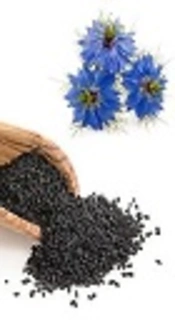
Diabetes is a chronic disease that requires essential care, support, and continuous instruction of patients in self-management to prevent acute complications and reduce the risk of chronic complications. The main causes of diabetes development are certain pathological processes, while the consequences are wide-ranging from autoimmune destruction of pancreatic cells that reduce insulin levels to disorders that lead to insulin resistance (1). The long-term complications of diabetes include retinopathy, neuropathy, nephropathy, heart disease, genitourinary symptoms, sexual symptoms, and vascular events. However, one of the acute consequences of uncontrolled diabetes can be diabetic ketoacidosis, which is life-threatening (2). One of the undesirable changes in diabetic patients is disorder of blood lipids, which in turn can lead to an increase in vascular complications and higher risk of cardiovascular disease in this group of people (3). Limiting lipid disorders in diabetic patients is therefore, one of the main goals of treatment. In other words, the primary goal of treatment is reducing low-density lipoprotein (LDL) and the secondary goal is reducing triglycerides (TG) concentration (4). Over the past few decades, in most countries, there has been an increase in the use of alternative therapies, especially herbal remedies and supplements, to treat various types of disease, including high blood lipids. Nigella sativa is the scientific name of the black cumin plant, a member of the buttercup family (5). Its black seeds, which can be used for disinfecting and preserving, have a range of constituents: thymokinone (the main ingredient), alanine, arginine, ascorbic acid, hydroxy ascorbic acid, asparagine, glucose, glutamic acid, glycine, iron, isulosin, leucine, linoleic acid, lipase, theine, mitocholine, myristic acid, neglin, neglone, oleic acid, palmitic acid, phenylalanine, phytoestrogen, potassium, bactiostosterol, alpha astrazole, citric acid, astigma sterol, tannin, and tetonin (6). Long-term oral intake of neglin can be effective for reducing vascular contractile responses to diabetes and possibly reducing subsequent cardiovascular complications (7). Plants, such as buckwheat, can reduce the incidence of diabetic complications through their flavonoids’ antioxidant properties (8). Polyphenols and phenol protanides in this plant can reduce fatty oxidation in the cell surface and lead to some functional and structural changes in the cardiovascular system in certain diseases, including diabetes (9).
Previous studies have stated that regular exercise in diabetics is an important part of weight loss programmes. As with diet control, medication, or timely delivery of insulin, regular exercise can lead to increased blood glucose absorption by active muscle and also a decrease in blood lipid levels (10). Sports activity can control the glucose and fat due to its insulin-like effects. On the other hand, insulin resistance is caused by the loss of tissue sensitivity to insulin-induced natural effects, which in turn leads to hyperglycaemia, hypertriglyceridaemia, and increased free fatty acid concentrations (11). In the current society, due to the high costs of treatment as well as side-effects of chemical drugs consumption, individuals tend to use less complicated and healthier therapies for treating diseases, e.g. engaging in sports activities and using more aromatic plants and traditional medicine.
2. Objectives
A review of the literature shows that there have been no previous investigations of the simultaneous effect of swimming and Nigella sativa consumption on diabetes. It is therefore necessary to examine the synergistic effect of the two factors, i.e. Nigella sativa extract (as an oral supplement) and exercise as a lipid reducer to address one of the common complications of diabetes. The results of this study can provide a clear view on the effect of black seed hydroalcoholic extract and swimming training on fat profile. The Nigella sativa extract can be used as a natural supplement to improve diabetes in terms of its positive effects on fat profile. The present study was therefore conducted to investigate the lipid-lowering effects of hydroalcoholic extract of Nigella sativa and swimming training on streptozotocin-induced diabetic rats.
3. Methods
A total of 32 male diabetic Sprague Dawley rats (11 weeks old) were used in this experimental study. The rats were housed in cages in rooms regulated for temperature (20°C - 24°C), humidity (40% - 55%) and light (12-hour light and dark cycle). During an eight day adaptation period, the rats were provided with laboratory chow and water ad libitum. Diabetes was induced with a single dose streptozotocin dissolved in sodium citrate buffer with pH = 4.5 in 30 mg/kg intraperitoneally. For confirmation of diabetes, 96 hours after injection, rats with glucose levels higher than 300 mg/dL were selected as samples. Based on the blood glucose, rats were divided into four equal-size groups: (1) swim training, (2) Nigella sativa, (3) swim training with Nigella sativa, and (4) control. Sample size was according to previous studies (2, 10). Groups 2 and 3 received daily 100 mg/kg/day of peritoneal Nigella sativa and Group 4 received peritoneal distilled water for four weeks. Groups 1 and 3 also swam in a swimming tank (water temperature 35oC, depth 30 cm) five days a week for four weeks. This point should be noted that swimming training in this study is different with swimming test due to the fact that the protocol of swimming training in this study was for 30 minutes per session and 4 sessions per week for four weeks. After this period, blood samples were taken. Before blood collection, the animals were kept fasting for 16 hours. After blood sampling from heart tissue of rats in the Animal Center of Islamic Azad University, Marvdasht Branch, 5 cc were injected into Falcon tubes (to measure the lipid profile). Blood samples without EDTA were kept at laboratory temperature for 40 min and then centrifuged at 3000 rpm for 15 min to prepare serum. In order to determine the fat profile, a quantitative diagnostic kit was used deploying the photometric method. To prepare the hydroalcoholic extract, Nigella sativa was powdered. A total of 30 g of the powder was placed in 40 cc of the physiology serum and then stored in a cool environment for 24 hours. After a day or night of using the shaker device, the contents of Erlon are completely mixed for five minutes. At this stage, after straightening the sample by Watmen paper and calculating the amount of residual extract in solution, the concentration of extract in the mother solution was determined and the dose was prepared (12). The swimming training protocol involved four weeks of swimming in water at a temperature of 25 oC-30oC for 30 minutes per session and five days per week. Upon completion of the training, the rats were dried with a hair dryer. To evaluate the normality of the data, the Kolmogorov–Smirnov test was used. For analysis of the findings, Paired Sample t-test and two-way ANOVA were used. Data for these variables were presented as means ± SD. All tests for statistical significance assumed a critical alpha level of P ≤ 0.05.
4. Results
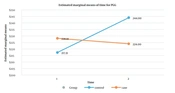
The pre-test and post-test rats’ weights are shown in Table 1. In addition, the lipid profile of four research groups are presented in Figures 1 - 5. The results of the paired sample t-test showed that there was no significant difference between the pre-test and post-test weights in any of the groups: control (P = 0.85), Nigella sativa (P = 0.48), swim training (P = 0.35), and swim training with Nigella sativa (P = 0.21) (Table 1). The results of the two-way ANOVA test in Table 2 showed that four weeks of swim training (F = 103.52, P = 0.001, effect size 0.78) and Nigella sativa consumption (F = 94.69, P = 0.001, effect size 0.77) had a significant effect in reducing cholesterol (Cho) in diabetic rats. The interactive effects of swim training and Nigella sativa was also significant (F = 166.43, P = 0.001, effect size 0.85).
Table 1.
Pre-Test and Post-Test Rats’ Weights in the Research Groupsa
| Group | Pre-Test, g | Post-Test, g | P Value |
|---|---|---|---|
| Control | 220.50 ± 12.06 | 219.62 ± 9.91 | 0.85 |
| Swimming training | 224.00 ± 16.40 | 220.62 ± 10.60 | 0.35 |
| Nigella sativa | 223.87 ± 13.41 | 221.50 ± 10.22 | 0.48 |
| Swimming training with Nigella sativa | 228.12 ± 16.79 | 222.37 ± 11.24 | 0.21 |
a Values are expressed as mean ± SD.
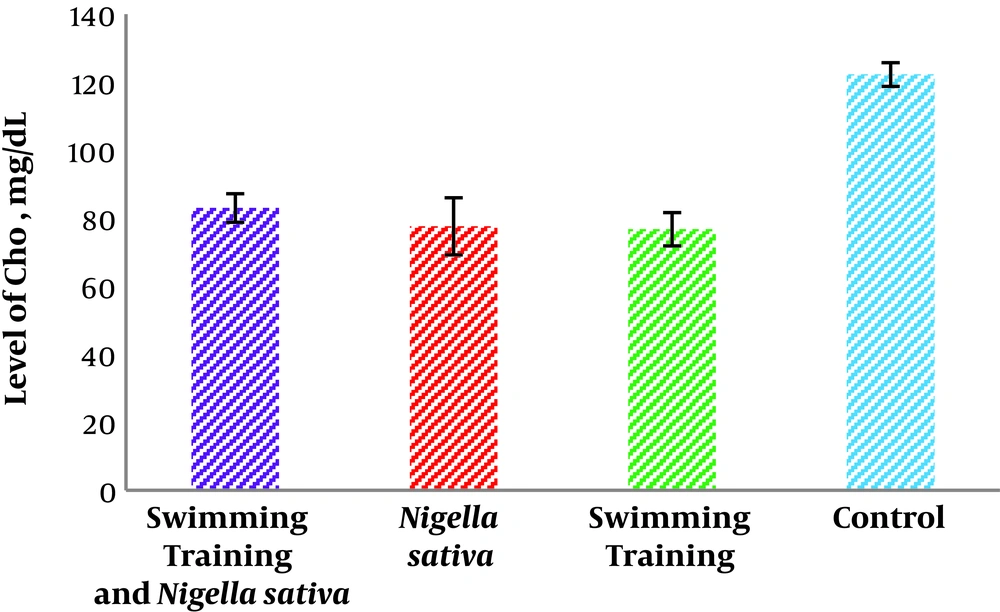
Figure 1.
Cho levels four groups of research
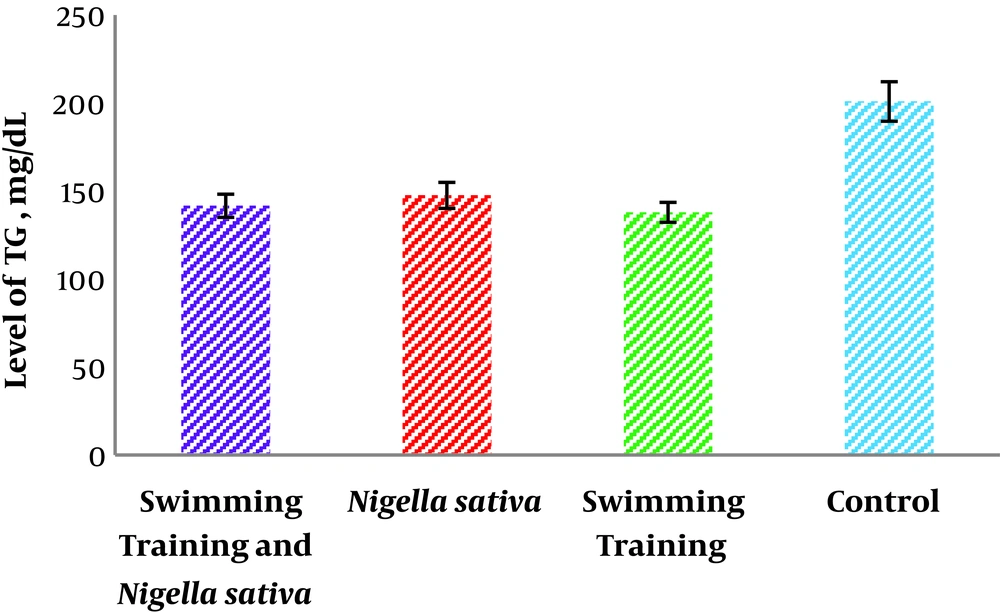
Figure 2.
TG levels four groups of research
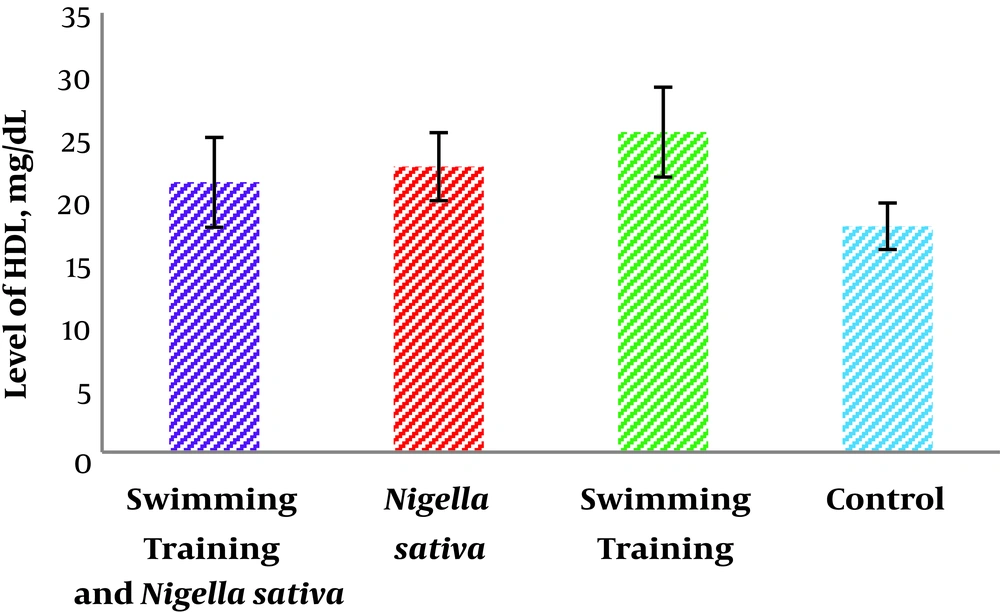
Figure 3.
HDL levels four groups of research
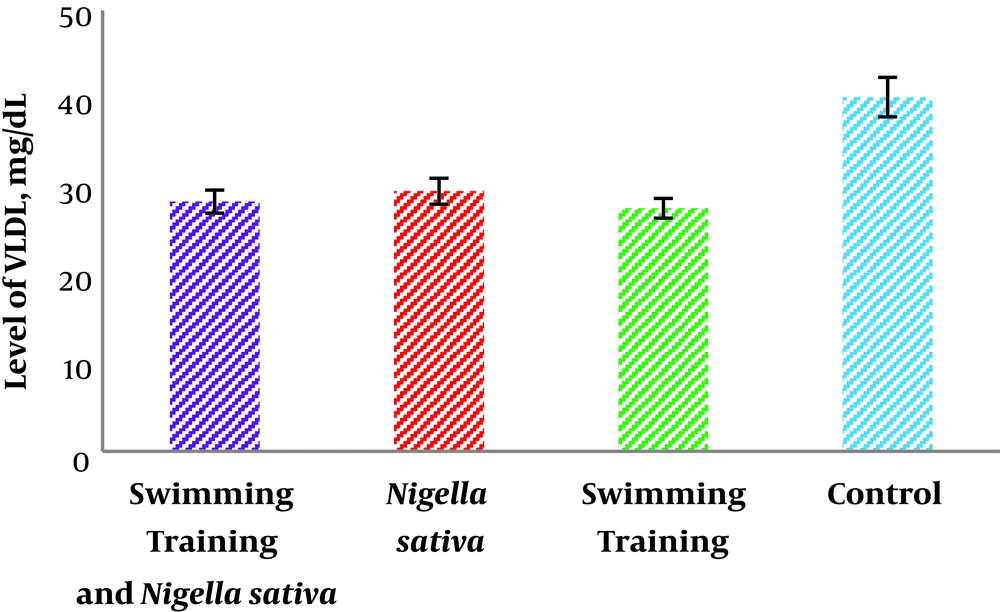
Figure 4.
VLDL levels four groups of research
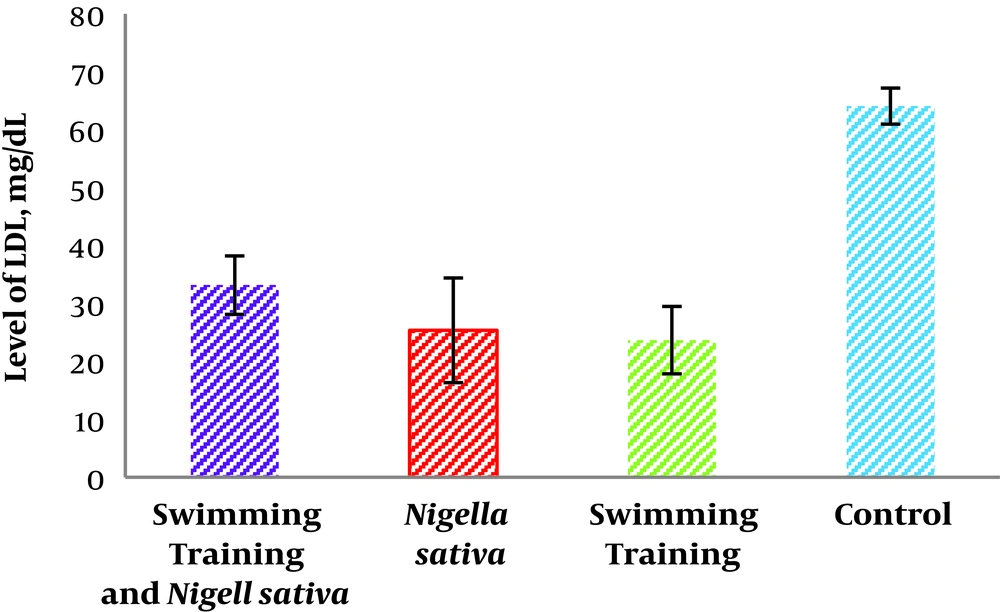
Figure 5.
LDL levels four groups of research
Table 2.
Two-Way ANOVA Findings for Investigate the Effects of Swimming Training and Nigella sativa Consumption on Lipid Profile
| Factor | Sum of Square | df | Mean of Square | F | P Value | Effect Size |
|---|---|---|---|---|---|---|
| Cho (mg/dL) | ||||||
| Swimming training | 3220.03 | 1 | 3220.03 | 103.52 | 0.001a | 0.78 |
| Nigella sativa | 2945.28 | 1 | 2945.28 | 94.69 | 0.001a | 0.77 |
| Interaction of swimming training and Nigella sativa | 5176.53 | 1 | 5176.53 | 166.43 | 0.001a | 0.85 |
| Error | 870.87 | 28 | 31.10 | |||
| TG (mg/dL) | ||||||
| Swimming training | 9487.53 | 1 | 9487.53 | 148.10 | 0.001a | 0.84 |
| Nigella sativa | 4925.28 | 1 | 4925.28 | 76.88 | 0.001a | 0.73 |
| Interaction of swimming training and Nigella sativa | 6526.53 | 1 | 6526.53 | 101.88 | 0.001a | 0.78 |
| Error | 1793.62 | 28 | 64.05 | |||
| HDL (mg/dL) | ||||||
| Swimming training | 87.12 | 1 | 87.12 | 8.56 | 0.007a | 0.23 |
| Nigella sativa | 1.12 | 1 | 1.12 | 0.12 | 0.72 | 0.004 |
| Interaction of swimming training and Nigella sativa | 153.12 | 1 | 153.12 | 16.78 | 0.001a | 0.37 |
| Error | 255.50 | 28 | 9.12 | |||
| VLDL (mg/dL) | ||||||
| Swimming training | 379.50 | 1 | 379.50 | 148.10 | 0.001a | 0.84 |
| Nigella sativa | 197.01 | 1 | 197.01 | 76.88 | 0.001a | 0.73 |
| Interaction of swimming training and Nigella sativa | 261.06 | 1 | 261.06 | 101.88 | 0.001a | 0.78 |
| Error | 71.74 | 28 | 2.56 | |||
| LDL (mg/dL) | ||||||
| Swimming training | 2125.52 | 1 | 2125.52 | 56.15 | 0.001a | 0.66 |
| Nigella sativa | 1705.28 | 1 | 1705.28 | 45.05 | 0.001a | 0.61 |
| Interaction of swimming training and Nigella sativa | 4646.48 | 1 | 4646.48 | 122.75 | 0.001a | 0.81 |
| Error | 1059.82 | 28 | 37.85 |
a Significant difference P ≤ 0.05.
Four weeks of swim training (F = 148.10, P = 0.001, effect size 0.84) and Nigella sativa consumption (F = 76.78, P = 0.001, effect size 0.73) had a significant effect on TG decreases in diabetic rats. The interactive effects of swim training and Nigella sativa consumption on TG decreases were also significant (F = 101.88, P = 0.001, effect size 0.78).
Four weeks of swim training resulted in a significant increase in high-density lipoprotein (HDL) in diabetic rats (F = 8.56, P = 0.007, effect size 0.23). However, four weeks of Nigella sativa consumption had no significant effect on HDL increase in diabetic rats (F = 1.29, P = 0.72, effect size 0.004). The interactive effects of swimming training and Nigella sativa consumption on HDL were also significant (F = 16.78, P = 0.001, effect size 0.37).
Four weeks of swim training (F = 148.10, P = 0.001, effect size 0.84) and Nigella sativa consumption (F = 76.88, P = 0.001, effect size 0.73) caused a significant decrease in very low-density lipoprotein (VLDL) in diabetic rats. The interactive effects of swim training and Nigella sativa consumption on VLDL were also significant (F = 101.88, P = 0.001, effect size 0.78).
Four weeks of swim training (F = 56.1, P = 0.001, effect size 0.66) and Nigella sativa consumption (F = 45.05, P = 0.001, effect size 0.61) had a significant effect in decreasing LDL in diabetic rats. The interactive effects of swim training and Nigella sativa consumption on LDL were also significant (F = 122.75, P = 0.001, effect size 0.81).
5. Discussion
The findings of present study showed that four weeks of swim training had a significant effect in reducing Cho, TG, VLDL, and LDL, and increasing HDL in diabetic rats. It has been reported that there is a significant relationship between diabetes and LDL, and that exercise and physical activity are a key factor in reducing LDL cholesterol. In this regard, it has been shown that LDL and lipid profile parameters in diabetics are significantly reduced after a period of swim trainings (13). Another study reported that aerobic exercise reduced lipid profile parameters, especially LDL (14). There are studies consistent with the findings of the present research suggesting that lipid profile parameters decrease after exercise (13-17). The use of a similar type of exercise (aerobic exercise) may be a reason for this consistency in the findings. Some findings showed that endurance exercise leads to an increase in HDL (14, 18-20), which is consistent with the findings of this study. The consistency in the findings may be also due to the similar type of exercise in the groups. Regarding lipid profile changes resulting from physical activity and exercise, it should be noted that HDL is one of the important factors contributing to the transmission of cholesterol, and HDL levels are increased according to the intensity and duration of the exercise. It has been determined that plasma HDL elevation has a close relationship with plasma triglyceride levels; these changes will improve insulin sensitivity (21). However, it should be noted that the mechanisms such as reduction of insulin sensitivity that lead to the changes in the levels of lipids and blood lipoproteins may be the cause of the exercise-induced changes in lipid profile (22).
The other result showed that four weeks of using Nigella sativa had a significant effect on Cho, TG, VLDL, and LDL. In this regard, the results of a study showed that the use of Nigella sativa significantly reduced levels of total cholesterol, LDL, and triglyceride (23). It has also been reported that the use of Nigella sativa reduces levels of cholesterol and triglyceride (24). In traditional books, Nigella sativa used to treat hyperlipidaemia, which is consistent with the findings of the present study (25). In addition, some studies have shown that Nigella sativa reduces hyperlipidaemia in animals (26, 27). Another study showed that the use of Nigella sativa supplement significantly reduced triglyceride, total cholesterol, and LDL, and significantly increased HDL (18). Nigella sativa has a number of pharmacological effects, such as hypoglycaemia (28), hypotension (29), and protective effects on liver tissues (30), which can improve the metabolism of the body. In this regard, it has also been reported that plants with antioxidant properties improve the body metabolism and reduce high blood lipids (31, 32). However, the potential mechanism of these effects remains unknown.
Meanwhile, the results of this study showed that four weeks of simultaneous use of Nigella sativa and swim training had significant interactive effects in reducing Cho and LDL and increasing HDL. Indeed, the results of the present study showed that effect size of interaction of swim training and Nigella sativa for Cho, LDL, and HDL was higher that swimming training and Nigella sativa alone. In this regard, Tofighi and Babaei investigated the simultaneous effect of aerobic exercise and Nigella sativa consumption on levels of glucose and apelin in diabetic rats. The results showed that aerobic exercise and Nigella sativa consumption improve the condition of diabetic patients (33). In a review of various studies, the study of Farzaneh et al. was the only one that investigated the simultaneous effect of exercise and Nigella sativa on lipid profile. It concluded that eight weeks of aerobic exercise and use of Nigella sativa has an interactive effect in improving lipid profile (18). However, it should be noted that this study was conducted on obese women. Overall, according to the results of this study it seems that the effect of simultaneous use of Nigella sativa and swim training had a more significant effect on reducing the lipid profiles of diabetic rats than the use of Nigella sativa or swimming training alone; this may be due to the different mechanisms of effect of each of these factors. In this study, Nigella sativa consumption led to improvement in lipid profile of diabetic rats, which could be due to the presence of thymoquinone. Thymoquinone, which is an effective compounds of Nigella sativa by increasing the LDL receptor expression in the liver, leads to an increase in LDL cholesterol withdrawal. In addition, the content of crude fiber (mucilage) of Nigella sativa leads to a decrease in the absorption of dietary cholesterol and stimulation of synthesis of bile acid, which itself leads to more cholesterol excretion (31). Considering that in this study, four weeks of swim training could improve the lipid profile of diabetic rats, which may be due to the increase and improvement of lipoprotein lipase activity after swimming exercises, it seems that the combination of Nigella sativa consumption and swim training can be used as an effective drug for improving the lipid profile of diabetic rats, so that each, with a separate effect mechanism, can improve lipid profile.
5.1. Conclusions
In conclusion, based on the findings of the present study, it can be concluded in summary that four weeks of swim training can improve lipid profile parameters in diabetic rats. Furthermore, four weeks of Nigella sativa consumption can improve the lipid profile of diabetic rats. However, four weeks of swim training combined with Nigella sativa use has greater lipid lowering effects in diabetic rats.