
1. Background
Anxiety disorders are among the most common mental disorders. Some people almost seem to be worried about anything; this state can be categorized as the generalized anxiety disorder (1). The extent of the comorbidity of anxiety disorders together is high (2). It is estimated 50% to 90% of patients with the generalized anxiety disorder also suffer from another mental disorder (1). Many factors, including mood and anxiety symptoms, have been suggested to identify the relationship between generalized anxiety disorder and other emotional comorbidities (3). A three-part model has been used to examine the common and unique characteristics of anxiety and depression and to investigate the symptoms of mood and anxiety. According to this model, anxious arousal is a unique feature of anxiety that is associated with more physiological arousal, such as hand tremor and muscle tension (4). Considering the strong empirical and theoretical evidence of the existence of more common factors than the specific factors among anxiety and mood disorders and other related emotional disorders, these common factors were considered as a reasonable basis for the emergence and a conceptual basis for the transdiagnostic treatments (5). The transdiagnostic approach seeks to reach a common therapeutic plan for the treatment of these disorders (6). There are relative limitations to specific treatments for each of the disorders. It is crucial to facilitate and provide diffusion and training focusing on a single set of principles of treatment with due observance of the brevity principle and avoid multiple therapeutic guidelines. The transdiagnostic approach has benefits to treatment such as the applicability for a wide range of disorders and easy learning by clients and therapists. There is a need for the development and application of effective unified treatment protocols for diagnostic categories and classes in order to target common features by focusing on emotional disorders. This approach can be economic and perhaps a powerful alternative to the current diverse guidelines for specific clinical diagnosis (5). The unified protocol (UP) for transdiagnostic treatment was designed by Barlow et al. to target common factors and transdiagnostic components and to treat patients with anxiety and unipolar mood. The potential applicability and capability for other emotional disorders were proven (7). One of the important variables in the transdiagnostic approach is emotion regulation. Emotion regulation, or reaction modulation, is defined in a variety of ways, as in the cognitive interpretation of arousal (8). In some therapeutic approaches, teaching emotion regulation strategies is a major part of the intervention in emotional problems. Among these approaches, Gross emotion regulation pattern (2002) is also featured (9).
2. Objectives
In the present study, a comparative study was done on the effectiveness of a unified protocol for the transdiagnostic treatment of Barlow et al. (7) and emotion regulation intervention of Gross (2002) in patients with generalized anxiety disorder and emotional comorbidity.
3. Methods
The quasi-experimental study aimed to comparatively study the effectiveness of a unified protocol for the transdiagnostic treatment and emotion regulation intervention in anxious arousal in patients with generalized anxiety disorder and emotional comorbidity in Kermanshah city. The study utilized a pretest-posttest design with a control group and three months of follow-up. All people with generalized anxiety disorder and emotional disorder in Kermanshah city constituted the general population. The target population included all patients with generalized anxiety disorder and emotional disorder referring to counseling centers, psychiatric clinics, and the psychiatric ward of one of the hospitals in Kermanshah city, as well as the psychiatrist’s personal office the study screening period. The sample was formed from among people who, after accepting requirements for entering the research, were randomly selected and assigned to the experimental and control groups. The sample size was determined to be seven subjects in each group based on the Cohen table with a test power of 0.87, an alpha level of 0.05, and an effect size of 0.8. However, due to the probability of dropout, the sample size was determined to be 10 in each group and 30 in total. Among eligible patients and according to the Cohen table, 30 subjects were selected by random sampling and were assigned to two experimental (10 persons receiving unified protocol for the transdiagnostic treatment and 10 persons receiving emotion regulation intervention) and control (10 persons receiving no intervention) groups. The criteria for entering the research included a diagnosis of generalized anxiety disorder comorbid with emotional disorder based on DSM-5, an age of 18 to 55 years, having a diploma or higher education, and the possibility of attending psychotherapy sessions regularly. The exclusion criteria included simultaneous receiving of any drug treatment and psychological interventions outside the research conditions by subjects, unwillingness to participate in the research, a diagnosis of any type of mental disorder other than generalized anxiety disorder and emotional disorders, and the absence in more than two treatment sessions. The study began after obtaining written consent and ensuring the compliance with all ethical considerations. During the research, we did not allow any factor such as being in a rush, ease of work, and researcher’s comfort at any time put the subjects in danger or make them feel any restrictions. The subjects were informed of anything that could influence their decisions. All subjects were assured that they could withdraw from the study at any time. The assurance was given that data or information of patients would not leak and the psychological health of the participants was the priority. The subjects participated in the study with their own discretion. In all stages of the research, the social, cultural, and religious values of the population under study were considered. The process of research implementation is presented in Figure 1. For analyzing the data, descriptive statistics including mean, standard deviation, minimum, and maximum and inferential statistics including repeated measurements and Bonferroni post hoc test were used. All research variables had an interval and they were measured by a standard questionnaire described as follows:
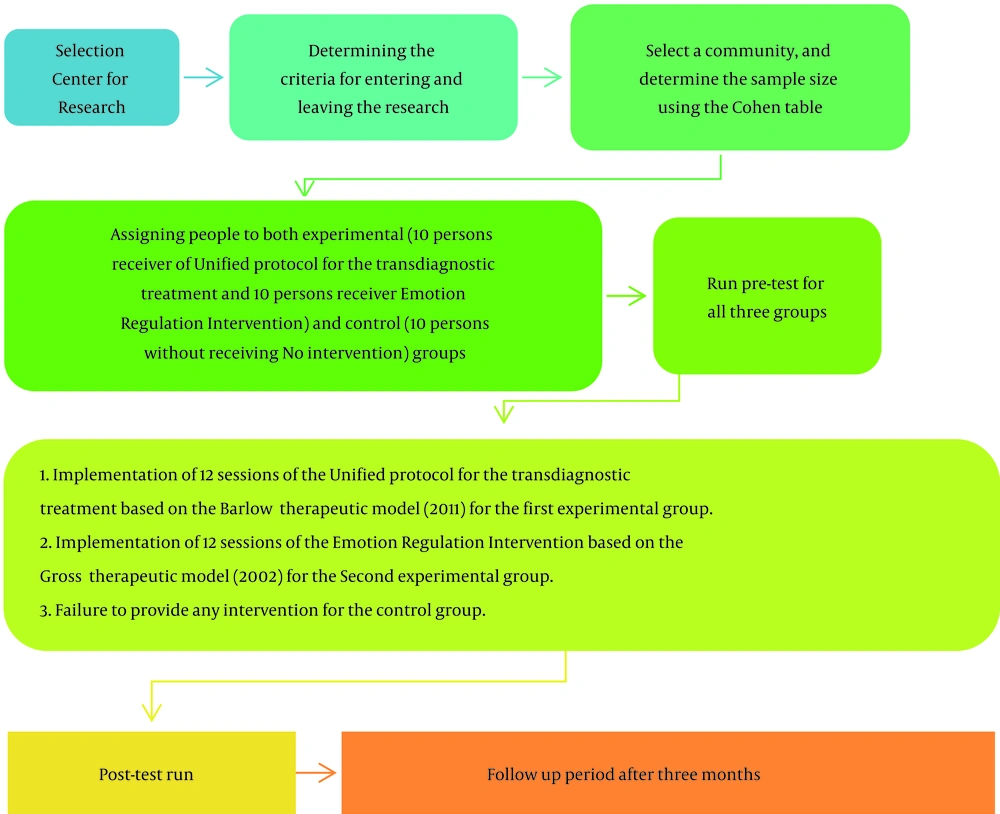
Figure 1.
The process of research implementation
3.1. Mood and Anxiety Symptoms Questionnaire (MASQ D30)
This is a questionnaire of 90 questions, which was converted to a short-form questionnaire of 30 questions by Wardenaar et al (10). The three main dimensions that are evaluated in the short form are: General distress (GD) as common features of anxiety and depression, anhedonic depression (AD) as a specific feature of depression, and anxious arousal (AA) as an attribute of anxiety on a five-point Likert scale (not at all = 1 to extremely = 5). Each dimension has 10 questions. Wardenaar et al. obtained the internal consistency for the three subscales in the short form from 0.87 to 0.93 (10). The study of the psychometric properties of this questionnaire in Iran confirmed its validity and reliability. In this research, the Cronbach’s alpha coefficient was 0.91 and the test-retest coefficients for the three subscales of GD, AD, and AA were 0.99, 0.98, and 0.98, respectively, indicating desirable reliability of the questionnaire (4).
3.2. Unified Protocol for the Transdiagnostic Treatment
This protocol is presented in the book entitled “The unified protocol for transdiagnostic treatment of emotional disorders” by Barlow et al. (7). It was modified in a timely manner based on research requirements. 12 sessions of 90 minutes were performed individually in the frequency of two sessions per week. A summary of the sessions of the unified protocol for the transdiagnostic treatment is outlined in Table 1.
Table 1.
A Summary of Sessions of the Unified Protocol for the Transdiagnostic Treatment
| Meetings No. | The Topic of the Meeting | Tutorials and Meeting Goals |
|---|---|---|
| First session | Increasing motivation | Motivational interviewing to motivate participation and engagement of patients during treatment, providing treatment logic and setting medical goals |
| Second session | Providing psychological training | Recognition of emotions, tracking emotional experiences and teaching the three-component model of emotional experience and the ARC model |
| Third and fourth sessions | Emotional awareness training | Learning to see emotional experiences (emotions and reactions to emotions), especially using mindfulness techniques |
| Fifth meeting | Cognitive reassessment | Creating awareness of the interrelation between thoughts and emotions, identifying automated maladaptive evaluations and commonly used livelihoods of thought, cognitive revaluation and increasing flexibility in thinking |
| Sixth session | Identifying avoidance patterns | Understanding different strategies to avoid excitement and its influence on emotional experiences and understanding the contradictory effects of avoiding excitement |
| Seventh session | Study of EDBS induced behaviors | Identifying behaviors caused by emotions and understanding their effects on emotional experiences, identifying maladaptive EDBS and creating alternate action trends through encountering behaviors |
| Eighth session | Awareness of physical senses | Increasing awareness of the role of feelings in emotional experiences and exercises on visceral exposure or visceral confinement in order to recognize physical sensations and increase the tolerance of these symptoms |
| Ninth to eleventh sessions | Visionary visions and excitement based on position | Knowledge of the emotional dream landscape, teaching how to prepare the hierarchy of fear, and eliminating and designing emotional exposure exercises in a visual and preventive way |
| Twelfth session | Overview | A comprehensive overview of the concepts of treatment and discussing patient’s therapeutic advances and relapse prevention |
3.3. Emotion Regulation Intervention
This intervention was based on the Gross emotion regulation intervention (2002), modified on a timely basis based on research conditions. It included 12 sessions of 90 minutes, two sessions per week. The sessions were held weekly and individually. A summary of intervention sessions based on emotion regulation is presented in Table 2.
Table 2.
A Summary of Sessions of Emotion Regulation Intervention
| Meetings No. | The Topic of the Meeting | Tutorials and Meeting Goals |
|---|---|---|
| First session | Understanding and communicating with patients and increasing motivation | Motivational interviewing to motivate the participation and involvement of patients during treatment, providing a logic therapy, determining the therapeutic goals and expressing the framework and rules of participation in the meetings. |
| Second to fourth sessions | Introducing a variety of excitements | The introduction of different emotions, identifying positive emotions (such as happiness) in oneself and others, identifying negative emotions (anger, sadness, hatred, fear, anxiety, and jealousy) in oneself and others, providing emotional training, recognizing excitement and stimulating situations through training, the difference in the performance of different types of excitement and information about different dimensions of excitement and the short and long-term effects of excitement |
| Fifth to sixth sessions | Selecting a position | Assessing the degree of vulnerability and emotional skills, discussing the workings of emotions in the process of human adaptation and their benefits, discussing the role of excitement in establishing relationships with and influencing others, discussing the role of excitement in organizing and stimulating human behavior and providing examples of their actual experiences and feedback in this field |
| Seventh session | Modifying position | Creating a change in emotional excitement, preventing social isolation and avoidance, teaching problem-solving strategies and training interpersonal skills (conversation, self-expression, and conflict resolution) |
| Eighth session | Extending attention | Changing attention, stopping thinking and worries and training attention |
| Ninth session | Cognitive assessment | Changing cognitive assessments, identifying false evaluations and their effects on emotional states and teaching open source assessment strategies |
| Tenth session | Adjustment of target response | Changing emotional, behavioral, and physiological outcomes, identification of the extent and method of using the strategy of inhibition and its emotional consequences, exposure, excitement training, and behavior modification through the modification of environmental amplifiers, emotional exhaust training, and reciprocity |
| Eleventh session | Evaluation and application | Re-evaluation and removal of barriers to application, assessment of achieved goals Applying skills learned in natural environments outside the session and examining and removing barriers to doing homework |
| Twelfth session | Overview | A comprehensive overview of the concepts of treatment and discussion of patient’s therapeutic advances and relapse prevention |
4. Results
Table 3 summarizes the obtained scores of the anxious arousal using descriptive indices including the mean and standard deviation in the pretest, posttest, and follow-up.
Table 3.
The Mean and Standard Deviation of Anxious Arousal
| Group | Mean | Standard Deviation | Number |
|---|---|---|---|
| Pretest | |||
| Unified protocol for the transdiagnostic treatment | 39.00 | 2.539 | 10 |
| Emotion regulation intervention | 38.50 | 2.014 | 10 |
| Control group | 39.10 | 2.079 | 10 |
| Posttest | |||
| Unified protocol for the transdiagnostic treatment | 17.40 | 9.131 | 10 |
| Emotion regulation intervention | 17.50 | 4.197 | 10 |
| Control group | 40.50 | 2.368 | 10 |
| Follow-up | |||
| Unified protocol for the transdiagnostic treatment | 19.00 | 8.498 | 10 |
| Emotion regulation intervention | 19.60 | 3.307 | 10 |
| Control group | 41.4000 | 2.41293 | 10 |
The mean anxious arousal scores in the experimental group receiving the unified protocol for the transdiagnostic treatment were 39.00 in the pretest, 17.40 in the posttest and 19.00 in the follow-up while in the experimental group receiving emotion regulation intervention, they were 38.50 in the pretest, 17.50 in the posttest, and 19.60 in the follow-up. The results showed a significant decrease in the mean scores of the experimental groups, but no significant difference was observed in the control group (Table 3).
It can be seen that in Pillai’s Trace, Wilks Lambda, Hotelling’s Trace, and Roy’s Largest Root, the level of significance is less than 0.01. On the other hand, the F score with degrees of freedom of 2 and 17 is more than the standard table F; so, it is possible to say that the unified protocol for the transdiagnostic treatment and emotion regulation intervention had significant effects on the variables of anxious arousal. Given that the square of the Eta coefficient is 0.913, it can be concluded that the effect of these protocols is about 91.3% (Table 4).
Table 4.
Repeated Measurements Test
| Anxious Arousal | Value | F | Degree of Freedom of Hypothesis | Freedom Degree Error | Significance Level | Squared Coefficient of Eta |
|---|---|---|---|---|---|---|
| Pillai’s Trace | 0.913 | 89.760a | 2.000 | 17.000 | 0.000 | 0.913 |
| Wilks Lambda | 0.087 | 89.760a | 2.000 | 17.000 | 0.000 | 0.913 |
| Hotelling’s Trace | 10.560 | 89.760a | 2.000 | 17.000 | 0.000 | 0.913 |
| Roy’s Largest Root | 10.560 | 89.760a | 2.000 | 17.000 | 0.000 | 0.913 |
Table 5 shows that the significance level is greater than 0.05, so there was no significant difference between the effects of the two protocols, but there was a significant difference between treatment protocols and the control group.
In Figure 2, it can be seen that the unified protocol for the transdiagnostic treatment and emotion regulation intervention had a relatively equal effect on reducing anxious arousal in the posttest and follow-up stages.
Table 5.
Between-Group Bonferroni Post Hoc Test for Anxious Arousal Variables
| Groups | Mean Diff. (I-J) | Std. Error | P Value | 95% Confidence Interval | |
|---|---|---|---|---|---|
| Lower Bound | Upper Bound | ||||
| Unified protocol for the transdiagnostic treatment | |||||
| Emotion regulation intervention | -5.2667 | 2.32680 | 0.096 | -11.2057 | 0.6724 |
| Control group | -20.4000* | 2.32680 | 0.000 | -26.3391 | -14.4609 |
| Emotion regulation intervention | |||||
| Unified protocol for the transdiagnostic treatment | 5.2667 | 2.32680 | 0.096 | -0.6724 | 11.2057 |
| Control group | -15.1333* | 2.32680 | 0.000 | -21.0724 | -9.1943 |
| Control group | |||||
| Unified protocol for the transdiagnostic treatment | 20.4000* | 2.32680 | 0.000 | 14.4609 | 26.3391 |
| Emotion regulation intervention | 15.1333* | 2.32680 | 0.000 | 9.1943 | 21.0724 |
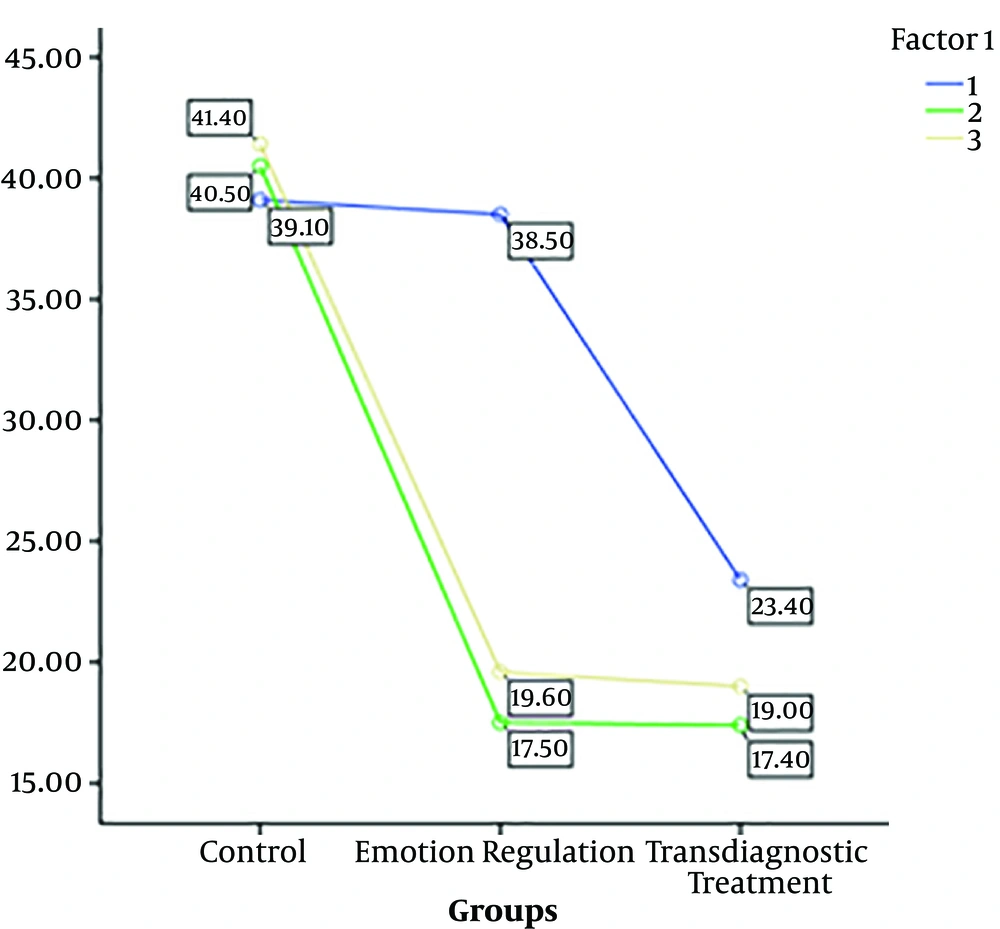
Figure 2.
Comparison of the unified protocol for the transdiagnostic treatment, emotion regulation intervention, and control group in three levels of pretest, posttest, and follow-up
5. Discussion
Over the past few decades, significant advances have been made in psychotherapy for mood and anxiety disorders. Studies on treatment response and impairment of other disorders are emphasized. Therefore, research supports an integrated approach that emphasizes the same and applies to a range of emotional disorders (7). The present study examined the effectiveness of two protocols and therapeutic interventions that use the transdiagnostic approach. The results from data analysis showed the positive effect of both treatment interventions on the arousal component. In explaining the above findings, we can refer to the model introduced by Tellegen in 1985. This model explains the strong association between anxiety and depression. Negative affection is an overall factor of mental affliction that is specifically associated with depression and anxiety. Further, Clark and Watson in 1991 developed the Tellegen model. In this model, anxious arousal is a unique feature of anxiety and is associated with more physiological arousal, such as hand tremor, muscle tension, and shortness of breath (4). Concerning the findings of the present study, it can be argued that anxiety symptoms, including anxious arousal, are important goals in the treatment and the reduction of anxious arousal may indicate an important change process among the range of emotional disorders. Emotional exposure is used as an intervention strategy that targets anxiety symptoms, including anxiety and aversion. Emotional exposure, which usually reduces anxiety symptoms, is one of the main elements of the unified protocol for the transdiagnostic treatment. Based on what Clark and Watson explained, anxious arousal is associated with more physiological excitement, such as hand tremor, muscle tension, and shortness of breath. In the unified protocol for the transdiagnostic treatment, the topic of one of the sessions is the awareness and tolerance of physical senses. In this meeting, the patient understands the physical senses and faces with them; this helps the patient to understand his/her physical senses and constantly encounter them. In the emotion regulation intervention, in one of the meetings with the topic of modifying the target response, the techniques are taught. In this session, the patients are encouraged to experience these excitements as much as possible and not try to escape from them. As another explanation for the effectiveness of this intervention, it can be said that anxious arousal increases or sustains the signs of generalized anxiety disorder and other emotional disorders with anxiety symptoms in a person who has difficulty in regulating his/her emotions. If individuals can adjust their anxiety with adaptive emotion regulation strategies, it decreases the possibility of anxiety arousal disrupting their functions, and this is what emotion regulation intervention is doing. The results also showed a relatively equal impact for both interventions. The findings of this study were in agreement with studies in this field (8, 11-18). In recent years, non-pharmacological methods have attracted the attention of people with psychological disorders. In this study, two of these interventions were examined as the third-generation treatments. Based on the results, they had significant effects on the reduction of symptoms of the patients. Eventually, according to the findings, healthcare providers are suggested taking into account the relative limitations of proprietary treatments, avoiding multiple treatment guidelines, and paying attention to the benefits of these approaches such as the applicability for a range of disorders and the ability to easy learning. Thus, the can find these methods as effective therapies in this area.