1. Background
Medical imaging with various modalities has an important role in medical diagnosis. X-ray radiography is the most widely used and helpful method in medical imaging (1). Nowadays, the correct diagnosis of dental diseases and problems is not achieved or is very hard to achieve without X-ray radiographic exams. Information resulting from these exams enhances clinical findings (2, 3). However, X-ray as ionizing radiation has proven biological harmful effects such as the increased probability of cancer incidence even at low doses and irreversible effects at higher doses. These side effects could be categorized into two different classes: malfunction in cellular pathways (e.g., malfunction in metabolism, cellular division, and growth defects) and genetic alterations. Therefore, it is important to investigate the factors influencing the decision of dentists to prescribe dental radiographic exams.
The X-ray dose is lower in dental radiographic exams than in other examinations. However, the professional judgment of decisions about dental X-ray is emphasized by the American Dental Association (ADA) and the Food and Drug Administration (FDA) (4). X-ray radiographic exams must be applied when there is a real need to decrease the potential risks of ionizing radiation (5). Nevertheless, many dentists prefer to order radiographs on routine schedules rather than considering the real need of patients (6, 7). It was shown that the number of unproductive radiographs can be decreased without the risk of diminishing clinical findings by using selection criteria (6). A set of guidelines about prescribing radiographs based on patient needs has been developed for dentists (8, 9). These guidelines could decrease the total number of radiographs by 36% in previous studies (10). For example, bitewing radiographs are just recommended for new patients. It may reduce unnecessary radiographs if this technique is ignored in patients with diagnosed disease. The periapical technique could be used in these patients instead of bitewing radiography (11, 12). In a study, Rushton and Horner (13) concluded that panoramic radiography was not an appropriate technique for the detection of dental caries and periodontal disease in many patients because there were some limitations in the image quality of panoramic radiography, such as the superposition of the edges of the teeth which are close together.
Evaluating the dentists’ awareness of the correct prescription of radiographic exams is potent to show whether the dentists’ prescriptions are based on the guidelines or not. The results of such evaluation provide valuable information for administrative organizations to decide on performing continuing education programs or changing the educational courses for dentists.
2. Objectives
The aim of the present study was to evaluate the dentists’ knowledge of the correct prescription of radiographs in Khorramabad, Iran.
3. Methods
This descriptive, analytical, cross-sectional study was carried out in summer 2018. A questionnaire draft was prepared based on the opinions of experts in the field of hazards and radiation protection with the help of medical physicists, an epidemiologist, and an occupational health specialist.
Following the equation developed by Cochran (14) and assuming that one percent of the population in Khorramabad were dentists, the minimal sample size of 15 dentists was obtained. However, in this study, we tried to consider all the dentists in the city. Thus, we recruited 55 dentists (47 general dentists and 8 dental specialists; male/female: 32/23) working in Khorramabad, Iran. However, only 8 dental specialists participated in our research, including three endodontists, two oral and maxillofacial surgeons, two orthodontists, and one prosthodontist. The inclusion criteria were being an active dentist working in Khorramabad city. We did not eliminate any of the responders due to appropriate responses to the questionnaires.
A questionnaire containing 20 multiple-choice questions was given to the respondents and collected after 10 days (to decrease the effect of time and location). Each correct answer received score one and each false answer received nil. The importance (weight) of all the questions was equal.
The level of knowledge in each section was evaluated according to gender, educational status (a general or specialized dentist), and work experience. The work experience in all the participants was considered equal to the years after graduation. The total received scores indicated the level of knowledge for each respondent in all sections.
Data were extracted from the questionnaires and analyzed based on the acceptable levels of awareness regarding previous studies and ADA/FDA guidelines (4, 5, 7). The awareness levels were categorized into a good level in the case of correct answers to more than 60% of questions, moderate level in the case of correct answers to 50% - 60% of questions, and poor in the case of correct answers to less than 50% of questions. Finally, these data were evaluated and compared between gender, educational status, and work experience groups using independent t-test by SPSS version 11.5 software (SPSS Inc., Chicago, IL, USA). P values of < 0.05 were considered statistically significant.
4. Results
In this study, 45 dentists (85%) introduced themselves as general dentists and 8 dentists (15%) as specialist dentists. Table 1 shows the other characteristics of the dentists such as gender, educational status, and work experience.
Table 1.
Summary of Demographic Data of Dentists
| Characteristics of Dentists | No. (%) |
|---|---|
| Age, y | |
| < 29 | 11 (20) |
| 30 - 39 | 27 (49. 1) |
| 40 - 49 | 16 (29.1) |
| 50 - 59 | 1 (1.8) |
| Gender | |
| Male | 23 (41.8) |
| Female | 32 (58.2) |
| Educational status | |
| General | 47 (85.5) |
| Specialist | 8 (14.5) |
| Work situation | |
| Governmental | 22 (40) |
| Non-governmental | 33 (60) |
| Work experience, y | |
| < 5 | 12 (21.81) |
| 15 - May | 29 (54.54) |
| 15 - 25 | 12 (21.81) |
| > 25 | 2 (1.81) |
Table 2 indicates the knowledge level of subjects about the correct prescription of radiography, the obtained scores, and the percentage of false and correct answers to questions. Good knowledge levels of the correct prescription of radiography belonged to items on the lowest effective dose, person who had been previously treated and restored with post-amalgam, study of TMJ soft tissue, presence or absence of teeth, and doing orthodontics in the system mixed dentition. However, the knowledge levels were found to be moderate about the correct prescription of radiography in the person who was a candidate for full dentures, inter-dental caries before the eruption of wisdom teeth in people with high risk of caries, and evaluation of inter-dental caries in high-risk middle-aged patients. For the rest of questions, the levels of knowledge were poor.
Table 2.
Mean Score of Knowledge Among Dentists in Each Domain of Radiography Prescription
| Row | Question | False Response, No. (%) | Correct Response, No. (%) | Mean Score: 0 - 1 |
|---|---|---|---|---|
| 1 | Correct prescription of radiography for diagnosis of periodontal disease in children | 46 (83.6) | 9 (16.4) | 0.16 |
| 2 | Correct prescription of radiography according to the lowest effective dose | 20 (36.4) | 35 (63.6) | 0.63 |
| 3 | Correct prescription of radiography for the person who had been previously treated and restored with post-amalgam | 14 (25.5) | 41 (74.5) | 0.74 |
| 4 | Correct prescription of radiography for diagnosis of dental caries | 28 (50.9) | 27 (49.1) | 0.49 |
| 5 | Correct prescription of radiography for evaluation of submandibular salivary gland stones | 35 (63.6) | 20 (36.4) | 0.36 |
| 6 | Correct prescription of radiography for the study of TMJ soft tissue | 22 (40) | 33 (60) | 0.6 |
| 7 | Correct prescription of radiography for evaluation of development state and teeth buds in 5-year-old children | 35 (63.6) | 20 (36.4) | 0.36 |
| 8 | Correct prescription of radiography for evaluation of development state and wisdom teeth buds | 29 (52.7) | 26 (47.3) | 0.47 |
| 9 | Correct prescription of radiography for evaluation of pins within the dentine | 37 (67.3) | 18 (32.7) | 0.32 |
| 10 | Correct prescription of radiography in the person with TMJ disorders and there is the probability of disk perforation | 36 (65.5) | 19 (34.5) | 0.34 |
| 11 | Correct prescription of radiography in the person with a chronic abscess in buccal space | 31 (56.4) | 24 (43.6) | 0.43 |
| 12 | Correct prescription of radiography for implant placement | 38 (69.1) | 17 (30.9) | 0.30 |
| 13 | Correct prescription of radiography for presence or absence of teeth | 15 (27.3) | 40 (72.7) | 0.72 |
| 14 | Correct prescription of radiography for evaluation of fractures in persons with a head injury | 31 (56.4) | 24 (43.6) | 0.43 |
| 15 | Correct prescription of radiography for doing orthodontics in the system mixed dentition | 11 (20) | 44 (80) | 0.8 |
| 16 | Correct prescription of radiography in the study of periodontal status and the evaluation of alveolar crest | 36 (65.5) | 19 (34.5) | 0.34 |
| 17 | Correct prescription of radiography in the person who is a candidate for the full dentures | 24 (43.6) | 31 (56.4) | 0.56 |
| 18 | Correct prescription of radiography in the person who needs 8 implants to check the width and height | 36 (70.9) | 19 (29.1) | 0.29 |
| 19 | Correct prescription of radiography for inter-dental caries before the eruption of wisdom teeth in people with a high risk of caries | 24 (43.6) | 31 (56.4) | 0.56 |
| 20 | Correct prescription of radiography for evaluation of inter-dental caries in high-risk middle -aged patients | 27 (49.1) | 28 (50.9) | 0.5 |
| Mean | 27.75 (52.55) | 26.25 (47.45) | 0.47 |
The overall mean score was 26.25 out of 55 (47.45%). The range of correct answers varied from 16.4% (correct prescription of radiography for the diagnosis of periodontal disease in children) to 80% (correct prescription of radiography for doing orthodontics in the system mixed dentition).
Figure 1 shows the P value and the mean level of awareness in the study groups. There were considerable differences in the mean level of awareness between general dentists and specialists (9.32 ± 2.92 for general dentists and 12.12 ± 3.31 for specialist dentists, P value = 0.001). There was no significant association between the mean level of awareness and gender (9.97 ± 3.40 for males and 9.39 ± 2.692 for females, P value = 0.502). Furthermore, the results showed that the mean level of knowledge was significantly higher among dentists with work experience of fewer than five years than among the other groups (P value < 0.05). The dentists with 5 - 15 and 15 - 25 years of work experience gained the same scores, while the dentists with more than 25 years of experience had the lowest mean score.
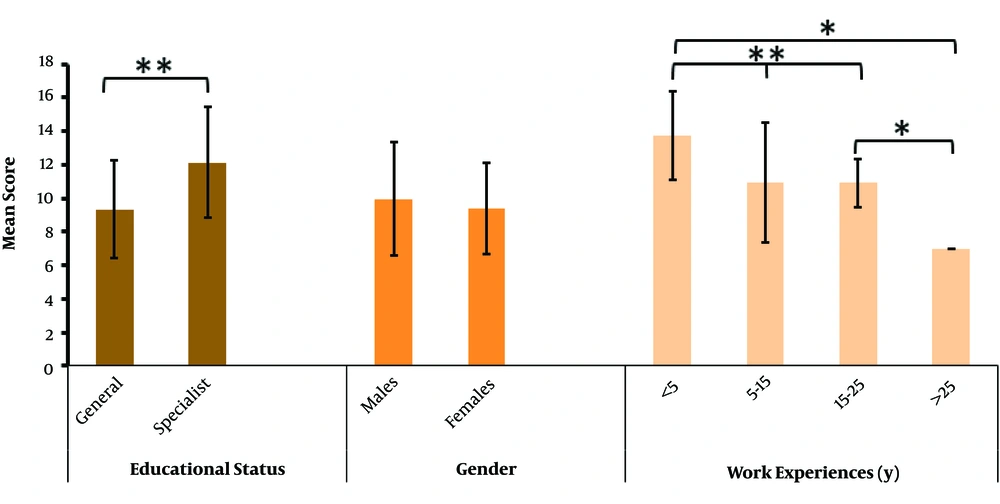
Figure 1.
The mean scores of awareness and P values for three groups of dentists. **Significant difference at P < 0.01. *Significant difference at P < 0.05.
5. Discussion
In this study, the level of awareness of dentists about the correct prescription of various radiographs was studied and compared regarding gender, work experience, and educational status.
The results of the current study showed that there was no significant difference between male and female dentists. Ezoddini Ardakani and Sarayesh (5) reported that there were no differences between male and female dentists in Yazd city. Furthermore, they expressed that the level of knowledge was higher in specialists than in general dentists. In another study (15), the authors assessed the awareness and performance of dentists in Babol city. They reported that female dentists had higher scores than male dentists (8.6 vs. 7.7). They also declared that the score of knowledge and practice was higher in dentists with more than 10 years’ experience than in those with lower experience but it was not significant. However, we found a significant difference between the groups of dentists with different work experiences. The dentists with less than five years and more than 25 years of work experience had the highest and the lowest mean scores, respectively, and the dentists with 5 - 15 and 15 - 25 years of experience gained the same scores. Another study (16) investigated the correct prescription of dental radiographies in practitioners and showed no considerable difference between the mean score of male and female dentists, while there was a significant difference between the mean awareness score of groups with different job experiences. The mean awareness scores were 11.76 ± 2.58 and 10.4 ± 2.74 among dentists with job experiences of less than 5 years and more than 5 years, respectively, with a statistically significant difference (P value < 0.001).
We found that radiation awareness among general dentists was insufficient (9.32 ± 2.92) and it was significantly different from the score of specialist dentists (12.12 ± 3.31) (P value = 0.001). Our data showed that academic education and completion of radiation protection training could increase dentists’ radiological knowledge, similar to other studies (5, 17-20).
The majority of responders had incorrect knowledge about the “correct prescription of radiography for the diagnosis of periodontal disease in children” (83.6%) and the “radiography for implant placement” (69.1%). This may be due to the lack of sufficient educational courses in the dentists’ educational program concerning the radiography prescription in children and implantation. The use of FDA guidelines can help dentists prescribe correctly and reduce the false or unnecessary prescriptions of diagnostic radiographies (5, 21).
Some studies indicate that panoramic radiography is not efficient for the diagnosis of tooth caries and periodontal problems, but bitewing or periapical radiographs should be used in such cases (13, 22). Our study showed that specialist dentists ordered fewer panoramic radiographies than general dentists. Other investigations reported that the overall knowledge of prescription of panoramic radiography was good although specialist dentists indicated better knowledge scores than general dentists (5, 13). Our results are in agreement with previous studies, as we showed that 86% of the dentists participating in our study answered correctly to the questions about the panoramic radiography and all of the specialist dentists answered correctly.
The techniques and approaches that dentists learn in universities are the first things that influence their performance. Therefore, continuing education courses and changes in the educational process may promote the correct radiography prescription (17, 18).
One of the limitations in our research was the ratio of dental specialists to general dentists, which was relatively low due to the lack of the contribution of all specialists in Khorramabad city. Moreover, various times and locations for gathering questionnaires were other limitations that may have affected the answers.
It is suggested that more studies be conducted on this topic to compare the awareness levels of radiographers and students in various locations at short periods.
5.1. Conclusions
In this study, the dentists’ awareness levels of the correct prescription of radiographic exams in Khorramabad city were assessed. Generally, our findings demonstrated that the dentists pay little attention to the correct prescription of radiography and this could be due to the lack of sufficient study, undesirable education in schools, and forgetting historical data over time. Therefore, it is necessary to increase the knowledge and awareness of all dentists, especially more experienced ones, by continuing education programs.