
1. Background
Mental and emotional disorders are common phenomena, causing a wide range of problems for the elderly and their caregivers. Evidence suggests that about 35% of the elderly develop different mental and emotional disorders due to aging (1). Dementia is one of the most common disorders in this population. This disorder is described as the progressive erosion of the executive functions of the brain (2). Although there are multiple risk factors for dementia (e.g., genetics, gender, and blood pressure), age is recognized as the most important cause of this disease (3).
Dementia affects the memory and cognitive functioning, and its symptoms include a combination of cognitive and neurological disorders (e.g., memory, attention, flexibility, language, psychological, psychiatric, and behavioral disorders and disruption of daily activities) (1). The functions affected by dementia contain intelligence, problem-solving, memory, learning, orientation, understanding, focus, evaluation, attention, and social capabilities. Research shows that a significant percentage of the elderly with dementia suffer from mental health problems (2). Therefore, attention must be paid to their psychological capital to improve their mental health.
The psychological capital can increase the brain function and reduce cognitive impairments. Conceptually, psychological capital is the positive psychological state of an individual that can be identified by at least four characteristics, that is, self-efficacy (self-confidence and making the necessary efforts to succeed in challenging tasks), optimism (positive thoughts about the current and future success), hope (perseverance in achieving goals and if necessary, changing the path to achieve success), and resilience (showing flexibility to achieve success and goals when faced with difficulties and problems). These characteristics give meaning to people's lives and prepare them for stressful situations. They also prepare them for life and ensure resilience and perseverance in achieving goals (4).
There is substantial evidence that psychological capital has a positive relationship with the quality of life, health, and psychological well-being of individuals and a negative relationship with feelings of loneliness, physical problems, stress, and anxiety. In this regard, a previous study showed that the elderly, whose mental needs are met, have significantly higher levels of optimism, purposefulness in life, and resilience as compared to the elderly with low life satisfaction; they also experience less depression (1). Moreover, it was found that there is a significant positive relationship between the components of psychological capital and spiritual health of the elderly. In other words, the elderly with high levels of optimism, hopefulness, and resilience are better prepared for problems and also have higher spiritual health.
Care for the elderly with dementia requires a significant amount of time and money and causes many problems for the patients and their families. However, diagnosis and treatment in the early stages of the disease can slow its progression, delay dysfunctions, and reduce the healthcare costs and the disease burden (5). Various therapies have been reported to be effective in increasing the psychological capital and its components in the elderly with dementia symptoms. These therapies include self-efficacy training, therapeutic reminders, cognitive behavioral therapy, family care education, communication and problem-solving training, targeted cognitive rehabilitation therapy, and aromatherapy, all of which can improve the health of the elderly.
There is another approach, called the Montessori method of education. The advantages of this method over other treatments include its person-centered, multi-generational, and multi-disciplinary design and dependence on purposeful activities (6). It is also recognized as a treatment that does not require any drugs and has no adverse side effects. The Montessori-based dementia cognitive rehabilitation method was developed and introduced by Dr. Cameron Kemp in 2004, based on Maria Montessori's ideas about working with the elderly with dementia. This program was designed based on different principles, such as guidance, segregation of duties, repetition, simple to complex principle, and reliance on implicit memory to improve various aspects of quality of life and well-being (7). This method is used by professional psychologists for people with dementia and memory disorders to improve their performance by stimulating the five basic senses.
Keleher et al. showed that the effectiveness of the Montessori-based cognitive rehabilitation program improved their quality of life (6). Ducak et al. stated that the Montessori-based dementia treatment reduced disturbances, increased cognition, improved interactions, relationships, and awareness, and strengthened optimism (8). Moreover, Eva van der Ploeg in her book, called “Relate, Motivate, Appreciate”, stated that planning the Montessori-based dementia treatment reduced agitation, increased cognition, and improved positive emotions and interactions (9). However, there are very few studies on this subject in Iran. The present study can be different from previous studies, as it evaluates the effectiveness of Montessori method for the elderly.
Given the importance of aging and Alzheimer's disease in the elderly and the increasing attention paid to the management of this disease around the world, it seems that psychological factors and cognitive rehabilitation can play an important role in the prevention and treatment of this disease.
2. Objectives
In the present study, we aimed to determine whether the Montessori cognitive rehabilitation treatment program can improve the psychological capital indices in the elderly with dementia.
3. Methods
The current quasi-experimental research, which was performed following a pre and -post test design with a control group, intended to investigate the effect of cognitive rehabilitation on the psychological capital of the elderly with dementia. The convenience sampling method was used in this study. The statistical population consisted of all elderly patients with dementia in the age range of 60 - 74 years, who were referred to three treatment clinics, located in the north and west of Tehran (Movafaghiat, Aramesj, and Pishro clinics) in 2020. Finally, 22 people were selected based on the available sampling method and recruited in the study according to the inclusion criteria.
The participants were selected according to the inclusion criteria and randomly allocated to the intervention (n = 11) and control (n = 11) categorizes. The elderly in the intervention group participated in 14 sessions of Montessori cognitive rehabilitation (45-minute sessions for seven weeks, two sessions per week). The follow-up test was performed one month later. On the other hand, the control group did not receive any treatments, and the follow-up was only carried out via phone calls to control bias and social support.
The inclusion criteria were as follows: (1) diagnosis of Alzheimer's disease by a psychiatrist; (2) a score < 25 on the Mini–Mental State Examination (MMSE) test; (3) taking memantine, galantamine, or donepezil (Abixa); (4) lack of epilepsy, vision or hearing problems, and severe physical disabilities; (5) having a companion or a caregiver; (6) lack of other acute physical and mental disorders; (7) willingness to participate in the study and giving a written consent; and (8) being in the age range of 60-74 years. On the other hand, the exclusion criteria were as follows: (1) withdrawal from the study; (2) absence of more than two sessions; (3) simultaneous participation in other cognitive rehabilitation programs; and (4) incomplete questionnaires.
3.1. Montessori-based Dementia Activities
The educational content of the dementia-based Montessori sessions (taken from the treatment protocol presented by Dr. Eva Vander Plug and Cameron Kemp at the University of Manche) included:
Watching activities: (1) Sorting pictures; (2) Sequencing pictures; (3) Making a memory book; (4) Making puzzles; and (5) Matching accessories.
Listening activities: (6) Enjoying music; (7) Feel the rhythm; (8) Dancing; (9) Exploring an instrument; and (10) Reading.
Touching activities: (11) Feeling different fabrics; (12) Feeling different textures; (13) Pampering; (14) Fishing gear; (15) Magical mystery bags; and (16) Clothes sorting.
Smelling activities: (17) Making coffee; (18) Flower arranging; (19) Herbs; (20) Planting seeds; and (21) Aromatherapy.
Tasting activities: (22) Orange juice squeeze; (23) Food tasting; (24) High tea; (25) Cooking; (26) BBQ; (27) Fruit sorting; and (28) Pasta sorting.
3.2. Psychological Capital Questionnaire
The psychological capital questionnaire was developed by Luthans in 2007. This 24-item questionnaire consists of four subscales of hope, resilience, optimism, and self-efficacy, with each subscale consisting of six items. Items were scored on a six-point Likert scale, ranging from “strongly disagree” to “strongly agree”. Validity of this questionnaire has been confirmed in various studies. Based on the factor analysis and structural equations, Luthans et al. (10) reported the Khido ratio of this test to be 6.24. The comparative fit index (CFI) and the root mean square error of approximation (RMSEA) statistics were 0.97 and 0.08 in this model, respectively. Also, the reliability of this questionnaire, based on Cronbach's alpha test, was estimated at 0.85 (3).
3.3. Statistical Analysis
In this study, SPSS Version 20 was used to analyze the data. Descriptive statistics, including tables, diagrams distribution of mean frequency, and standard deviations (SD), were measured to describe the data. Also, to investigate the research propositions, the normal distribution of data, homogeneity of variance, and homogeneity of regression slopes were evaluated.
4. Results
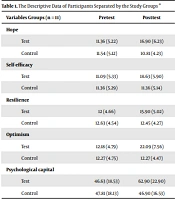
The rest of descriptive data are provided in Table 1.
Table 1.
The Descriptive Data of Participants Separated by the Study Groups a
| Variables Groups (n = 11) | Pretest | Posttest |
|---|---|---|
| Hope | ||
| Test | 11.36 (5.22) | 16.90 (6.23) |
| Control | 11.54 (5.12) | 10.81 (4.23) |
| Self-efficacy | ||
| Test | 11.09 (5.33) | 18.63 (5.90) |
| Control | 11.36 (5.29) | 11.36 (5.14) |
| Resilience | ||
| Test | 12 (4.66) | 15.90 (5.02) |
| Control | 12.63 (4.54) | 12.45 (4.27) |
| Optimism | ||
| Test | 12.18 (4.79) | 22.09 (7.56) |
| Control | 12.27 (4.75) | 12.27 (4.47) |
| Psychological capital | ||
| Test | 46.63 (18.53) | 62.90 (22.90) |
| Control | 47.81 (18.13) | 46.90 (16.53) |
aValues are expressed as mean (SD).
Kolmogorov-Smirnov test was used to evaluate the hypothesis of normal distribution of data, which revealed a normal distribution (P > 0.05). In addition, we applied MANOVA to perform intra-group comparisons. Levene’s test was applied to evaluate the variance homogeneity. Statistical significance was considered when P-value < 0.05 (Table 2).
Table 2.
The Results of Levene’s Test
| Variables | Df1 | Df2 | P Value |
|---|---|---|---|
| Pretest psychological capital | 1 | 20 | 0.83 |
| Posttest psychological capital | 0.16 |
Table 3.
The Results of Wilks’ Lambda Test
| Test | Value | F | P Value | Partial Eta Squared |
|---|---|---|---|---|
| Wilks’ Lambda | 0.37 | 33.002 | 0.0001 | 0. 90 |
The Wilks’ Lambda (Table 3) revealed a significant difference between the control and experimental groups at least for one factor (Wilk’s Lambda, 0.37; F, 33.002; P < 0.0001). According to the partial eta squared, about 90% of the intra-group variance was attributed to the interaction of dependent variables.
Table 4.
Descriptive Statistics and t-Test Results
| Groups | Mean (SD) | Standard Error | Difference in Average | Significance Level | t-Test |
|---|---|---|---|---|---|
| Psychological capital | 0.27 | 0.63 | 0.42 | ||
| Posttest | 16.90 (6.23) | 1.88 | |||
| Follow-up | 17.18 (5.23) | 1.57 | |||
| Hope | 0.36 | 0.70 | 0.38 | ||
| Posttest | 18.63 (5.90) | 1.78 | |||
| Follow-up | 18.27 (6.03) | 1.81 | |||
| Self-efficacy | 0.54 | 0.05 | 2.20 | ||
| Posttest | 15.90 (5.02) | 1.51 | |||
| Follow-up | 16.45 (5.08) | 1.53 | |||
| Resilienc | 0.78 | 0.71 | 0.01 | ||
| Posttest | 22.09 (7.56) | 2.28 | |||
| Follow-up | 21.31 (7.16) | 2.01 | |||
| Optimism | 0.72 | 0.65 | 0.46 | ||
| Posttest | 69.90 (22.90) | 6.90 | |||
| Follow-up | 70.63 (23.29) | 7.02 |
According to Table 4, since the significance levels of t-test are greater than 0.05, it can be concluded that the effect of cognitive rehabilitation on the improvement of psychological capital and its components is preserved over time. The table above shows that the means of psychological capital and its components in the posttest and follow-up were not significantly different.
5. Discussion
Psychological capital and its subscales have not been investigated in previous studies. However, studies have been performed on similar indicators and concepts, which might be consistent with our findings. According to the present results, the psychological capital of the elderly with dementia increased after the Montessori cognitive rehabilitation program. Considering the problems of the elderly with dementia, such as low quality of life and poor mental health, the present results can help improve the indicators of psychological capital, quality of life, and mental health (11). Also, further research on the effects of Montessori method on the psychological capital and its subscales can lead to a more effective use of this method in different communities.
The components of quality of life, well-being, agitation, and participation/engagement examined in previous studies, as well as the indicators of psychological capital measured in the present study, indicate the effectiveness of Montessori method in the general indicators of mental health and psychological functioning. So far, some studies have directly examined this method, and some studies have reported improved quality of life, positive emotions, and increased self-esteem after the program. Among studies that directly investigated this method, a study by Booth et al. (12) showed that this treatment improved quality of life, emotions, and self-esteem. They also showed that this type of treatment reduced disruptive behaviors, increased social interactions, and improved the quality of life. It should be noted that their program included a four-hour intervention for seven elderly people in a nursing home. Therefore, their study is different from ours which included 22 elderly people with memory impairments, visiting the clinics for 14 two-hour sessions of the program; nevertheless, similar results were reported in these two studies.
Moreover, Yuen and Kwok (13) stated that the Montessori method reduced anxiety, agitation, and verbal and physical aggression, which can in turn improve health and psychological capital indicators. Their study was performed on 23 residents of a nursing home, and the program was held twice a week (six sessions of 45 minutes). Also, this study is different from the present study in terms of the sample size. Moreover, Brush et al. (14) stated that this method reduced hospitalization, use of psychotropic drugs, and psychiatric symptoms of dementia in the elderly. It also increased the elderly’s quality of life, participation/engagement, positive emotions, and feelings of self-esteem and belonging. The elderly also showed tendencies toward increased communication and more job satisfaction.
In addition, Hunter et al. (15) showed that an affordable three-session treatment, based on the Montessori method, led to improved quality of life, positive emotions, and increased self-esteem. Also, in 2017, Hitzig and Sheppard (16) reviewed the implementation of Montessori method for dementia. It was found that this method improved the quality of life of the elderly with dementia. Contrary to the results of the present study, Wilks et al. (17) observed that the Montessori method significantly reduced the individuals’ psychological well-being, social interactions, and capacity for daily activities. However, it caused a slight increase in the quality of life and a slight decrease in anxiety and problematic behaviors. One of the main differences between this study and ours is the implementation of the program for people who were in the late stages of dementia. It should be noted that the symptoms of dementia in the final stages deteriorate and become more severe over time. Therefore, the loss of physical, cognitive, speaking, and hearing abilities, besides significant memory impairments, negatively affect the abilities of the elderly, especially in our program, where the tasks focus on the five basic senses.
The results reported by Chaudhry et al. (18) are in line with the results of the current study. They showed that treatment based on the Montessori method could be effective in the indicators of positive interaction, positive social behaviors, and cognitive functions that are indirectly related to the psychological capital. According to the available literature, it can be concluded that this method is based on human dignity, equality, and respect. Considering the importance of independence in performing tasks, this method can improve self-efficacy and life satisfaction. Also, attention to the basic principles of Montessori method (e.g., use of daily life facilities, attention to the person’s interests and skills, use of past preferences and experiences, adapting to cognitive and physical conditions, design of simple and enjoyable homework, design of homework activities based on individual abilities from simple to complex levels, motivation, contributions to positive behaviors and emotions, encouragement and support, development of abilities, and finally, assessment at different levels) can create and strengthen hope and optimism and improve the mental health, psychological well-being, and psychological capital indicators of the elderly with dementia.
The Montessori method for dementia involves stimulation of each person's cognitive, social, and functional skills. This method uses the principles of rehabilitation, which include training, repetition, guidance, and segregation of duties; improves various aspects of quality of life and cognitive skills; and generally, increases the performance of the elderly (5). Montessori's philosophy focuses on the ability of individuals to succeed in performing their tasks and considers segregation of duties to create a sense of confidence in the elderly and increase their self-efficacy. Overall, since the Montessori method is person-centered, it can meet the cognitive, physical, spiritual, social, and emotional needs of the elderly and those living with dementia.
Moreover, the Montessori method, by considering the needs, interests, and abilities of the elderly, makes them feel empowered by engaging them in different roles and affairs of daily life, which in turn increases their hopefulness and autonomy and enriches their lives (6). The results of the present study showed that this method could increase resilience among the elderly with dementia. However, there is no similar study on the effects of Montessori method on resilience, and there are limited resources on this subject. Nevertheless, since this method has a positive impact on agitation, it seems that it can also increase resilience.
Overall, the Montessori method, which is a multidisciplinary and activity-based training program, has been developed for healthcare professionals, social workers, and family members of the elderly. It can be implemented as a multicultural and intergenerational treatment to support cultural changes. It also ensures that people living with dementia, regardless of where they are, can have as much independence as possible, have a meaningful and valuable place in the community, enjoy high self-esteem, and have a purpose in their lives.
The limitations of this study include the method of sampling, lack of distinction between male and female samples, limited age range of the participants, and lack of comparison between different levels of dementia. It is suggested that future studies compare male and female samples at levels 1 to 5 of the MMSE test. Also, the effect of each behavioral task can be examined separately.
5.1. Conclusions
The Montessori method is an effective non-pharmacological method for treating behavioral and psychological symptoms of dementia. Activity-based Montessori cognitive rehabilitation can increase self-efficacy, improve resilience, optimism, and hope, and generally increase the psychological well-being and mental health of the elderly. At the same time, the results of this study and the protocol can be used to plan and implement trainings for counselors, nurses, caregivers, therapists, and family specialists for improving the psychological capital indicators and creating a positive attitude to improve the quality of life of the elderly with dementia.