
1. Background
Elderly is one of the most important and critical periods of life, and paying attention to the issues and problems of this period is very important (1, 2). In Iran, significant changes occur in the elderly population so that, based on the forecasts, the elderly population will increase about 21% by 2050 (3). In old age, patients may expose to various disorders, one of which is cognitive disorders. One of the existing cognitive disorders is dementia, which is called neurodegenerative disorder, and has psychological effects and leads to a decrease in daily activities of life and functions of the individual. In these patients, memory, visual ability, judgment, calculation, and problem-solving are impaired, and the patient suffers from restlessness, insomnia, delirium, and hallucinations (4-6).
Over 50 million cases all over the world and more than trillion-dollar costs in 2018, this is a well-known health issue and has created challenges for the individual, family, and community at various levels (7-9), which creates many difficulties in patients’ families (10). In addition to the pressure of care, family caregivers of these patients, face with social isolation, psychological disorders (such as anxiety, depression), financial problems, social problems (eg, maltreatment, disruption of patient and family relationships), disorders in physical activity as well as decreased physical health (10-12).
The needs of the elderly as one of the vulnerable groups in all dimensions and areas have not been specially studied, and it is necessary to pay more attention to this group of people (13). Elderly people with dementia experience many difficulties, including pain (14), disability (15), and falls (16). Pain is one of the problems of the elderly, which has many negative effects on the living conditions of this age group, and the prevalence of pain in the elderly with dementia has been significant. Pain in these patients may also reduce social interactions and increase stress, depression, irritability, and the need for health care in patients (17). Therefore, pain assessment is effective in reducing the risk of mortality and increasing the quality of life of these patients (18). Despite the different side effects of pain and its high prevalence in patients, the pain in this group may be well considered for reasons such as fear of drug dependence, misunderstandings about the inevitable pain in the elderly, and side effects of painkillers (19).
Other problems of the elderly include disability and falls, especially in dementia patients. In fact, the decrease in the abilities of the elderly has increased their dependence on others, and these disabilities can affect various dimensions, including hearing and vision loss (20, 21). On the other hand, when these disabilities are associated with dementia, this function becomes weaker and may even lead to the patient falling (16). Falls are one of the most important causes of fatal and non-fatal injuries in people over 64 years of age, which has high prevalence and many consequent injuries, and this shows the importance of the issue (22).
The study by Lin et al. showed that 49.07% of elderly people with dementia had experienced pain at least once and that the three most common types of pain reported in these patients’ included osteoarthritis, headache, and osteoporosis (23). In the study of Takenoshita et al., the prevalence of dementia in patients with a disability was 13.9% for old group (24). Pain and disability in all the elderly, especially in the elderly with dementia, are very important issues that need to be prevented (23, 24).
2. Objectives
Based on the need for paying attention to the issues and problems of the elderly, especially vulnerable elderly, and the lack of knowledge gap in this regard, the present study aimed to investigate the relationship between pain and disability and falls in the elderly with dementia in Ilam in 2021.
3. Methods
3.1. Study Design
In the present cross-sectional descriptive study, the elderly with dementia living in Ilam were included.
3.2. Study Population
The patients included in this study were patients with a history of dementia, and 120 patients were included in the study.
3.3. Inclusion and Exclusion Criteria
3.3.1. Inclusion Criteria
The patients included in this study had a history of dementia. Inclusion criteria were dementia based on a neurologist diagnosis using interview and CT scan, Iranian nationality, auditory ability, being in the age range of over 65 years old, lack of valid pain expression by the patient by self-report method, having a primary caregiver, and willingness of primary caregiver to cooperate.
3.3.2. Exclusion Criteria
Exclusion criteria were incomplete completion of information and also the existence of any conditions other than dementia in the patient that may have affected the pain status and disability of patients.
3.4. Data Gathering
The instruments used in the four sections were the demographic form, the Persian-Abbey Pain Scale (P-APS) pain observation tool, and the Stanford Disability Questionnaire.
3.4.1. Demographic Characteristic Form
The used form had questions about age, gender (male, female), education (illiterate, diploma, bachelor's degree or higher), place of residence (Outside the nursing home, In a nursing home), and History of chronic disease (yes, no).
3.4.2. Persian-Abbey Pain Scale
The used tool had questions about pain assessment and pain intensity based on behavioral indicators, including patient speech, facial expression, changes in body movements, behavioral changes, physiological changes, and physical changes. This instrument with six items in the 4-point Likert scale was rated as non-existent with a score of zero, mild with a score of one, moderate with a score of two, and severe with a score of three, and the overall score ranged from 0 to18. If patients scored 2 - 0, they had no pain, a score of 3 - 7 had mild pain, a score of 8 - 13 had moderate pain, and a score of 14 or higher indicated severe pain (19, 25, 26).
3.4.3. Health Assessment Questionnaire Disability Scale
This tool (HAQ-DI) had eight questions, which assigned a score between 3 - 0 based on the person’s ability, and if the patient did not have any problems, was given a score of 0, with a little difficulty, was given a score of 1, with a high difficulty was given a score of 2, and if the person was unable to do it or could do it with the help of mobility aids, a score of 3 was considered. Finally, in this questionnaire, the person’s score was between 0 - 24 and if the patient's score was higher, it indicated a higher degree of disability (27, 28).
3.5. Method of Research
With the permission of the Ethics Committee of the Ilam University of Medical Sciences, the researcher identified the elderly with dementia by available sampling method and if the elderly with dementia were eligible and written informed consent was obtained from the elderly and their primary caregiver, the questionnaires were completed. Demographic profile form tools, P-APS pain instrument, Stanford Disability Questionnaire were completed by observing the patient and interviewing the patient’s primary caregiver.
3.6. Data Analysis
Conditions of pain and disability were described by descriptive tests, and then the relationship between pain and the degree of disability in patients was analyzed by statistical analysis using SPSS 16 software.
4. Results
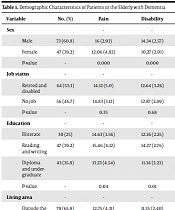
Based on the results in Table 1, Mean (SD) pain score was 14.45 (4.23), disability score was 12.75 (3.09), and fall score was 37 (30.8%) (Table 1). According to pain score status classification, 4 (3.3%) of the elderly had no pain, 8 (6.7%) had mild pain, 27 (22.5%) had moderate pain and 81 (67.5%) had severe pain.
Table 1.
Demographic Characteristics of Patients in the Elderly with Dementia
| Variable | No. (%) | Pain | Disability |
|---|---|---|---|
| Sex | - | - | |
| Male | 73 (60.8) | 16 (2.93) | 14.34 (2.57) |
| Female | 47 (39.2) | 12.06 (4.82) | 10.27 (2.01) |
| P-value | - | 0.000 | 0.000 |
| Job status | - | - | - |
| Retired and disabled | 64 (53.3) | 14.12 (5.0) | 12.64 (3.26) |
| No job | 56 (46.7) | 14.83 (3.13) | 12.87 (2.89) |
| P-value | - | 0.35 | 0.68 |
| Education | - | - | - |
| Illiterate | 30 (25) | 14.63 (3.56) | 12.36 (2.25) |
| Reading and writing | 47 (39.2) | 15.46 (4.12) | 14.27 (2.76) |
| Diploma and undergraduate | 43 (35.8) | 13.23 (4.54) | 11.34 (3.23) |
| P-value | - | 0.04 | 0.01 |
| Living area | - | - | - |
| Outside the nursing home | 79 (65.8) | 12.75 (4.31) | 11.35 (2.40) |
| In a nursing home | 41 (34.2) | 17.73 (0.54) | 15.43 (2.41) |
| P-value | - | 0.000 | 0.000 |
| Marital status | - | - | - |
| No spouse | 82 (68.3) | 14.25 (4.23) | 12.46 (3.10) |
| Has a spouse | 38 (31.7) | 14.89 (4.24) | 13.36 (2.99) |
| P-value | - | 0.44 | 0.13 |
| History of chronic disease | - | - | - |
| Yes | 70 (58.3) | 16.01 (3.23) | 13.94 (2.81) |
| No | 50 (41.7) | 12.28 (4.53) | 11.08 (2.67) |
| P-value | - | 0.000 | 0.000 |
| Family support | - | - | - |
| Low | 41 (34.2) | 15.21 (3.53) | 13.09 (3.12) |
| Medium | 57 (47.5) | 13.66 (4.81) | 12.52 (3.17) |
| Much | 22 (18.3) | 15.09 (3.55) | 12.68 (2.86) |
| P-value | - | 0.14 | 0.66 |
| Income | - | - | - |
| Weak | 69 (57.5) | 15.68 (3.07) | 13.62 (2.99) |
| Medium | 41 (34.2) | 13.90 (3.90) | 12.00 (2.80) |
| Good | 10 (8.3) | 8.3 (6.54) | 9.80 (4.15) |
| P-value | - | 0.000 | 0.000 |
| Age (mean [SD]) | R = 0.570, P = 0.000 | R = 0.69, P = 0.000 |
Tables 2 and 3 indicate the relationship between pain status and disability. Based on the results of Tables 2 and 3, there is a significant relationship between pain status and disability in the elderly with dementia (P = 0.000, F = 79.971).
Table 2.
Investigating the Relationship Between Pain and Disability in the Elderly with Dementia
| Model | Sum of Squares | df | Mean Square | F | P-Value | |
|---|---|---|---|---|---|---|
| Disability | Regression | 861.949 | 1 | 861.949 | 79.971 | 0.000 |
| Residual | 1271.843 | 118 | 10.778 | |||
| Total | 2133.792 | 119 | ||||
Table 3.
The Relationship Between Pain and Disability in the Elderly with Dementia
| Model | Unstandardized Coefficients | Standardized Coefficients | T | P-Value | |
|---|---|---|---|---|---|
| B | Std. Error | Beta | |||
| Disability (constant) | 3.355 | 1.277 | 2.626 | 0.010 | |
| 0.871 | 0.097 | 0.636 | 8.943 | 0.000 | |
5. Discussion
The present study was conducted for investigating the relationship between pain and disability and falls in the elderly with dementia in Ilam in 2021. In this study, most of the subjects were male, had low education, without a spouse, without a job, with a history of other chronic diseases, moderate family support status, and poor economic status. Zare et al. in Iran demonstrated that most of the participants in the study were female, unmarried, illiterate, and unemployed, which is consistent with the results of this study (19). While in the study of Lin et al. in the elderly with dementia in Taiwan, most of the elderly were women, had low education, and were married (23). In the cohort study of Meuleners et al., most of the patients were female and unmarried (29). It seems that the difference in demographic variables is related to diversity in the study countries.
Based on the results, the Mean (SD) pain score in the elderly with dementia was 14.45 (4.23) out of 18, and the reported number (percentage) of severe pain was 81 (67.5%). In the study of Lin et al., it was demonstrated that 49.07% of the elderly had experienced pain during the last year (23). Also, in the study of Atee et al., on 479 elderly people with dementia, it was shown that the prevalence of pain was 65.6% in this group (30), which is consistent with the results of prevalence of high pain in elderly with dementia.
In this study, mean (SD) disability score was 12.75 (3.09) out of 24, according to the results of Sathya and Premkumar’s study in the elderly group in India, where the prevalence of disability was 12.6% (31) in India, the prevalence of disability was 92 (25.6%) (32); in the study of Saha et al., with the amount of 28.9% (33), in another study it was equal to 32.4% (34), in the study of Gupta et al., it was 37.4% (35), which are consistent with the results of this study on the existence of disability in the elderly.
According to fall prevalence, its rate was 37 (30.8%), which in the study of Dev et al. showed that this rate in the group of Alzheimer’s patients 32 (22.8%) for a minimum of one fall, prevalence 8 (5.7%) multiple falls and a prevalence of 18 (12.8%) have been reported for non-vertebral fractures (22). In the paper of Kato-Narita and Radanovic, the prevalence of falls in AD patients was 55% (36), in the study of Soysal et al. on dementia patients, the prevalence of fear of falling was 86.9% in patients with dementia and 36.0% in patients with AD (37). A cohort study by Meuleners et al., from 2001 to 2013, included 32,519 elderly people with dementia and found that 8,970 (27%) of the elderly had experienced a fall at least once (29). Based on the results of similar studies, the rate of falls in the elderly was consistent with the results of this study.
5.1. Conclusions
According to the results of this study, disability and a history of falls were higher in the elderly who experienced more pain. Hence, it is recommended to take the necessary interventions to reduce the pain of the elderly with dementia to prevent disability and reduce the risk of falls.