
1. Background
Multiple sclerosis (MS) usually presents at a highly productive stage of life, and the prevalence is increasing worldwide. The disease now affects about 2.8 million people all around the world. Iran is estimated to be one of the countries with a high prevalence of MS (90 per 100,000) (1). Patients with MS tend to refer to the Emergency Department (ED) due to various reasons, some of which are directly related to their disease (eg, MS relapses) and some not related to or indirectly related to their disease [eg, pseudo relapses, urinary tract infection (UTI), adverse drug effects].
2. Objectives
The present study aimed to investigate the ED visits of individuals with MS, admission rate, diagnostic interventions, therapeutic decisions, and final diagnosis. Findings may be useful for proposing a better triage system in the future to improve the management of these patients by avoiding unnecessary admissions and promoting rapid treatment.
3. Methods
3.1. Study Design and Setting
This retrospective cross-sectional study was conducted during 22 September 2018 - 21 September 2019 in Sina Hospital, Tehran, Iran. Sina Hospital, affiliated with Tehran University of Medical Sciences, is one of the major referral centers for MS in Tehran, Iran. Data of all patients enrolled in this study were kept confidential. The study proposal was approved by the Ethics Committee of Tehran University of Medical Sciences (code: IR.TUMS.MEDICINE.REC.1397.204)
3.2. Study Population
All known patients with MS (ICD-10 diagnosis code G35) and older than 18 years old admitted to the ED during the given study period were included. Those with incomplete medical records were excluded. Sampling was performed through the census.
3.3. Data Collection
The names and chief complaints of all patients visiting the ED were recorded in the triage. All people with MS admitted to the ED during the study period were separated and studied. The medical records of all enrolled patients were evaluated by the researcher, a PGY-3 emergency medicine resident. All the data were registered in a pre-prepared checklist. All medical records were registered and available in the hospital’s archives. Admission chief complaints were divided into two categories. One group entailed patients admitted due to neurological complaints (ie, MS true and pseudo attacks). The second category included patients admitted due to non-neurological reasons that may or may not be related to the disease (eg, UTI, fever, trauma, seizures). For each category, various variables were recorded, including patient demographics, length of hospital stay, number of patients undergoing magnetic resonance imaging (MRI), and final diagnosis.
3.4. Statistical Analysis
To compare the differences between the two categories, t and χ2 tests were used. The results were analyzed and reported by a statistician approved by the Research Center of Sina Hospital.
4. Results
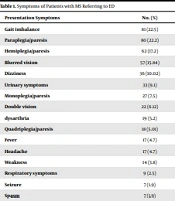
A total of 375 visits by 346 patients with known MS were identified and reviewed. All 375 visits were included in the study and were analyzed. We found that 269 visits (71.7%) were made by female patients, and the mean age of the patients was 35.6 ± 9.7 years. The mean duration of their MS diagnosis was 87.2 ± 77.5 months. The most common complaint of the patients at the time of admission to the ED was balance impairment (81 patients, 22.5%), lower limb motor impairment (80 patients, 22.2%), and hemiparesis/hemiplegia (62 patients, 17.2%). Moreover, 33 patients (9.1%) presented UTI symptoms (Table 1). Brain or spine MRI was obtained in 247 visits (65.9%), of which 121 (49%) showed positive radiologic activity. The duration of stay at the hospital was less than 24 h in 41 visits (10.9%). The average stay of the patients admitted for more than 24 h was 6.47 ± 4.73 days.
Table 1.
Symptoms of Patients with MS Referring to ED
| Presentation Symptoms | No. (%) |
|---|---|
| Gait imbalance | 81 (22.5) |
| Paraplegia/paresis | 80 (22.2) |
| Hemiplegia/paresis | 62 (17.2) |
| Blurred vision | 57 (15.84) |
| Dizziness | 36 (10.02) |
| Urinary symptoms | 33 (9.1) |
| Monoplegia/paresis | 27 (7.5) |
| Double vision | 22 (6.12) |
| dysarthria | 19 (5.2) |
| Quadriplegia/paresis | 18 (5.01) |
| Fever | 17 (4.7) |
| Headache | 17 (4.7) |
| Weakness | 14 (3.8) |
| Respiratory symptoms | 9 (2.5) |
| Seizure | 7 (1.9) |
| Spasm | 7 (1.9) |
| Trigeminal neuralgia | 5 (1.3) |
| Facial palsy | 4 (1.1) |
| Diarrhea | 4 (1.1) |
| Dyspnea | 4 (1.1) |
| Abdominal pain | 4 (1.1) |
| Ear pain or tinnitus | 3 (0.8) |
| Joint pain | 2 (0.5) |
| Limb edema | 2 (0.5) |
| Back pain | 1 (0.2) |
| Skin reactions | 1 (0.2) |
| Drug adverse effect | 1 (0.2) |
4.1. Patients with Neurological and Non-neurological Complaints
Our results showed that 239 (63.7%) of visits were due to neurologic complaints, out of which 183 were female patients. In addition, 213 (89.1%) of 239 visits were diagnosed with MS relapse, and 26 (10.9%) were due to pseudo attacks or not related to MS attacks (Table 2). We identified that 136 visits were because of non-neurologic complaints. UTI with urinary symptoms was the most common complaint observed in 31.6% of the patients. Respiratory infections and tension headaches were the following common complaints with 6.6% and 4.4% prevalence, respectively. Fifteen patients were discharged within 24 h, and 21 cases left the hospital with personal consent. MRI was performed on 40 patients (Table 2).
Table 2.
Characteristics of the Patients with Neurological and Non-neurological Complaints a
| Characteristics | Neurological Complaints | Non-neurological Complaints |
|---|---|---|
| Total | 239 | 136 |
| Female | 183 (76.5) | 86 (63.2) |
| Married | 142 (59.4) | 79 (58.1) |
| Age (y) | 34.6 ± 9.3 | 37.5 ± 10.6 |
| MS relapse | 213 (89.1) | - |
| Unrelated to MS or pseudo attacks | 26 (10.9) | - |
| MRI performed | 207 (86.6) | 40 (29.4) |
| Positive MRI | 108 (52.2) | 13 (9.5) |
| Corticosteroid received | 207 (97.2) | - |
| Days of admission (d) | 6.9 ± 3.7 | 3.8 ± 6 |
a Values are expressed as mean ± SD or No. (%).
5. Discussion
We studied MS patients referred to ED during a year and divided the patients into two categories of neurologic symptoms contributing to MS relapses or pseudo attacks and symptoms other than MS relapse that may or may not be related to the disease. The majority of patients visiting the ED were female, as predicted due to the higher prevalence of MS in females worldwide (2-5). However, there was no significant difference between men and women diagnosed with true relapses in our study. In a study by Abboud et al., true relapses were reported in only 18% of male patients (6). This difference may result from the larger sample size in our study.
Furthermore, in the current research, patients with neurologic symptoms were younger than those with non-neurologic symptoms. This finding has been reported in other studies as older people are more likely to present with complaints other than MS relapse due to aging, longer disease duration, and increased medical comorbidities (7). In our study, disease duration was not significantly different between patients with true relapses and pseudo attacks. However, patients with a longer disease duration are more likely to experience disease sequels, such as cases with a severe disability who are at a higher risk for UTI (7, 8), and UTI is often associated with pseudo attacks in these patients. About 90% of the patients with neurological symptoms were diagnosed with true relapses. This percentage was much higher than other investigations performed in other parts of the world (6, 7). Sina Hospital being one of the biggest referral centers for MS in Iran, explains the main reason for this difference.
Although 90% of the patients with neurological symptoms underwent MRI, the yield of MRI was approximately 50%. The magnetic resonance scanner at Sina Hospital has a magnetic field strength of 1.5 Tesla. Due to the low magnetic field strength, many MRIs may not show positive Gad findings. These findings show that true relapses may not be associated with positive radiological findings, and clinical findings along with radiological results should be considered for the diagnosis and treatment of patients. The treatment of MS patients with neurological symptoms attributable to a new MS relapse should not be postponed due to imaging (7). The duration of admission was significantly longer in patients with neurological symptoms because of the longer time required for treatment, imaging, laboratory study, hospital care, and assessment.
5.1. Limitations
This study was based on a medical record review, which is associated with bias and may confound the results. Second, Sina Hospital is a referral center for MS, and the results of this study cannot be generalized to other hospital centers. Finally, we did not analyze the costs of ED visits, which significantly impact patients with MS and ED medical resources.
5.2. Conclusions
According to the results of the current investigation, MS relapse was the most frequent cause of ED referral by MS patients. There were also many ED visits by MS patients due to non-neurological causes, with UTI being the most prevalent chief complaint among them.