
1. Background
Multiple sclerosis (MS) is an autoimmune, chronic, and inflammatory disorder of the central nervous system (1, 2). It is the most common debilitating nontraumatic disease affecting young adults (3); it affects nearly 1 million young people, mostly women, all around the world (4). Women are affected by this disease twice as often as men (5). Multiple sclerosis is a progressive neurological disorder that destroys axon myelin in the central nervous system. Demyelination changes saline conduction (conduction of saline stimulation), reduces conduction velocity, and causes conduction blockage. These pathophysiological mechanisms underlie a myriad of symptoms in people with MS (PwMS) (6). The most common symptoms in MS patients are fatigue, walking problems, including balance and coordination problems, bowel dysfunction, dizziness, pain, emotional changes, spasticity (muscle stiffness), numbness, bladder dysfunction, sexual dysfunction, vision problems, cognitive dysfunction, and depression (7).
Patients with MS are generally more vulnerable and at a higher risk of infection than the general population. COVID-19 has raised concerns for them, particularly those receiving disease-modifying therapies (8-11). During the pandemic, severe limitations (closure of educational and cultural centers, restrictions on service facilities, and social distancing) were imposed to reduce the rapid spread of COVID-19 (12, 13). The fear of life-threatening infection, coupled with quick changes in lifestyles and socioeconomic challenges, had an unpleasant effect on people's prosperity in many countries. People with MS are expected to be affected by this epidemic in a particular way (14). In addition, the cognitive and psychological disorders that can be easily observed in the MS population, along with inadequate coping skills, can make these patients vulnerable to the discomfort caused by the pandemic (15, 16). People with MS have reported many times that psychological stress can exacerbate their symptoms (3, 17). The pandemic has affected MS patients in several ways. It is essential to recognize this impact from the patients' point of view to be able to address their needs and effectively manage the serious problems caused by the pandemic (18). Choosing the most suitable treatment for each person requires the consideration of several factors, which is a constant challenge for both patients and doctors (19, 20). Although COVID-19 vaccines are recommended for PwMS, there is doubt about vaccination, and these doubts have been expressed in many countries (21-23). An important factor to encourage people to get vaccinated is confidence in the safety and effectiveness of vaccination (24). When patients face a new challenge about their health and treatment decisions, they usually search for information before and after visiting their physician. Patients seek not only evidence-based information but also the experiences of other patients online and in person (25, 26). Therefore, there is a need for high-quality and care-oriented studies to make patients' experiences available and investigate their effects (27).
2. Objectives
In this research, we examine the challenges and experiences of MS patients after receiving COVID-19 vaccines.
3. Methods
3.1. Study Design
This was a qualitative research using conventional qualitative content analysis conducted on MS patients in Ilam (Iran) in 2023. First, an ethics code was obtained from the Ethical Committee of the Ilam University of Medical Sciences.
3.2. Inclusion Criteria
The inclusion criteria were having MS for at least 1year, having the ability to speak Persian or Kurdish, injection of the COVID-19 vaccine, and providing written informed consent for participating in the study. The researcher was fluent in the local language (Kurdish) and the official language of Iran (Persian). Therefore, the choice of the interview language was up to the participants for their well-being. After the completion of the interviews, the researcher recorded the Persian equivalent of the sentences while transcribing the interviews.
3.3. Exclusion Criteria
The exclusion criteria were withdrawing from the study at any time, the existence of active psychotic disorders, and the use of psychoactive substances.
3.4. Data Collection
The demographic profile form included items about the history of MS, age, sex, education level (illiterate, high school diploma, Bachelor's degree, etc.), and marital status.
3.5. Research Method
We received the list and contact information of MS patients from the Special Patients Unit of Martyr Mostafa Khomeini Educational and Therapeutic Center in Ilam. The sample was selected by purposive sampling from PwMS who had visited the hospital in 2022 and were willing to participate. After the initial phone conversation with each patient, the research objectives were explained to them. The time and place of the interview were suggested to the patients, and they were asked to express their satisfaction. Due to the limitations of visiting the patients' homes, coordination was made with 3 clinics in Ilam (Imam Khomeini Hospital Clinic, Fajr Clinic, and Shahada Clinic), which were located in different areas of the city to facilitate transportation; then, the participants were selected for interviews in the morning or evening.
We collected data with semi-structured and face-to-face interviews with each patient. We tried to make the atmosphere safe and peaceful. After data saturation (in about 3 months), interviews were conducted with 2 more patients to make sure about data saturation. After completing and recording the interviews, the researcher transcribed them on paper and started analyzing the concepts and expressions. Depending on each patient's condition, the interview lasted between 30 and 45 minutes.
Data or theoretical saturation is an approach used in qualitative research to determine sampling adequacy. Theoretical saturation with theoretical sampling is used in contextual theory and is relevant, and it means that the characteristics of a category or class of theory have reached saturation. This state occurs when more pieces of data that could lead to the development, modification, enlargement, or addition to the existing theory are not included in the research. Any new piece of data that enters the research does not change the existing classification or create a new category.
A criterion for saturation is the repetition of previous data so that the researcher regularly encounters pieces of data that are repetitious. For example, when the researchers hear the same words and opinions repeatedly in ongoing interviews, they can guess that they have reached data saturation.
The interview questions were designed by the researchers based on a review of previous texts and studies and according to the objectives. The interviews were conducted until no new piece of data was obtained; after this stage, two more interviews were conducted to ensure data saturation. The research started with the question, "Explain your challenges of injecting the COVID-19 vaccine." Then, the next questions were posed. These follow-up questions included "Please explain this more," "What do you mean?" and "Can you explain what you mean with an example so that I can better understand it?" posed to clarify the concept of the study based on the information provided by the participants. These questions were posed according to the participants' answers. At the end of the interview, they are asked to contact the researcher and help complete the information if they found an item that matched the purpose of the research.
3.6. Data Analyze
We analyzed the quantitative variables SPSS v. 16 (SPSS Inc., Chicago, IL, USA) via descriptive statistics (mean and standard deviation) to differentiate between the investigated groups. Semi-structured interviews were conducted to examine the challenges. The researcher guided the interviews while paying attention to the answers. After conducting the interview, the transcripts were checked by 2 researchers, and the recorded voices were compared with the written text. Data analysis was performed by Graneheim and Lundman's (2004) method and using MAXQDA 10. To this end, immediately after conducting each interview and transferring the audio files to the computer, at the first opportunity, the interview was transcribed and typed verbatim and entered into MAXQDA 10 for analysis. Then, they were reviewed and revised several times until a general perception emerged about the concept. In the next step, a code was assigned to each key phrase and sentence related to the purpose of the research. For coding, the same words of the participant or a similar name that could represent it was used. Then, the initial classification of codes was performed. Codes that were conceptually similar were divided into subcategories, and a name was assigned to each. With the emergence of each new code in the course of coding, that code was compared with other existing codes and placed in the subcategory that had the most similarity with it. Next, similar and related subclasses were collated to form a category. Finally, a general description of the research topic was prepared and reported by creating categories and categorizing the main categories and subcategories. Guba and Lincoln's criteria were used to ensure the trustworthiness of the data.
4. Results
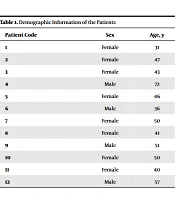
The findings of this study included experiences related to the injection of the COVID-19 vaccine in patients with MS. The participants were 12 patients (8 women and 4 men) with MS, with a mean age of 47 years. The demographic information of the patients is presented in Table 1.
Table 1.
Demographic Information of the Patients
| Patient Code | Sex | Age, y | Marital Status | Education |
|---|---|---|---|---|
| 1 | Female | 31 | Married | Associate degree |
| 2 | Female | 47 | Married | High school |
| 3 | Female | 43 | Single | High school diploma |
| 4 | Male | 72 | Married | High school diploma |
| 5 | Female | 46 | Married | High school |
| 6 | Male | 36 | Single | Master's degree |
| 7 | Female | 50 | Married | High school diploma |
| 8 | Female | 41 | Married | Bachelor's degree |
| 9 | Male | 51 | Married | High school |
| 10 | Female | 50 | Married | Master's degree |
| 11 | Female | 40 | Married | High school diploma |
| 12 | Male | 57 | Married | High school diploma |
Four main categories and 19 subcategories were extracted (Table 2). The categories were mental concerns, quarantine suffering, educational resources, and personal experiences.
Table 2.
Categories and Subcategories
| Categories | Subcategories |
|---|---|
| Mental concerns | Negative rumors about the complications of vaccination, hearing the news of the death of COVID-19 patients, worrying about the interference of COVID-19 vaccines and MS treatments |
| Quarantine suffering | Movement disorders, depression, immune system weakness, social distancing, and compliance with health protocols |
| Educational resources | Physicians, clinic staff, national media, cyberspace, and family |
| Personal experiences | COVID-19 vaccine efficiency and effectiveness, reduction of symptoms compared to unvaccinated people, and having no complications |
4.1. Mental Concerns
The participants expressed mental concerns, including some negative rumors about complications of vaccination, hearing the news of the death of COVID-19 patients, and worrying about the interference of COVID-19 vaccination and MS treatments. The patients had heard too many rumors about the danger of COVID-19 vaccine injection; the media emphasized that children and people with underlying diseases are more vulnerable and introduced them as at-risk groups. According to a participant,
"My neighbors told me that this disease was not known well yet, so how could they make a vaccine for it?"
When MS patients heard news of the death of COVID-19 patients, with awareness of their weak immune system because of using immunosuppressive drugs, they felt more anxious and saw their death as more probable. One of the participants said,
"Upon hearing the death of any COVID-19 patient, I felt that I would die too if I got COVID-19 because I knew about my weak immune system".
The participants believed that when they were deciding to determine therapeutic interventions, using other patients' experiences was effective in their decisions, but there was not enough experience with the newfound COVID-19 vaccine. For the patients, it was not clear what complications might arise after the injection and if something happened, whether it was caused by the COVID-19 vaccine or their underlying disease. About this, one of the participants said,
"I didn't know anyone who had received the vaccine, so I couldn't ask anyone about the side effects. I didn't have anyone to ask them about the complications."
Due to the chronic treatment protocols they had for the treatment of MS, the participants were worried that the COVID-19 vaccine would interfere with the drugs used to control MS and harm them. One of the participants said,
"I was worried that if I got the vaccine and used my previous drugs like before, some problems might arise; if I stopped using my MS drugs for some time to get the vaccine, would my MS get worse or not? What was I supposed to do?"
The first category in this study was the mental concerns of patients with MS, which made them feel anxiety, fear, and apprehension and disturbed their mental and intellectual activity in relation to factors associated with COVID-19 vaccination. Different people use different defense mechanisms when dealing with stressful situations, which may be incompatible in some cases. The patients with COVID-19 live in a situation where there is uncertainty about their death or life, and suffering from MS intensifies this uncertainty. Novelty, speed of spread, variety of complications and symptoms of COVID-19, and, as a result, the global efforts to accelerate the manufacture of vaccines and drugs effective in the prevention and treatment of COVID-19 led to mental concerns for MS patients. Unfortunately, little research is available on the experiences of patients with COVID-19. The findings of Aghahoseini's study on the lived experience of recovered COVID-19 patients showed that the participants experienced mental concerns such as fear of imminent death (28). The results of Rahmatenejad et al.'s study on COVID-19 patients showed that the participants experienced death anxiety (29), which is in accordance with the findings of the present study. Their concerns increased significantly due to the publication of conflicting content in cyberspace and by some social groups regarding the doubts about the effectiveness of the COVID-19 vaccine and the lack of dangerous complications, especially for those who had a disorder in their immune system (30).
4.2. Quarantine Suffering
The other category was quarantine suffering, with subcategories of movement disorders, depression, immune system weakness, social distancing, and compliance with health protocols. According to the participants, the period of illness involved a collection of experiences and challenges that forced on them many negative issues and hard psychological conditions. Some participants who had movement limitations arising from MS faced more trouble in performing health care and personal routines; this matter exacerbated their physical problems. Thinking that they couldn't appear in society like before the pandemic made them depressed. Their immune system was weakened, and they could not take part in society freely; despite compliance with all health protocols, they might get the disease, and this was a cause of suffering. Some participants reported that they got COVID-19 despite compliance with protocols. According to a participant,
"I received the vaccine, but I got COVID-19 three times in the past year, while some people didn't receive the vaccine and didn't get COVID-19."
Participants expressed another challenge and problem created for their family, which was the mandatory restrictions for their family to comply with the patient's condition. This restriction was reduced by COVID-19 vaccine injection. A participant said,
"For my sake, my family was forced to limit their relationships and continue them in cyberspace and via phone calls."
The second category was quarantine suffering of patients with MS. The participants had experienced physical and mental challenges related to the disease, which made life difficult for them. Depression included impatience and avoidance of activity or apathy and reluctance, which could affect their thoughts, behaviors, feelings, happiness, and well-being. Emotional problems of being away from the family and limited social communication due to social distancing, fear of disease transmission in crowded environments, movement complications caused by MS and its negative impact on physical activities needed to comply with health protocols and independence in self-care, and thinking about the weaknesses caused by MS could be the main causes of depression in these patients. The findings showed that the participants experienced movement complications, fear of contamination, threats related to their weak immune systems, depression related to social distancing, and compliance with health protocols. In the study by Rahmatinejad et al. in 2020, the results indicated that the patients' communication with others decreased the experience of uncertainty during the quarantine period and distancing (29). In the study by Ramezani et al. in 2021, the prevalence of anxiety and depression in MS patients was higher than in previous reports. Fear of COVID-19 was related to anxiety and depression. Therefore, the results obtained in this study were in line with the results of previous studies (31).
4.3. Educational Resources
Another category was the participants' educational resources, with subcategories of physicians, clinic staff, national media, cyberspace, and family. During the COVID-19 pandemic, sufficient documentation for reporting was not available, and society was agitated, so rumors were very common. In this situation, the participants were looking for confirmation from knowledgeable people. Many participants mentioned their doctors' emphasis on COVID-19 vaccine injection, and their families took an advisory position. Patients stated that cyberspace was misleading in most cases, but in some cases, reliable and clear information was obtained. Still, according to a participant,
"I didn't pay attention to rumors. I went to my doctor, and he said, 'You should get the vaccine,' and I did that.
Another participant noted,
"My doctor was in Tehran, so I went to the clinic near my home. The clinic staff said that I should get the vaccine, and I did that, so I didn't get COVID-19.
Another participant said,
"When doctors and broadcasters emphasize vaccination, they must have a reason; they know that the vaccine is effective."
The third category was the educational resources for MS patients related to vaccination. Due to the novelty of COVID-19 and its very fast global pandemic, many questions were raised in people's minds about the nature of the disease, its routes of transmission, possible complications and risks, therapeutic and preventive methods, and risk factors, mostly at the beginning of the pandemic, and no answers were found for these questions. Due to the weaknesses resulting from the nature of MS and its therapeutic and medicinal complications, patients with MS have a special condition when suffering from other diseases, which should provide and facilitate access to reliable educational resources to help them make treatment decisions. In the current study, the majority of patients' opinions were based on their educational sources, including doctors, clinic staff, family, and national media, which agreed on the effectiveness of the COVID-19 vaccine for immunity against the disease. Some participants noted the publication of some unreliable content in cyberspace, but they did not pay attention to these rumors due to their doctors' emphasis on vaccination. In a 2021 review by Biswas et al., the majority of studies identified concerns about vaccine safety, efficacy, and potential side effects as the main reasons for hesitancy in getting vaccinated against COVID-19 among healthcare workers. Most studies also found that people who were male, older, and had a doctorate degree) were more likely to accept the COVID-19 vaccine. Factors such as increased risk of COVID-19 infection, direct patient care, and a history of influenza vaccination also increased the likelihood of receiving the COVID-19 vaccine. Due to the high prevalence of hesitancy in getting vaccinated against COVID-19 among health care workers, communication and educational strategies, along with the duties of clinical staff, should be considered to increase the acceptance of COVID-19 vaccination in these people. Health care workers play a key role in reducing the burden of the pandemic, modeling preventive behaviors, and helping to vaccinate others (30). Moreover, the 2022 study by Cupertino et al. showed that parental decisions and attitudes strongly influence the immunization status of adolescents. Students tending to receive information about the COVID-19 vaccine from family doctors and at school emphasized the potential role of pediatricians and school educators in helping increase vaccine coverage in childhood (32). The results obtained in this study, like the studies cited, show a consensus on the effective role of healthcare staff and the family (as available educational resources) in the acceptance of healthcare programs by patients and in modeling preventive behaviors.
4.4. Personal Experiences
The last category was personal experiences, with subcategories of COVID-19 vaccine efficiency and effectiveness, reduction of symptoms compared to unvaccinated people, and having no complications. Most of the participants stated that it is possible to get positive results and improve health by following the recommendations of doctors and health care workers. The participants were satisfied that despite the lack of sufficient documentation regarding the effectiveness of the COVID-19 vaccine and the absence of dangerous complications, they decided to inject the vaccine simply by trusting the recommendations of their doctors and health care staff. One of the participants noted,
"The COVID-19 vaccine was effective for me, and I didn't get COVID-19."
Another one said,
"I got COVID-19, but I had mild symptoms because I had injected the vaccine, but my husband didn't inject the vaccine and got severe COVID-19."
According to another participant,
"I was vaccinated, and I wasn't different from other people."
About the category of personal experiences of patients, the experience of most participants indicated the effectiveness of the COVID-19 vaccine, the mildness of the symptoms compared to unvaccinated people, and the absence of severe complications noted by MS patients. The patients who had doubts about the effectiveness of the vaccine and the absence of serious complications had been vaccinated with the advice of the attending physician and the medical staff; they eventually expressed their satisfaction with their decision and stated that after the vaccination, they were less infected compared to the people who had not been vaccinated or showed fewer symptoms. Some patients noted the observation of cases of COVID-19 in their surroundings with serious complications and more severe symptoms compared to themselves. A 2021 study by Glatman-Freedman et al. suggests that vaccination with BNT162 is highly effective in preventing new cases of COVID-19, and in cases of disease progression, vaccination reduces morbidity and mortality (33); this result is in line with the results obtained in the present study, in which the participants expressed the effectiveness of the vaccine, the reduction of cases, and the mildness of the symptoms, compared to non-vaccinated people.
5. Discussion
This research investigated the experiences related to the injection of the COVID-19 vaccine in patients with MS in Ilam. The first category was the mental concerns of MS patients, including anxiety, fear, and apprehension, which caused mental and intellectual preoccupation about some factors related to COVID-19 vaccination. Different people use different defense mechanisms when dealing with stressful situations, which may be incompatible in some cases. Unfortunately, there are few studies available about people's experiences with COVID-19. In Aghahoseini's study on the lived experiences of recovered COVID-19 patients, it is mentioned that the participants have experienced mental concerns, such as a fear of imminent death (28). Moreover, Rahmatinejad et al. showed that the participants experienced death anxiety (29). Patients with COVID-19 live in a situation where there is uncertainty about their death or life, and suffering from MS intensifies this uncertainty. The novelty, speed of spread, variety of complications and symptoms of COVID-19, and, as a result, the global efforts to accelerate the manufacture of vaccines and drugs effective in the prevention and treatment of COVID-19 exacerbated the mental concerns of MS patients. Restrictions due to social distancing, lack of access to medical staff and doctors, and deprivation of emotional support from the family made the presence of these people in cyberspace more prominent; their concerns increased significantly due to the publication of conflicting content in cyberspace and by some social media regarding doubts about the effectiveness of COVID-19 vaccine and lack of dangerous complications, especially for those who had a disorder in their immune system. In the study of Ramezani et al. in 2021, the prevalence of anxiety and depression in MS cases was higher than in previous reports. Fear of COVID-19 was associated with anxiety and depression. Multicenter research should be conducted to provide specific recommendations to MS patients. By doing this, patients can be screened during epidemics (31).
Another category was quarantine suffering in MS patients related to COVID-19 vaccination. Participants experienced physical and psychological challenges that made their lives hard. Depression is a mood state that includes boredom and activity avoidance or apathy and reluctance and can affect people's thoughts, behaviors, feelings, happiness, and well-being. Emotional problems of being away from the family, limited social communication due to social distancing, fear of disease transmission in crowded environments, movement complications caused by MS and its negative impact on physical activities needed to comply with health protocols and independence in self-care, and thinking about the weakness caused by MS were the main factors leading to depression. Research findings show that patients experienced movement complications, fear of infection, threats related to the weakness of the immune system, depression related to social distancing, and compliance with health protocols. In the study by Rahmatinejad et al. in 2020, the findings showed a decrease in the communication of patients with others, ambiguity in the experience of quarantine, and distancing of people from each other (29).
The third category was educational resources. Given that COVID-19 was a newfound disease and with rapid spread, there were many questions in people's minds about the nature of the disease, its transmission routes, possible complications and risks, therapeutic and preventive methods, and risk factors. At the beginning of the pandemic, most of these questions could not be answered. Due to the weaknesses resulting from the nature of MS and its therapeutic and medicinal complications, patients with MS have special conditions when suffering from other diseases; therefore, access should be provided to reliable educational resources to meet the necessary conditions for making treatment decisions. In the current study, the majority of patients agreed on the emphasis of their educational sources, including the attending physician, clinic staff, family, and the national media, on the effectiveness of the COVID-19 vaccine in immunity against COVID-19; they only expressed the publication of some unreliable content in cyberspace, which they did not pay attention to due to the emphasis of their attending physicians on vaccination. In a review by Biswas et al. in 2021, most studies identified concerns about vaccine safety, efficacy, and possible side effects as the main reasons for hesitancy in getting vaccinated against COVID-19 among healthcare workers. Most studies also found that people who were male, older, and doctors were more likely to accept the COVID-19 vaccine. Factors such as increased risk of COVID-19 infection, direct patient care, and a history of influenza vaccination also increase the likelihood of COVID-19 vaccination acceptance. Considering this, in the case of the COVID-19 vaccine in health care, communication and educational strategies with clinical staff should be considered to increase the acceptance of COVID-19 vaccination by these people. Health care workers play a key role in reducing the burden of the epidemic, modeling preventive behaviors, and helping to vaccinate others (30). In a study by Cupertino et al. in 2022, the immunization status of adolescents was affected by the parents' decisions and thinking. In general, those students who preferred to receive information about the COVID-19 vaccine from their family and school doctors emphasized the potential role of pediatricians and school educators in helping to increase childhood vaccine coverage (32).
As for the category of personal experiences, most experiences showed the effectiveness of the COVID-19 vaccine, having no severe complications and mild symptoms compared to unvaccinated people. The patients who had doubts about the effectiveness of the vaccine and the absence of serious complications and had been vaccinated with the advice of the attending physician and the medical staff expressed their satisfaction with their decision; they stated that after the vaccination, the number of COVID-19 cases was lower compared to those who had not received the vaccine, and those who did get infected showed fewer symptoms. A number of patients attributed the observation of COVID-19 cases in their surroundings with serious complications and more severe symptoms compared to themselves who were vaccinated to the effectiveness of the vaccine. In a study by Glatman-Freedman et al. in 2021, it is mentioned that the BNT162 vaccine is very effective in preventing new cases of COVID-19. Among people who were 80 years old, high effectiveness grows slower. In cases of disease progression, vaccination reduces morbidity and mortality (33).
5.1. Conclusions
According to the findings, the experiences related to the injection of the COVID-19 vaccine in patients with MS had four main categories, showing their mental concerns related to negative rumors about the side effects of the vaccine, hearing the news of the death of COVID-19 patients, mental preoccupation with the unknowns of the new vaccine, concern of the complications of the vaccine, concerns of the interaction of COVID-19vaccine with MS treatment. Besides, movement complications, depression, fear of getting infected, weak immune system, social distancing, and compliance with health protocols caused the suffering of quarantine in PwMS to be more severe than in others. Doctors, clinic staff, family, national media, and cyberspace, as educational resources, have talked at length about the effects of the COVID-19 vaccine, among which doctors and families had the most impact on patients with MS. Other results of this study included the belief in the effectiveness of the COVID-19 vaccine, the reduction of symptoms compared to unvaccinated people, and the absence of reportable complications as individual experiences of MS patients.
5.2. Limitation and Strengths
There was no specific limitation regarding the study. Of course, there were limited resources, but on the other hand, the strength of this study is that few studies have been conducted on this topic so far; therefore, the results of this study can pave the way for other researchers, treatment staff, and health system managers to check the experiences of MS patients and use them in other epidemics.