This study aimed to evaluate the relationship between migraine and cognition using the FAB test. In the present study, the FAB results in all migraine patients were significantly worse than those in the control group. Additionally, the performance of patients with MO in the FAB results was considerably lower than that of the control group, suggesting worse cognitive function in all migraine patients, and specifically in patients with MO, compared to the control group. However, the differences in the FAB results between patients with MA and the control group were not significantly important. Also, in our study, the FAB results in patients with MA were higher than in patients with MO, but these results were not considerably important.
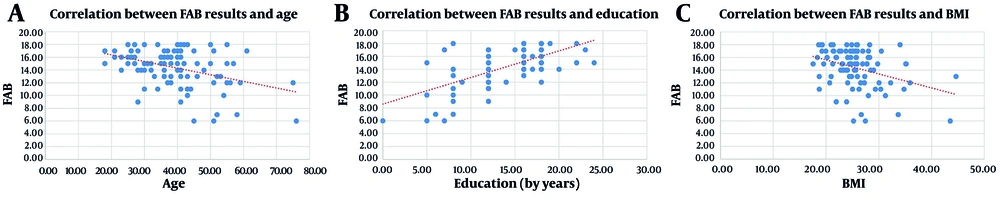
The differences in age between patients with MA and MO, and between patients with MA and healthy subjects, were significant. Thus, age could be considered a confounding factor in our study. However, the differences in age between all migraine patients and healthy subjects, and between patients with MO and healthy subjects, were not statistically significant. Therefore, the comparison of FAB results between patients with migraine and healthy subjects was not affected, and age had no confounding effect on our primary objective. Furthermore, it should be mentioned that age only had a weak negative correlation with the FAB results (
Figure 1).
Studies investigating the relationship between migraine and cognition have shown conflicting results. Some studies suggest that migraine could lead to poorer cognitive functions. For instance, in a survey of 44 migraine patients and 16 control subjects, it was demonstrated that migraineurs generally had inferior results in cognitive tests; also, patients with MA performed worse in the FAB than patients with MO (
13). In a meta-analysis of 17 studies on migraine and cognitive deficits, Braganza et al. suggested that migraine could have a negative, moderate effect on spatial cognition, executive function, immediate and delayed memory, and complex attention (
14). Furthermore, de Araujo et al., in a systematic review of 23 studies on cognition, migraine, and cognitive impairment, proposed that migraine might increase the risk of cognitive impairment, with patients with MA displaying more cognitive changes (
15). Additionally, Pellegrino Baena et al., in a cross-sectional analysis of the association between cognitive function and migraine among 4208 participants of the Brazilian Longitudinal Study of Adult Health, ELSA-Brasil, observed that migraineurs in general and patients with MO had poorer performance in cognitive tests; however, these results were not observed in patients with MA (
16).
On the other hand, some studies suggest that migraine does not affect cognition. In a prospective cohort study, Rist et al. found that among 1170 participants (167 had migraine) of the epidemiology of vascular ageing study, using nine different tests, including the mini-mental state examination (MMSE), there was no greater cognitive decline in migraine patients compared to healthy participants (
17). Also, in a blinded study on four different cognitive tests, Pearson et al. found that patients with both MA and MO did not differ significantly from matched controls (
18).
However, other studies suggest that migraines may enhance cognitive functions. In a survey of 21 patients with MO and 21 healthy participants, Baschi et al. observed that MO was associated with better performances in learning and visuospatial memory (
20). In a cross-sectional analysis of 6708 participants of the Rotterdam study, Wen et al. showed that patients with migraine, and especially those with MA, had better results in the MMSE, letter-digit substitution test, 15-word learning test, Stroop test, verbal fluency test, and Purdue pegboard test than healthy participants (
21).
Though it is challenging to reconcile these conflicting results, the differences in the relationship between migraine and cognition could be explained by considering various factors. These include the different tests used for evaluating cognition and cognitive function, which are designed to assess different domains of understanding. Additionally, the populations from which participants are chosen in different studies, such as clinical populations or community samples, could influence the outcome of a survey. For example, Braganza et al., in their meta-analysis, showed that migraineurs recruited from clinical settings, such as neurology clinics, tend to present with more neuropsychological deficits than those chosen from the community (
14).
Furthermore, factors such as different sample sizes, ethnic populations, languages, and socioeconomic statuses of participants could contribute to these inconsistent results. It should also be noted that the adverse effects of migraine on cognition observed in our study could align with the abnormal structural changes found in previous imaging studies (
6-
12). Altogether, our results could support the use of cognitive function assessment tools, including the FAB, to identify probable cognitive dysfunctions in patients with migraine, particularly those with MO. These results could also be beneficial for the early identification of possible changes in these patients in the future.
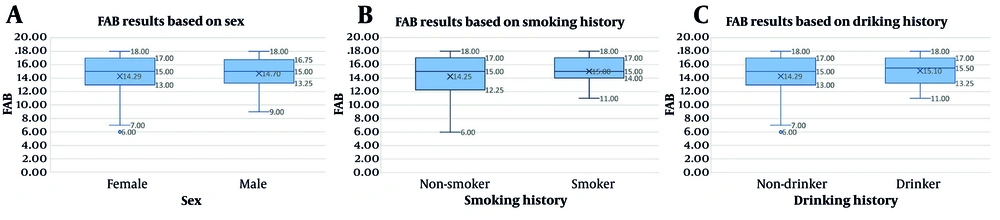
The results of our study suggest that differences in sex, drinking, and smoking status have no effects on the FAB results; therefore, we did not find any relationship between these variables and cognition (
Figure 2).
Regarding the relationship between years of education, age, BMI, and cognition, our study found a moderate positive correlation between years of education and a mild negative correlation between age and BMI with the FAB results, and thus cognition (
Figure 1). In a similar study, Mulholland et al. demonstrated that aging could reduce gray matter density and cognition (
36). Additionally, in a cross-sectional study, Mumme et al. observed that younger age and having a university education were associated with better global cognitive function (
37). Furthermore, Matallana et al. investigated the relationship between cognition and education, suggesting that more years of education correlate with better performance in the MMSE results (
38).
As for BMI, studies show conflicting results. For example, Lynch et al. reported that a slower rate of cognitive decline with age was observed in subjects with a BMI ≥ 27.5 kg/m
2 (
39). However, Mwamburi and Qiu suggested that a higher BMI was associated with lower verbal IQ (
40).
Another interesting result from our study was that there were no differences in the FAB results and cognition based on migraine-specific variables. In this study, differences in the frequency of migraine headaches did not cause changes in cognition; an increase in the disease duration among migraineurs did not cause differences in the FAB results. Consistent with our findings, Rist et al. observed that after 4 - 5 years of follow-up, migraine did not cause faster cognitive decline in patients (
17). However, in another study, Zhao et al. showed that increases in the duration of the disease are related to progressive brain damage in regions associated with cognition and pain processing (
41).
In our study, the severity of migraine headaches did not cause more cognitive decline. Inconsistent to our findings, Kurth et al. observed that the severity of any headache could increase the volume of white matter hyperintensities (
6). The history of preventive drug usage did not improve the FAB results, and therefore cognitive function. Inconsistent with our results, Borsook et al. suggested that as the insula plays a vital role in cognitive function, migraine treatments can activate and affect insular cortex function and structure (
42).
5.1. Conclusions
The present study suggests that a history of migraine, especially MO, significantly reduces the FAB results, thereby indicating worse cognitive function in patients with migraine compared to healthy populations. However, these results are not observed in patients with MA, and we cannot specify the relationship between MA and cognition, nor its differences with MO. Additionally, it should be noted that the FAB results and cognition could have a moderate positive correlation with years of education and a mild negative correlation with age and BMI. Furthermore, this study found no significant differences in the FAB results and cognition based on Duration of the disease, Frequency of the disease, severity of headaches, and the history of any preventive drug use.
5.2. Limitations
The cross-sectional method used in our study could limit the precise determination of the effect migraine has on FAB results and cognition. Furthermore, the limited sample size restricts a thorough evaluation of FAB results among migraine patients and the control group; the low sample size also limits the comparison between patients with MA, patients with MO, and healthy subjects. This study was conducted in the neurology department of Tehran Imam Khomeini Hospital clinics, which could result in socioeconomic and sampling biases. Additionally, due to financial constraints, we were unable to perform imaging evaluations of the study population.
5.3. Suggestions
Further studies are needed, as the cognitive changes in migraine patients can significantly influence their quality of life. For future research, multicenter longitudinal studies with larger patient populations could provide a more precise understanding of the cognitive effects of migraine and its subtypes. Additionally, the use of imaging modalities can help determine the specific brain regions affected by migraine and enable researchers to identify the mechanisms by which migraine impacts cognition. Furthermore, the utilization of a broader range of cognitive tests could assist researchers in evaluating the exact relationship between migraine and cognition.