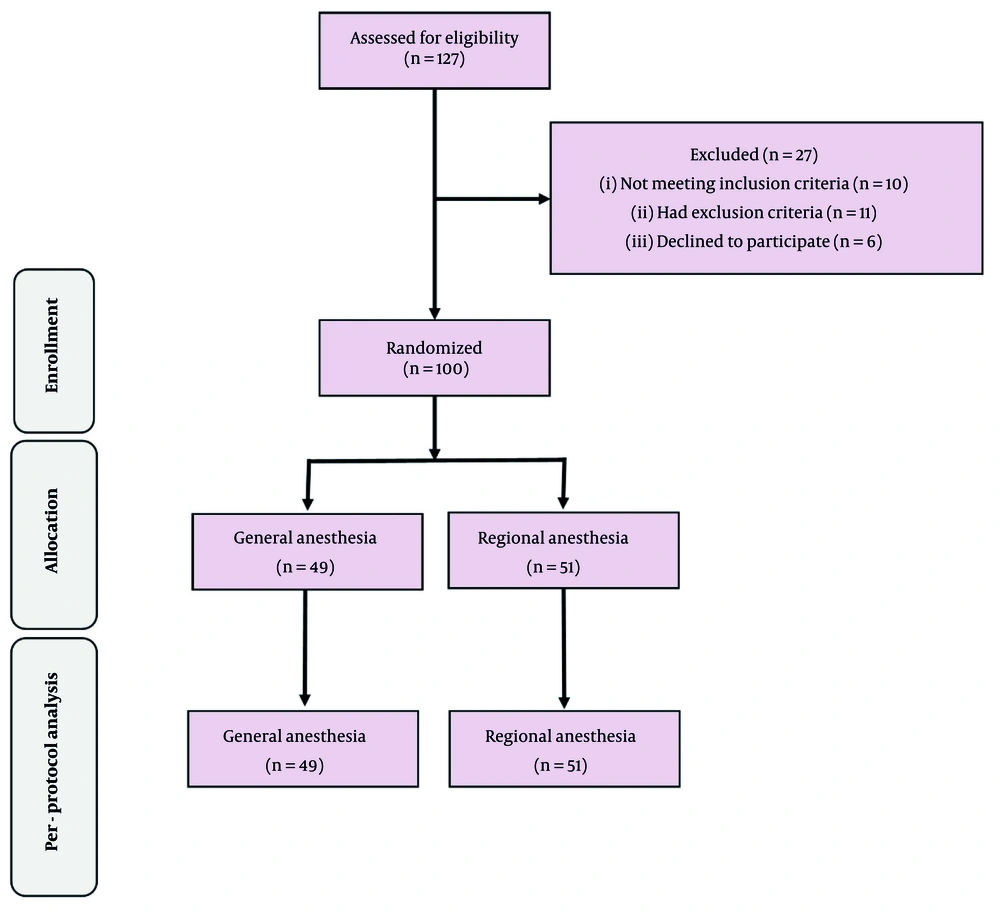
This study compared RA and GA in degenerative spine surgeries. The GA group showed better pain control, with lower Visual Analogue Scale (VAS) scores and reduced analgesic consumption. However, the RA group had shorter hospitalization and operation durations. Interestingly, the RA group experienced higher bleeding volumes, though the number of patients requiring blood transfusions and pre- and postoperative Hgb levels were similar between groups.
Patient satisfaction was higher in the RA group, as was surgeon satisfaction. Postoperative ODI scores showed no significant difference between groups. The RA group reported lower rates of PONV compared to the GA group.
While numerous studies have compared GA and RA in spine surgery, most focused on non-fusion procedures (
22). Common primary outcomes included postoperative pain, patient and surgeon satisfaction, surgery and hospitalization duration, bleeding rates, and cost. Our findings align with some previous studies but differ in others.
Regarding hemodynamic stability, unlike previous studies that found worse outcomes in GA groups, our study showed no significant difference between the two groups.
Most studies report higher bleeding rates with GA (
8,
22-
25)), though two studies showed slightly higher, but not significant, bleeding in RA (
7,
26). This study found significantly higher bleeding in the RA group. This could be due to increased venous pressure from the Valsalva maneuver, as patients are awake and prone during RA procedures, potentially leading to more bleeding from epidural vessels. Although RA is predominantly associated with reduced intraoperative blood loss, our findings indicate a higher blood loss in the RA group. One potential explanation is the variation in venous hemodynamics observed under RA. Patients under RA maintain spontaneous ventilation and may experience incomplete sympathetic blockade, leading to fluctuations and transient increases in venous pressure. These hemodynamic changes, possibly exacerbated by surgical positioning and patient-specific factors, could result in increased bleeding from venous channels. Similar observations have been noted in the literature, suggesting that under particular clinical conditions, RA might contribute to a higher overall blood loss than expected (
27,
28).
Despite higher intraoperative bleeding in the RA group, postoperative Hgb decreases were similar between groups. This may be attributed to lower systemic blood pressure during GA, resulting in less expected blood loss. The similar Hgb decrease in both groups, despite higher bleeding in RA, could be related to propofol's hemolytic effect (
29). Consequently, the overall postoperative Hgb reduction was comparable in both groups, regardless of the higher bleeding observed in the RA group.
This study demonstrates that pain levels (VAS) and analgesic consumption were higher in the GA group compared to the RA group, aligning with most research in this field (
5,
7,
22-
25). Consistent with other studies, the RA method resulted in less postoperative pain and a reduced need for pain relief.
Muscle relaxation was more effective in the GA group than in the RA group, likely due to GA's impact on muscle tone. For patients undergoing RA, using an appropriate muscle relaxant during surgery is advisable, as it can simplify pain management postoperatively (
30). Although GA inherently provides better muscle relaxation through the use of neuromuscular blocking agents, patients receiving RA may not achieve equivalent levels of muscle relaxation. This difference can have implications for postoperative recovery. Inadequate muscle relaxation during surgery may lead to increased postoperative muscle stiffness and pain, which could hinder early mobilization and prolong recovery. Recognizing this, future protocols in patients receiving RA might benefit from the incorporation of targeted muscle relaxation strategies, such as supplemental local infiltration or additional regional nerve blocks. These interventions may improve intraoperative conditions and subsequently promote enhanced postoperative recovery by reducing muscle tension and pain (
31,
32).
A systematic review examined eleven studies comparing GA and RA for spinal lumbar surgery, including four RCTs, three case-control trials, two retrospective analyses, and two prospective cohorts. Seven studies found lower heart rates and mean arterial pressures in the RA group, while seven reported reduced postoperative analgesic requirements and/or lower pain scores in the RA group (
1).
The operating room is a critical and expensive hospital resource, with a high percentage of patients admitted for surgical procedures. Managing the operating theater is complex, involving scheduling surgeries efficiently to maximize profits without increasing costs or patient wait times (
33). Reducing operation duration significantly aids in operating room management and helps decrease the workload of medical staff and surgeon fatigue (
34,
35). This study found that spine surgery using RA took considerably less time than GA. Additionally, the duration of anesthesia was significantly shorter in the RA group. These findings suggest that RA can positively impact operating room management, staff workload, and surgeon fatigue.
A 2020 meta-analysis of 1747 patients undergoing retrograde intrarenal surgery showed that RA patients had shorter operation times compared to GA patients, but similar VAS scores and hospital stays (
36).
This study finds that GA patients experience longer anesthesia duration and hospital stays than RA patients, consistent with similar research (
22,
25). Most studies comparing anesthesia duration between the two methods show longer times for GA, except for one randomized and one non-randomized clinical trial that found no significant difference (
23,
24). The extended time for GA can be attributed to induction and recovery periods. In this study, GA patients had longer hospital stays and higher costs, supporting findings from comparable studies (
22,
25).
Postoperative nausea and vomiting, a common complication after spine surgery, occurred more frequently in the RA group in this study. This contrasts with most studies, where GA patients typically experience more nausea and vomiting (
23,
37). Some studies align with the present findings, potentially due to variations in drugs used for GA and RA across studies (
26). The difference may be explained by the anti-nausea effects of GA (
38). For patients undergoing spinal surgeries with RA, prescribing anti-nausea medication based on individual needs may be beneficial.
Patient satisfaction, which reflects perceived care outcomes, influences treatment choices (
39). This study found significantly higher patient and surgeon satisfaction with RA compared to GA. As shown in
Table 2, few studies have examined satisfaction levels. Vural and Yorukoglu reported significantly higher patient satisfaction with RA. Surgeon preferences for anesthesia methods vary, with some favoring RA and others preferring GA (
7,
24,
40).
A 2023 systematic review and meta-analysis of 10 RCTs involving 733 patients found higher rates of hemodynamic disorders in the GA group. The RA group showed lower rates of nausea and vomiting, shorter hospital stays, and reduced analgesic needs. These findings align with a 2017 meta-analysis and largely correspond with the current study and the data presented in
Table 2 (
41,
42).
5.1. Limitations
This study was conducted in a single tertiary hospital with high patient turnover. To enhance the generalizability of the findings, a multicenter study with a larger sample size is recommended. Additionally, the surgeon's awareness of the anesthesia type may have introduced bias regarding surgery duration. Another limitation of our study is that postoperative narcotic and muscle relaxant requirements were not recorded, which may limit the comprehensive evaluation of overall analgesic management protocols.
5.2. Conclusions
Over recent decades, numerous clinical studies have compared regional and GA. This study contributes to addressing some of the ongoing questions in this field. In line with most previous research, our findings suggest that RA is a viable alternative to GA for spine surgery. The results largely corroborate those of similar studies in this area.