


1. Background
2. Objectives
3. Methods
3.1. Study Design
3.2. Primary Outcome
3.3. Data Collection
3.4. Sample Size
3.5. Data Analysis
4. Results
4.1. Study Population
4.2. Laboratory Findings
| Variables | Mean ± SD (Range) | No. (%) |
|---|---|---|
| WBC (n = 43) | 4.9 ± 1.72 (1.9 - 9.2) | - |
| Hb | ||
| Male (n = 21) | 12.9 ± 2.1 (9.1 - 17.7) | Anemia: 16 (76.2) |
| Female (n = 23) | 11.5 ± 1.9 (9.3 - 15) | Anemia: 8 (34.8) |
| Platelet (n = 44) | 107.5 ± 87.1 (22 - 402) | Thrombocytopenia: 26 (59.1) |
| ESR (n = 18) | 10.33 ± 6.4 (1 - 24) | - |
| ALT (n = 38) | 41.73 ± 61.88 (7 - 390) | High: 16 (42.1); normal: 22 (57.9) |
| AST (n = 38) | 34.5 ± 26.17 (17 - 150) | High: 33 (86.8); normal: 5 (13.2) |
| ALKP (n = 32) | 244 ± 215.15 (122 - 862) | High: 27 (84.3); normal: 5 (15.7) |
| Total bilirubin (n = 18) | 0.9 ± 0.911 (0.4 - 3.4) | High: 4 (22.2); normal: 14 (77.8) |
Abbreviations: WBC, white blood cell; Hb, hemoglobin; ALT, alanine aminotransferase; AST, aspartate aminotransferase; ALKP, alkaline phosphatase.
| Clinical Features | Total Number | Positive | Prevalence Percent |
|---|---|---|---|
| Dystonia a | 40 | 34 | 85 |
| Tremor b | 34 | 27 | 79.4 |
| Dysarthria | 44 | 30 | 68.2 |
| Gait disturbances c | 40 | 26 | 65 |
| Hypobradykinesia | 42 | 22 | 52.4 |
| Neuropsychological disorders d | 30 | 14 | 46.7 |
| Rigidity | 43 | 19 | 44.2 |
| Increased DTR | 32 | 14 | 43.8 |
| Dysphagia | 36 | 12 | 33.3 |
| Ataxia | 15 | 5 | 33.3 |
| Increased muscle tone | 24 | 7 | 29.2 |
| Drooling | 33 | 8 | 24.2 |
| Upward plantar reflex | 34 | 5 | 14.7 |
| Sensory disorder | 24 | 3 | 12.5 |
| Seizure | 30 | 3 | 10 |
| Chorea-athetosis | 21 | 2 | 9.5 |
a Dystonia: Generalized (23.5%), dystonia in four limbs (14.7%), dystonia with tremor (14.7%), upper limb, speech, facial, and unspecified types.
b Tremor: At rest (26.5%), action (29.4%), postural (14.7%).
c Gait disturbances: Dystonic (26.9%), ataxic (15.3%), spastic (11.5%), wide-based, atonic, inability to walk, and unspecified types.
d Neuropsychological disorders: Depression (4 patients), hallucinations (2 patients), insomnia (2 patients), developmental delay (2 patients), low MMSE scores (4 patients), cognitive impairment, irritability, and delusions (1 patient).
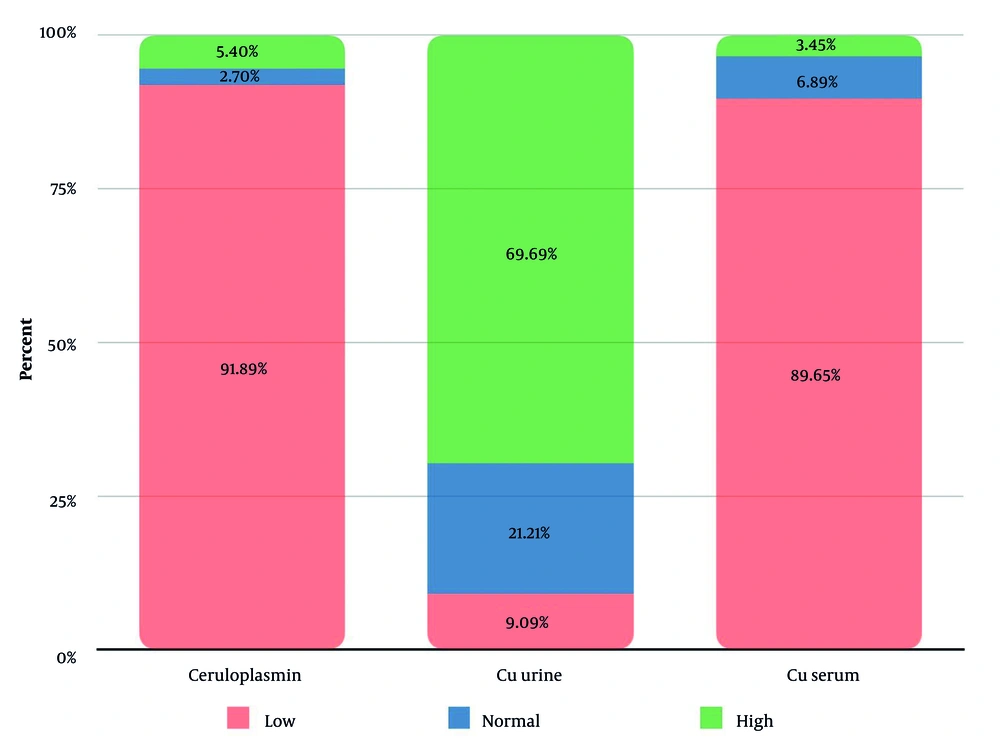
Copper profile of patients
4.3. Gastrointestinal Findings
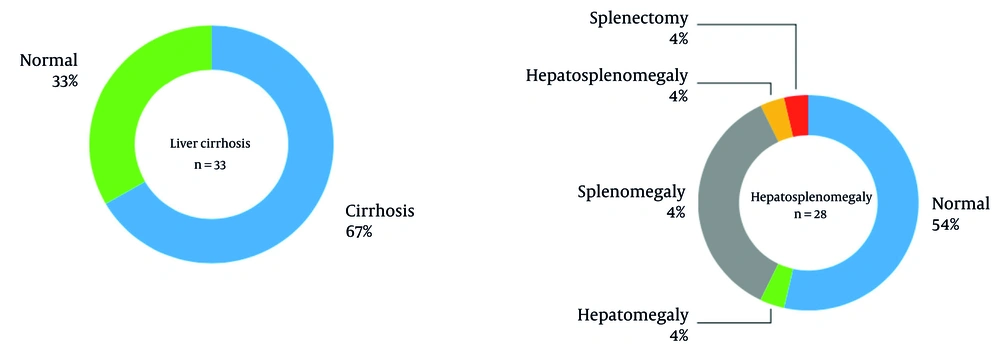
Liver cirrhosis and hepatosplenomegaly based on abdominopelvic sonography of patients
4.4. Neurologic Findings
4.5. Imaging Findings
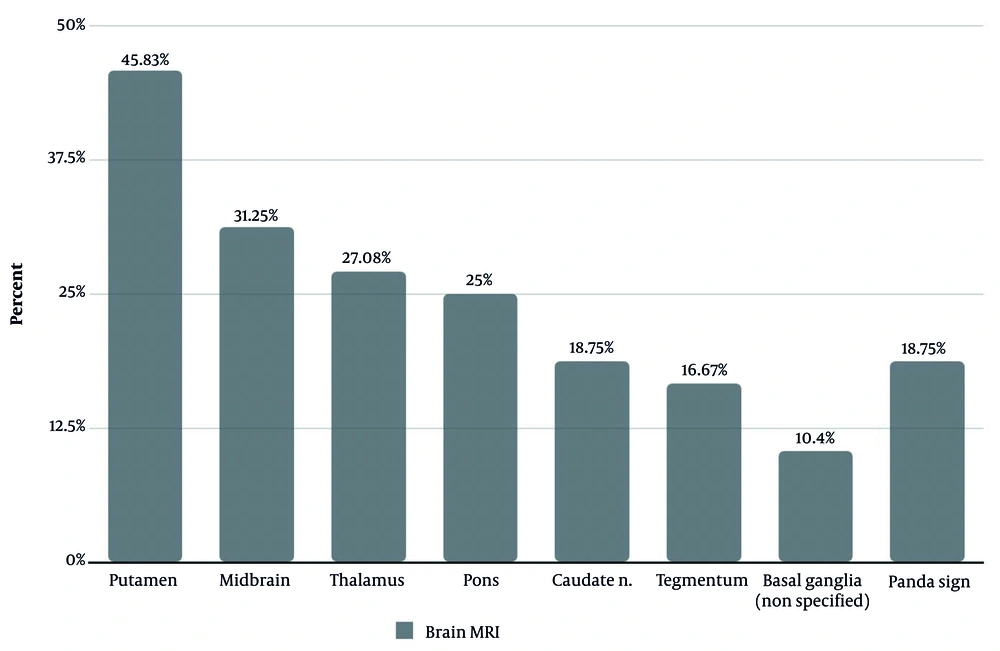
Signal changes in the brain MR images of patients
5. Discussion
5.1. Neurologic Findings
| Study | Study Design | Location | Year Conducted | Mean Age | Most Common Neurologic Manifestations (%) | Imaging Findings (MRI) (%) |
|---|---|---|---|---|---|---|
| Present study | Case series | Rasoul Akram Hospital, Tehran, Iran | 2002 - 2022 | 20.78 | Dystonia (85); tremor (79.4); dysarthria (68.2); gait disturbances (65); hypobradykinesia (52.4); neuropsychological disorders (46.7) | Signal changes in: Putamen (45.8); midbrain (31.2); thalamus (27.1); pons (25); caudate (18.7); tegmentum (16.7); panda sign (18.7) |
| Lankarani et al. (11) | Case-control | Shiraz Organ Transplantation Center, Shiraz, Iran | 2000 - 2014 | 16 a, 22 b | Tremor (40.5); ataxia (32.4); depression (24.3); dysarthria (21.6); drooling (21.6); fine motor task (17.6); gait disorder (17.6); anxiety (16.4); neurosis (16.2); seizure (16.2) | |
| Asadi Pooya et al. (12) | Case series | Namazee Hospital, Shiraz, Iran | 1990 - 2004 | 11 ± 7 | Dystonia (15.3); dysarthria (12.6); tremor (11.7); gait disturbances (9); impaired school performance c (7.2); psychosis c (7.2); other psychological symptoms c (9.9) | |
| Soltanzadeh et al. (13) | Case series | Shariati University Hospital, Tehran, Iran | 1984 - 2004 | 16 | Dysarthria (80); drooling (48); abnormal gait (44); psychiatric symptoms (44); tremor (44); dystonia in limbs (42); dystonia in face (36); dysphagia (30) | |
| Machado et al. (14) | Case series | University of Sao Paulo, Sao Paulo, Brazil | 1963 - 2004 | 19.6 | Dysarthria (91); gait abnormalities (75); risus sardonicus (72); dystonia (69); psychiatric sumptoms (67); rigidity (66); tremor (60); bradykinesia (58); dysphagia (50); postural instability (49) | |
| Lorincz (15) | Systematic review | - | 2010 | Around 17 | Dysarthria (85 - 97); dystonia (11 - 65); tremor (22 - 55); parkinsonism (19 - 62); ataxia (30); psychiatric features (30 - 50) | High T2 signals in: Lentiform and caudate n., thalamus, brain stem, white matter |
| Pfeiffer (16) | Systematic review | - | 2016 | 20 | Dysarthria in the vast majority; tremor (50); dystonia (69); parkinsonism (40); dysphagia (50); gait disturbances (45 - 75); cerebellar dysfunction (30); psychiatric manifestations (30 - 40) | High T2 and low T1 signal changes in: Basal, ganglia, brain stem, thalamus |
| Mulligan and Bronstein (17) | Systematic review | - | 2020 | 10 - 20 | Dysarthria (46 - 97); gait abnormality/ataxia/cerebellar (28 - 75); dystonia (38 - 69); parkinsonism (12 - 58); postural tremor (55); dysphagia (50) | Signal changes in: Basal, ganglia, thalami, pons, white matter, face of giant Panda (14) |
| Czlonkowska et al. (5) | Systematic review | - | 2017 | 20 - 30 | Tremor up to (55); dystonia (11 - 65) d, (38 - 65) e; parkinsonism (19 - 62); ataxia (30); chorea (6 - 16); dysarthria up tp (97); dysphagia (50); drooling (46); gait and posture (44 - 75) | Hyper or mixed intensive changes in T2-weighted images localized in: Putamina, globi pallidi, caudate n., thalami, pons |
| Dusek et al. (18) | Systematic review | - | 2019 | 20 - 40 | Dysarthria (100); dysphagia (50); drooling (70); gait/posture disturbances (44 - 75); dystonia (11 - 65); parkinsonism (19 - 62); ataxia (30) | Symmetric hyperintensities in t2-w images in: Putamen (45 - 85); caudate (30 - 60); anterolateral thalamic n. (30 - 60); pons (10 - 80); mesencephalon (20 - 70) |
| Salari et al. (19) | Systematic review | - | 2018 | Variable | Variable in different studies | Symmetric hyperintensities in T2-W in: Pons, midbrain, basal ganglia |
a Full hepatic failure patients (acute Wilson’s disease).
b Chronic Wilson’s disease.
c Classified as psychological sign and symptoms.
d As an initial symptom.
e During the course of disease.

