
1. Context
1.1. Brief History of Tissue Plasminogen Activator Production and Use
The production of thrombolytic agents started in 1930s and continued until 1979, when tissue plasminogen activator (t-PA) was purified by Collen and colleagues from the human melanoma cell culture (1-3). Thrombolytic therapy for stroke began in 1958, on a case by case basis, and, in 1963, a small trial was performed. In order to find the appropriate t-PA dose, additional trials were conducted in 1980 (4). In 1983, it became possible to produce recombinant t-PA (rt-PA) by expression of a cloned gene, which opened the door for clinical trials to start, mainly for coronary thrombolysis (5). In 1990, Terashi and coworkers performed the first rt-PA clinical trial, on 364 patients, with acute ischemic stroke (6). In 1995, the National Institute of Neurological Disorders and Stroke (NINDS) study claimed that rt-PA was an effective treatment for acute ischemic cerebrovascular accident (CVA), if started in less than 3 hours after symptoms onset (7, 8). In 1996, the food and drug administration (FDA) approved intravenous t-PA. Thereafter, thrombolytic therapy became the worldwide approved treatment option for acute ischemic stroke (9, 10). Nowadays, in addition to acute ischemic stroke, thrombolytic therapy is considered a treatment option for acute myocardial infarction. Furthermore, studies have indicated the use of t-PA in acute renal artery thrombosis (11), cerebral venous thrombosis and other type of venous thromboembolism (12-15).
2. Evidence Acquisition
2.1. Tissue Plasminogen Activator in Stroke: Dosage and Time Window
Intravenous t-PA was recognized as the approved thrombolytic agent for acute ischemic stroke that can improve patients’ outcome and resolve their neurological deficits. The main reason for the difficulty of stroke treatment is the narrow time window, which leads to a small proportion of eligible patients to be treated with t-PA (16). The first clinical application of t-PA, with the aim of dose verification, mechanism of action, and safety profile, in stroke thrombolysis, began in early 1990s. Then, large randomized, placebo-controlled, double-blinded trials tested the safety and efficacy of t-PA, in acute ischemic stroke. Studies like ATLANTIS A and B (Alteplase Thrombolysis for Acute Non-interventional Therapy in Ischemic Stroke), and ECASS-1 and -2 (European Cooperative Acute Stroke Study) are several of the famous studies that have challenged the proper dose, efficacy, side effects and cost-effectiveness of intravenous t-PA, for treatment of acute stroke (Table 1) (17-20).
Table 1.
Summary of the Early Large Randomized Controlled Trials of Tissue Plasminogen Activatora
| Study | Reference | Year | Number of Patients | Dose, mg/kg IV | Time Window, h | Findings |
|---|---|---|---|---|---|---|
| ATLANTIS-A | (21) | 1993 | 142 | 0.9 | (0 - 6) | This trial stopped due to increased rate of symptomatic ICH in the 5 - 6 hour time window from stroke onset. |
| ATLANTIS-B | (22) | 1996 | 613 | 0.9 | (0 - 5) | There was no significant rt-PA benefit on the 90-day efficacy end points in patients treated between 3 and 5 hours. The risk of symptomatic ICH increased with rt-PA treatment. |
| NINDS t-PA | (23) | 1995 | P.1 = 291, P.2 = 333 | 0.9 | (0 - 3) | Treatment with intravenous t-PA, within 3 hours of the onset of ischemic stroke, improved clinical outcome at 3 months. |
| ECASS-I | (24) | 1995 | 620 | 1.1 | (0 - 6) | In this trial, 1.1 mg/kg dose was effective for the subgroup of stroke patients, with moderate to severe neurologic deficit and without extended infarct signs, on the initial CT scan. The risk of treating ineligible patients is associated with increase of hemorrhagic complications and death. |
| ECASS-II | (25) | 1998 | 800 | 0.9 | (0 - 6) | This trial should set a trend towards efficacy, although ICH up to 7 days was observed. |
| ECASS-III | (26) | 2000 | 821 | 0.9 | (3 - 4.5) | In this trial, rt-PA improved clinical outcomes, in patients with acute ischemic stroke, treated between 3 and 4.5 hours. |
aAbbreviations: ATLANTIS: alteplase thrombolysis for acute non-interventional therapy in ischemic stroke; CT, computed tomography; ECASS: European cooperative acute stroke study; ICH, intracerebral hemorrhage; NINDS: National Institute of Neurological Disorders and Stroke; rt-PA, recombinant tissue plasminogen activator.
Results of the literature review on 15 articles, regarding t-PA and stroke, published in 2012, suggested that intravenous thrombolysis using t-PA can be applied, as an effective treatment, by using 0.9 mg/kg up to 4.5 hours from stroke onset, when infused under good conditions, and emergency medicine physicians play a crucial role in this process (26-29).
3. Results
3.1. Profits and Possible Side Effects of Tissue Plasminogen Activator
The cost-effectiveness and feasibility of intravenous t-PA, for the treatment of acute stroke in 3 - 4.5 hour time window, after symptom onset, have been proved in previous studies (17-19, 30-32). A published systematic review and meta-analysis have found an overall 46% recanalization rate, with intravenous t-PA (33). In a cost effectiveness study, thrombolytic therapy was compared with medical therapy, without t-PA; the quality-adjusted life-years (QALYs), as a measurement for health benefits, was balanced with the cost of intravenous t-PA in 3 to 4.5 hour time window (17). The budget impact analysis, based on stroke incidence rates and the impact of thrombolysis on society’s health, showed that thrombolysis improve society’s health, although the quality of life may have a stronger association with age, sex, level of education and post-stroke duration (34-36). The most serious complication of rt-PA thrombolytic therapy is intracranial hemorrhage (ICH) (16). Based on NINDS trials, ICH could be categorized in two groups: 1) symptomatic ICH, documented with computed tomography (CT) and associated with clinical deterioration; 2) ICH with CT finding and no clinical deterioration (9). To decrease the risk of ICH, t-PA protocols have been developed by the American Heart Association, American Stroke Association (ASA), American Academy of Neurology, NINDS and recently by the American College of Emergency Physicians (37). According to previously published reports, racial differences in blood coagulation and fibrinolytic factors are the main causes of ICH among Asians, which affects the cost and advantages of thrombolysis therapy (38). Monitoring the administrated t-PA plays a critical role in appropriate treatment of patient with ischemic stroke. The American Academy of Neurology and the Stroke Council of the American Heart Association recommend neurological assessments and blood pressure monitoring. It is also suggested that the monitoring should be performed every 15 minutes, for 2 hours, every 30 minutes, for 6 hours, and every 60 minutes, until 24 hours after beginning the t-PA treatment (39).
3.2. Tissue Plasminogen Activator in Developing Countries
Data about thrombolytic therapy, at the national level, are scarce in Asia and developing countries, compared to the developed world. The Indian Stroke Epidemiology Study reported that intravenous and intra-arterial thrombolysis is commonly used in India; also, according to the ongoing Indo-USA national stroke registry, the rate of intravenous thrombolysis is 11% (40). In the study performed in south India, they reported that from the 30% of patients, who were referred within 3 hours after stroke onset, only 16% were eligible for intravenous thrombolysis with t-PA. However, they could not afford to pay the cost. More importantly, stroke rehabilitation services are only available in the private hospitals of the cities (40, 41). Findings of a cross-sectional study in Taiwan, regarding thrombolytic therapy for acute CVA, from 2003 through 2010, showed that of the 394988 patients with CVA, 2385 (0.60%) had received thrombolytic therapy, and that the utilization of t-PA increased from 0.03%, in 2003, to 1.51%, in 2010 (40).
In South Africa, the stroke services and units are available at hospitals of both the public and private sectors (42). Evaluation of all stroke patients receiving t-PA for thrombolysis in South Africa, between January 2000 and February 2011, showed that there were similar safety and early efficacy outcomes, compared to the developed and other developing countries (43).
3.3. Specific Obstacles of Tissue Plasminogen Activator Use in Iran
Thrombolytic therapy, using t-PA, is used in few low-income countries, including Iran (38). Based on the studies performed by Ghandehari et al. the resources and infrastructure for thrombolysis of stroke patients exist in approximately 14 hospitals, in Iran, which cover less than one third of Iranian stroke patients (38, 44). According to estimations of Iranian stroke patients, eligible for thrombolysis therapy, only 30% of Iranian stroke patients received t-PA (44). There are several obstacles towards t-PA use, such as prehospital barriers, financial constraints, lack of infrastructure and low levels of public information (38). The high cost of t-PA and lack of appropriate infrastructure are the main barriers for thrombolytic therapy, in developing countries like Iran. On the other hand, most stroke units and centers, which have the infrastructure to deliver thrombolysis, are predominantly available in urban areas of big cities (38, 45). Lack of coverage for t-PA treatment of stroke patients, in the Iranian health insurance system, has been supposed as one of the most important barrier of thrombolytic therapy (44). Several of the Iranian centers that use intravenous t-PA in stroke patients are the Neurology Department of Firoozgar Hospital, Tehran, Iran and the Emergency Department of Shohadaye Tajrish Hospital, Tehran, Iran.
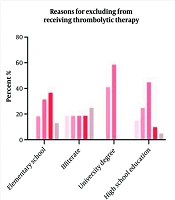
Results of a pilot study (Part I in 2009) of intravenous t-PA, in CVA Iranian patients, showed that only 30% of eligible patients were capable of paying the t-PA vial, by themselves, and 86% of eligible patients missed thrombolytic therapy, due to delay in diagnosis, if t-PA was free of charge (44, 46). In part II of the same study (2010 - 2013), in which eligible patients were treated with intravenous t-PA, based on the ASA guidelines and using the established stroke code to prevent delay in diagnosis and triage, there was a 62% recovery rate for patients treated with t-PA (47). Part III of the study (2013) investigated the problems and limitations of intravenous t-PA (38, 44, 46).
4. Conclusions
Understanding these obstacles will help in finding solutions to meet them and provide the necessary infrastructures in this regard. Solving these problems will certainly help to improve the quality of life, in patients with stroke.