
1. Introduction
In this paper, we demonstrate an unusual location for sphenopalatine ganglion (SPG) in the pterygopalatine fossa in a patient who was a candidate for radiofrequency (RF) thermocoagulation of SPG. Patients with certain types of headache can usually benefit from SPG block 1 and subsequent SPG RF denervation.
2. Case Presentation
A 33-year-old female with intractable headache (predominantly left-sided) without any clear diagnosis, who was being medically treated with a wide variety of analgesics, was referred to our pain clinic. The review of her drug history demonstrated that she had already taken more than 20 different medications, including indomethacin with adequate doses. The extensive work-up, including brain magnetic resonance imaging (MRI) performed by the referring service, neurology, had previously ruled out all possible causes of secondary headaches. The patient reported recurrent bouts of extremely painful, predominantly unilateral headaches, mainly located over the first trigeminal nerve distribution (VI). However, the extension of the pain to the other areas of the face was also reported. She also mentioned a shift in the sides of the head between the attacks. The pain was reported to exacerbate a few times per year, and each attack lasted a couple of weeks. However, the patient did not experience any pain-free periods. There was always basal pain. Pain attacks were associated with conjunctival injection, lacrimation and nasal congestion. The clinical response to indomethacin was inconclusive because she reported periods of indomethacin responsiveness, which eventually evolved to headaches that were not relieved by indomethacin. After a comprehensive review of the history and exams, and also a review of the long list of the previous medical and interventional treatments, we concluded that the patient had an atypical trigeminal autonomic cephalalgia (TAC). Our plan for her treatment was a prognostic SPG block and then a therapeutic RF denervation, if indicated.
2.1. Prognostic Block
The patient signed an informed consent after she had understood the sequence of the procedures and the potential side effect(s). After preoperative evaluation and preparation, the IV line was secured. Standard monitoring (SpO2, ECG, NIBP, HR, RR) were applied and mild sedation including 1 mg of midazolam and 50 mg of fentanyl was injected. The patient was placed in the supine position on the operating table. The suprazygomatic approach for SPG Block was chosen. The skin entry area was prepped and draped. C-Arm fluoroscopy was employed so that the intensifier was close to the left (LT) side of her face. The skin entry point was superficially and deeply anesthetized with 0.5% lidocaine. Next, under the guide of the sequential images of the C-Arm Fluoroscopy, the sphenopalatine (SP) fossa was identified beneath the sphenoid and behind the LT maxillary sinus. The classic radiographic target point is deeply situated in the uppermost part of the SP fossa. This point can be classically addressed in an image named “inversed vase”, on the lateral C-Arm fluoroscopic view (Figure 1A) and also in the superomedial angle of the maxillary sinus, adjacent to the lateral wall of the nasal cavity in the AP view (Figure 1B) (1). Figure 1A and 1B are two classic demonstrations of the target points chosen from the author’s archive and were not the target points in this case report.
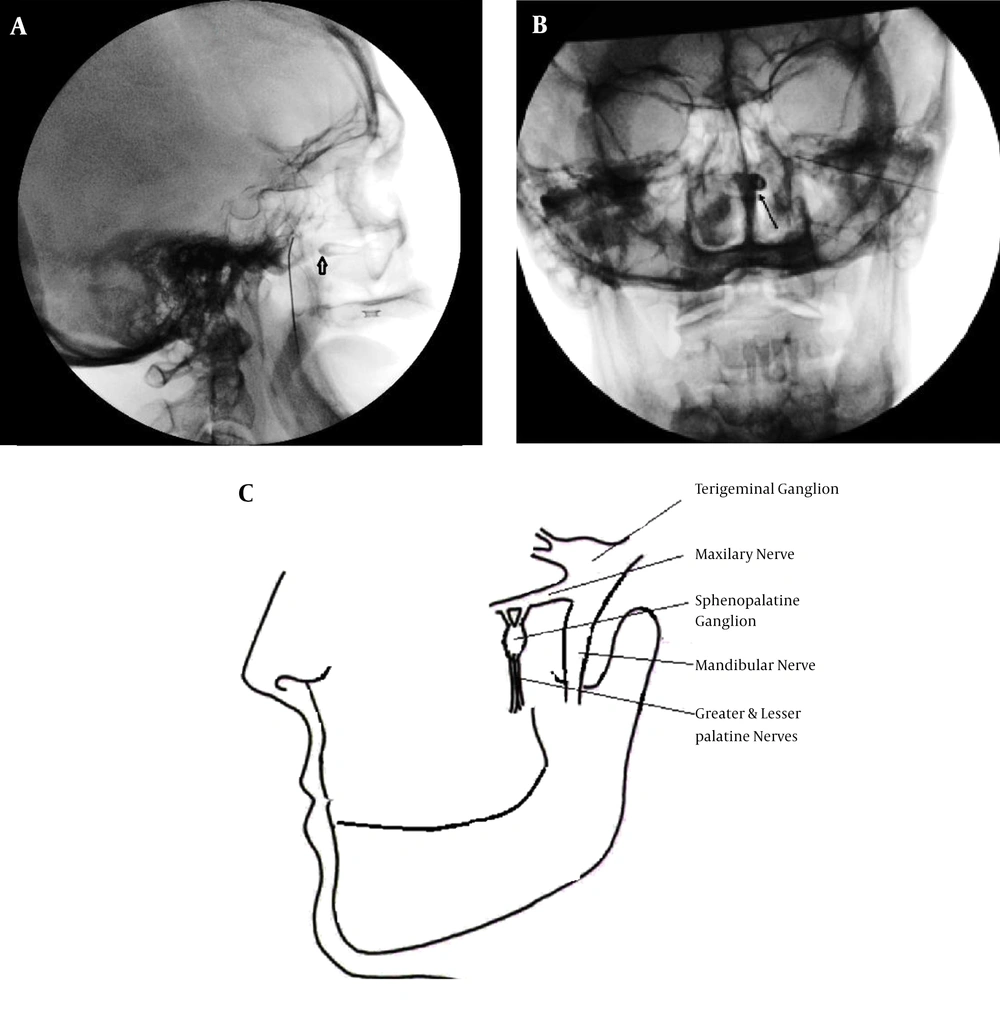
Figure 1.
A, Needle placed in the SP fossa in the right (classic) position on the lateral C-Arm fluoroscopic image. The needle placement should be in the uppermost area of the SP fossa. The SP fossa will be demonstrated like a ‘V’ shape or an ‘inverted vase’ on the lateral view. A contrast-immerged applicator is placed deeply in the nasal cavity (the intranasal approach to the SPG, arrow). This applicator can be used as a guide to address the ganglion. This image is chosen from the author’s archive. B, Needle placed in the SP fossa in the right (classic) position on the AP C-Arm fluoroscopic image. The target point for needle placement is in the superomedial angle of the maxillary sinus on the AP view. A contrast-immerged applicator is placed into the nasal cavity, (the intranasal approach to the SPG, arrow). This applicator can be used as a guide to address the ganglion. This image is chosen from the author’s archive. C, anatomy of SPG and its relationship with the surrounding nervous structures. Figure 1C was prepared by the author.
A 10 - cm, 22 G spinal needle was inserted on the LT skin entry point, which was above the temporal process of the zygomatic bone. The needle was advanced toward the radiographic target point in the left SP fossa under the guide of the frequent C-Arm fluoroscopy images. However, proceeding of the needle was blocked before approaching the exact target point. The proceeding of the needle was blocked midway behind the left maxillary sinus, before it could be accurately placed deeply in the SP fossa (Figure 2A). Frequent and gentle manipulation of the needle in the fossa in order to reach the classic radiographic target was not successful. The first aspiration revealed the blood; therefore, the tip of the needle was replaced and again, after negative aspiration, 0.5 mL of omnipaque 300 was injected. After making sure that the IV spread or intranasal placement of the needle was ruled out, 8 mg dexamethasone and 1 mL of 2% lidocaine (total volume 2 mL) was injected slowly in the LT SP fossa. The needle was flushed with normal saline and then removed. The skin entry point was cleaned and dressed. The patient was transferred to the PACU.
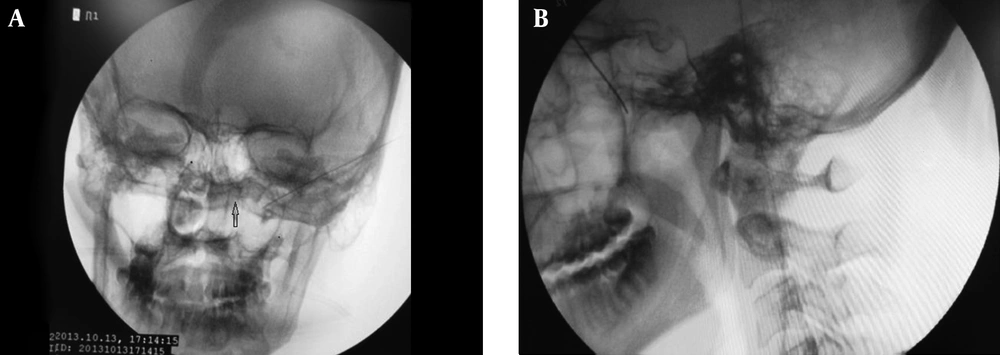
Figure 2.
The tip of the needle should have been placed in the marked area (superomedial angle of the maxillary sinus, arrow).
The patient was interviewed and examined after 10 minutes. She felt numbness over the LT pharynx, and also LT hard and soft palates. The patient reported complete pain relief only over the LT side of the head. A few minutes later she also reported numbness over her LT cheek. We noticed mild swelling over the left cheek as well, which was relieved by an ice pack.
The patient was followed for two weeks by frequent telephone calls and also visited after 16 days in the pain clinic. She was consistently pain free on the left side of her head. Consequently, the prognostic block produced favorable clinical results. The patient remained pain free on the LT side of her head for about one month. Later, she again complained from pain on the same side of her head. Consequently, we considered the RF denervation of the LT SPG.
2.2. Therapeutic Denervation
The patient signed an informed consent after clearly understanding the sequence of the procedures and the potential side effect(s). After standard monitoring and mild sedation, the patient was placed in the supine position on the operating table. The supra zygomatic approach for SPG block was chosen. The skin entry area was prepped and draped. C-Arm fluoroscopy was placed around the table so that the intensifier was close to the left side of the face. The skin entry point was superficially and deeply injected with 0.5% lidocaine for local anesthesia.
2.3. Radiofrequency (RF) Denervation
Over the skin entry point, a 16-G angiocatheter was inserted as an introducer for passage of the RF needle. The angiocatheter was preceded toward the radiographic target point in the LT SP fossa under the guide of the frequent C-Arm fluoroscopy images. Next, after removing its needle, the catheter was left in place. An insulated, 150-mm, 22 G, blunt, curved, RF needle with 10 mm active tip was inserted through the previously placed catheter of the angiocatheter and under the guide of the frequent C-Arm fluoroscopy images, was advanced toward the radiographic target point in the LT SP fossa. Proceeding of the RF needle was again blocked while the tip of the needle was behind the LT maxillary sinus, midway and lateral to the exact target point, before it could be accurately placed deeply in SP fossa (Figure 2A), where we expected to place the tip of the needle in the superomedial angle of the LT maxillary sinus (Figure 2A, arrow). Frequent and gentle manipulation and rotation of the needle in order to accurately place the tip of the needle in the classic radiographic target point was not successful. On the lateral image, the needle was on the right track (Figure 2B), visualized in the ‘inverted vase’; however, on the AP image, the tip of the needle was not adjacent to the lateral nasal mucosa or at the superomedial angle of the sinus. The needle was about 1 cm away from the target point on AP image. To verify whether the tip of the needle was at an acceptable distance from the SPG, sensory stimulation of the ganglion was performed. The sensory stimulation was initiated at 50 Hz; the intensity of the stimulation was augmented gradually up to 1 Volt. The patient felt a tingling sensation in the root of her nose, even with a stimulation of less than 1 volt. No tingling or paresthesia was reported in the palates or upper teeth. Therefore, surprisingly the needle had been placed within an acceptable distance from the LT SPG. Furthermore, 0.5 mL of omnipaque 300 was injected to make sure that the IV spread, intra-maxillary sinus or intranasal placement of the needle was ruled out.
Conventional mode of the RF denervation was chosen. Two milliliters of 1% lidocaine and 8 mg of dexamethasone were injected before making the lesion. Two cycles of thermocoagulation at 80°C for 90 seconds were performed. The needle was flushed with normal saline and removed. The skin entry point was cleaned and dressed. The patient was then transferred to the PACU.
The patient remained pain free on the left side of the head for five months by frequent calls or during her direct visits to the clinic.
3. Discussion
The SPG is classically located deeply in the sphenopalatine (SP) fossa. The anterior and posterior borders of the fossa are limited by the maxillary sinus and medial pterygoid plate, respectively. The medial border is made up of a palatine bone. The fossa is covered superiorly by the sphenoid sinus. The SP fossa generates a V-shaped appearance (inversed vase) on the lateral fluoroscopic image. A large venous plexus covers the fossa and the maxillary artery is also located in this anatomic area. The SPG is suspended from the maxillary nerve. Greater and lesser palatine nerves are caudally connected to the ganglion. There are some sensory fibers, which leave the maxillary nerve. They pass through the SPG and innervate the V2 (maxillary) sensory territory, including upper teeth, hard and soft palates, nasal membranes and some areas of the pharynx. The SPG is located approximately at the level of the middle nasal turbinate (1) (Figure 1B). The radiological target point in the AP fluoroscopic view is the junction of the superior and medial walls of the maxillary sinus, at the level of the middle nasal turbinate (very close to the lateral nasal mucosa) (Figure 1B). On the lateral image, the SPG is located in the pterygopalatine fossa, posterior to the maxillary sinus, in a V-shaped space, named the ‘inverted vase’ (Figure 1A). It is highly recommended to place the tip of the needle deeply in the SP fossa over the mentioned target point on the AP view (1-3).
Therefore, the tip of the needle is recommended to advance deeply in the SP fossa, while avoiding penetration of the nasal cavity or maxillary sinus. Injury to the adjacent neural structures should also be kept in mind. The right place of the tip of the needle will be evaluated by C-Arm fluoroscopy images and also by sensory stimulation of the local neural tissues including the maxillary somatic branches of trigeminal ganglion (TG), palatine nerves, and the SPG.
The SPG block can lead to some important complications. Infection can occur if the aseptic technique is not perfectly respected. The needle can penetrate the nasal cavity and consequently cause infection and epistaxis. The highly vascular area may predispose the hematoma formation or IV spread of the medications. Thermocoagulation of the SP fossa may lead to hypoesthesia or anesthesia of the palate or pharynx (4).
Obviously, the complications of this procedure would increase by frequent and aggressive manipulation of the needle in the fossa. If the practitioner does not succeed to place the tip of the needle in the right place, they have to manipulate, rotate, and redirect the needle to ultimately place it in the right position. This attempt will prolong the procedure and consequently will increase the X-Ray exposure as well. However, we demonstrated that the SPG may be located more laterally in the fossa or can be successfully stimulated in a more lateral position than expected in the exact anatomical target point. In other words, in difficult situations, the right position of the needle can be evaluated prematurely (before placing the tip of the needle deeply in the fossa) by sensory stimulation. The tingling sensation with appropriate voltage in the right position (root of the nose) shows that the needle is in the right position or close enough to the ganglion. Therefore, the needle can generate an adequate thermocoagulation in the ganglion. Right stimulation response can justify subsequent thermocoagulation of the SPG leading to adequate pain relief (5-10).
This report demonstrated that in difficult technical situations, when advancing the needle deeply in the SP fossa is not easily possible, adequate outcome of the sensory stimulation of the area, even if the needle is 1 cm lateral to the right position, may justify accomplishing the procedure. This stimulation technique is at a more superficial location in SP fossa and will reduce the frequent attempts of needle manipulation, hematoma formation, vascular and neural injury, X-Ray exposure and eventually intranasal placement of the needle.
It should be mentioned that obtaining a computerized-tomography (CT) scan view of the SP fossa would have been justified in this situation. The CT scan image could have revealed valuable details of the anatomical variation of the bony structure in this patient. However, unfortunately it was not performed in this case and is of course a limitation of this report. Meanwhile, performing the procedure under CT-guided images is not feasible and also practical in many interventional pain settings.