


1. Background
Parkinson’s Disease (PD) is a progressive neurodegenerative disorder, which is more commonly seen in males (1, 2). Due to its rapidly growing incidence, it is estimated that nine million people will be living with PD by 2030 (3). Clinical signs and symptoms of PD occur through alterations in inhibitory and excitatory patterns of the basal ganglia (4). Hoehn and Yahr’s criteria have been used to determine the severity of PD (5). To confirm a diagnosis of PD, two of four cardinal signs, including tremor at rest, rigidity, akinesia (or bradykinesia), and postural instability (TRAP) should be established as cardinal features (6). Furthermore, PD is currently treated with dopaminergic drugs, Monoamine Oxidase (MAO-B) inhibitors, dopamine agonists, and anticholinergic agents (7, 8). Protective factors include smoking, caffeine (9), non-steroidal anti-inflammatory drugs (10), and moderate to severe physical activity (11). On the other hand, decreased vitamin D levels and a lack of sufficient sunlight are related factors, which can increase the risk of PD (12, 13). Vitamin D is a steroid hormone with an active form with the name of 1, 25-dihydroxyvitamin D (14). According to the Food and Agriculture Organization (FAO) and World Health Organization (WHO), the rate of vitamin D deficiency was 41.6% in people over 20 years old in 2004 to 2005 (15).
Vitamin D plays a protective role on nerves and neurons by increasing calcium-binding proteins, such as parvalbumin. It also plays a major role in inhibiting the synthesis of NO synthase made during ischemia or neurodegenerative conditions, such as Alzheimer’s disease, Parkinson’s disease, Multiple Sclerosis (MS), and infections in neurons and other cells (16-18).
The substantia nigra region, which is degenerated in PD, has the most amount of vitamin D receptors. Various genes can be found in the premotor regions in connection with Vitamin D Response Elements (VDRE), which are also directly associated with PD (19). Because of the increasing elderly population and prevalence of Parkinson’s disease as well as the high patient maintenance costs for families and governments, research on the disease is being considered significant all over the world.
According to contradictory reports about the role of vitamin D in Parkinson’s disease in previous studies, the aim of the current study was to evaluate the relationship between low levels of vitamin D and the severity, duration, cardinal features, and patients’ age in Parkinson’s disease.
2. Methods
This case-control study was conducted on 50 PD patients and 50 healthy individuals as the control group, who were referred to Ayatollah Rouhani Hospital of Babol in 2015 to 2016. The study was approved by the Research Ethics Committee of Babol University of Medical Sciences (MUBABOL.REC.1395 - 43). Both groups were randomly selected and divided to two groups, according to their age (older than 60 and 60 years and older). They were also classified in terms of education in three groups: higher than an Iranian diploma, under diploma, and illiterate.
Inclusion criteria were having a diagnosis of PD in accordance with common criteria and four cardinal features based on UK Brain Bank Criteria (20), patient’s consent, the possibility of taking blood samples to measure serum vitamin D levels, and access to patients and their information during the study.
Exclusion criteria were based on the common criteria for this topic (21) and those that were specifically related to this study, such as a history of bone disease or fractures, renal or liver failure, a history and current risk of debilitating diseases, such as malignancies and some neurological disorders, such as Multiple Sclerosis (M.S), patients treated with corticosteroids or those who recently used medical supplements and those who refused to continue being in the study.
The Movement Disorder Society-Unified Parkinson’s Disease Rating Scale (MDS-UPDRS) was used to assess the clinical condition of enrolled cases (21) and determination of the severity of Parkinson’s disease was based on Cohen and Yar modulated criteria (22). Patient evaluation was not performed at specific times of disease such as in Off conditions or on conditions.
Serum 25-hydroxyvitamin D levels were measured in both case and control groups using CLIA kits with radioimmunoassay method (IDS ltd) at the laboratory of Ayatollah Rouhani Hospital. In the current study, the authors considered serum vitamin D levels of ≥ 30ng/mL as normal and < 30 ng/mL as deficient (22).
All data including demographic information (age, gender, marital status, education, and occupation), serum vitamin D levels of the two groups, cardinal features, duration (time between the onset of symptoms until diagnosis and entry in the study), and severity of the disease in the patient group was recorded in a checklist and then analyzed using SPSS 23. Descriptive statistics, t-test, Kruskal Wallis and Mann-Whitney tests were used to explain the data, compare the two groups, and analyze non-parametric data, respectively. Moreover, logistic regression test was applied to adjust the effect of confounding variables. P values of ≤ 0.05 were considered significant in all of the aforementioned tests.
3. Results
The researchers conducted this case-control study on 50 PD patients aged from 56 to 97 with a mean age of 70.56 ± 8.08 and 50 healthy individuals aged from 45 to 85 as the control group with a mean age of 57.20 ± 10.08 (Table 1).
Table 1.The Demographic Data and Clinical Features of Ssubjects
| Variables | Groups | |||
|---|---|---|---|---|
| Case | Control | |||
| N | Percentage | N | Percentage | |
| Gender | ||||
| Male | 24 | 48 | 25 | 50 |
| Female | 26 | 52 | 25 | 50 |
| Age, y | ||||
| < 60 | 5 | 10 | 10 | 20 |
| ≥ 60 | 45 | 90 | 40 | 80 |
| Marital status | ||||
| Single | 0 | 0 | 0 | 0 |
| Married | 45 | 90 | 48 | 96 |
| Death of consort | 5 | 10 | 2 | 4 |
| Education | ||||
| Diploma and upper degree | 6 | 12 | 12 | 24 |
| Middle and higher school | 19 | 38 | 13 | 26 |
| Unlettered | 25 | 50 | 25 | 50 |
| Disease duration, y | ||||
| < 5 | 34 | 68 | 0 | 0 |
| 5 - 10 | 9 | 18 | 0 | 0 |
| > 10 | 7 | 14 | 0 | 0 |
| Cardinal features of disease | ||||
| Tremor | 34 | 68 | 0 | 0 |
| Rigidity | 2 | 4 | 0 | 0 |
| Bradykinesia | 11 | 22 | 0 | 0 |
| Postural instability | 3 | 6 | 0 | 0 |
| Disease severity | ||||
| 1 - 2 | 19 | 38 | 0 | 0 |
| 2.5 - 3 | 20 | 40 | 0 | 0 |
| More than 3 | 11 | 22 | 0 | 0 |
In 29 (58 %) patients, serum vitamin D levels were < 30 ng/mL and in the other 21 (42 %) cases, they were ≥ 30 ng/mL (mean 27.28 ± 27.75 ng/ml). In 12 (24 %) controls, the levels were < 30 ng/mL and in the other 38 (76 %) ≥ 30 ng/mL, with a mean of 32.00 ± 17.76 ng/mL. The difference between serum vitamin D levels in case and control groups was statistically significant (P = 0.009), (Table 3).
Serum vitamin D levels of males were 21.90 ± 12.00 ng/mL in patients and 28.80 ± 12.20 ng/mL in control groups, respectively. These findings were statistically significant in males with PD (P = 0.043) (Table 3).
Serum vitamin D levels of females were 32.25 ± 27.22 ng/mL and 35.20 ± 21/77 ng/mL in patient and control groups, respectively (Table 3). These levels were lower in the patient group compared with the controls. Although serum vitamin D levels of females in both groups were in the normal range, a significant difference was observed between males and females in terms of serum vitamin D levels (P = 0.001).
The authors also recognized a significant difference in serum vitamin D levels of patients younger than 60 years old (P = 0.010) (Table 2). For the participants under 60 years of age, the mean serum vitamin D levels were 20.24 ± 12.62 ng/mL and 32.46 ± 19.14 ng/mL in patient and control groups, respectively (Table 3). In participants aged 60 and older, the mean serum vitamin D levels were 28.06 ± 22.49 ng/mL and 30.93 ± 14/59 ng/mL in patient and control groups, respectively. These differences were statistically significant only in patients under 60 years (P = 0.041).
Table 2.Vitamin D Levels Based on Variables of Demographic Characteristics and Cardinal Features of Disease in Patient and Control Groupsa
| Vitamin D Level, ng/ml | Patient Group (50) | Control Group (50) | P Value |
|---|---|---|---|
| Gender | |||
| Male | |||
| < 30 | 13 (26) | 8 (16) | 0.154 |
| ≥ 30 | 11 (22) | 17 (34) | |
| Female | 0.001 | ||
| < 30 | 16 (32) | 4 (8) | |
| ≥ 30 | 10 (20) | 21 (42) | |
| Age, y | |||
| < 60 | 0.010 | ||
| < 30 | 4 (8) | 7 (14%) | |
| ≥ 30 | 1 (2) | 3 (6%) | |
| ≥ 60 | 0.376 | ||
| < 30 | 25 (50) | 22 (44%) | |
| ≥ 30 | 20 (40) | 18 (36) | |
| Education | |||
| Higher than diploma | 0.083 | ||
| < 30 | 3 (6) | 1 (2) | |
| ≥ 30 | 3 (6) | 11 (22) | |
| Under diploma | 0.289 | ||
| < 30 | 10 (20) | 4 (8) | |
| ≥ 30 | 9 (18) | 9 (18) | |
| Illiterate | 0.022 | ||
| < 30 | 16 (32) | 7 (14) | |
| ≥ 30 | 9 (18) | 18 (36) | |
| Cardinal feature | |||
| Tremor | 0.943 | ||
| < 30 | 19 (88/55) | - | |
| ≥ 30 | 15 (12/44) | ||
| Rigidity | |||
| < 30 | 1 (0/50) | ||
| ≥ 30 | 1 (0/50) | ||
| Bradykinesia | |||
| < 30 | 7 (63/63) | ||
| ≥ 30 | 4 (37/36) | ||
| Postural instability | |||
| < 30 | 2 (6/66) | ||
| ≥ 30 | 1 (4/34) |
aValues are expressed as N (%).
Table 3.Comparison of the Mean Serum Vitamin D Level in PD Patients and Control Group Based on Gender and Agea
| Variable | Patients Group | Control Group | P Value |
|---|---|---|---|
| Sex | |||
| Male | 21.90 ± 12.00 | 28.80 ± 12.20 | 0.043 |
| Female | 32.25 ± 27.22 | 35.20 ± 21.77 | 0.107 |
| Total | 27.28 ± 27.75 | 32.00 ± 17.76 | 0.009 |
| Age, y | |||
| < 60 | 20.24 ± 12.62 | 32.46 ± 19.14 | 0.041 |
| ≥ 60 | 28.06 ± 22.49 | 30.93 ± 14.59 | 0.140 |
| Total | 27.28 ± 27.75 | 32.00 ± 17.76 | 0.009 |
aValues are expressed as mean ± SD.
Regarding education, six patients had higher than diploma education, 19 patients and 25, under diploma and illiterate in the patient group, respectively. In the control group, 12, 13, and 25 individuals were higher than diploma, under diploma, and illiterate, respectively (Table 1). In terms of education and its relationship with serum vitamin D levels, (Table 2) the illiterates indicated a significant difference (P = 0.022).
From a total of 34 (17 males and 17 females), two (females), 11 (four females and seven males), and three (females) of PD patients had tremor, rigidity, akinesia, and postural instability, respectively (Table 2). The researchers found no significant differences among the patients in terms of cardinal features of the disease (0.943).
According to the results presented in Table 4, mean disease severity was 2.65 ± 1.11. At same level of disease severity, serum vitamin D levels were lower in males than females. The levels were also lower in patients with a disease severity of one to two than those with a severity of 2.5 to 3. Patients with a severity of more than three had lower serum vitamin D levels compared with those having a score of 2.5 to 3. However, it is noteworthy that this finding was only significant in males (95%CI: 22.27-5.62; P = 0. 018).
Table 4.Comparison of the Mean Serum Vitamin D Levels in PD Patients Based on Disease Severity and its Duration According to Gendera
| Variables | Male, Confidence Distance 95% | Female, Confidence Distance 95% |
|---|---|---|
| Disease severity | ||
| 1 - 2 | 20.54 ± 8.79 (26.83-14.25) | 27.36 ± 26.37 (47.63 to 7.08) |
| 2.5 - 3 | 31.79 ± 12.81 (43.64 - 19.94) | 35.85 ± 30.21 (54.10 - 17.59) |
| > 3 | 13.94 ± 9.01 (62.5 - 27.22) | 31.55 ± 23.23 (68.51- 5.41) |
| P value | 0.018 | 0.840 |
| Disease duration | ||
| < 5 | 21.49 ± 11.65 (27.70 - 15.29) | 31.12 ± 28.57 (46.35 - 15.89) |
| 5 - 10 | 17.70 ± 10.60 (34.65 - 0.84) | 14.68 ± 4.11 (19.78 - 9.58) |
| > 10 | 26.80 ± 19.00 (74.01- 20.41) | 63.03 ± 13.63 (84.71 - 41.34) |
| P value | 0.784 | 0.049 |
aValues are expressed as mean ± SD.
Mean PD duration was 5.80 ± 4.16 years. While serum vitamin D levels decreased as the duration of the disease became longer, this result was completely reversed in patients affected by PD for more than 10 years, as their levels were increased. Overall, this was most remarkable and statistically significant in females (Table 4) (95%CI: 19.78-9.58; P = 0. 049).
As shown in Table 5, lower serum vitamin D levels are statistically significant in patients aged 60 years and older compared with those younger than 60 years of age in unadjusted logistic regression model (P = 0.009).
Table 5.The Effect of Vitamin D on PD Uusing Logistic Regression with Adjustment of Age, Gender and Education Effects
| Variables | Crude Logistic Regression | Multivariate Logistic Regression | ||||
|---|---|---|---|---|---|---|
| OR | CI (95%) | P Value | OR | CI (95%) | P Value | |
| Age, y | 0.009 | 0.920 | ||||
| Less than 60 | Ref | Ref | Ref | Ref | ||
| 60 and more | 3.21 | 1.34 - 7.71 | 0940 | 0.28 - 3.11 | ||
| Gender | 0.711 | 0.468 | ||||
| Female | Ref | Ref | Ref | Ref | ||
| Male | 3.21 | 0.53 - 2.58 | 0.711 | 0.28 - 1.79 | ||
| Education | ||||||
| Illiterate | Ref | Ref | Ref | Ref | Ref | Ref |
| Under diploma | 0.34 | 0.10 - 1.16 | 0.074 | 0.361 | 0.09 - 1.52 | 0.166 |
| Higher than diploma | 0.91 | 0.37 - 2.23 | 0.701 | 70.2 | 25.0 - 98.1 | 0.504 |
| Group | 0.001 | 0.012 | ||||
| Control | Ref | Ref | Ref | Ref | ||
| Patient | 4.37 | 1.85 - 10.32 | 4.17 | 1.37 - 12.71 | ||
Abbreviations: CI, confidence interval; OR, odds ratios.
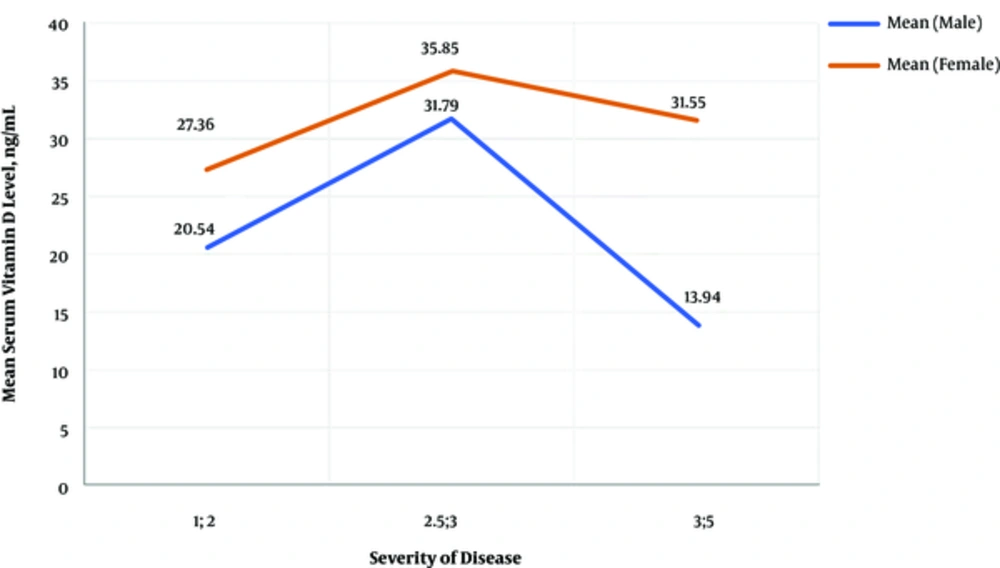
Figure 1.
Mean serum vitamin D level in PD patients based on disease severity according to gender
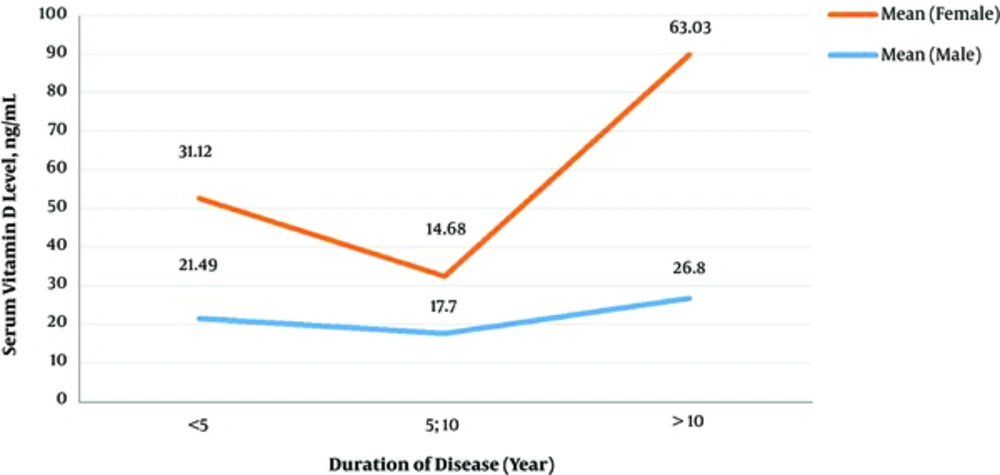
Figure 2.
Mean serum vitamin D level in PD patients based on its duration according to gender
Based on this model, these levels were significant in patients with PD compared with the control group (OR = 4.37; 95%CI: 1.85 - 10.32; P = 0. 001). Other variables were not statistically significant in this model. After removing the effects of the confounding variables, such as age, gender, and education based on adjusted logistic regression model, the difference in serum vitamin D levels between case and control groups was statistically significant (OR = 4.17:95%CL:1.371 - 12.71: P = 0.012).
4. Discussion
The current study demonstrated that PD has a relationship with low levels of serum vitamin D and this relationship is more prominent in higher severities of the disease. Peterson et al. also measured the serum vitamin D levels in PD patients and similarly found that there was a relationship between these levels and higher severity of PD (23).
In a separate study, Evatt et al. suggested that the prevalence of vitamin D deficiency in patients with early PD was higher than those reported by previous studies (24).
Also, the insufficiency of vitamin D was not enhanced during the progression of PD. They recommended further studies to be done to find the relationship between vitamin D levels and PD (24).
Their findings are inconsistent with those of previous studies and the current study. Of course, the results of the present study can confirm the relationship between vitamin D levels and higher severity of PD.
This study observed insufficient serum 25-hydroxyvitamin D levels in patients with PD while serum 1, 25-hydroxyvitamin D levels were normal in all patients. Furthermore, 25-hydroxyvitamin D levels were higher in patients with lower severities of PD, while there was no significant relationship between 1, 25-hydroxy vitamin D levels and PD severity in the study of Suzuki et al. (25).
Like the study done by Suzuki et al., this study measured 25-hydroxyvitamin D levels and the decline in these levels had a significant relationship with higher disease severity, which illustrates the similarity of these findings with previous research (26).
In 2002, Chen et al. found a significant link between consumption of dairy products and elevated risk of PD in males yet they did not observe such a relationship in females. In their study, they saw a significant association between dairy intake of calcium, vitamin D, protein, and lactose and an elevated risk of PD (27).
In the mentioned study, intake of calcium supplements, vitamin D, and protein from other sources had no effect on increasing the risk of PD. Finally, they stated that further investigations were needed to evaluate this relationship. However, their result about the increase of PD risk with the intake of vitamin D from dairy products was not associated with the results of this study. However, they defined that vitamin D from non-dairy sources did not enhance the risk of PD.
This study observed a significant correlation between low serum vitamin D levels and the duration of the disease in female participants. Since the majority of Iranian males, work outdoors and are more exposed to the sun, they can take vitamin D from this source more than females. Vitamin D levels were significantly lower in males than females in terms of disease duration based on the region and type of work in this study for disability and crippling caused by PD might lead to lack of vitamin D intake and decrease receiving sunlight so the effect of disease duration was increased in men than women.
The increase in PD risk was significant in females compared with males on the basis of the relationship between reduced serum vitamin D levels and gender in the study, which might be due to social factors, such as lack of outdoor work and constant presence at home because of domestic chores resulting in low sunlight exposure in females.
There was a significant relationship between reduced serum vitamin D levels in patients under 60 years old compared with the control group based on the two age groups (less and more than 60 years), which is inconsistent with other studies.
Although this research did not perform full age adjustment in patient and control groups of the study, the reduction in serum vitamin D levels was significantly higher in patients more than 60 years old compared with those less than 60 years based on the unadjusted logistic regression model.
In this study, serum vitamin D levels were significantly lower in participants with lower education levels. A similar result was represented in a 2010 study by Paul Knekt, who reported people with higher education levels had higher serum vitamin D levels (28).
Additionally, in the current study, the researchers classified the patients based on the cardinal features of PD (TRAP), which was an innovation in evaluating the relationship between serum vitamin D levels and PD. However, these features were not significantly related to serum vitamin D levels.
The impact of several variables, such as age, gender, education, cardinal features of the disease as well as its severity and duration were evaluated on PD and serum vitamin D levels, which are the strengths of the present study. Moreover, in this study, the relationship between decreased serum vitamin D levels and PD was confirmed when gender, age and education variables were adjusted.
This study was limited to a small sample size, thus the authors suggest further studies with larger sample sizes and based on the mentioned variables and other related variables.
4.1. Conclusion
Reduced serum vitamin D levels were statistically significant in the patient group compared with the controls, according to logistic regression analysis with adjustments for the effects of gender, age and education. Low serum vitamin D levels were related to the severity and duration of Parkinson’s disease under the age of 60 years old. There was no significant relationship between cardinal features of PD, including TRAP, and serum vitamin D level.


