
1. Background
Multiple sclerosis (MS) is a complex chronic disease of the central nervous system and a category of neurological problems. It is accompanied with some pathologic symptoms such as inflammation, demyelization, remyelination, and neuron destruction. One of the most prevalent demyelization illnesses occurs as the formation of small, big, individual or numerous lesions (also called plaques) in the central nervous system, inflammation, and the destruction of myelin sheaths of neurons. It is the third disability reason over adults (1-4).
The inflammatory process might be caused by lymphocytes gaining entry into the central nervous system via disruptions in the blood-brain barrier, and reacting to a yet unknown antigen. This interaction causes inflammation in the cortex and the white matter of the central nervous system. This damage might be mild and repairable in the early phases of the disease, however, with the gradual accumulation of damages and the passage of time, this will lead to vast chronic neuron destruction, which in turn results in a permanent functional lapse (5-7).
MS is a multi-factorial disease with genetic and environmental risk factors contributing to its occurrence (8). Some of these environmental risk factors include Epstein-Barr virus infection, vitamin D deficiency, smoking, and latitude. Some genetic agents might also increase the risk for this disease (8-11). Genetic studies have indicated that 25% of factors causing this illness are inherent (12). As the risk for this illness is increasing, an exact determination of these factors is difficult because the environmental risk factors also influence the genetic ones (13). It is assumed that a stimulus agent, such as viral infections or other agents, causes the activation of demyelinating and autoimmune mechanisms for genetically susceptible individuals (14). Symptoms and the clinical process of the illness vary from a benign silent to a disabling progressive form. Symptoms first occur in Relapsing-Remitting form while they gradually change into permanent neurological symptoms as the illness advances (14).
The illness progression is classified into 4 types as follows: 1, relapsing-remitting (RRMS); 2, primary progressive (PPMS); 3, secondary progressive (SPMS); and 4, progressive relapsing (PRMS) (1-3). It is a chronic progressive illness of the central nervous system, which causes sensation disorders (tingling), or the loss of sensitivity (numbness), muscle weakness, loss of power or skills, feeling tired or difficulty in moving, automatic or moving-caused muscle spasms; visual problems (decrease in visual acuity, visual dimness or a decrease in color distinction at the central visual scope), cognitive disorders (memory and attention disorders,) difficulty in solving problems, slow analysis, tiredness, trembling bodies, urination and excretion disorder, sexual disorder, balance disorder, amnesia, hearing diminution, dimness of vision and double vision, parocsismal attack symptoms, quickly executed bandings and extensions of the neck or other movements (Lermit’s symptom), as well as vertigo and mental disorders such as depression (15-17).
Depression is the most prevalent psychotic disorder over MS patients who are subject to a 50% risk of suffering from depression during their lives. Depression is reported to be prevalent over them by 54.27, with mild depression symptoms and anxiety being more prevalent. The pathophysiology of depression is still unknown over these patients; however, some factors including mental, social, and biological ones, as well as the chronic nature of the illness might influence the occurrence of depression. MRIs have recently indicated the relationship between depression and brain lesions in some patients; however, this has not been proved for sure (18).
In addition to depression, anxiety is highly prevalent over MS patients as numerous studies found this prevalence to be 19.63% (19-22). Anxiety is an unpleasant ambiguous widespread feeling, a worry and apprehension with an unknown origin, including uncertainty, distress, and physiologic excitation caused for an individual. Anxiety is known as a preventive factor, destroying and deteriorating patients’ strength against the treatment process (23, 24).
Regarding the impact of depression and anxiety on the lowering of the quality of life and the treatment process for MS patients as well as the lack of available information on the frequency of these disorders in MS patients in Rafsanjan, we decided to conduct this study in Iran. This research is aimed to study the depression and anxiety frequencies over MS patients in Rafsanjan, Iran. Results would be influential in treatment planning for a better control of MS and an increase in the quality of life in such patients.
2. Methods
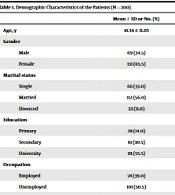
This is a descriptive-sectional research performed on 132 patients diagnosed with MS by a neurologist in Rafsanjan, Iran. These patients were either referring to or hospitalized in the neurology ward from May to July 2013. The research population included 132 MS patients composed of 36 males (27.2%) and 96 females (72.8%). They were classified into 3 groups of under 21, 21 - 40, and over 40. The 21-item Beck depression inventory was given to all patients to measure the depressed patient feedbacks and symptoms (25). The 40-item state-trait anxiety inventory (STAI) by Spiel Berger et al., was also given to all patients for measuring their personal and situational anxieties (26). The disability level was also determined using the expanded disability status scale (EDSS), according to clinical visits and patient histories.
It must be noted that, EDSS is a criteria of quantifying disability in MS. It measures the disability in 8 somatic functional systems and is scored from 0 to 10. The score of 0.0 indicates a normal neural examination and that of 10.0 indicates the death due to MS. The MS patients who are out of bed are scored 1.0 - 4.5, while the walking impaired is scored 5.0 - 9.5 (27, 28).
When collected, the data were computerized as special codes and were analyzed using SPSS17 in descriptive (tables and graphs) and inferential (Chi-square and Fisher’s tests) statistics.
3. Results
This research was performed on 132 MS patients including 36 males (27.2%) and 96 females (72. 8%). They were classified into 3 groups of under 21, 21 - 40, and over 40. Having evaluated their depression and state-trait anxiety, the following results were obtained.
1- Regarding the relationship between age and anxiety, it was indicated that the over-40 MS patients suffered from at least a medium to high state anxiety, and those under 21 suffered from a less (14.3%) serious anxiety (Table 1). The serious trait anxiety was indicated 25% for over 40, 22.5% for 21 - 40, and 13.6% for under 21-year-old patients. Regarding the relationship between age and depression, also, all 100% of patients over 40 suffered from extreme depression. The under 21 (39%) and the 21 - 40 (28.5%) patients suffered from rather serious and serious depression, respectively.
Table 1.
Relationship between State Anxiety and Agea
| Variables | Age, year | Total | ||
|---|---|---|---|---|
| Under 21 | 21-40 | Over 40 | ||
| State anxiety | ||||
| Mild | 2 (4.8) | 6 (7.3) | 0 (0.0) | 8 (6.1) |
| Medium to low | 4 (9.5) | 4 (4.9) | 0 (0.0) | 8 (6.1) |
| Medium to high | 10 (23.8) | 14 (17.1) | 2 (25.0) | 26 (19.7) |
| Rather serious | 20 (47.6) | 46 (56.1) | 2 (25.0) | 68 (51.5) |
| Serious | 6 (14.3) | 12 (14.6) | 4 (50.0) | 22 (16.7) |
| Total | 42 (100) | 82 (100) | 8 (100) | 132 (100) |
aValues are expressed as No. (%).
2- Regarding the relationship between gender and anxiety, it was indicated that females were more affected than males by the state anxiety and this difference is statistically significant (P = 0.029). Regarding the rather serious trait anxiety, however, this statistics is 40% for males and 21.6% for females; therefore, their difference is not statistically significant (P = 0.171). It was also indicated that 22.9% of females and 11.1% of males suffered from serious trait anxiety. The percentage for medium to high anxiety is 44.4 for males and 29.2 for females; therefore, their difference was not statistically significant (P = 0.131). It was found that 90% of females suffered from serious and extreme depression, and 1.17% of males suffered from relative depression. Although there is a difference in both groups, this difference is not statistically significant (P = 0.051).
3- Regarding the relationship between occupation and anxiety, it was indicated that workers suffered from at least a medium to high anxiety. The house keepers suffered from the highest level of state anxiety. No self-employed individuals suffered from state anxiety and most employees (68.4%) suffered from rather serious anxiety. A total of 63.7% of employees, also, suffered from rather serious and serious trait anxiety. A total of 58.3% of self-employed people suffered from medium to high trait anxiety. A total of 80% of workers suffered from medium anxiety and 21.1% of housekeepers suffered from serious trait anxiety. Regarding depression, a total of 78% of housekeepers, 70% of employees, 65.2% of the self-employed, and 20% of workers suffered from extreme depression.
4- Regarding the relationship between academic level and anxiety, it was indicated that those at elementary, high school diploma, junior cycle, and university academic levels suffered from serious state anxiety in sequence. It was also indicated that those at the junior cycle academic level suffered at least from medium to low anxiety (Table 2). In addition, those at elementary (31.2%), university (25%), junior cycle (14.3%), and high school diploma (12.5%) academic levels suffered from serious trait anxiety in sequence. This sequence was as follows for the rather serious trait anxiety: at elementary (31.2%), university (25%), junior cycle (14.3%), and high school diploma (12.5%). Regarding the relationship between academic levels and depression, it was indicated that those at the elementary (100%), university (90.2%), high school diploma (88.2%), and at junior cycle (71.4%) academic levels suffered from serious and extreme depressions.
Table 2.
Relationship between State Anxiety and Academic Levela
| Variables | Academic Level | Total | |||
|---|---|---|---|---|---|
| Elementary | Junior Cycle | High School Diploma | University | ||
| State anxiety | |||||
| Mild | 2 (5.7) | 0 (0.0) | 2 (6.9) | 4 (10.5) | 8 (6.1) |
| Medium to low | 2 (5.7) | 2 (6.7) | 2 (6.9) | 2 (5.3) | 8 (6.1) |
| Medium to high | 4 (11.4) | 14 (46.7) | 4 (13.8) | 4 (10.5) | 26 (19.7) |
| Rather serious | 19 (54.3) | 10 (33.3) | 15 (51.7) | 24 (63.2) | 68 (51.5) |
| Serious | 8 (22.9) | 4 (13.3) | 6 (20.7) | 4 (10.5) | 22 (16.7) |
| Total | 35 (100) | 30 (100) | 29 (100) | 38 (100) | 132 (100) |
aValues are expressed as No. (%).
5- Regarding the relationship between marital status and trait anxiety, it was indicated that 20.7% of the single and 15.5% of the married suffered from serious state anxiety. On the other hand, a total of 13.3% of the single and 21.6% of the married were affected by serious trait anxiety. However, this statistics was as follows for the rather serious trait anxiety: males 40% and females 21.6%. Hence, there was no statistically significant difference between these groups (P = 0.171). A total of 93.3% of the single and 86.6% of the married suffered from serious to extreme depression, which indicated a statistically significant relationship (P = 0.035).
6- Regarding the relationship between state anxiety and the course of illness, it was indicated that those with either less than a year or above 10 years from the onset of their illness suffered from rather serious and serious state anxieties. Those in their 1st 3 - 5-year period of their illness suffered from the lowest level of serious anxiety. It was also indicated that those in their 1st year of the illness suffered 100% from serious trait anxiety. A total of 66.6% of those with more than ten years of illness suffered from rather serious and serious anxiety. Other similar groups in sequence are as follows: those in 5 - 10 years of illness (55%), in 1 - 3 years of illness (41%), and finally in 3 - 5 years of illness (33.3%). In our study, all patients below 1 and above 10 years of illness (100%) suffered from extreme depression, and 14.6% of those in their 1 - 3 years of illness suffered from relative depression.
7- Regarding the relationship between the state anxiety and treatment type, it was indicated that those who took Corticosteroid suffered from serious state anxiety by 23.5%. This amount was 20.8% for those who took more than 1 medication. Those who took Ziferon, Betaferone, Rebif and Resigne, this amount was equal to 0%. In 9.5% of those who took Cinnovex and Avonex medications, a mild state anxiety was observed. This type of anxiety was 11.8% for those who took medications other than the 3 main groups. This amount was 0% considering other medications. It was also indicated that only 9.8% of those treated with Cinnovex and Avonex suffered from serious trait anxiety. This was 0% for patients taking other medications. Among those patients taking more than 1 medication at the same time, 27.5% suffered from serious trait anxiety, which is the highest percentage among all groups. A total of 23.1% of those treated with Cinnovex and Avonex suffered from relative depression.
8- Regarding the relationship between state anxiety and the disability level, it was indicated that those with lower levels of disability suffered from lower state anxiety, and as the disability level grows, the state anxiety is also increased. On the other hand, it was also indicated that those with lower levels of disability suffered from lower trait anxiety, and as the disability level grows, the trait anxiety is also increased. Those with lower levels of disability suffered from lower depression, and vice versa.
4. Discussion
MS is an inflammatory demyelinating chronic disease of the central nervous system occurring often over young adults mostly in their 20’s. An autoimmune disease involves the central nervous system (i.e. the brain and spinal cord), such that the myelin cover of the neurons is attacked by white corpuscles and is characterized by disorders in transmitting neural messages, resulting in motor and sensational disabilities. This illness is named MS as it makes lesions in numerous areas of the nervous system and scars (hard tissues) are replaced by the damaged myelin. In case of partial damage, the neural messages are transmitted with a lower tribulation, and in case of vast damage, the scar tissue is replaced by the myelin and the transmission of neural messages might be stopped completely (21).
Our research was performed on 132 MS patients including 36 males (27.2%) and 96 females (72.8%). The depression and state-trait anxiety were evaluated in relation to variables such as their age, gender, occupation, marital status, academic level, taken medications, course of treatment, and disability level.
According to Beiske et al., the frequencies of depression and anxiety were 31.4% and 19.3%, respectively, over MS patients. The patients were more than healthy in both cases (20).
In another study by Brajkovic et al. (2009), it was indicated that 57.9% suffered from depression and 63.2 suffered from anxiety (21).
According to Aloulou et al., it was indicated that depression and anxiety were 42% and 52% frequent over MS patients. It was concluded that about half of the MS patients suffered from temperamental disorders, with depression being the most important one (19).
Garfield et al., (2012) performed on 150 MS patient in England, it was indicated that 57% of these patients were anxious (29).
According to Sari soy et al., in addition to anxiety, depletion, and sleep disorder, other mental disorders such as somatization and paranoid imaginations are also prevalent over MS patients. It is suggested that the illness seriousness is related to the seriousness of psychiatric disorders (30).
As observed, some previous studies have obtained illness percentages similar to our study and some others have found different ones. However, the main point is that all studies have found serious depression for these patients, and anxiety exists in all patients in all communities. In Beiske et al., it was indicated that tiredness and low age at the disease onset were related to depression (20). These results were different from our study, which indicates the older the patients get, the higher their mental problem levels would be. On the other hand, the results of our study are similar to Dehghani et al., who have stated that there is a significant relationship between stress, anxiety, and depression with the course of MS illness (31); this is true about the different regions of Iran.
It was indicated in our study that females suffered from both state and trait anxieties more than males. The serious and extreme depressions were reported in 90% of females, whereas relative depression was reported in 17.1% of males.
According to Dahl et al. in Norway, anxiety was 31.1% frequent over males and 39.7% over females. Depression frequency was also reported as 26.2%. It was concluded that tiredness is prevalent over MS patients and is only related to anxiety over females (22).
The results of our study were similar to Dehghani et al., regarding the relationship between marital status and state-trait anxiety over MS patients; however, they were different regarding the relationship between marital status and depression over these patients. It was also indicated in their study that there was no significant relationship between stress, anxiety, and depression with academic level; which was slightly different from our findings (31). We found the following sequences: those at elementary (31.2%), university (25%), junior cycle (14.3%), and high school diploma (12.5%) academic levels suffered from serious trait anxiety; and those at the elementary (100%), university (90.2%), high school diploma (88.2%), and at junior cycle (71.4%) academic levels suffered from serious and extreme depressions. In Dehghani et al., however, it was indicated that there was no significant relationship between stress, anxiety, and depression with the academic level (31).
According to Juszczak et al., it was indicated that the anxiety frequency over patients diagnosed lately with MS is more than others (32). We also found that those with less than a year from the onset of their illness suffered from rather serious and serious state anxieties. On the one hand, it was indicated in Dehghani et al., that there is a relationship between stress, anxiety, and depression with patients’ hospitalization rate (31). It was also indicated in our study that those above 10 years from the onset of their illness suffered from rather serious and serious state-trait anxieties; whereas those in their first 3-5-year period of their illness suffered from the lowest level of serious anxiety.
We did not find any relationship between taken medications and levels of state-trait anxiety and depression, which is similar to the results of Dehghani et al. (31).
It was indicated in our study that patients with lower levels of disability suffered from lower state-trait anxiety and depression. As the disability level grows, their state-trait anxiety and depression are also increased.
According to Juszczak et al., there was no relationship between anxiety and the MS nature over MS patients, and it is mostly related to their fear from becoming motionless and dependent on others in the future (32).
4.1. Conclusion
This research was performed on 132 MS patients. The 21 - 40-year-old patient group included the largest portion of the research population. No significant relationship was found between depression and state-trait anxiety with their age, gender, occupation, marital status, academic level, taken medications, course of treatment, and disability level. Although these factors seem to be somehow influential, no significant effects were found, except between state anxiety and gender, and between depression and marital status.