
1. Background
The ageing phenomenon is one of the most significant social transformation around the world. The global population aged 60 years or over was 962 million in 2017. It is estimated that by year 2050 about two billion people will be at age 60 years and older, and about three-quarters of them will reside in low- and middle-income countries (LMICs) (1).
Aging has an enormous effect on health and health systems. As the population becomes old, the rate of age related conditions will be increased. In this context, cognitive disorders like Dementia are especially significant. There were 50 million people worldwide living with dementia in 2018 and this number will reach 152 million in 2050 (2). In 2012, the World Health Organization (WHO) introduced dementia as a health priority and recommended health systems, especially in LMICs, to provide a sound estimation of the prevalence of dementia in their countries (3). However, those countries have problems in providing an effective system of social and health care for older individuals (4).
The elderly population of Iran is growing fast. The results of National population and housing census in 2016 showed that 9.3% of the population was at old age. It has been estimated that this number will increase to 25.9% by 2060 (5, 6). The prevalence of dementia was estimated 7.9% in 2016. Therefore, dementia would be a challenge for the health system during future decades and the only way to decrease the burden of disease would be early detection (7).
People with dementia have poor access to appropriate healthcare. The usual approach to dementia care is specialist-based, which cannot provide proper services according to the speed of old age population growth. Based on studies, even in most high income countries, only around 50% of people living with dementia receive a diagnosis. In low and middle income countries, this number is less than 10%. Therefore, task-shifting and task-sharing, specifically in LMICs, with primary care services could improve coverage of diagnosis and health care and decrease the burden of disease (8).
One of the major obstacles for dementia care in primary health systems of LMICs is the shortage of validated neuropsychological tools with adjusted cut-points, which are adapted based on population socio-cultural characteristics and literacy level (9). In addition, the majority of those tools are time consuming and not designed for non-specialist use (10). The memory impairment screen (MIS) test is a brief, four-item, delayed free- and cued-recall test of memory impairment, which was designed and validated by Herman Buschke in 1999. It is highly correlated with Alzheimer’s pathology, takes less than five minutes to perform and can be easily used by trained non-specialists. These advantages make MIS a suitable screening tool. However, the application of this test might be restricted due to minimum literacy level requirement. The picture based MIS (PMIS) is a modified version that can be used by even illiterate or low-education individuals. Furthermore, the pictures can be adapted based on cultural differences (11).
Many neuropsychological tools, such as mini mental state examination (MMSE) and Montreal cognitive assessment (MoCA) have been validated for Iranian elderly population. However, a high percentage are illiterate or low-educated, and cannot conduct the test (10). The advantage of PMIS is that it could be used for illiterate people yet has not been adapted based on Iranian socio-cultural and religious profile (11).
2. Objectives
The aim of the current study was to validate the Persian version of illustrated form of MIS (PIMIS) for screening of Alzheimer’s disease in the elderly population of Iran in primary health settings.
3. Methods
3.1. Study Design
This was a cross-sectional study for the evaluation of validity and reliability of the Persian version of illustrated form of the memory impairment screen (PIMIS) in Iran.
3.2. Participants
The participants were selected from adults aged 60 years old and older, who were referred to the Roozbeh Memory Clinic at the Tehran University of Medical Sciences (TUMS) and Yaadmaan Referral Center for Dementia and Cognitive Disorders, Tehran, Iran and received AD, MCI or SCI diagnosis by a neurologist with expertise in dementia. From a total of 119 subjects, who were enrolled in this study, 76 had SCI, MCI or Alzheimer’s disease. The participants with normal cognition were selected from the informants or caregivers of patients (N = 43).
3.3. Interviewers
The interviewers included general practitioners and psychologists, who were trained by a neurologist with expertise in dementia to ensure that the study procedure was conducted correctly, namely: data gathering, data entry, and the like. They also were blind to the cognitive status of participants.
3.4. Diagnostic Criteria
Dementia, MCI, and SCI were diagnosed by a neurologist with expertise in dementia, according to the diagnostic and statistical manual of mental disorders, fourth edition criteria (DSM-IV-IR), the Persian version of the functional assessment staging of dementia of the Alzheimer’s type (FAST) and National Institute of Neurological and Communicative Disorders and Stroke and the Alzheimer’s Disease and Related Disorders Association (NINCDS-ADRDA-AD) after clinical examination.
3.5. Inclusion Criteria
Inclusion criteria for all participants in the study were age of 60 and older, speaking in Persian as maternal language, lack of visual or hearing loss, geriatric depression scale (GDS) ≤ 8 and FAST ≤ 4 (diagnosed by a neurologist). Based on these criteria, the participants were divided to three categories: AD, MCI and SCI groups. The presence of an informant or caregiver for the individuals with MCI and AD, who were informed about the subjects’ activities of daily living were mandatory for inclusion.
The normal control group were elderly participants without any complain about memory loss or cognitive decline and free from depression symptoms (GDS ≤ 8). The demographic variable of the control group was similar to the dementia group in terms of age, gender, and level of education.
3.6. Exclusion Criteria
Exclusion criteria for all participants were clinically significant depression (GDS > 8), FAST > 4, delirium, mental retardation, taking medication affecting cognitive functions, visual or hearing loss, speech disorder, and alcohol or drug addiction.
The rationale for the exclusion of FAST > 4 was the severity of AD, behavioral and psychological symptoms of patients and inappropriate attention, which would have led to a distortion of the test. Moreover, the test was used to diagnose patients in the early stages of dementia.
3.7. Materials
After obtaining permission from the author of the test, Prof. Herman Buschke, for using the picture based MIS (PMIS), a pool of 40 high resolution, color photographs was selected from www.stockphoto.com. The photographs were selected from various familiar and highly naming plots, according to Iranian socio-cultural and religious context. Then, a pilot study was conducted on 10 healthy individuals (five males and five females) and 12 easily recognized photographs were selected. In the next step, they were randomly divided to three sets of four photographs in a way that each set included four photographs from different categories. The photographs were printed on A5 cards in high resolution.
3.8. Data Collection
The test condition was the same for all groups. The trained interviewer gathered the main demographic data, such as age, gender, and educational level, based on the number of years of formal education, form all participants or their caregiver.
In the test procedure, a randomly selected set of photographs were shown to each participant. The photographs were shown one by one and they were asked to name each item (e.g. bus) when its category cue was presented by the interviewer (vehicle). Then, an interactive assignment, which lasted around two minutes was given to the subjects. The assignment could be counting from one to twenty or some questions about daily living activities. After the interference task, the participant was ask to recall the items in any order. For each item that was not retrieved by Free Recall, the interviewer read the appropriate category cue to the participant, and asked to recall the picture that was learned with that cue. The total score was obtained by multiplying the number of Free Recall words by two and adding the result to the number of cued Recall words (range zero to eight).
A neurologist with expertise in dementia visited all the participants to determine final diagnosis as the gold standard. The neurologist was blind to the PIMIS results.
In all stages of the study, the collected data (demographic, PIMIS, diagnosis, etc.) was kept confidential.
3.9. Validation
An expert panel of two neurologists, one psychiatrist, and one psychologist confirmed the content validity of the Persian illustrated MIS.
3.10. The Criterion Validity
The mean score of the Persian illustrated MIS in AD, MCI, SCI and normal groups were compared with the neurologist diagnosis as gold standard to determine criterion validity.
3.11. Reliability
The reliability of the test was evaluated by conducting the test on 10% of participants within a month after the initial evaluation. Gender, education, and FAST of those participants were consistent with the general sample. The results showed that the MIS test was appropriate and had relatively good results.
3.12. Statistical Analysis
The univariate analysis of variance (ANOVA) and independent sample t-test were performed for comparison of parametric variables between the groups. The cut-off was determined via the receiver operating characteristic (ROC) curve.
The precision of the test was assessed using the area under the ROC curve with 95% confidence interval. To obtain a cutoff, a suggestion was used for Youden’s index. Wherever this index is the maximum, this score is selected as the cutoff score.
3.13. Ethical Considerations
Written informed consent was obtained from all participants (or their companion or legal guardian) before entering the study and after giving full explanation about the objectives of the project. They became informed that they were free to leave the study whenever they wanted. All individuals participating in this research were required to protect the participants’ life, health, dignity, right, privacy, and confidentiality of their information. All of the collected data was confidential and only the main researcher and limited individuals, who were allowed had access to the information. All documents were stored in a privacy secured location.
4. Results
Of the 119 participants, 50 (42%) were males and 69 (58%) were females. Mean age was 72 years (60 to 89). Mean education level was 8.4 years (28 participants with university degree, 18 with high school education (= 12 years), 64 with ≤ 6 years of education, 10 with reading and writing ability and 11 illiterate). Thirty-eight participants received dementia diagnosis (all of them had Alzheimer’s disease) (Table 1).
Table 1.
Mean Age and Education Level in the Sample Population
| No. | Minimum, y | Maximum, y | Mean | Standard Deviation | |
|---|---|---|---|---|---|
| Education | 119 | 0 | 23 | 8.46 | 5.77809 |
| Age | 119 | 60 | 89 | 72 | 7.50532 |
The difference of mean education level in control and dementia group was negligible (P value > 0.05). The gender distribution of both groups was similar (68% of dementia group and 53% of control group were women, P = 0.163). There was only a significant difference in mean age of control and dementia groups (70 versus 75, P = 0.002) (Table 2).
Table 2.
The Comparison the Patients with Dementia and Healthy Subjects Regarding Age, Gender and Education
| Dementia | Non-Dementia | P Value | |
|---|---|---|---|
| Age (mean ± SD) | 75 ± 3.62 | 70 ± 3.6 | 0.002 |
| Gender (female %) | 68 | 53 | 0.163 |
| Education (mean ± SD) | 7.10 ± 3.05 | 9.09 ± 2.77 | 0.079 - 0.092 |
The PIMIS mean score was 6.2 ± 2.2. There was a weak correlation between IMIS scores with age (r = -0.11) and education level (r = 0.18). There was no significant difference between the score of females and males. The average score was 6.1 ± 2.2 in females and 6.4 ± 2.3 in males, which was not significantly different from the Independent sample t-test (P = 0.62).
The difference between the IMIS scores in normal group and SCI and MCI was not significant. However, mean score in people with dementia and other subjects were significantly different (4.34 versus 7.18, P < 0.01).
There was no significant difference in mean scores obtained from different sets of IMIS (P = 0.564), which indicates the correlation between the peer form (Tables 3 and 4).
Table 3.
Mean Scores of PIMIS in Different Photograph Sets
| Set | No. | Mean | Standard Deviation | 95% Confidence Interval for Mean | |
|---|---|---|---|---|---|
| Lower Bound | Upper Bound | ||||
| 1.00 | 40 | 6.0000 | 2.36426 | 5.2439 | 6.7561 |
| 2.00 | 40 | 6.5500 | 2.14775 | 5.8631 | 7.2369 |
| 3.00 | 39 | 6.2821 | 2.36141 | 5.5166 | 7.0475 |
| Total | 119 | 6.2773 | 2.28453 | 5.8626 | 6.6920 |
Table 4.
Mean Scores of PIMIS in Different Photograph Sets (ANOVA)
| (I) Set | (J) Set | Mean Difference (I - J) | Standard Error | P Value | 95% Confidence Interval | |
|---|---|---|---|---|---|---|
| Lower Bound | Upper Bound | |||||
| 1 | 2.00 | -0.55000 | 0.51268 | 0.533 | -1.7672 | 0.6672 |
| 3.00 | -0.28205 | 0.51596 | 0.848 | -1.5070 | 0.9429 | |
| 2 | 3.00 | 0.26795 | 0.51596 | 0.862 | -0.9570 | 1.4929 |
The area under the ROC curve for IMIS was 0.82, which showed a high specificity for a relatively large range of sensitivities (P = 0.000, 95% confidence interval = 0.73 - 0.90) (Table 5 and Figure 1).
Table 5.
AUROC for PIMIS
| Area | Standard Error | Asymptotic Sig. | 95% Confidence Interval | |
|---|---|---|---|---|
| Lower Bound | Upper Bound | |||
| 0.824 | 0.044 | 0.000 | 0.738 | 0.909 |
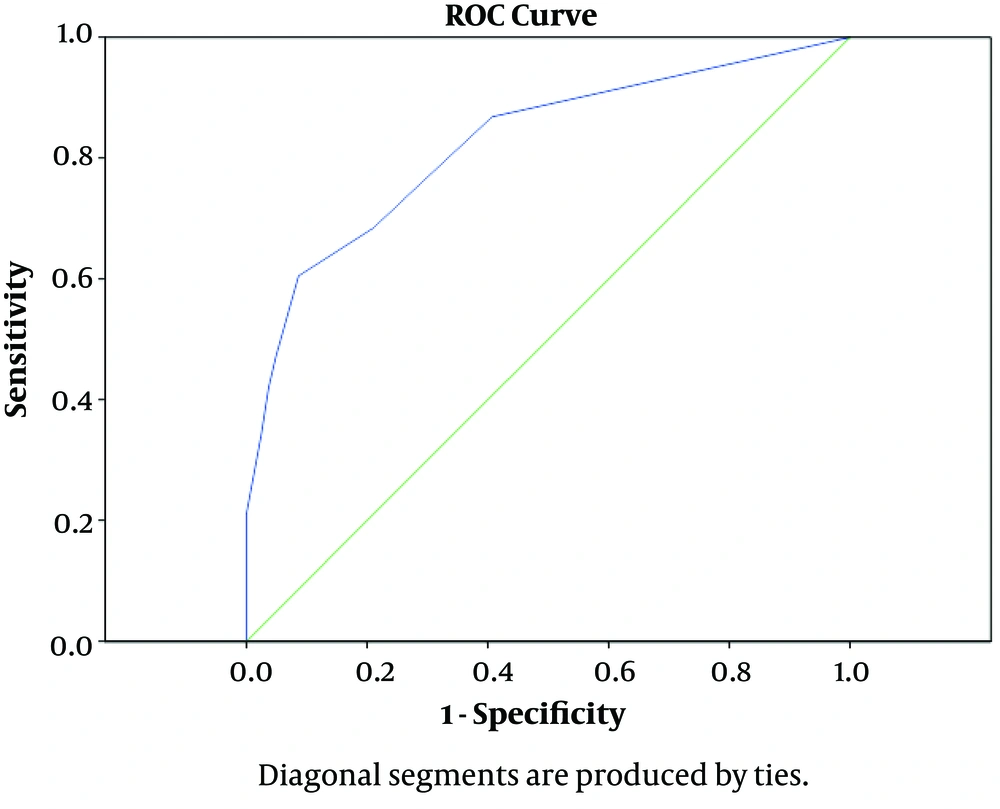
Figure 1.
AUROC for PIMIS
The appropriate cut-off point with the highest sensitivity and specificity in the IMIS test was five (specificity = 0.91 and sensitivity = 0.60).
Considering 30% dementia prevalence in this study and in different environments and age groups, PPV and NPV of the test were calculated in different cut-points and prevalences, based on Bayes’s theorem.
Regarding Table 6, it seems that cut-off point 5 had a higher positive and negative predictive value at all rates of the prevalence (Table 6).
Table 6.
Positive and Negative Predictive Value for Different Rates of Dementia Prevalence
| MIS Score | Sensitivity | Specificity | Prevalence of Dementia | |||||||
|---|---|---|---|---|---|---|---|---|---|---|
| 1% | 5% | 10% | 20% | |||||||
| PPV | NPV | PPV | NPV | PPV | NPV | PPV | NPV | |||
| 0 | 0.0526 | 1.000 | 1 | 0.9905 | 1 | 0.9525 | 1 | 0.9047 | 1 | 0.8085 |
| 1 | 0.2105 | 1.000 | 1 | 0.9920 | 1 | 0.9601 | 1 | 0.9193 | 1 | 0.8351 |
| 2 | 0.3421 | 0.9753 | 0.1227 | 0.9932 | 0.4216 | 0.9657 | 0.6061 | 0.9302 | 0.7759 | 0.8556 |
| 3 | 0.4210 | 0.9629 | 0.1028 | 0.9939 | 0.3739 | 0.9693 | 0.5576 | 0.9373 | 0.7393 | 0.8693 |
| 4 | 0.4736 | 0.9382 | 0.0718 | 0.9943 | 0.2874 | 0.9713 | 0.4598 | 0.9413 | 0.6570 | 0.8769 |
| 5 | 0.6052 | 0.9135 | 0.0660 | 0.9956 | 0.2691 | 0.9777 | 0.4373 | 0.9541 | 0.6362 | 0.9024 |
| 6 | 0.6842 | 0.7901 | 0.0318 | 0.9959 | 0.1464 | 0.9793 | 0.2658 | 0.9574 | 0.4490 | 0.9091 |
| 7 | 0.8684 | 0.5925 | 0.0210 | 0.9977 | 0.1008 | 0.9884 | 0.1914 | 0.9759 | 0.3475 | 0.9473 |
| 8 | 1.000 | 0.000 | 0.01 | - | 0.05 | - | 0.1 | - | 0.2 | - |
5. Discussion
The prevalence of dementia is increasing throughout the world. The early detection of dementia is the most important factor to decrease the burden of disease on health systems. The Alzheimer’s Association has recommended to detect cognitive impairment in a primary care setting. In the issued algorithm by Alzheimer’s Association, it is recommended to use brief screening tests for assessment (12).
In previous studies, it has been shown that cognitive tests, which contain an encoding, such as DMT and FCSRT, have a higher differential diagnostic value for dementia. In addition, the use of images in screening tests involves deeper layers of cognitive processing, which improves learning and information recall (13-15). The PIMIS is a brief and easy to apply test that uses both pictures and cues for recall during the process. This test takes around five minutes and can be easily implemented by trained non-specialists in illiterate or low-educated populations. The use of different images did not influence recall, thus, the photographs of the test could be easily adapted based on literacy level and cultural profile of each country (11).
This study showed a sensitivity of 60% and a specificity of 86% for a cut-off point of five, which indicates that PIMIS is an appropriate screening instrument in the consultations of primary care to detect dementia in the mild stage. In the present study, the sensitivity and specificity of the test in different types of dementia have not been studied. However, considering the purpose of PIMIS (early detection of cognitive impairment), this issue is not significant.
The first limitation of the study was the sample selection method. The participants were selected only from two referral outpatient clinics, thus, the sample was not representative of the geriatric people of Iran. This study was a preliminary examination of PIMIS as a screening test in geriatric population. Second, the test was implemented in two referral clinics by researchers, rather than in primary healthcare system by non-specialist healthcare workers. Third, there are other domains than memory to be evaluated for dementia diagnosis like calculation and working memory. Forth, because of low literacy level among SCI and MCI subjects, this study was less selective than other similar studies. However, the necessity of validation in different populations still remains. Fifth, considering the fact that the test was performed only by an evaluator, the sensitivity and specificity of the tests may vary in different statistical samples with larger populations. The PIMIS is the only screening test and should not be used for definite diagnosis.
5.1. Conclusions
Early detection is an important factor for decreasing the prevalence of dementia. In this context, diagnosis at MCI level is very important. Illiterate and low educated people are at higher risk of dementia; in addition, memory loss is considered as a normal aging phenomenon in those populations (11). Thus, it is necessary to diagnose the MCI cases better in low-educated individuals. However, it is difficult because there is no suitable test. The brief CSI-D is a favorable tool for screening dementia at the community level. This study showed that the Persian version of brief CSI-D could detect MCI, which is an advantage in dementia screening among illiterate and low educated populations.