
1. Background
The mental rotation task is a cognitive dynamic process for comparing or identifying objects or body limbs in different or canonical orientations, where there is a need for mental rotation stimulus to align with a reference (1). Mental rotation typically refers to imagery processes (2) that can be accomplished by several strategies, including visual imagery and motor imagery (3). In the mental rotation task, a mental image is rotated along a continuous trajectory until reaching a new orientation (4). Hand mental rotation, which is commonly evaluated in the hand laterality judgment task, is known as implicit motor imagery because it does not depend on conscious imagery for a movement (5). The results of previous behavioral studies indicated that participants’ reaction time in the laterality judgment task was proportional to the time of actual hand movement in the stimulus position (6). The reaction time is typically longer than the larger angle difference between the stimulus direction and vertical orientation (4, 7). In the hand mental rotation, longer response time is obtained in situations where it is more difficult to achieve physically.
Neuroimaging studies of hand mental rotation tasks suggest that successful task processing relies on the integration of specific cortical-subcortical motor systems such as motor and premotor areas and basal ganglia that are involved in planning and performing the movement (4, 8). The process of mental rotation of body limbs shares similar or even identical brain activity with that of, which occurs during the actual movement of those body limbs (9). Several brain imaging studies have shown that mental rotation tasks can activate both motor-related areas, such as the premotor and supplementary motor areas and the posterior parietal areas involved in spatial processing. Studies have shown that both the primary and general motor areas are included in mental rotation, in particular, the supplementary motor area, precentral gyrus, inferior parietal lobule, superior parietal lobule, and premotor cortex (10, 11). Mental rotation training is used for neurorehabilitation purposes focusing on motor imagery strategies in patients with motor-related injuries (12). Therefore, if this ability can be enhanced in a non-invasive manner, it will be effective in patients’ recovery.
It has recently been documented that the tactile stimulation is effective in increasing sensory function, promoting synaptic efficacy, improving motor functions (13, 14), and reducing the two-point discrimination threshold at a fingertip (15, 16). Furthermore, activating cerebral hemispheres using intermittent tactile stimulations of the hands increases functional communication between the two hemispheres and improves memory functions (17). It has also been noted that tactile stimulation enhances the primary motor cortex excitability (18).
2. Objectives
So far, there is no study to explore the effect of repeated tactile stimulation on motor imagery ability. There are, however, only a few studies on the impact of tactile stimulation on the two point’s discrimination and motor function. The current study aimed to investigate the effect of tactile stimulation over the right index fingertip on the hand mental rotation task in young, healthy adults, hoping to improve motor function due to enhanced hand mental rotation.
3. Methods
The present cross-sectional randomized clinical trial used the pretest-posttest design with a control group.
3.1. Participants
The experiments in this study were conducted in 2018 at the Shiraz University of Medical Sciences, Iran. The statistical population of the study included 91 university students (22 males and 70 females) from the Shiraz University of Medical Sciences, who had a normal or corrected-to-normal vision, were right-handed and had an average age of 21.20 years (SD = 2.6 years; range = 18 to 24 years). Participation in this study was voluntary. The students were recruited by public notifications in the university.
3.2. Study Procedure
Informed consent was obtained from all eligible participants. The protocol was approved by the local ethics committee [Rafsanjan University of Medical Sciences, Iran (permit number: IR.RUMS.REC.1396.59)]. All participants were checked for history or current presence of any significant neurological/medical or psychological conditions that may impact cognitive functioning. Volunteers with psychiatric/neurological diseases and drug use were excluded from the study. After the hand mental rotation task was explained to the participants; they were randomly divided into two control (n = 41) and tactile stimulation (n = 50) groups. Both groups initially performed a seven-minute hand mental rotation task (pretest). Then, in the intervention group, a 30-min tactile stimulation was applied over the right index finger. For the control group, the tactile stimulation device was turned off during the 30-min intervention. Next, they were asked to re-perform the hand mental rotation task (posttest).
3.3. Hand Mental Rotation Task Procedure
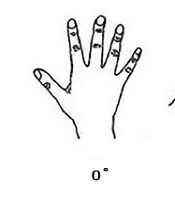
By performing the hand mental rotation task, the implicit mental imagery of upper limbs was assessed in the participants. First, the hand mental rotation task was developed in PSYTASK software, and Paint software was used to provide images at six different angles (0º, 60º, 120º, 180º, 240º, and 300º). Two hand positions (palm and back) and two hand sides (left and right) were displayed for each angle, and each image was taken in triplicate (a total of 72 images). An example of right-hand back images at different angles is shown in Figure 1.
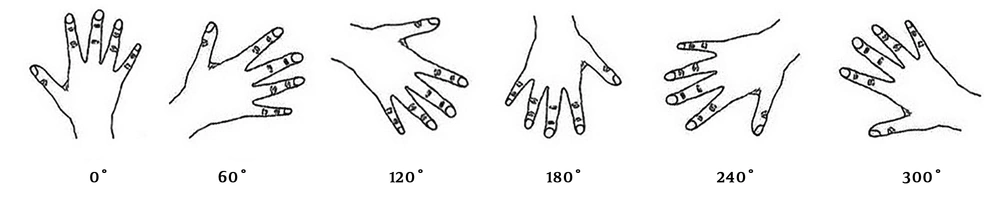
Figure 1.
Images of right hand back at different angles of 0º, 60º, 120º, 180º, 240º and 300º.
The task lasted about seven minutes. The images were randomly presented by the software to reduce the learning effect. Before the images were displayed on the center of the screen, a plus sign (+) was shown to let the user know what part of the screen to look at. Before starting the main task, the participants received complete information about the task and knew that both the reaction time and the number of correct responses would be recorded in the software. The reaction time was recorded in milliseconds (the time lag between the emergence of the stimulus and the subject’s correct responses to items), and the percentage of correct responses showed the subject’s response accuracy rate (19).
3.4. Implementation of Tactile Stimulation
The implementation of tactile stimulation was performed using a tactile stimulation device (Kavosh Pars Mahan Sanat Co., Iran) consisting of a control unit and stimulus modules to be connected to the hands. The stimulus module had 24 pins (1.5-mm height) and stimulated the right fingertip for 30 min (16 Hz) with the aid of a computer control system. The 24 pins for repeated tactile stimulations randomly hit the fingertip, thus avoiding nerve adaptation to tactile stimulation. When the tactile stimulation device was attached to the participants’ hands in both control and tactile stimulation groups, the subjects were not required to focus on the stimulation or anything else. During tactile stimulation, the hand was fixed in the most comfortable condition to prevent muscle fatigue as much as possible. Before implementing the tactile stimulation, the experimenter made sure that the tactile stimulation was applied correctly to the fingertip. In the control group, the tactile stimulation device was turned off during the 30-min intervention.
3.5. Statistical Analysis
Data (reaction time and response accuracy rate) were collected from two groups (control and intervention) in a mental rotation task (images with six different angles: 0º, 60º, 120º, 180º, 240º, and 300º) and two hand sides (left and right) across two time periods (pretest, posttest). The data were analyzed by paired t-test to compare the groups before and after the intervention and independent t-test to compare the variables between the two groups. In the case of non-normal distribution, the nonparametric equivalent tests, including the Mann Winnie U test and Wilcoxon test, were used.
4. Results
There were 50 participants in the tactile stimulation group and 41 in the control group. All participants in both groups had a bachelor’s degree. The two groups were compared for homogeneity in terms of age (P = 0.746) and gender (P = 0.412) variables, which showed no significant difference, as seen in Table 1 (P > 0.05).
Table 1.
Comparison of Age and Gender in Tactile Stimulation and Control Groups
| Group | Age, Mean ± SD | Gender, No. (%) | |
|---|---|---|---|
| Male | Female | ||
| Tactile stimulation | 21.12 ± 1.40 | 12 (24.0) | 38 (76.0) |
| Control | 21.22 ± 2.05 | 13 (31.7) | 28 (68.3) |
| P value | 0.746a | 0.412b | |
aMann Whitney Test
bChi-square test
The variables related to hand mental rotation (reaction time to hand stimulus in correct responses and response accuracy rate) were measured before and immediately after the intervention in both tactile stimulation and control groups. Table 2 shows the reaction time and response accuracy rate in the two groups of tactile stimulation and control in the pretest and posttest stages for both right and left hands. As the results of the independent t-test showed, the mean reaction time for the right hand (P = 0.342), left hand (P = 0.350), and both hands (P = 0.333) had no significant differences between the tactile stimulation and control groups in the pretest.
Table 2.
Reaction Time and Response Accuracy Rate in Tactile Stimulation and Control Groups
| Dependent Variable | Hand | Groups | Pretest, Mean ± SD | Posttest, Mean ± SD | P Valuea | Posttest-Pretest, Mean ± SD |
|---|---|---|---|---|---|---|
| Reaction Time (milliseconds) | Right | Tactile stimulation | 1869.84 ± 373.33 | 1624.32 ± 313.15 | < 0.001d | -244.77 ± 287.38 |
| Control | 1797.77 ± 349.43 | 1696.06 ± 367.96 | 0.183 | -97.27 ± 482.55 | ||
| P value | 0.342b | 0.322b | 0.082b | |||
| Left | Tactile stimulation | 1948.68 ± 397.93 | 1769.01 ± 427.00 | 0.006d | -179.67 ± 424.97 | |
| Control | 1877.37 ± 326.80 | 1825.03± 477.46 | 0.500 | --52.33 ± 522.34 | ||
| P value | 0.350b | 0.555b | 0.203b | |||
| Mean of both hands | Tactile stimulation | 1908.24 ± 375.42 | 1721.21 ± 428.99 | 0.004d | -187.02 ± 413.01 | |
| Control | 1837.04 ± 324.34 | 1784.04 ± 472.26 | 0.497 | -52.99 ± 525.22 | ||
| P value | 0.333b | 0.506b | 0.177b | |||
| Accuracy rate | Right | Tactile stimulation | 79.04 ± 17.10 | 84.77 ± 19.40 | 0.002d | 5.73 ± 11.61 |
| Control | 83.02 ± 16.20 | 80.79 ± 20.51 | 0.475 | -2.23 ± 21.04 | ||
| P value | 0.133c | 0.157c | 0.040cd | |||
| Left | Tactile stimulation | 77.83 ± 17.06 | 83.98 ± 17.79 | 0.001d | 6.15 ± 11.85 | |
| Control | 81.93 ± 14.74 | 79.88 ± 20.19 | 0.518 | -2.04 ± 21.33 | ||
| P value | b0.221b | 0.194c | 0.004cd | |||
| Mean of both hands | Tactile stimulation | 78.43 ± 16.58 | 84.38 ± 18.15 | < 0.001d | 5.94 ± 10.35 | |
| Control | 82.48 ± 14.94 | 80.33±19.93 | 0.478 | -2.14 ± 20.28 | ||
| P value | 0.192c | 0.189c | 0.019b, d |
aPaired t-test
bIndependent t-test
cMann Whitney test
dWilcoxon test (P < 0.05)
The paired t-test results also showed that the mean posttest reaction time in the tactile stimulation group for the right hand (P < 0.001), left hand (P = 0.006), and both hands (P = 0.004) significantly decreased compared to the pretest stage. In the control group, the difference between the mean pretest and posttest reaction time was not significant for the right hand (P = 0.183), left hand (P = 0.500), and both hands (P = 0.497).
The independent t-test results showed that the mean posttest reaction time was lower in the tactile stimulation group for the right hand (P = 0.322), left hand (P = 0.555), and both hands (P = 0.506) than in the control group, but not statistically significant.
As the mean pretest reaction time in both right and left hands was higher in the tactile stimulation group, the difference between the posttest and pretest scores was calculated between the two groups to investigate the effect of tactile stimulation on the posttest reaction time and compare the two groups. The independent t-test results showed that the differences between the posttest and pretest scores for the right hand (P = 0.082), left hand (P = 0.203). Both hands (P = 0.177) were considerably greater in the tactile stimulation group than in the control group, but not statistically significant, and probably it was due to the small sample size and large standard deviation.
To investigate whether the tactile stimulation was more effective on the mean reaction time of the right hand or the left hand, the posttest and pretest mean difference was first calculated for the right and left hands. Then the mean difference between the right and left hands was compared separately for both groups using the paired t-test and presented in Table 3. The results of the analysis suggested that the mean difference was greater for the right hand than for the left hand in the tactile stimulation group but not statistically meaningful. However, this difference was clinically considerable (P = 0.583). The mean differences between the right and left hands were also insignificant in the control group (P = 0.833) (Table 3); it was not unexpected because, as mentioned above, the mean differences in the right (P = 0.192) and left (P = 0.169) hands were more in the tactile stimulation group than in the control group. However, these differences were not statistically significant (Table 2).
Table 3.
Comparison of the Mean Difference in Posttest-Pretest Reaction Time and Response Accuracy Rate for Right and Left Hands in Tactile Stimulation and Control Groups
| Dependent Variable | Group | Mean Difference Posttest-Pretest (Right Hand) | Mean Difference Posttest-Pretest (Left Hand) | P Value |
|---|---|---|---|---|
| Reaction time | Tactile stimulation | -244.77 ± 287.38 | -179.67 ± 424.97 | 0.583 |
| Control | -97.27 ± 482.55 | --52.33 ± 522.34 | 0.833 | |
| Accuracy rate | Tactile stimulation | 5.73 ± 11.61 | 6.15 ± 11.85 | 0.798 |
| Control | -2.23 ± 21.04 | -2.04 ± 21.33 | 0.919 |
To determine whether the tactile stimulation was effective more in the mean reaction time of large-rotation angles or small-rotation angles, first, the mean reaction times at 0º, 60º, and 30º angles were calculated as the small-rotation angles and 120º, 180º, and 240º angles as large-rotation angles for both hands in the pretest and posttest stages. Then, the mean differences of posttest and pretest were calculated for small-rotation, and large-rotation angles and the mean differences of small-rotation and large-rotation angles were compared separately for both groups using the paired t-test. As the results presented in Table 4 show, the effect of stimulation was significantly greater on large-rotation angles than on small-rotation angles in the tactile stimulation group (P = 0.008), but this difference was not significant in the control group (P = 0.799) (Table 4).
Table 4.
Comparison of Reaction Time and Response Accuracy Rate for Small-Rotation Angles and Large-Rotation Angles in Tactile Stimulation and Control Groupsa
| Dependent Variable | Group | Mean Difference Posttest-Pretest (Small-Rotation Angles) | Mean Difference Posttest-Pretest (Large-Rotation Angles) | P Value |
|---|---|---|---|---|
| Reaction time | Tactile stimulation | -192.49 ± 279.16 | -276.83 ± 295.48 | 0.008 |
| Control | -90.05 ± 426.80 | -102.90 ± 538.30 | 0.799 | |
| Accuracy rate | Tactile stimulation | 4.70 ± 11.50 | 7.18 ± 12.09 | 0.146 |
| Control | -4.71 ± 20.34 | 0.42 ± 23.07 | 0.032 |
aSmall-rotation angles are 0, 60, and 300 degrees, and large-rotation angles are 120, 180, and 240 degrees.
As shown by the Mann-Whitney U test and independent t-test results (Table 2), the mean percentage of correct responses (response accuracy rate) showed no significant differences between the tactile stimulation and control groups in the right hand (P = 0.133), left hand (P = 0.221), and both hands (P = 0.192) in the pretest. The paired t-test results showed that the mean response accuracy rate significantly increased in the tactile stimulation group for the right hand (P = 0.002), left hand (P = 0.001), and both hands (P < 0.001) in the posttest compared to the pretest. Still, the differences between the mean pretest and posttest reaction times were not significant in the control group for the right hand (P = 0.475), left hand (P = 0.518), and both hands (P = 0.478) (Table 2).
The Mann-Whitney U test results demonstrated that the mean response accuracy rates in the posttest for the right hand (P = 0.157), left hand (P = 0.194), and both hands (P = 00.189) were higher in the tactile stimulation group than in the control group, but not statistically significant (Table 2).
Since the mean pretest response accuracy rates for both right and left hands were lower in the tactile stimulation group, the differences between the posttest and pretest scores were calculated to investigate the effect of tactile stimulation on the posttest response accuracy rate and compare the two groups. The independent t-test and Mann-Whitney test results showed that the differences between the posttest and pretest scores for the right hand (P = 0.040), left hand (P = 0.004), and both hands (P = 0.019) were significantly higher in the tactile stimulation group than in the control group. These differences were statistically significant (Table 2).
To determine whether tactile stimulation was more effective in the response accuracy rate of the right hand or the left hand, first, the posttest and pretest mean differences were calculated for the right and left hands. Then the mean differences between the right and left hands were compared using the paired t-test results for both groups separately. As the results in Table 3 showed, the differences between the mean response accuracy rates of the right and left hands were not significant in the tactile stimulation (P = 0.798) and control (P = 0.919) groups (Table 3).
To specify whether tactile stimulation was effective more in the mean response accuracy rate of large-rotation angles or small-rotation angles, first, the mean response accuracy rates of 0º, 60º, and 30º angles were calculated as small-rotation angles and 120º, 180º, and 240º angles as large-rotation angles for both hands in the pretest and posttest stages. The posttest and pretest mean difference was calculated for small-rotation and large-rotation angles. Then the mean difference between small-rotation and large-rotation angles was compared for both groups using the paired t-test separately, as shown in Table 4. The results showed that the effect of stimulation was greater on large-rotation angles than on small-rotation angles in the tactile stimulation group, but this difference was not statistically significant (P = 0.146). However, the differences between small-rotation and large-rotation angles were significant (P = 0.032) in the control group (Table 4).
5. Discussion
The main objective of the current study was to investigate the effect of tactile stimulation on hand mental rotation abilities of young, healthy adults. The results revealed that the implementation of tactile stimulation in the right index finger for 30 min, could improve the hand mental rotation ability, evidenced by increased response accuracy rate and response speed.
The results of this study showed that although the stimulation was only applied to the right-hand finger, there was an increase in the accuracy rate and a decrease in reaction time in both hands. Also, the results showed that the effect of tactile stimulation on hand mental rotation was not significantly different at small-rotation and large-rotation angles because the reaction time in the tactile stimulation group at the large-rotation angles significantly decreased after stimulation, but the accuracy rate had no significant increase. In the control group, the accuracy rate increased at large-rotation angles compared to the pretest condition, while the reaction time did not decrease significantly. It seems that in both groups, one of the two dimensions of hand mental rotation with rigid angles was improved due to the effect of learning in the posttest stage.
Various studies have investigated the effect of techniques with different mechanisms on the ability of motor imagery in healthy individuals and patients. For example, a study found that hand posture changes influenced hand mental rotation, confirming that postural and sensory-motor information of the organs could influence the mental rotation of the same organ (20). Daily exercise for healthy children improved their mental chronometry based on walking (21). Furthermore, it has been recently reported that theta-burst stimulation over the primary motor area did not improve hand mental rotation in multiple sclerosis patients (19). A growing number of studies focused on possible beneficial effects of tactile stimulation on different sensory, motor, and cognitive functions. One of the pioneer research groups in this field was the Dinse HR group. They reported that the tactile stimulation could improve two-point discrimination ability in humans (13, 14). Mikula et al. reported that the tactile stimulation of the left index finger before the right-hand movement could better determine the spatial position of the left finger and that the movement of the right hand towards the left index finger was dealt with more accurately when the left finger was invisible (22). In addition, it was reported that the tactile stimulation could increase the primary motor cortex excitability during mental imagery (18). However, the duration and frequency of tactile stimulation seem to be important parameters on the efficacy of tactile stimulation. For the two-point discrimination task, it was reported that two- and six-hour tactile stimulation reduced the two-point discrimination threshold while reducing the stimulation time to 30 min could not improve the two-point discrimination (13). For proprioceptive localization, the tactile stimulation of the left index finger at frequencies of 30 and 300 Hz for 1,000 ms seems to have improving effects (22). The results of our study demonstrated that 30-min tactile stimulation at the frequency of 16 Hz seemed to be appropriate for improving hand mental rotation in young healthy adults.
One of the possible mechanisms for the effect of repetitive tactile stimulation is structural changes in the cortex after tactile stimulation. Schmidt-Wilcke et al. showed that 45-min repetitive somatosensory stimulation increased the regional gray matter volume in the primary and secondary left somatosensory cortex, which received afferent inputs from the stimulated body site (23, 24). In addition to investigations on the characteristics of cortical regions receiving tactile stimulation, studies that more generally examined the activity of the brain after tactile stimulation could provide a better understanding of the mechanism of tactile stimulation. A study of functional connections in the sensorimotor cortex based on electroencephalography signals showed that the repetitive tactile stimulation significantly increased functional connections between the motor and somatosensory areas (25). Because somatosensory and motor cortical regions are involved in mental rotation (10, 11), the tactile stimulation may increase the mental rotation of individuals by increasing the plasticity of these regions.
However, longer follow-ups of this effect and increased stimulation duration or location should be investigated in future studies. In addition to the motor imagery ability assessment, the motor function examination after tactile stimulation can also strengthen the study. In addition, cortical activity using event-related potential before, after, or during tactile stimulation can be investigated in future studies.
5.1. Conclusion
In summary, the tactile stimulation may be prescribed for improving hand mental rotation in young adults. However, it seems that optimizing the duration and frequency of tactile stimulation is an important factor.