Cover image of the article: An Algorithmic Approach to Children’s Gastroenteritis in SARS-CoV-2 Epidemic: Iranian Expert’s Consensus Statement

Image Credit:Arch Pediatr Infect Dis

An Algorithmic Approach to Children’s Gastroenteritis in SARS-CoV-2 Epidemic: Iranian Expert’s Consensus Statement

Authors

Ahmad Moein KarimiAhmad Moein Karimi ORCID1, Maryam RajabnejadMaryam Rajabnejad ORCID1,*, Zahra PourmoghaddasZahra Pourmoghaddas ORCID2, Roxana Mansour GhanaieRoxana Mansour Ghanaie ORCID1, Sedigheh Rafiei TabatabaeiSedigheh Rafiei Tabatabaei ORCID1, Shahnaz ArminShahnaz Armin ORCID1, Seyed Alireza FahimzadSeyed Alireza Fahimzad ORCID1, Amin Khoshgovari1, Katayoun Tayeri3, Abbas Solgi1, Zahra Soltantooyeh Zahra Soltantooyeh  ORCID1
1Pediatric Infections Research Center (PIRC), Research Institute for Children's Health (RICH), Shahid Beheshti University of Medical Sciences, Tehran, Iran
2Child Growth and Development Research Center, Isfahan University of Medical Sciences, Isfahan, Iran
3Iranian Research Center of HIV & AIDS, Tehran University of Medical Sciences, Tehran, Iran
*Corresponding Author: Pediatric Infections Research Center (PIRC), Research Institute for Children's Health (RICH), Shahid Beheshti University of Medical Sciences, Tehran, Iran. Email: mrajabnejad2@yahoo.com

Archives of Pediatric Infectious Diseases:Vol. 9, issue 3; e108635
Published online:Mar 06, 2021
Article type:Discussion
Received:Oct 29, 2020
Accepted:Jan 25, 2021
How to Cite:Karimi AM, Rajabnejad M, Pourmoghaddas Z, Mansour Ghanaie R, Rafiei Tabatabaei S, et al. An Algorithmic Approach to Children’s Gastroenteritis in SARS-CoV-2 Epidemic: Iranian Expert’s Consensus Statement. Arch Pediatr Infect Dis. 2021;9(3):e108635. doi: https://doi.org/10.5812/pedinfect.108635

Abstract

Diarrhea and vomiting with or without fever are common symptoms in children, while one of the most common clinical findings of Coronavirus disease 2019 (COVID-19) is gastrointestinal symptoms. Therefore, there is a need to develop an algorithm for dealing with a patient with gastroenteritis in the SARS-CoV-2 epidemic.

1. Introduction

Diarrhea and vomiting with or without fever are common symptoms in children, while, in recent days, gastrointestinal symptoms have become more common in Coronavirus disease 2019 (COVID-19) patients. On the other hand, evidence suggests that the prevalence of SARS-CoV-2 in children is not 2%, but 15% (1). Now, a question arises that to which patients should we suspect SARS-CoV-2-related gastroenteritis given that diarrhea can have viral, bacterial, parasitic, and non-infectious causes.
Clinical studies have shown that the expression of angiotensin-converting enzyme 2 (ACE2) is high not only in the lung alveolar type 2 progenitor cells (AT2) cells but also in the GI tract, especially upper esophagus, liver, epithelial cells, and absorptive enterocytes from the ileum and colon (2, 3) and then, gastrointestinal symptoms such as diarrhea will occur. According to studies, intestinal involvement and diarrhea are seen in 2 to 50% of COVID-19 cases; besides, in 20 to 30% of cases, gastrointestinal findings such as diarrhea are the first presentations of the disease, and pulmonary symptoms appear in the following days. Therefore, the involvement of the gastrointestinal tract and lungs may occur independently of each other (4).
Usually, at this stage of the disease, there is diarrhea without mucus and blood, but if there are complications such as pseudomembranous colitis, intussusception, and HUS, there will be exudative diarrhea. Although in COVID-19, diarrhea may be due to drug side effects, the gastrointestinal tract can be directly involved through ACE2 receptors and indirectly through the gut lung axis. Also, in multisystem inflammatory syndrome (MIS-C) caused by SARS-CoV-2, diarrhea can be watery or exudative. The average duration of diarrhea in COVID-19 is four days and the frequency of defecation varies from three to 30 times per day (4, 5). The number of virus particles is higher in the feces of patients with diarrhea than in patients without diarrhea, and the virus is excreted in the feces for several weeks.
Intestinal involvement in COVID-19 has been reported in up to 25 - 50% of studies. The duration of hospitalization, duration of elevated liver enzymes, coagulopathy, and high inflammatory markers are higher in patients with diarrhea than in patients without diarrhea, and if these conditions are observed, the patient's prognosis is worse (4, 6-8).

2. Considerations and Recommendations

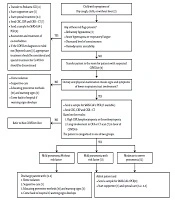
In the current SARS-CoV-2 epidemic, most diagnostic and therapeutic protocols are focused on the respiratory symptoms of the disease, while in recent days, gastrointestinal symptoms such as vomiting, diarrhea, and abdominal pain increased in patients with COVID-19. The number of days from the onset of symptoms to hospitalization is significantly higher in patients with gastrointestinal symptoms than in patients without gastrointestinal symptoms; as a result, complications and prognosis are worse in patients with gastrointestinal symptoms (7). Therefore, there is a need to develop an algorithm for dealing with a patient with gastroenteritis in the SARS-CoV-2 epidemic (4) (Figure 1).
Algorithmic approach to a child with acute gastroenteritis in COVID-19 epidemic (<a href="#A108635REF9">9</a>, <a href="#A108635REF10">10</a>)
Figure 1.
Algorithmic approach to a child with acute gastroenteritis in COVID-19 epidemic (9, 10)

3. Conclusions

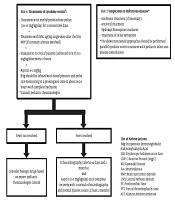
In any patient with acute and watery diarrhea, with or without vomiting, abdominal pain, fever, or respiratory symptoms, if there is one of the following: (1) a history of contact with a known or suspected case of COVID-19 patient; (2) a history of traveling to infected areas or presence in crowded places; (3) unexplained sign and symptoms of other organ involvement such as respiratory or cerebral system; (4) lymphopenia, impaired liver function tests, or increased inflammatory markers in lab tests (Box 1); the following steps must be taken: (1) preventive precautions should be taken according to the last version of protocols (approach to a child suspected of COVID-19). Patients should be placed in an isolated room, the caregiver must wear appropriately a mask on the face, and avoid direct contact with respiratory and other secretions, and should also wash hands with soap and water (9, 11, 12); (2) according to the recommended protocol, send CBC, CRP, a sample for SARS-CoV-2 PCR, and CXR with or without CT. Appropriate treatment measures, including supportive care and special treatment, should be considered (9, 12); (3) evaluate the patient for MIS-C criteria as per the last protocols (approach to a child with MIS-C suspected to COVID-19) (13); (4) after discharge, the patient should be isolated at home, and preventive measures and warning signs should be taught to the patient and remind him that come back to the hospital if warning signs develop.
Box 1.
Comments on Gastroenteritis Caused by SARS-CoV-2
Comments
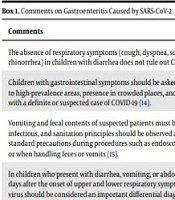
The absence of respiratory symptoms (cough, dyspnea, sore throat, and rhinorrhea) in children with diarrhea does not rule out COVID-19 (3).
Children with gastrointestinal symptoms should be asked about travel history to high-prevalence areas, presence in crowded places, and history of contact with a definite or suspected case of COVID-19 (14).
Vomiting and fecal contents of suspected patients must be considered infectious, and sanitation principles should be observed according to the standard precautions during procedures such as endoscopy and colonoscopy or when handling feces or vomits (15).
In children who present with diarrhea, vomiting, or abdominal pain about five days after the onset of upper and lower respiratory symptoms, the SARS-CoV-2 virus should be considered an important differential diagnosis (15-17).

Acknowledgments

Footnotes

  • Authors' Contribution: All authors equally contributed to the design and implementation of the research, analysis of the results, and writing of the manuscript.

  • Conflict of Interests: No conflict of interest is expressed by the authors.

  • Ethical Approval: This manuscript does not need an ethical approval code.

  • Funding/Support: No funding to declare.

References

Copyright

Copyright © 2021, Author(s). This is an open-access article distributed under the terms of the Creative Commons Attribution-NonCommercial 4.0 International License (http://creativecommons.org/licenses/by-nc/4.0/) which permits copy and redistribute the material just in noncommercial usages, provided the original work is properly cited.

Similar Articles

12
Mar
2020
An Algorithmic Approach to Diagnosis and Treatment of Coronavirus Disease 2019 (COVID-19) in Children: Iranian Expert’s Consensus Statement

An Algorithmic Approach to Diagnosis and Treatment of Coronavirus Disease 2019 (COVID-19) in Children: Iranian Expert’s Consensus Statement

Abdollah Karimi,
Sedigheh Rafiei Tabatabaei,
Maryam Rajabnejad,
Zahra Pourmoghaddas,
Hamid Rahimi,
Shahnaz Armin
,et al.

Karimi A, Rafiei Tabatabaei S, Rajabnejad M, Pourmoghaddas Z, Rahimi H, et al. An Algorithmic Approach to Diagnosis and Treatment of Coronavirus Disease 2019 (COVID-19) in Children: Iranian Expert’s Consensus Statement. Arch Pediatr Infect Dis. 2020;8(2):e102400. doi: https://doi.org/10.5812/pedinfect.102400

8
Jul
2020
A Review on Coronavirus Disease 2019 (COVID-19) in Pediatric Patients

A Review on Coronavirus Disease 2019 (COVID-19) in Pediatric Patients

Solmaz Ohadian Moghadam,
Davoud Afshar

Ohadian Moghadam S, Afshar D. A Review on Coronavirus Disease 2019 (COVID-19) in Pediatric Patients. Arch Pediatr Infect Dis. 2020;8(3):e104225. doi: https://doi.org/10.5812/pedinfect.104225

18
May
2020
A Review of COVID-19 in Children

A Review of COVID-19 in Children

Parisa Khoshnevisasl,
Mansour Sadeghzadeh,
Sara Sadeghzadeh

Khoshnevisasl P, Sadeghzadeh M, Sadeghzadeh S. A Review of COVID-19 in Children. J Compr Ped. 2020;11(3):e103780. doi: https://doi.org/10.5812/compreped.103780

25
Sep
2020
An Algorithmic Approach to Multisystem Inflammatory Syndrome in Children with COVID-19: Tehran Children’s Medical Center Protocol

An Algorithmic Approach to Multisystem Inflammatory Syndrome in Children with COVID-19: Tehran Children’s Medical Center Protocol

Vahid Ziaee,
Raheleh Assari,
Setareh Mamishi,
Aliakbar Zeinaloo,
Masoud Mohammadpour,
Iran Malekzadeh
,et al.

Ziaee V, Assari R, Mamishi S, Zeinaloo A, Mohammadpour M, et al. An Algorithmic Approach to Multisystem Inflammatory Syndrome in Children with COVID-19: Tehran Children’s Medical Center Protocol. Inn J Pediatr. 2020;30(5):e108617. doi: https://doi.org/10.5812/ijp.108617

19
Sep
2020
SARS Coronavirus 2, Severe Acute Respiratory Syndrome, and Middle East Respiratory Syndrome in Children: A Review on Epidemiology, Clinical Presentation, and Diagnosis

SARS Coronavirus 2, Severe Acute Respiratory Syndrome, and Middle East Respiratory Syndrome in Children: A Review on Epidemiology, Clinical Presentation, and Diagnosis

Seyed Ahmad Tabatabaii,
Pegah Soltani,
Ghamartaj Khanbabaee,
Deepak Sharma,
Rohollah Valizadeh,
Nazanin Farahbakhsh
,et al.

Tabatabaii SA, Soltani P, Khanbabaee G, Sharma D, Valizadeh R, et al. SARS Coronavirus 2, Severe Acute Respiratory Syndrome, and Middle East Respiratory Syndrome in Children: A Review on Epidemiology, Clinical Presentation, and Diagnosis. Arch Pediatr Infect Dis. 2020;8(4):e104860. doi: https://doi.org/10.5812/apid.104860

More by these authors

Ahmad Moein KarimiPubMedScholar
Maryam RajabnejadPubMedScholar
Zahra PourmoghaddasPubMedScholar
Roxana Mansour GhanaiePubMedScholar
Sedigheh Rafiei TabatabaeiPubMedScholar
Shahnaz ArminPubMedScholar
Seyed Alireza FahimzadPubMedScholar
Amin KhoshgovariPubMedScholar
Katayoun TayeriPubMedScholar
Abbas SolgiPubMedScholar
Zahra SoltantooyehPubMedScholar
Share
Cited by
Metrics