The emergence and spread of third-generation cephalosporin-resistant
E. coli in developing countries are a great concern. Healthy children colonized with ESBL-producing strains may transmit the resistant strains to other individuals, including the hospitalized patients (
19). Based on four genes, namely
arpA,
chuA,
yjaA, and
TspE4.C2,
E. coli strains could be categorized into the phylogenetic groups presented as follows: A, B1, B2, C, D, E, F, and clade I/II (
3). Among these phylogroups, the phylogroup B2 mainly includes the strains which cause extraintestinal infections in humans as opportunistic pathogens (
18). The present study was conducted to investigate the virulence factors, determine phylogroups, B2 subgroups, and serogroups of
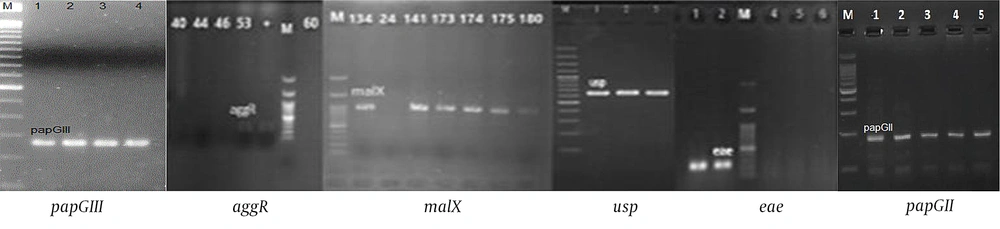
E. coli strains resistant to the broad-spectrum Cephalosporins isolated from the fecal samples of healthy children below 10 years of age. The study showed that 27% of the strains belonged to B2 phylogroup and 6% to B1 phylogroup. Among B2 phylogroup strains, the highest frequency belonged to subgroup V (
polB genes). The
malX,
papGII,
usp,
papGIII,
aggR, and
eae virulence genes, respectively, had the highest to lowest supply among the tested strains. However, among B2 phylogroup strains, only
malX,
papGII,
usp, and
papGIII virulence genes were reported. We observed that 14 strains were positive for
usp genes (is prevalent among strains causing urinary tract infections), one strain was positive for
eae gene (a marker for EPEC pathovar), one strain was positive for
aggR gene (a marker for
EAEC pathovar), 29 strains were positive for
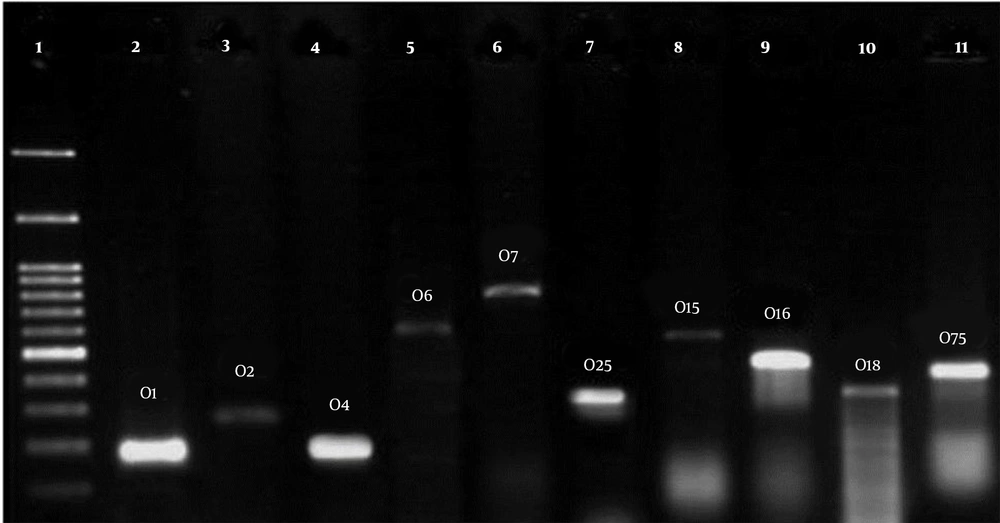
malX gene (it is enriched in the strains causing extraintestinal infections). The results of serogroup determination based on O antigen indicated that the highest frequency was observed in the serogroups O1, O2, and O4 among all phylogroups, yet serogroups O2, O16, and O25 were predominant among phylogroup B2 strains. Nowrouzian et al. reported that among 140 commensal
E. coli B2 strains, 47% of the Pakistani strains and 84% of the Swedish strains belonged to a major B2 subgroup (subgroups I-X) (
7). Alizade et al. conducted a study on 216 strains of
E. coli isolated from fecal samples of the patients with watery diarrhea. Although most strains belonged to B1 phylogroup, most strains contained the broad-spectrum beta-lactamase gene (
CTX-M1) (
20). Nojoomi and Ghasemian addressed
E. coli strains isolated from the feces of the healthy children, about 98% of
E. coli strains had
CTX-M1 gene, which indicates the difference between serogroup and antigenic profile of the strains and the virulence genes (
21). Our results indicate the diversity of phylogroups among
E. coli strains with the predominance of B2 group, and none of the isolates were recognized as phylogroup A, C, D, E, and F. This is, while in another similar study in Tunisia on community fecal carriage of broad-spectrum cephalosporin-resistant was B1, D, B2, and A phylogroups, respectively (
22). It is the first study in Iran that showed a higher frequency of B2 phylogroup than other phylogroups among the
E. coli isolates from fecal samples of the healthy children, while most similar studies were performed on urine, feces, and or blood samples of children or adults with urinary tract infection, diarrhea, and or sepsis. According to the obtained findings herein and similar articles, it seems that phylogroup B2 strains play a major role in the extraintestinal infections and carrying resistance genes that can result in the dissemination in hospital settings, and increase frequency in nosocomial infections with human health impact. Meanwhile, their frequency in healthy individuals is a function of lifestyle, customs, geographical area, nutritional status, and level of public health. The frequency of virulence genes in these bacteria varies depending on their invasive conditions or coexistence with the host, how they interact with the host immune system, and the infection site. The obtained findings suggested the evolution of features in the group B2
E. coli strains, which enable them to survive in the complicated context of the humans’ intestines.